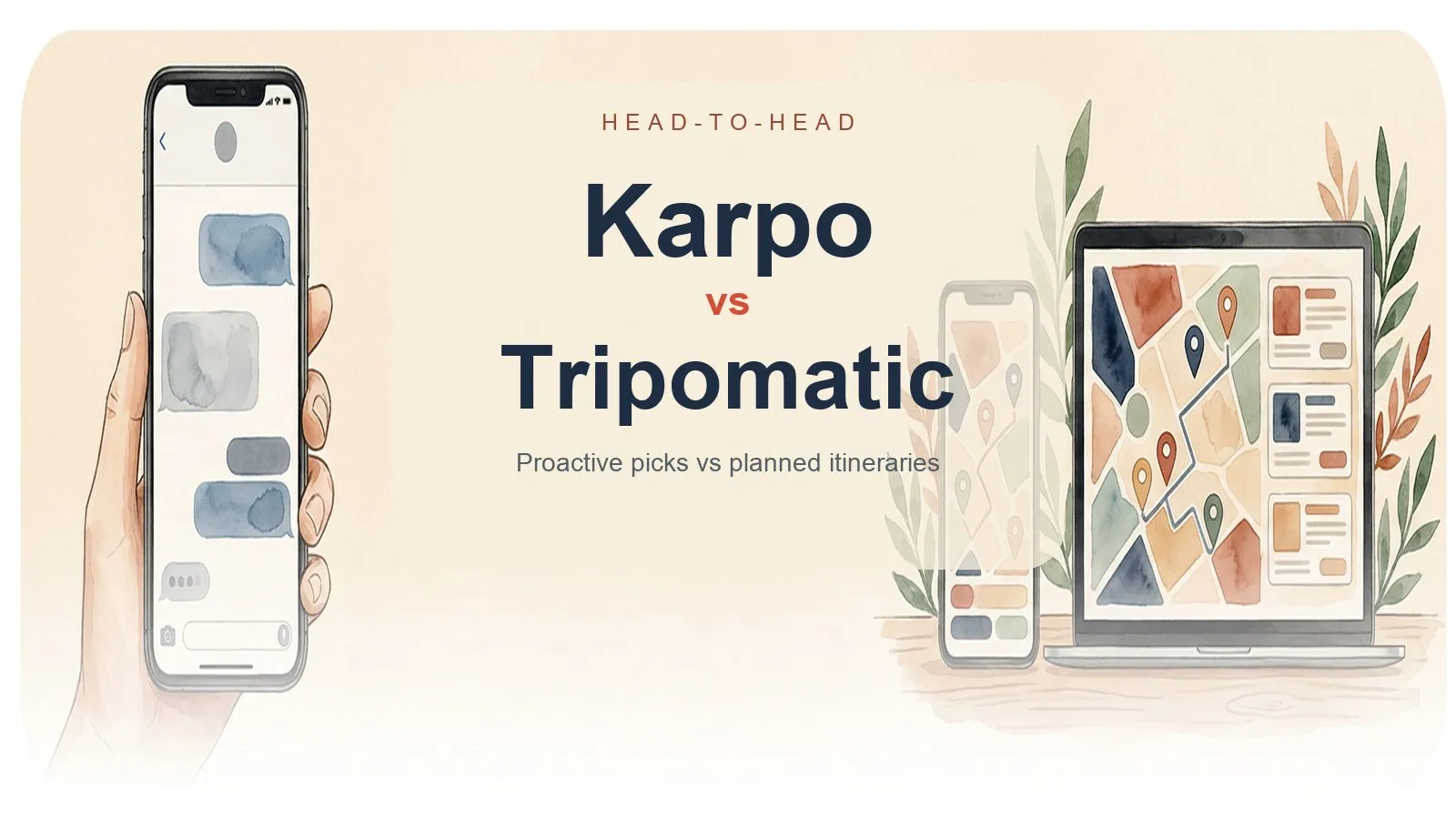
TL;DR — The 30-Second Verdict
Tripomatic is a mature visual itinerary builder with an AI planning layer. It can draft around interests, pace, and travel style, then help travelers arrange attractions by day, see them on a map, estimate travel time, and carry the plan across web, iOS, and Android. Its public site says travelers can explore millions of places.
Building the itinerary is only half the trip. Text Karpo for timely local picks, neighborhood-level alternatives, and a plan that adapts when your day changes.
Tripomatic organizes the places you have chosen. Karpo reduces the number of choices you need to make in the first place — then keeps learning after the vacation-style itinerary would normally be archived.
If the job is “build a four-day sightseeing schedule,” Tripomatic has the more complete canvas. If the job is “make my actual city life less repetitive without asking me to research it again,” Karpo is the sharper tool.
Quick Comparison Table
Primary surface — Karpo: iMessage on iPhone. Tripomatic: web planner plus iOS and Android apps.
Account required — Karpo: phone onboarding. Tripomatic: planning can be explored on the web; an account is used to save and sync itineraries.
Pricing today — Karpo: free. Tripomatic: free core planning with optional in-app Premium purchases whose prices vary by store and region.
Best for — Karpo: recurring local discovery. Tripomatic: structured sightseeing itineraries.
City depth — Karpo: selected cities with neighborhood and editorial context. Tripomatic: global attraction coverage across many destinations.
Learns you over time — Karpo: persistent taste memory is foundational. Tripomatic: the itinerary reflects what the user saves and schedules.
Proactive recommendations — Karpo: yes. Tripomatic: no comparable message-first behavior.
Real-time event awareness — Karpo: stronger fit for time-sensitive local ideas. Tripomatic: stronger fit for established attractions and planned routes.
Editorial content — Karpo: weekly local lifestyle edits. Tripomatic: destination content, photos, videos, and attraction information.
Offline travel utility — Karpo: link- and message-led. Tripomatic: mobile travel guides and offline-oriented map features are part of its app proposition.
General-purpose ability — Both are travel and lifestyle specialists.
Multimodal — Karpo communicates conversationally; Tripomatic is highly visual and map-led.
iOS native — Both support iPhone, but only Karpo lives inside iMessage.
Android — Karpo: not currently. Tripomatic: yes.
The defining row is “learns you over time.” A saved itinerary knows what you selected for Rome. A sidekick should also know that at home you avoid long brunch waits, prefer neighborhood cinemas, and will walk farther when the weather is good.
What Karpo Does Better
1. It Starts in Conversation, Not on a Planning Canvas
Tripomatic’s visual planner is an advantage when the user wants a visual planner. For ordinary local life, opening a destination workspace can be too much ceremony. Karpo begins in the same thread where someone is already asking whether the group wants dinner, a show, or “something chill.”
The surface also changes the unit of work. Tripomatic encourages a complete day or trip. Karpo can solve a two-hour gap, one rainy evening, or the single decision standing between a group chat and an actual reservation.
2. It Builds a Taste Model Beyond a Single Itinerary
Tripomatic personalizes a plan through the attractions and days a user selects. Karpo’s intended model is more behavioral and persistent. It can remember:
- The neighborhoods you actually spend time in, rather than one place you searched once.
- That you bring a book when eating alone.
- That happy hour matters more than tasting menus.
- That natural wine is in, while orange wine is currently out.
- That your last four Saturdays were in Brooklyn, not Manhattan.
- That you would rather walk 25 minutes than take the subway for eight.
Those details are not useful for ranking the Colosseum against the Trevi Fountain. They are decisive when choosing between three plausible places tonight.
3. It Treats Local Culture as a Moving Target
Tripomatic’s attraction database is broad and useful, especially for first-time visitors who want major sights and a coherent route. Karpo’s local editorial layer is designed around change: temporary exhibitions, limited-run menus, seasonal events, openings, ticket windows, and neighborhood momentum.
A database rewards durability. A city sidekick must also understand expiry. The recommendation that is useful for only four days may be the most valuable one precisely because a static sightseeing list will not prioritize it.
4. It Can Deliver the Idea Before You Build the Day
Tripomatic waits for the traveler to open the product and compose an itinerary. Karpo can initiate. In the best version of the experience, it sees the empty window, understands the likely mood, and sends a small set of opinionated options instead of asking the user to browse dozens of attraction cards.
This is a meaningful product difference, not a notification setting. Proactivity changes discovery from a research task into a timely invitation.
5. Its Core Value Does Not Sit Behind a Travel Upgrade
Karpo is free. Tripomatic offers free planning and optional Premium purchases through its mobile distribution channels; the exact prices can differ by platform and region. The paid value can be sensible for travelers who want richer mobile guide or offline capabilities.
For the city-resident use case, however, the key comparison is not the dollar amount. Tripomatic’s Premium layer expands travel utility. It does not turn a trip itinerary into a persistent, proactive local relationship.

What Tripomatic Does Better
Tripomatic gives visual planners a better workspace. Its AI can create an initial itinerary around interests and pace; users can then drag attractions into days, inspect the geographic shape of the route, and compare transport modes. That workflow can be faster than discussing every stop conversationally.
It also has broader destination coverage. Karpo is intentionally concentrated in selected cities; Tripomatic is designed for travelers moving across a much wider global catalogue of attractions.
Tripomatic supports Android and the web as first-class surfaces. That matters for mixed-device groups and for people who prefer building a trip on a laptop before carrying it on a phone.
Finally, Tripomatic is stronger for conventional sightseeing. If the user wants the landmark sequence, travel-time logic, attraction cards, and an organized four-day plan, the product is operating exactly where it should.
That is the honest list: four real strengths around itinerary visualization, global breadth, cross-platform access, and sightseeing structure. They are meaningful, but they solve a planned-trip problem rather than Karpo’s recurring local-life problem.
Pricing — The Most Lopsided Row in the Table
Free tier — Karpo: free core experience. Tripomatic: free web and app planning functionality is available.
Paid tier — Karpo: none. Tripomatic: optional Premium in-app purchases; the official app listings present store-specific products and pricing rather than one universal global price.
Trial — Karpo: not applicable. Tripomatic: trial or introductory availability depends on the app-store offer shown to the user.
Refund — Karpo: not applicable. Tripomatic: refunds follow the purchase channel and applicable store rules.
Tripomatic’s paid layer is easiest to justify for an active traveler who wants enhanced guide or offline utility. Karpo’s advantage is that the proactive city-sidekick behavior is the free core, not an itinerary upgrade.
Use Case Verdict — Decision Tree

Choose Karpo if any of these apply:
- You want everyday city ideas after the tourist checklist is finished.
- You prefer a few opinionated recommendations over building a full itinerary.
- Your history, taste, budget, companions, and neighborhood should affect each answer.
- You want the product to message first when something timely fits.
- Most plans begin inside iMessage or a group chat.
- You care about openings, limited runs, and what is unusually relevant this week.
- You want the core experience at no cost.
Choose Tripomatic if any of these apply:
- You are constructing a day-by-day sightseeing itinerary.
- You want attractions arranged visually on a map.
- You need web and Android access.
- You are visiting destinations outside Karpo’s supported city focus.
- You prefer to choose and schedule every stop yourself.
- Offline-oriented travel guide features matter to your trip.
Treat them as tools for different moments. Use Tripomatic to structure the trip you can see coming. Use Karpo for the local opportunities you would otherwise miss because you never opened a planner at all.
FAQ
Is Karpo free? Yes. Karpo’s core experience is free.
Can Tripomatic replace Karpo for local recommendations? It can help a visitor organize attractions, but it does not replace a persistent, taste-aware sidekick designed for repeated city decisions.
Does Tripomatic have proactive recommendations? No comparable message-first feature is presented in its official product positioning. The user opens the planner and builds the itinerary.
Which has better real-time event awareness? Karpo is the stronger fit for time-sensitive local discovery; Tripomatic is stronger for stable attractions and sightseeing plans.
Which is better for “what should I do tonight”? Karpo, especially for a resident or repeat visitor who wants a contextual answer rather than a full itinerary.
Can I use Karpo on Android? Not currently. Tripomatic supports Android.
Which is better for a first trip to Rome or Paris? Tripomatic may be better when the main job is arranging major sights across several days. Karpo becomes more compelling for cities it supports when taste, timing, and local context matter more than the checklist.
Does Tripomatic work on the web? Yes. Its web planner is a core strength and can sync plans with mobile use through an account.
#Karpo #Tripomatic #AITravelPlanner #ItineraryPlanner #CitySidekick #LocalDiscovery #TravelApps #iMessageAI #TravelTech #CityGuide
Sources consulted: Tripomatic official site · Tripomatic iOS listing · Tripomatic Android listing · Sygic official Tripomatic announcement · Tripomatic AI trip planner feature
All trademarks are the property of their respective owners.