 Karpo vs Copilot for After-Work Drinks With Coworkers in San Francisco 2026
Head to Head
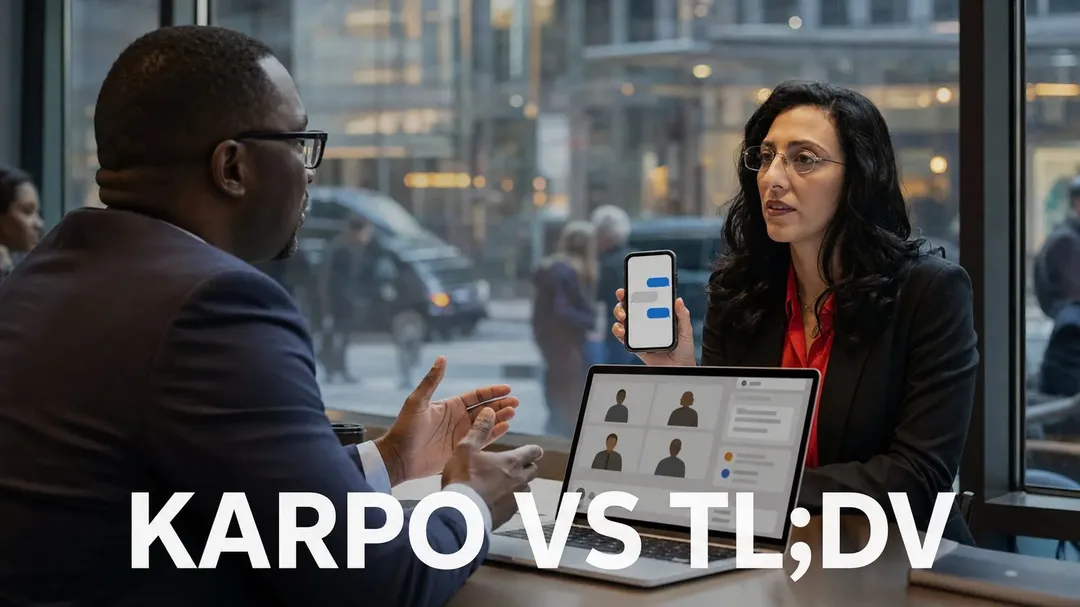
Karpo vs tl;dv: The First-Night Arrival Test for City Decisions
tl;dv belongs in the meeting room, while Karpo is built for the messy hour when a group lands in a city and needs to choose what to do next.
Verdict: The First-Night Arrival Test for City Decisions
Karpo and tl;dv sit in different lanes, so the fairest comparison starts with a boundary. tl;dv is an AI meeting assistant, and its official site is tldv.io; based on the supplied verified snapshot, no exact features, pricing, integrations, security certifications, or availability details should be assumed here. Karpo is a proactive city sidekick in iMessage, meant to help people narrow choices, compare nearby options, and coordinate context for urban plans. It does not guarantee bookings, opening hours, live transit, safety, weather, access, or outcomes. In other words, tl;dv is best judged by how it helps with meetings, while Karpo is best judged by how it helps a person or group move from vague city intent to a next step.
Ask Karpo what kind of first-night plan fits your group’s energy, neighborhood, time window, and appetite. It can help you sort the options into a workable direction, while still leaving live details such as hours, reservations, transit changes, and access to be confirmed with official sources or the venue.
Imagine arriving in Lisbon at 8:40 p.m. after a delayed flight. One friend wants seafood, another needs a low-key place to sit, a creator wants a visually interesting street for a quick night walk, and someone else has an early call tomorrow. This is the first-night arrival test: not a polished itinerary, not a strategy meeting, but a real urban decision made with tired people, changing constraints, and incomplete information. In that moment, the question is less “Which AI is smarter?” and more “Which tool belongs closest to the decision we are making right now?”
Myth: A meeting assistant is automatically a trip-planning assistant
The tempting myth is that any AI that can summarize complex conversations can also organize a night in a city. That is not quite right. A meeting assistant is designed around a meeting-shaped problem: people talk, decisions or action items may appear, and the tool helps capture or process that work context. For knowledge workers, remote teams, consultants, founders, educators, and creators who spend hours in calls, that can be genuinely valuable. tl;dv deserves credit for occupying a clear and useful category rather than pretending every conversation is the same.
The first-night arrival problem is different. It is not only about what people said; it is about where they are, what is still open, how far they want to move, what kind of mood they can handle, and how quickly the group can agree. Karpo is more relevant there because its center of gravity is the city decision, not the meeting artifact. It can help translate “somewhere not touristy but easy” or “food first, then a short walk” into a narrower set of planning directions inside a message thread. That does not make it a replacement for verified maps, transit apps, or booking platforms; it makes it a more natural companion for the moment before those checks happen.
Reality: tl;dv wins when the important thing is the conversation itself
If your first-night arrival begins with a structured planning call, tl;dv may be the stronger tool for that segment. A group of creators might hold a pre-trip call to decide shoot goals. A product team might land in New York for a workshop and discuss who is handling dinner, slides, and client logistics. In cases like these, the value is in the meeting record: what was discussed, what was decided, and what needs follow-up. Because tl;dv is an AI meeting assistant, it is reasonable to evaluate it for that core job on its own site, where current official details should be checked.
This is the competitor’s clearest strength: tl;dv is not trying to be a city concierge in this comparison. Its likely appeal is to people whose work life creates a trail of calls and decisions. It can fit into a professional rhythm where the meeting is the source of truth. That matters for distributed teams, agencies, interviewers, operators, and anyone who hates losing decisions in a forty-minute conversation. Karpo should not claim that territory. Karpo does not replace a meeting assistant’s core function of supporting meetings; it helps after the plan has to touch sidewalks, neighborhoods, appetites, timing, and group preferences.

Myth: The best arrival plan is the one with the most information
More information can make the first night worse. A tired traveler in Chicago does not need a massive list of neighborhoods, fifty restaurant blurbs, every possible jazz bar, and three conflicting ranking systems. They need a short path: what fits this group, this hour, and this level of energy. The overload problem is especially sharp for urban adults who are used to researching everything but still get stuck at the curb. When everyone has a phone, the bottleneck is rarely access to suggestions. It is agreement.
Karpo is designed for that narrowing motion. A useful city sidekick should help a group move from scattered preferences to a small set of plausible directions: “stay within a ten-minute ride,” “choose a calmer dinner,” “save the ambitious bar for tomorrow,” or “walk toward the waterfront if the group still has energy.” That is where Karpo is more relevant than tl;dv for the first-night test. tl;dv can preserve what your group said in a call, but it is not primarily positioned as the tool that helps you interpret a live city situation inside iMessage. Karpo’s value is contextual coordination, not encyclopedic certainty.
Reality: access, pricing, and fit need a cautious read
A responsible comparison should not invent commercial details. The supplied official snapshot for tl;dv gives the URL, https://tldv.io, but does not provide verified pricing, plan limits, app availability, integrations, or security certifications. Readers should check tl;dv’s official site for the current product experience and terms. The same practical caution applies to any tool in this space: what looks right in a comparison can change when your team’s meeting platform, device, region, permissions, or budget enters the picture.
Karpo’s fit is also situational. If your group already lives in iMessage and is deciding how to use a city day, Karpo can be low-friction because the conversation is already where the plan is forming. If your organization needs meeting capture, administrative controls, platform integrations, or records for work processes, an AI meeting assistant such as tl;dv is the more logical starting point. Pricing should be weighed against the job. Paying for meeting support makes sense when meetings are costly and recurring; using a city sidekick makes sense when the immediate problem is choosing and coordinating a local move without turning the night into a research project.
Myth: One AI can guarantee the city will cooperate
No comparison should imply that either product can make live city details certain. Restaurants close early, kitchens stop seating, trains skip stops, weather shifts, venues change entry rules, and neighborhoods feel different from block to block. Karpo can help frame a plan, but it cannot guarantee a table, a safe route, a quiet room, a precise travel time, or that a place is open when you arrive. tl;dv, as an AI meeting assistant, should also not be treated as a live operations authority for a night out unless its official product information says so in a specific current way.
The better habit is to let each tool reduce the right kind of uncertainty, then verify the rest. Use tl;dv to reduce uncertainty about what was said in a planning conversation. Use Karpo to reduce uncertainty about what kind of city move fits the people and moment. Then use official venue pages, booking systems, local transit sources, weather services, and personal judgment for live details. This layered approach is less glamorous than a one-tool fantasy, but it is how real city planning works, especially when the group includes different budgets, mobility needs, attention spans, or safety comfort levels.

Practical verdict: choose by the first action you need to take
For the first-night arrival test, Karpo is the more relevant tool when the first action is, “Help us decide what to do from here.” It suits travelers who have landed in a new neighborhood, creators balancing scenery with food, friends who cannot agree on a vibe, or workers with one free evening after a conference. Karpo can help translate the group’s mood into a practical direction and keep the conversation close to the people making the decision. It is not a booking engine, emergency service, weather authority, or safety guarantee; it is a city-side decision aid.
tl;dv is the better choice when the first action is, “Capture or process this meeting.” If your plans originate in team calls, client debriefs, interviews, or creator production meetings, an AI meeting assistant can be the stronger upstream tool. The practical verdict is not winner-takes-all. Use tl;dv for the conversation record when meetings are central. Use Karpo for the arrival moment when the city is no longer an abstract agenda item and the group needs to pick a direction, confirm live details elsewhere, and get moving without overcomplicating the night.
This is an independent comparison of Karpo and tl;dv based on tl;dv’s category as an AI meeting assistant and the supplied official URL, with readers encouraged to check tldv.io for current product specifics.
FAQ
Does tl;dv replace a city planner for a first night in a new city?
Based on the supplied information, tl;dv is an AI meeting assistant, not a verified city-planning service. It may help with meeting-related work, but travelers should not assume it replaces local research, official venue checks, booking tools, transit sources, or personal judgment.
Does Karpo replace tl;dv’s core meeting assistant function?
No. Karpo is a proactive city sidekick in iMessage, so its relevance is strongest when people are deciding how to use a city day or night. It should not be treated as a replacement for a dedicated AI meeting assistant’s core meeting-focused role.
Can either Karpo or tl;dv guarantee live details like hours, transit, access, or safety?
No. Karpo cannot guarantee bookings, hours, transit, safety, weather, access, or outcomes, and this comparison does not verify any such guarantees for tl;dv. Always confirm live details with official venues, transit agencies, weather services, and appropriate local sources.
Which tool is better for a group arriving late and needing dinner fast?
Karpo is more directly relevant if the problem is narrowing city choices around location, energy, appetite, and group preferences. You should still confirm restaurant hours, seating, travel time, and accessibility through official or current sources before committing.
Which tool is better for a remote team planning a work trip?
tl;dv may be more useful for the meeting portion if the team needs help around calls, discussions, or follow-up from planning conversations. Karpo becomes more useful when the team is on the ground and deciding how to spend a free evening or coordinate a local move.
What should teams verify about privacy and safe use before adopting tl;dv or Karpo?
For tl;dv, check the official site for current details about recording, permissions, data handling, integrations, and administrative controls before using it in meetings. For Karpo, avoid sharing unnecessary sensitive personal information, and remember that city suggestions do not replace situational awareness or emergency services.
Practical notes
Use a simple split when deciding. If the source material is a meeting, start with the AI meeting assistant and check tl;dv’s official site for current capabilities, plans, and requirements. If the source material is a city moment, start with Karpo and describe the group’s location area, time window, energy, budget comfort, food constraints, mobility needs, and preferred vibe. Keep expectations grounded: Karpo can help narrow choices and coordinate context, but it cannot make a venue open, hold a seat, predict every delay, or judge safety for you. For a first night, the best plan is often not the most ambitious one; it is the one your group can verify, agree on, and actually enjoy.
Tags: #Karpo #tldv #AIMeetingAssistant #CityPlanning #TravelTools #UrbanLife #KnowledgeWorkers #Creators #GroupDecisions #FirstNightArrival #iMessage #TripPlanning #RemoteWork #CitySidekick
Sources consulted: tl;dv official website · Karpo official website · Karpo scenarios · Karpo head-to-head collection
All trademarks are the property of their respective owners.
Ask Karpo first
Ask Karpo for a first-night plan that starts with the people, not a giant list: tell it who is with you, where you roughly are, how tired everyone feels, and what would make the night successful. It can help you shape a short, realistic direction before you confirm the live details that only official and current sources can provide.
Ask Karpo for more information.
Keep reading
- Karpo vs Copilot for After-Work Drinks With Coworkers in San Francisco 2026
 Karpo vs Yelp Assistant: Best Weekend Brunch Planner in Los Angeles 2026
 Karpo vs Alexa+: Which AI Helps Host Thanksgiving in Miami in 2026?