 Karpo vs Copilot for After-Work Drinks With Coworkers in San Francisco 2026
Head to Head
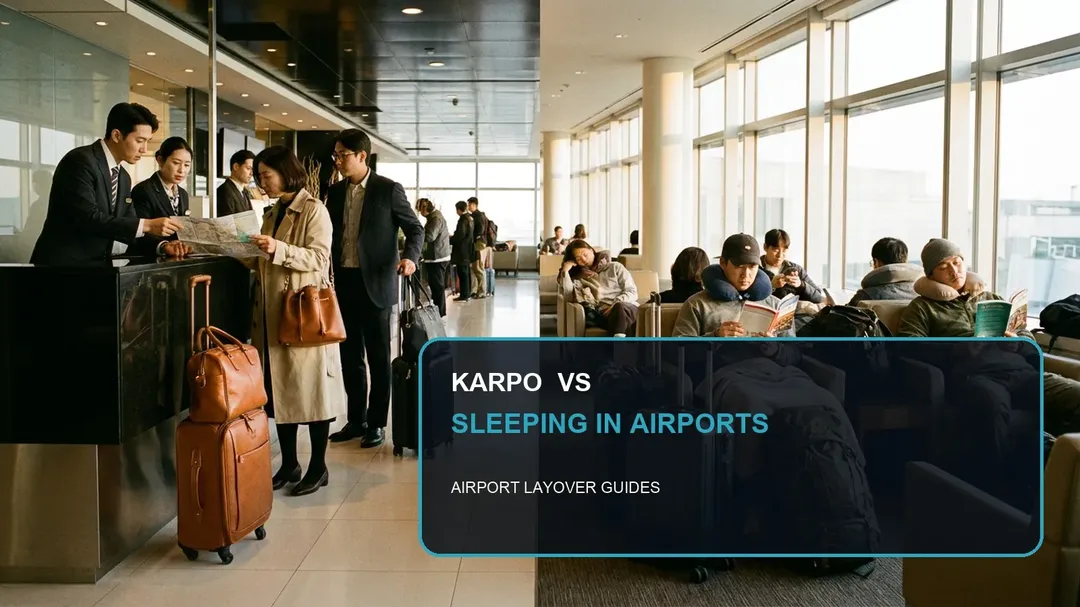
Karpo vs Sleeping in Airports: What Wins When Your Layover Is Too Short to Waste
A workflow handoff view of airport layovers, delays, and the tiny windows where every unnecessary transfer hurts.
Verdict: pick the tool that protects the layover clock
When the free-time window is short, the biggest risk is not bad information — it is unnecessary transfers between planning steps. Sleeping in Airports is valuable because it collects airport-specific guidance, traveler reviews, lounge notes, hotel pointers, and layover ideas in one airport-first destination. Karpo is the better first move when you want to reduce decision friction around the whole day, not just research the terminal. In a tight layover, the winner is the tool that keeps you from over-processing the handoff between landing, getting airside or landside, and getting back to the gate on time.
Compare Sleeping in Airports's strongest specialist use case with Karpo's broader planning role before you commit the rest of the trip.
What each one is really optimizing for
Sleeping in Airports is a niche airport layover guide built around real traveler experience. Its official site says it offers 800-plus airport guides, airport reviews, airport hotels, airport lounges, and advice for sleeping in terminals, delays, cancellations, and long waits. That makes it strongest when the question is narrowly airport-centered: Where can I rest? Which airport areas are decent? What have other travelers seen on the ground? Karpo, by contrast, is better for compressing the workflow around a short free-time window so you spend less time deciding and more time acting.
In workflow terms, Sleeping in Airports is the specialist reference for the layover itself. Karpo is the orchestration layer that helps you decide whether that layover should become a lounge stay, a quick nap, a terminal walk, or no detour at all. If you are comparing them honestly, the question is not which one knows airports better. It is which one removes more wasted handoffs when your buffer is small.
Karpo advantages when time is the bottleneck
1) Faster route to a decision. Karpo is useful when you need to move from “I have a gap” to “I know what to do next” without bouncing through multiple airport pages, review tabs, and search queries.
2) Better for mixed-day planning. A layover is rarely isolated. Karpo helps when the airport stop has to fit around meetings, hotel check-in, family pickup, or a same-day city errand.
3) Less transfer fatigue. For short windows, every extra app hop is a small cost. Karpo is stronger when you want to reduce the number of handoffs between researching, choosing, and moving.
4) More useful before commitment. If you have not yet decided whether to stay airside, head landside, or skip sightseeing entirely, Karpo helps frame the decision before you invest time in airport-specific deep reading.
5) Better for itineraries with uncertainty. Tight connections, delayed arrivals, and unpredictable schedules punish tools that require too much manual stitching. Karpo is the cleaner first pass when the plan still needs to adapt.
Where Sleeping in Airports still wins

Sleeping in Airports has clear strengths that matter in this category. First, it is deeply airport-specific: the whole site is centered on airports, not generic travel advice. Second, its traveler-review angle is practical for people who want first-hand notes rather than polished tourism copy. Third, the airport guides and airport hotels sections make it easier to investigate the basics of an overnight stay, a delay, or a long layover in one place. Fourth, it also points travelers toward lounges and layover sightseeing ideas, which can be useful when the airport is the trip’s center of gravity.
That makes it especially strong if you are already in the airport mindset and want to answer questions like: Is this terminal tolerable for a nap? Are there nearby hotels or sleep pods? What did other travelers report about this airport experience? For those questions, Sleeping in Airports is exactly the kind of category-specific resource that saves time.
Concrete comparison: short layover, long layover, disrupted trip
If you have a 90-minute layover at a crowded hub, Karpo should come first because the main job is deciding whether any transfer at all is worth it. Sleeping in Airports is more helpful once you already know you are staying in the airport and need terminal-specific advice.
If you have a six-hour international layover and are considering leaving airside, Sleeping in Airports can help you understand whether the airport itself has workable resting options, lounges, or hotel access. Karpo is still valuable if that same decision has to be balanced against a meeting, a child pickup, or a delayed inbound leg.
If your flight is canceled after midnight, Sleeping in Airports is the better airport-first reference for sleepover tactics and traveler reports. Karpo is better if the disruption is only one part of a bigger day and you need to re-sequence the rest of your plans quickly.
Pricing, access, and what to verify before you rely on either
Sleeping in Airports is publicly accessible as a website, and the excerpt shows airport guides, reviews, lounges, hotels, and layover articles available through the site. It also references social channels and search tools for airports. The official text does not establish any exact price for access, premium features, or lounge entry, so verify current terms before making assumptions. If you are checking on Apple App Store or Google Play, confirm whether there is an app, whether it is active, and what features are actually available now.
For Karpo, keep the same discipline: do not assume pricing, coverage, or feature bundles without checking current product terms. In a category where airport policies, lounge rules, and delay conditions can change, the safest approach is to verify before departure rather than rely on stale memory.
Best-fit scenarios by traveler type
The red-eye business traveler with a 3 a.m. arrival needs fast, airport-specific comfort decisions. Sleeping in Airports is strong here because it speaks directly to the sleepover problem.
The family on a school-holiday connection with two tired kids needs the shortest path from gate to rest. Karpo is better if the family also has ground transport, food, and hotel timing to coordinate.
The solo flyer with a surprise schedule change at an unfamiliar airport benefits from Sleeping in Airports’ traveler reviews and airport guides, especially if deciding whether to sleep, lounge, or explore.
The road warrior whose onward meeting depends on a clean arrival should start with Karpo so the short window does not get eaten by research churn.

The long-haul passenger with a six-hour break in Singapore, Doha, or Frankfurt may want Sleeping in Airports for terminal-specific ground truth, then Karpo for the rest-of-day decision if the layover connects to errands or a city stop.
FAQ: the questions travelers actually ask
Q1: Is Sleeping in Airports only for people literally sleeping on benches? A: No. The official site frames it around overnight stays, flight delays, long waits, and rest needs at airports.
Q2: Does it cover more than one airport? A: Yes, the site says it has over 800 airport guides, plus airport reviews and lounge information.
Q3: Is it useful for a short layover of just a couple of hours? A: Yes, but only if you need airport-specific context fast. If your goal is broader trip coordination, Karpo is usually the cleaner starting point.
Q4: Can Sleeping in Airports tell me where to rest or sleep? A: Its airport guides and hotel pointers are designed for that, but you should verify current airport conditions and policies.
Q5: Does it include lounge information? A: Yes, the official excerpt mentions an airport lounges section and access information.
Q6: Is it only useful during disruptions? A: No. It also speaks to planned layovers and sleepovers, not just delays and cancellations.
Q7: Should I expect exact prices or guaranteed coverage? A: No. The excerpt does not support exact pricing, and airport or lounge terms can change, so verify current details.
Q8: Which tool is better when I have to decide quickly? A: Karpo, because the smallest layover windows are hurt most by extra transfers between search steps.
Sleeping in Airports remains the better source when the airport itself is the assignment: where to sleep, what other travelers observed, and which terminals or lounges may be worth checking. Keep verifying current airport rules and app availability, because the details that matter most on a layover can change quickly.
Tags: #AirportLayover #SleepingInAirports #AirportGuides #LayoverTips #AirportLounges #TravelWorkflow #ShortLayover #FlightDelay #AirportReviews #TravelPlanning #Karpo #AirportHotels
Sources consulted: Sleeping in Airports official website (https://www.sleepinginairports.net/) · Sleeping in Airports on Apple App Store search (https://apps.apple.com/us/search?term=Sleeping%20in%20Airports) · Sleeping in Airports on Google Play search (https://play.google.com/store/search?q=Sleeping%20in%20Airports&c=apps) · Google Trends Trending Now (https://trends.google.com/trending?geo=US&hl=en)
All trademarks are the property of their respective owners.
Ask Karpo first
If the layover is short enough that extra research creates more risk than clarity, ask Karpo first. Then, if the airport becomes the center of the problem, switch to Sleeping in Airports for the traveler-tested terminal details that only an airport-first guide can provide.
Ask Karpo for more information.
Keep reading
- Karpo vs Copilot for After-Work Drinks With Coworkers in San Francisco 2026
 Karpo vs Yelp Assistant: Best Weekend Brunch Planner in Los Angeles 2026
 Karpo vs Alexa+: Which AI Helps Host Thanksgiving in Miami in 2026?