 Karpo vs Copilot for After-Work Drinks With Coworkers in San Francisco 2026
Head to Head
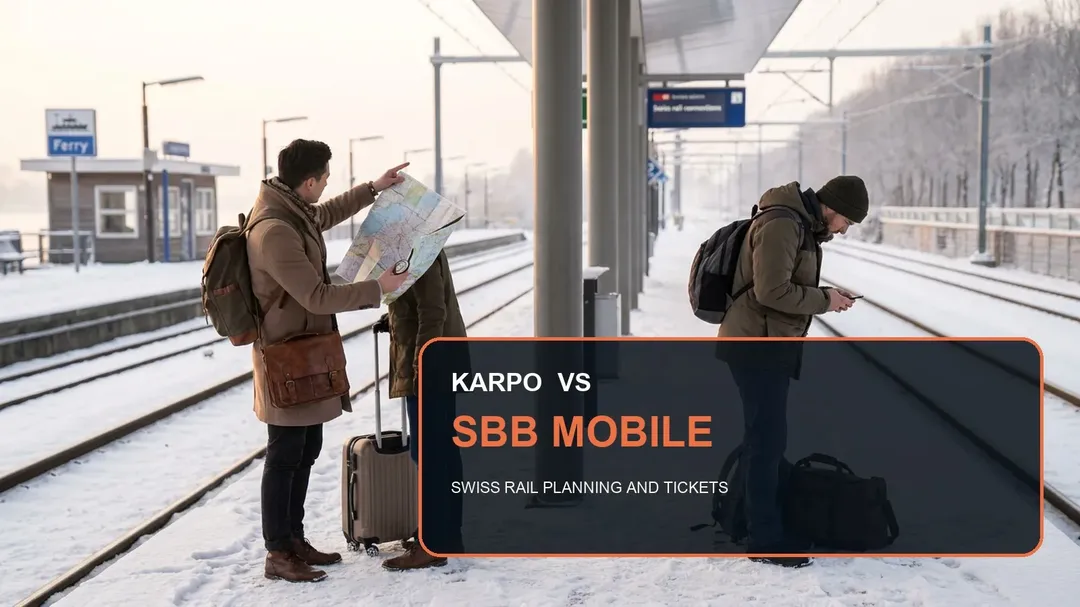
Karpo vs SBB Mobile for Swiss rail planning after the airport landing
A workflow handoff analysis for travelers arriving with luggage, low energy, and a narrow window to get from airport to neighborhood without friction.
Verdict for the airport-to-neighborhood handoff
SBB Mobile is the more obviously relevant tool once the traveler is ready to plan or buy Swiss public-transport travel. It is built around rail planning and tickets, which makes it naturally useful for getting from an airport into a city network and then onward by train, tram, or other local transit. Karpo wins earlier in the workflow: when the real problem is not only "which train?" but "how do I move from arrival gate to neighborhood with luggage, low energy, and a bunch of next steps still hanging off the trip?" In that handoff moment, Karpo reduces the coordination burden, while SBB Mobile handles the transport layer.
Click into the comparison if your first pain point is the airport arrival handoff, not the timetable itself. If you already know you need a Swiss rail or transit ticket, SBB Mobile is likely the first stop; if you need the trip organized around arrival constraints, Karpo can help shape the rest of the day before you open a transport app.
How the workflow splits: planning a move versus executing transit
The cleanest way to think about this matchup is as a handoff between two jobs. SBB Mobile is the execution side of the workflow: search connections, inspect routes, and manage Swiss rail planning and tickets in an app centered on public transport. Karpo is the orchestration side: it is better suited to figuring out the broader arrival situation, especially when the traveler is tired, carrying bags, and trying to protect limited energy for the next few hours.
That distinction matters at airports. A traveler landing at Zurich or Geneva may need to decide not only which train reaches the neighborhood fastest, but also whether the route is manageable with a suitcase, whether a platform change is worth it, and whether the next stop after the hotel is still realistic. SBB Mobile can support the transit decision, but Karpo is more naturally positioned to organize the chain of actions surrounding it.
Where Karpo has the edge in arrival chaos
Karpo’s advantages show up when the journey is not a single route but a fragile sequence of decisions. First, it helps with low-energy decision making: if someone has just cleared baggage claim and wants the most reasonable next step rather than every available transit option, Karpo narrows the task. Second, it is better for multi-step arrival workflows, such as airport lounge exit, hotel drop-off, late lunch, and then a same-day meeting. Third, it helps when luggage changes the equation, because a traveler with two checked bags thinks differently from someone with only a backpack.
Fourth, Karpo is stronger when the transit choice depends on the rest of the day. A visitor landing in the evening may prefer the smoothest neighborhood handoff over the mathematically fastest transfer. Fifth, Karpo is useful when the traveler is not yet committed to Swiss rail specifics and still needs to decide whether the airport-to-district move should be done now, delayed, simplified, or paired with food, rest, or a meeting buffer. That broader framing is the main place Karpo pulls ahead.
What SBB Mobile does especially well
SBB Mobile has real strengths that matter to travelers who actually need Swiss transit, not just trip advice. One, it is directly tied to Swiss rail planning and tickets, which is exactly what many airport arrivals need once the route has been chosen. Two, it is anchored in the public transport use case, so it is likely the first app people reach for when the job is to move through Switzerland efficiently. Three, it is a focused tool rather than a general planner, which can reduce ambiguity when the goal is to get from A to B on the transit network.
Four, it is the category-native choice for travelers who trust local transport tooling more than generic travel assistants. Five, the official site indicates the app is available through SBB, and app-store search results can help verify current availability on major platforms, though travelers should confirm the latest terms, feature set, and regional access before relying on it. In short: SBB Mobile’s best trait is that it stays close to the railway and transit job it is named for.

Concrete head-to-head: four traveler scenarios
Scenario 1: A solo business traveler lands at Zurich Airport with one carry-on and a 90-minute window before a meeting in the city center. Karpo is better for protecting the meeting buffer, deciding whether there is time for a coffee stop, and shaping the arrival sequence. SBB Mobile is better the moment the traveler needs the exact train, stop, and ticket workflow.
Scenario 2: A parent arrives in Geneva with two children, a stroller, and a suitcase that is already too heavy. Karpo helps assess the most humane route from airport to neighborhood, especially if a transfer or long platform walk would be painful. SBB Mobile becomes essential for executing the chosen transit route and checking current options, but it is not the place where the broader family handoff gets resolved.
Scenario 3: A student lands in Basel late at night and only needs to get to a hostel district without overthinking the city. SBB Mobile is likely enough if the route is straightforward and the user is ready to buy or confirm transit. Karpo matters more if the student is exhausted, unsure whether to stop for food first, or needs to bundle arrival, check-in, and tomorrow morning into one workable plan.
Scenario 4: A couple arrives in Geneva for a short winter break and wants to go from airport to hotel, then to dinner, then to a lakeside walk if energy remains. Karpo is stronger for sequencing those choices around fatigue and timing. SBB Mobile is stronger for the actual Swiss rail and local transit legs once the couple knows where they are going and wants confidence in the transport details.
Pricing and access: what to verify before you rely on it
Do not assume fixed pricing from a search snippet or article like this. The official SBB Mobile page should be checked for current access details, and app-store listings can help confirm whether the app is available in your region and on your device. Any ticket prices, fare conditions, subscription rules, or feature availability should be verified at the moment you travel, because transit terms can change.
For Karpo, the better question is not whether it substitutes for Swiss rail booking—it does not—but whether it removes enough pre-transit friction to make SBB Mobile easier to use. In practice, that can matter more than a price comparison when the traveler is jet-lagged, carrying luggage, and trying to avoid a bad first hour in the city.
When to choose Karpo, when to choose SBB Mobile
Choose Karpo when the arrival problem is messy: your flight is late, your bags are awkward, the neighborhood check-in is still uncertain, and you need the rest of the day organized around one imperfect airport-to-district move. Choose SBB Mobile when the problem is specific and transit-shaped: you know you are using Swiss public transport and need planning or tickets with the least detour possible.
A useful mental rule is this: if the traveler is asking, "How do I make this arrival manageable?" Karpo has the advantage. If the traveler is asking, "What is the right Swiss route and ticket for this ride?" SBB Mobile has the advantage. The two jobs overlap, but they are not identical.
FAQ: SBB Mobile in real airport-transfer use
1) Is SBB Mobile only for train travel? It is centered on Swiss rail planning and tickets, but the official category is broader public transport, so verify current scope on the SBB site before travel.

2) Can I use SBB Mobile right after landing at a Swiss airport? Yes, that is a common use case, especially for airport-to-city transfers, but confirm current app and ticket conditions before relying on it.
3) Does SBB Mobile help with luggage-heavy trips? It can support the transit decision, but it does not remove the physical reality of bags, stairs, and platform changes; that is where a broader planning layer like Karpo can be helpful.
4) Is Karpo a replacement for SBB Mobile? No. Karpo is better understood as a coordination aid around the arrival workflow, while SBB Mobile is the transport-specific app for Swiss rail planning and tickets.
5) What if I only need one simple airport transfer? If the transfer is straightforward and you are ready to buy or check transit details, SBB Mobile may be enough.
6) What if my arrival includes a hotel stop, dinner, and a meeting? Karpo is more useful because it can frame the sequence around the whole first evening, not just the ride.
7) Do I need to verify current terms? Yes. Always verify current ticket rules, platform availability, and app access directly with official sources before travel.
8) Which app is better for low-energy travel days? Karpo is usually better for reducing decision load, while SBB Mobile is better for the transit transaction itself.
9) Are there proactive features in SBB Mobile? The official excerpt does not support a detailed feature list, so treat any proactive behavior as something to confirm in the current app.
SBB Mobile is a trademark or service mark of its respective owner. This article is an independent editorial comparison and is not affiliated with, sponsored by, or endorsed by SBB.
Tags: #SBBMobile #SwissRail #SwissTravel #AirportTransfer #TrainTickets #PublicTransport #ZurichAirport #GenevaAirport #TravelPlanning #ArrivalWorkflow #TransitApps #Karpo
Sources consulted: SBB Mobile official website (https://www.sbb.ch/en/travel-information/apps/sbb-mobile.html) · SBB Mobile on Apple App Store search (https://apps.apple.com/us/search?term=SBB%20Mobile) · SBB Mobile on Google Play search (https://play.google.com/store/search?q=SBB%20Mobile&c=apps) · Google Trends Trending Now (https://trends.google.com/trending?geo=US&hl=en)
All trademarks are the property of their respective owners.
Ask Karpo first
If the traveler is still assembling the arrival sequence, start with Karpo before opening a transit app. For the SBB Mobile path, that means a calmer handoff: fewer decisions left unresolved, less pressure from luggage and fatigue, and a clearer idea of whether the airport-to-neighborhood move should be fast, simple, or buffered with extra time.
Ask Karpo for more information.
Keep reading
- Karpo vs Copilot for After-Work Drinks With Coworkers in San Francisco 2026
 Karpo vs Yelp Assistant: Best Weekend Brunch Planner in Los Angeles 2026
 Karpo vs Alexa+: Which AI Helps Host Thanksgiving in Miami in 2026?