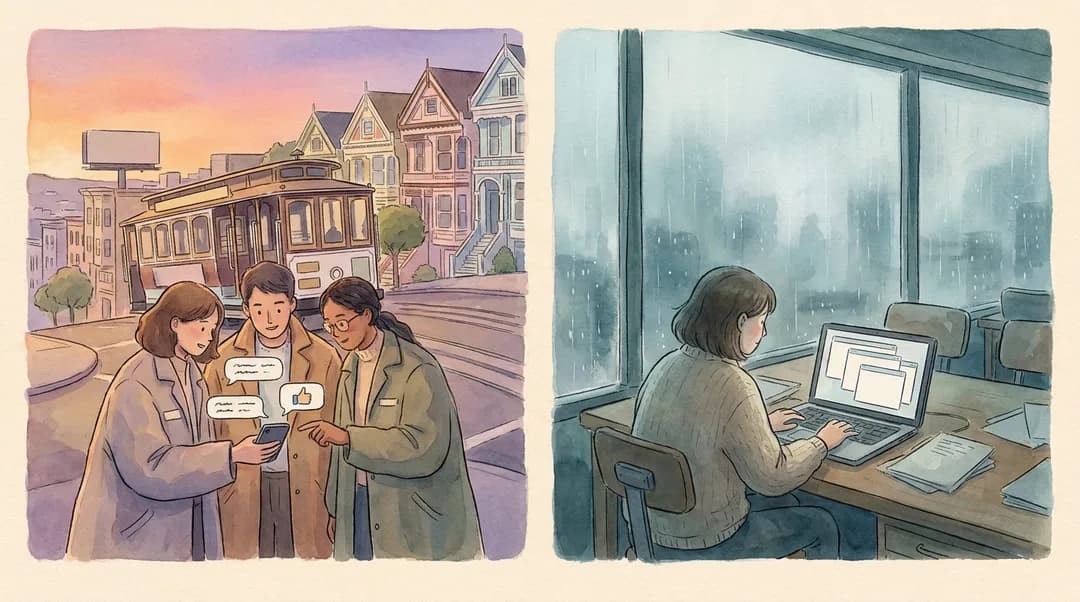
 Karpo vs Copilot for After-Work Drinks With Coworkers in San Francisco 2026
Head to Head
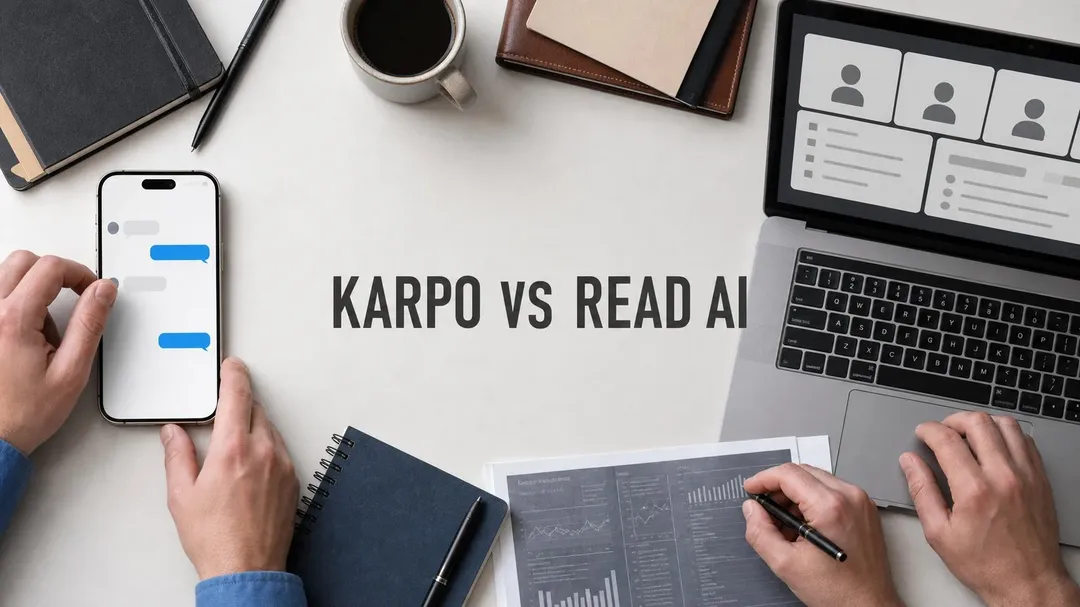
Karpo vs Read AI: The Boundary Between Meeting Notes and City Days
Read AI is built for capturing and searching work conversations, while Karpo is built to help people shape a real-world day in the city without pretending to be a meeting recorder.
Verdict: The Boundary Between Meeting Notes and City Days
A product can be excellent and still be the wrong tool for a particular moment. Read AI, according to its official page, is an AI meeting assistant offering real-time transcription, smart summaries, and AI search and discovery across content such as meetings, messages, emails, CRM, and documents. Karpo is not trying to replace that core function. It is a proactive city sidekick in iMessage, meant to help people narrow city choices, coordinate context, and make better use of a day outside the inbox or conference room. The honest boundary is simple: Read AI is for making conversations and work content more usable; Karpo is for turning loose urban intent into a practical next move, while still avoiding guarantees about bookings, hours, safety, transit, weather, access, or outcomes.
Ask Karpo when the question has moved from “what did we decide?” to “what should we do next in this city?” You can text it the context you already have, the people involved, the neighborhood you are considering, and the constraints you care about, then use its suggestions as a starting point to check live details on official sources before you go.
Picture a Saturday in Chicago. A documentary editor has two visiting friends, a half-finished shot list, a dinner preference that keeps changing, and a three-hour window between a gallery opening and a late train. Earlier in the week, the editor had a remote production meeting where Read AI could have captured decisions, summarized action items, and made the discussion easier to revisit. But now the problem is not a transcript. It is whether to walk through Pilsen, find a place that fits the group’s mood, keep an eye on timing, and avoid turning every choice into a separate search thread. That is where the boundary starts to matter.
The before-during-after test: meeting memory versus city momentum
Before a meeting, Read AI fits the preparation layer for knowledge work. Its official positioning emphasizes meeting summaries, transcripts, AI notetaking, and search across work content, so the natural expectation is that it helps teams preserve and retrieve what was said. If your day begins with a client call, a creator collaboration, a project kickoff, or a sales discussion, Read AI’s value is tied to recording the work conversation and making the aftermath less foggy.
Karpo sits in a different before-during-after cycle. Before a city day, it can help translate vague intent into a short list: coffee near a museum, a low-pressure dinner zone, a kid-friendly stop between errands, or a plan B if the group gets tired. During the day, it can keep the shared context close in iMessage rather than forcing everyone to re-explain preferences. Afterward, it may help remember what kind of place worked for the group, but it should not be treated as an official record, a reservation system, or a source of guaranteed live conditions.
Handoff points: where a meeting assistant stops and a city sidekick starts
The cleanest handoff happens when the artifact changes. If the artifact is a call, a transcript, a smart summary, or searchable work content, Read AI is in its lane. A travel writer’s sponsor briefing, a design review for a pop-up, or a nonprofit board meeting all create conversational material that benefits from being captured. The official Read AI snapshot also mentions AI search and discovery across meetings, messages, emails, CRM, and documents, which makes it especially relevant when someone needs to connect meeting knowledge to other professional material.
If the artifact is a possible afternoon, Karpo becomes more relevant. A group deciding between a waterfront walk, a bookstore crawl, and an early dinner does not primarily need enterprise search. It needs context held lightly: who is hungry, who needs a quiet place, which neighborhood is realistic, what the weather might imply after checking a reliable source, and how much decision fatigue the group can handle. Karpo’s job is not to certify the city. It is to reduce the gap between scattered preference and a workable next step.
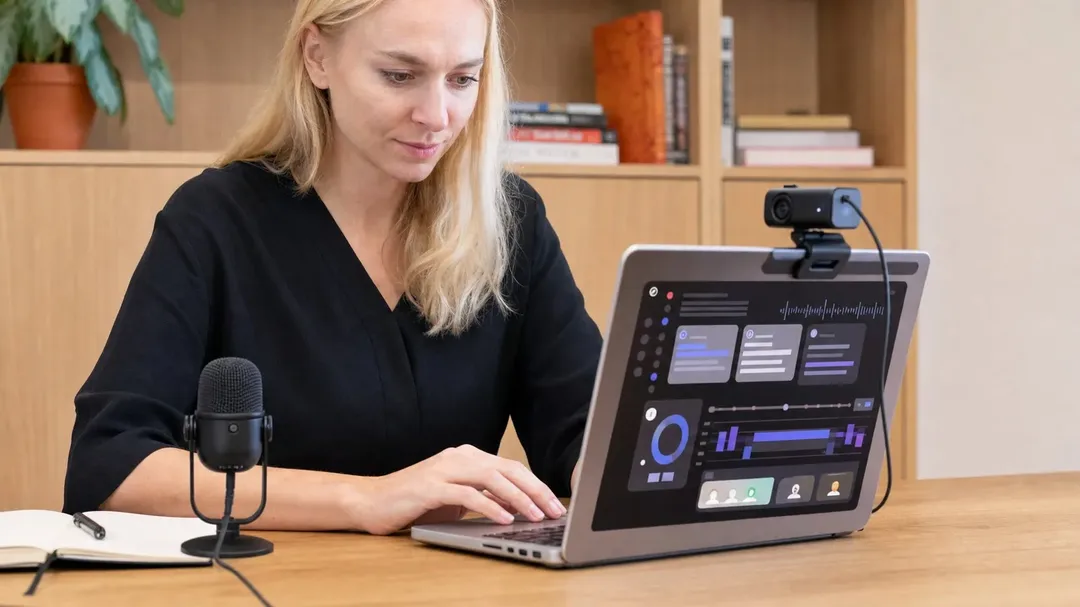
Failure modes: transcripts can miss the street, city plans can miss the record
Read AI can be the stronger tool and still fail the city-day problem. A strong transcript of Tuesday’s planning call may show that everyone wanted “something casual near the venue,” but it does not itself become a living guide for a Saturday afternoon. It may help a group remember a decision; it is not designed, from the verified snapshot, as a city planner that checks venue realities, navigates moods, or arbitrates between a tired traveler and an energetic local friend. Users should look at Read AI’s official site for current feature details, access options, and supported workflows rather than assuming it covers every planning edge case.
Karpo has its own limits. It should not be used as a substitute for Read AI’s meeting transcription, smart summaries, or work-content search. It also cannot guarantee that a restaurant is open, a train is running, a neighborhood is safe, a ticket is available, or a forecast will hold. In a city, the last mile still matters: official venue pages, transit agencies, weather services, accessibility information, and direct confirmations can change the plan. Karpo is useful in the messy middle, not as an authority that removes the need to verify.
Where Read AI clearly wins for creators and knowledge workers
Read AI has several real strengths that Karpo does not try to match. First, it is purpose-built around meetings, with official messaging that highlights real-time transcription and smart summaries. For a creator interviewing a subject, a consultant juggling client calls, or a remote team trying to preserve decisions, that core function is central. Second, the official page describes AI search and discovery across a broad set of work content, including meetings, messages, emails, CRM, and documents. That points to a knowledge-retrieval use case far beyond a single conversation.
Third, Read AI’s category fit is clear for teams that need continuity. When a meeting ends, people often need to know what was agreed, what was deferred, and where related information lives. Fourth, the product’s enterprise-search framing may matter to organizations with many documents and communication channels, though readers should confirm exact integrations, admin controls, availability, and security details directly on Read AI’s official site. Fifth, its value is legible to managers and operations teams because the problem is familiar: too many meetings, not enough recall. Karpo is not a replacement for that.
Where Karpo is more relevant for an actual day in the city
Karpo becomes more useful when the decision is embodied, social, and local. Urban adults rarely plan in clean documents. They text half-formed ideas: “near the station,” “not too loud,” “somewhere good for photos,” “maybe after the show,” or “my cousin has luggage.” Those constraints are not a formal meeting agenda, but they decide whether the day feels smooth. Because Karpo lives in iMessage, it fits the conversational way many groups already negotiate plans, especially when one person is doing invisible coordination work for everyone else.
For travelers, Karpo can help narrow unfamiliar neighborhoods without pretending to be a licensed guide or official data source. For creators, it can connect a vibe, location, and time window into a plausible route or shortlist. For friends, families, and couples, it can reduce the emotional tax of repeatedly asking, “What do you want to do?” Its edge is not that it knows everything live. Its edge is that it can hold the group’s stated context, propose city-shaped options, and keep the planning conversation moving toward a next checkable action.
Access, pricing, and the practical verdict for mixed work-and-city days
Access and pricing should be treated cautiously because the supplied verified snapshot does not include exact plan terms for Read AI, and this comparison should not invent them. Anyone considering Read AI should review the official Read AI site for current pricing, account requirements, supported platforms, enterprise options, privacy terms, and feature availability. The same practical caution applies to Karpo: understand how it works in iMessage, what it can and cannot do, and which live details you still need to confirm through official or direct sources.
The practical verdict is not a single winner. If your main pain is losing meeting decisions, searching across work content, or turning calls into usable notes, Read AI is the more relevant product. If your main pain is turning a half-planned urban day into a sequence of choices that respects people, timing, neighborhoods, and mood, Karpo is more relevant. Many users may use both: Read AI for the production meeting on Friday, Karpo for the gallery route, dinner shortlist, and plan B on Saturday. The better question is not which AI is bigger, but which boundary you are standing on right now.
This is an independent comparison of Karpo and Read AI based on the supplied Read AI official-page snapshot and category-level understanding, not an endorsement by or partnership with Read AI.
FAQ
Does Read AI replace a city planner for a day out?
Based on the official snapshot, Read AI is positioned as an AI meeting assistant with transcription, smart summaries, and search across work content. That does not make it a dedicated city planner, venue verifier, transit checker, or group itinerary sidekick.
Does Karpo replace Read AI’s core meeting function?
No. Karpo is not meant to replace real-time transcription, meeting summaries, AI notetaking, or enterprise search across meetings and documents. If the central task is capturing and retrieving work conversations, Read AI is the more directly relevant tool.
Can either Karpo or Read AI guarantee live city details?
No. Karpo cannot guarantee bookings, opening hours, transit status, safety, weather, access, or availability, and Read AI’s verified positioning does not suggest it is a live city-conditions authority. Always check official venues, transit agencies, weather sources, and direct confirmations before relying on a plan.
Which tool is better for a creator planning content around a city visit?
Use Read AI when the creator needs to preserve briefing calls, interviews, production notes, or sponsor discussions. Use Karpo when the creator is choosing neighborhoods, timing shoots, coordinating companions, or shaping a flexible city route from preferences and constraints.
Which privacy and safety boundaries should someone review before using Read AI with Karpo?
For Read AI, users should review the official site and terms to understand how meeting content, messages, emails, CRM data, or documents may be handled, especially in professional settings. For Karpo, users should be thoughtful about sharing sensitive personal, location, health, financial, or safety information in any planning conversation.
How should a group decide between Karpo and Read AI before a trip or workday?
Look at the object you need help with. If it is a meeting record or searchable work knowledge, choose Read AI; if it is a changing city plan negotiated through texts, Karpo is more useful. For mixed days, use each at its natural boundary instead of forcing one tool to do everything.
Practical notes
Practical notes: Treat Read AI as a work-memory tool and Karpo as a city-context tool. Before relying on Read AI for a team workflow, confirm current pricing, supported content sources, privacy terms, administrative controls, and availability on the official Read AI site. Before relying on Karpo for a city day, decide what information is sensitive, then verify live details through official venues, transit services, weather sources, ticketing pages, and direct calls when needed. For groups, appoint one person to keep the plan grounded: share constraints clearly, avoid uploading unnecessary private details, and separate suggestions from confirmations. The best setup is simple: capture the meeting with the meeting tool, then plan the street-level day with the city sidekick.
Tags: #Karpo #ReadAI #AIMeetingAssistant #CityPlanning #UrbanLife #KnowledgeWork #Creators #TravelPlanning #GroupPlans #MeetingNotes #AIComparison #iMessage #Productivity #CitySidekick
Sources consulted: Read AI official website · Karpo official website · Karpo scenarios · Karpo head-to-head collection
All trademarks are the property of their respective owners.
Ask Karpo first
Ask Karpo when your group has moved past the meeting notes and into the living city: “We have two hours near the station, one vegetarian, one person with luggage, and we want something memorable but not hectic.” Karpo can help turn that context into a narrower set of options and a sensible next step, while you still confirm the details that matter before you head out.
Ask Karpo for more information.
Keep reading
- Karpo vs Copilot for After-Work Drinks With Coworkers in San Francisco 2026
 Karpo vs Yelp Assistant: Best Weekend Brunch Planner in Los Angeles 2026
 Karpo vs Alexa+: Which AI Helps Host Thanksgiving in Miami in 2026?