 Karpo vs Copilot for After-Work Drinks With Coworkers in San Francisco 2026
Head to Head
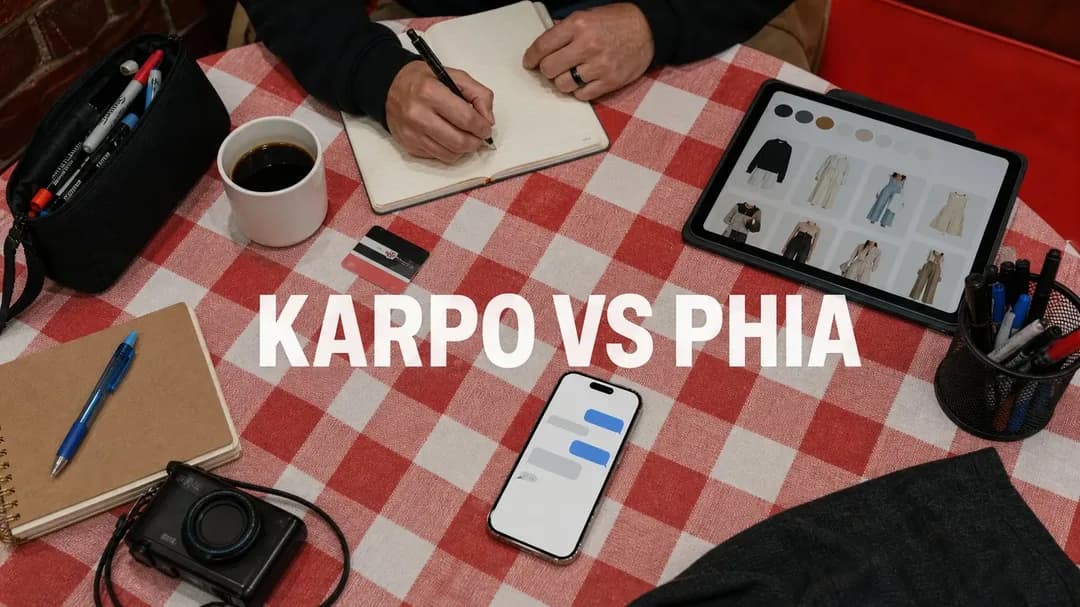
Karpo vs Phia: The Hidden Cost of Choosing, Shopping, and Moving Through a City
Phia focuses on personal shopping decisions, while Karpo is built for coordinating city choices when people, timing, and attention compete.
Verdict: The Hidden Cost of Choosing, Shopping, and Moving Through a City
Karpo and Phia are not interchangeable products, even though both sit near the broad world of AI assistance. Phia’s official positioning is clear: it is a personal shopping assistant that helps people build a closet seamlessly and find the best prices instantly. Karpo, by contrast, is a proactive city sidekick in iMessage, meant to help people narrow city choices, coordinate context, and reduce the friction of deciding what to do next. The honest boundary is simple: Phia is closer to the wardrobe and shopping-price problem, while Karpo is closer to the day-in-the-city coordination problem. Neither should be treated as a magic operator that guarantees availability, live hours, inventory, transit, safety, weather, or access.
Ask Karpo when the shopping question is only one part of the day: “We are near Logan Square, one person wants vintage shopping, one needs lunch, and one has to be back by 4.” Karpo can help sort the context into a more usable plan, while still leaving you to confirm live details with the places you choose.
Picture a Saturday in Chicago with three friends, one visiting from Toronto, one creator filming street interviews, and one local knowledge worker who only has five free hours. Someone needs a rain jacket, someone wants coffee with seating, someone wants a bookstore, and someone refuses to cross town twice. Phia may be highly relevant to the person thinking about clothes, closet gaps, and price discovery. Karpo becomes relevant when the group must turn scattered preferences into a workable city day, with timing, neighborhoods, energy, and competing intentions all in play.
The real comparison is attention, not just AI features
An AI shopping assistant reduces one kind of attention cost: the mental load of searching, comparing, and second-guessing purchases. Based on Phia’s official snapshot, its promise centers on building your closet and finding the best prices. For many urban adults, that is not a small problem. Clothing choices are fragmented across stores, resale platforms, seasonal needs, personal taste, creator aesthetics, travel constraints, and budget limits. If Phia helps a shopper move faster from “I need something like this” to a better-informed purchase path, its value is concentrated and concrete.
Karpo reduces a different attention cost: the coordination tax of a city day. That tax shows up when a group chat contains too many options, people answer slowly, neighborhoods are unfamiliar, and the plan must bend around meals, errands, transit, weather, and energy. Karpo is not trying to become the best-price engine for your closet. Its usefulness appears when the decision is no longer simply “which item should I buy?” but “how do we spend the next four hours without making everyone manage the whole city in their head?” That makes the comparison less about which assistant is broadly smarter and more about which attention problem you are actually paying.
Where Phia wins: closet logic and purchase focus
Phia’s strongest advantage is focus. A tool described as “Your Personal Shopping Assistant” with an official promise to help build your closet and find the best prices instantly is aimed at a specific user moment: deciding what belongs in your wardrobe and where the buying opportunity looks strongest. That focus can be especially useful for creators maintaining a visual identity, travelers packing for changing conditions, or professionals trying to avoid wasteful purchases. Instead of asking a general assistant to understand shopping intent from scratch, a shopping-first product starts closer to the problem.
Phia also wins when the outcome is a shopping decision rather than a city itinerary. If someone in the group needs to compare a jacket, refresh work basics, fill a closet gap, or look for a better price before purchasing, Karpo should not be presented as a replacement for that core shopping function. Karpo may help the group decide whether there is time to visit a retail district or whether shopping fits before dinner, but Phia is the more relevant product for the personal-shopping layer. Its strengths are category clarity, wardrobe relevance, price-oriented positioning, and a tighter relationship to purchase intent.
Where Karpo becomes more relevant: the group has to move
Karpo’s edge appears when preferences collide in the real world. A solo shopper can spend an hour comparing items; a group in New York, Lisbon, or Seattle may not have that luxury. One person wants a quiet gallery, another wants sneakers, another needs a patio, and another is trying to avoid a long ride before a meeting. The hard part is not merely discovering options. It is sequencing the day in a way that respects the people, geography, and time window. Karpo is designed for that kind of city context inside iMessage, where plans often begin as messy conversations rather than clean search queries.
For travelers and urban knowledge workers, that difference matters. A city day is rarely a single-purpose funnel. It mixes errands, taste, constraints, and social negotiation. Karpo can help narrow choices and keep the group oriented: which neighborhood makes sense, which preference should lead, what trade-off the group is actually making, and what to check before leaving. It cannot guarantee that a shop is open, that a table is available, or that a train is running smoothly. But it can reduce the number of unresolved decisions sitting in the chat, which is often the difference between getting out the door and spending the afternoon debating.
The time-and-attention cost in a conflicted city day
Consider a creator in Austin visiting with two friends. She wants a visually interesting vintage store for a short video, one friend wants a practical shirt for a dinner later, and the third wants tacos, not retail. Phia can be useful for the person evaluating clothing needs and possible prices. But the group’s bigger cost is attention fragmentation: switching between shopping research, maps, food choices, neighborhood distances, and social patience. Every switch feels small, yet together they drain the day. The question becomes: should the group optimize the purchase, the route, the meal, or the mood?
Karpo is more useful when the answer must balance all four. It can help turn “vintage plus tacos plus not too much walking” into a tighter set of neighborhoods or a sequence to investigate. Phia remains the better companion for the wardrobe-specific choice, especially if the shopper is thinking about closet fit and price. The practical division is easy to remember: use Phia when the item is the center of gravity; use Karpo when the city day is the center of gravity. In group settings, that distinction saves attention because it prevents one assistant from being forced into the wrong job.
Access, pricing, and what to verify before relying on either
The supplied official snapshot for Phia does not include exact pricing, account requirements, supported regions, store coverage, platform availability, or integration details. Readers should check Phia’s official site for current access terms and any limits around how its shopping assistance works. The snapshot also does not verify specific retailers, inventory feeds, security certifications, user counts, or commercial arrangements. That does not weaken Phia’s stated category; it simply means a careful buyer should avoid assuming details that are not publicly confirmed in the provided official summary.
Karpo should be evaluated just as practically. It operates as a proactive city sidekick in iMessage, which makes it natural for people already coordinating through messages, but users should still understand what it can and cannot do. Karpo may help structure choices, compare city-day trade-offs, and keep context together, but it cannot guarantee bookings, live hours, transit status, weather outcomes, safety conditions, or entry to a venue. If cost, access, privacy, or platform support determines your decision, check the current official information before building a habit around either product.

Practical verdict: choose by the decision you need to finish
If your unresolved decision is “what should I buy, and where might I find a strong price?” Phia is the more directly relevant assistant. It is built around the shopping problem and presents itself as a personal shopping assistant for closet building and price discovery. That makes it a good fit for wardrobe planning, purchase comparison, style maintenance, and moments when the city around you is secondary. For a creator choosing a look, a traveler filling a packing gap, or a professional replacing everyday basics, Phia’s category focus is a real advantage.
If your unresolved decision is “what should we do next, given where we are, who is with us, and how much time we have?” Karpo is the more relevant companion. It does not replace Phia’s shopping-centered role, but it can help a group decide whether shopping belongs in the plan at all, which area to consider, and how to balance one person’s errand against everyone else’s day. The strongest workflow is not necessarily choosing one forever. It is using the focused assistant for the focused decision and the city sidekick for the moving, social, time-bound decision.
This is an independent comparison based on Phia’s official public positioning as a personal shopping assistant for closet building and price discovery, not a claim of partnership with or endorsement by Phia.
FAQ
Does Phia replace a city planner for groups?
No. Based on the official snapshot, Phia is positioned as a personal shopping assistant for closet building and finding best prices. It may help with shopping decisions, but it is not described as a city planning or group coordination tool.
Does Karpo replace Phia’s core shopping function?
No. Karpo can help place a shopping stop inside a city day, but it is not a dedicated closet-building or best-price shopping assistant. If the main job is wardrobe and purchase comparison, Phia is the more category-specific choice.
Can either product guarantee live details such as hours, inventory, bookings, or transit?
No. Users should verify live hours, inventory, prices, reservations, transit status, weather, and access directly with official sources or the venue. Karpo can help organize decisions, but it cannot guarantee changing real-world conditions.
Which is better for a traveler with limited time in a city?
It depends on the traveler’s bottleneck. If the bottleneck is buying the right clothing item, Phia is more relevant; if the bottleneck is coordinating neighborhoods, food, timing, and companions, Karpo fits better.
How should privacy and safety be handled with AI shopping and city assistants?
Avoid sharing sensitive personal, financial, medical, or safety-critical information unless you understand the product’s current policies and settings. For purchases, check payment and retailer details carefully; for city movement, confirm conditions through reliable live sources and use personal judgment.
Can Karpo and Phia be used together?
Yes. A practical pattern is to use Phia for the shopping-specific decision and Karpo for deciding how that shopping stop fits into a broader city plan. They address different attention costs rather than solving the same problem.
Practical notes
Practical notes: Before depending on either assistant, define the decision you are trying to reduce. For Phia, that may be a closet gap, a style choice, or a price comparison; check the official Phia site for current features, availability, access terms, and any purchasing details. For Karpo, give the city context clearly: neighborhood, time window, group preferences, mobility limits, and must-do stops. Treat suggestions as planning support, not final confirmation. Call the venue, check maps, verify transit, review weather, and confirm reservations when the outcome matters. In a group, assign one person to make the final call so the assistant reduces discussion instead of creating more options.
Tags: #Karpo #Phia #AIShoppingAssistant #CityPlanning #UrbanLife #GroupCoordination #TravelPlanning #CreatorTools #KnowledgeWorkers #ShoppingDecisions #PersonalShopping #CitySidekick #TimeManagement #AttentionCost
Sources consulted: Phia official website · Karpo official website · Karpo scenarios · Karpo head-to-head collection
All trademarks are the property of their respective owners.
Ask Karpo first
Ask Karpo before the group chat splinters: “We have three hours in Brooklyn, one person wants shopping, one wants a low-key meal, and one needs a photo-friendly stop.” Karpo can help frame a realistic city plan to check, adjust, and confirm before you go.
Ask Karpo for more information.
Keep reading
- Karpo vs Copilot for After-Work Drinks With Coworkers in San Francisco 2026
 Karpo vs Yelp Assistant: Best Weekend Brunch Planner in Los Angeles 2026
 Karpo vs Alexa+: Which AI Helps Host Thanksgiving in Miami in 2026?