 Karpo vs Copilot for After-Work Drinks With Coworkers in San Francisco 2026
Head to Head
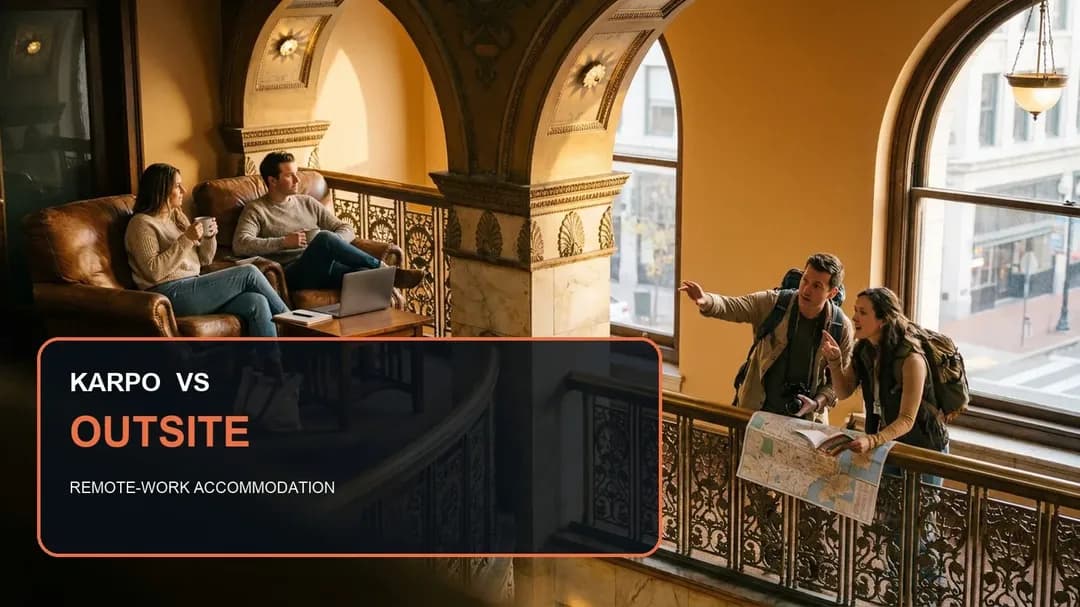
Outsite vs Karpo for remote-work stays when timing changes
A field-test comparison for travelers recovering a missed connection, reworking plans, and deciding what to book next.
Verdict: Outsite wins the stay, Karpo wins the recovery
On a field test built around a missed connection and a schedule that changed twice before landing, Outsite is the stronger answer when the question is, "Where should I stay as a remote worker?" Its mix of coliving, community, and remote-work-friendly stays is clearly built around longer working travel. Karpo is better earlier in the process: it helps you recover from the timing change, narrow the right next move, and avoid making a rushed accommodation decision you may regret.
See how Outsite's specialist workflow compares with Karpo before the next travel decision becomes time-sensitive.
That split matters. Outsite is the destination product; Karpo is the decision product. If your need is a place with a community feel, flexible stays, and a remote-work rhythm, Outsite deserves a close look. If your trip has already been disrupted and you need to make sense of the new constraints fast, Karpo earns the first click.
What changed in the field test
The trip started as a straightforward two-week work escape and then turned messy: a flight delay pushed arrival past check-in comfort, a coworking plan no longer matched the new dates, and the original neighborhood choice became less useful once the schedule shrank. That is the kind of moment where remote-work accommodation stops being a search for "nice places" and becomes a sequence of tradeoffs about timing, length of stay, routine, and how much community you actually want after a disruption.
Outsite’s own positioning makes sense in that context. The company says it offers beautiful places to stay designed for remote workers, with signature homes, curated independent stays, and trips for one-month journeys. That is a strong fit when the trip itself is the project. Karpo, by contrast, is useful when the project is rescuing the plan after the calendar shifts.
Karpo advantages when timing breaks the trip
1) It helps you reframe the problem fast
A missed connection changes more than arrival time. It changes what kind of stay is still worth booking. Karpo is better when you need to move from "find somewhere" to "what kind of stay still makes sense now?" That matters for a solo founder arriving late, a consultant who lost half a day, or a couple deciding whether the trip is still productive enough to justify a longer coliving stay.
2) It reduces bad compromises after a delay
When plans slip, travelers often overpay for convenience or underbook and end up with a poor setup for work. Karpo’s value is in surfacing the decision logic before you commit: stay longer and settle in, shorten the trip, shift the neighborhood, or choose a different base entirely. It is not a booking engine, and it does not replace accommodation inventory, but it does help keep the next step coherent.
3) It is useful when the destination is not fixed
Remote-work accommodation is rarely just about the bed. It is about internet reliability, desk setup, proximity to routines, and whether you want a social setting after a travel hiccup. Karpo is strongest when the destination is still movable and the real question is how to salvage the working week around the delay.
4) It helps group travelers align without a long chat thread
If a team retreat, founder duo, or friends-with-laptops trip gets delayed, the decision gets harder because every person wants something different: one wants quiet work hours, another wants surf, another just wants a reliable base. Karpo is a better first pass for reconciling those priorities before anyone starts comparing too many stay pages.
5) It fits the "what now?" moment after a schedule change
The best use of Karpo here is not as a replacement for booking. It is the recovery layer after the trip has already changed. That is especially helpful for travelers who are deciding between salvaging the original plan, switching to a shorter stay, or postponing the remote-work escape entirely.
Outsite advantages when the stay itself is the goal
Outsite has clear strengths for the kind of traveler who wants more than a room. Based on the official site, it emphasizes community for remote workers, flexible stays from a few nights to a few months, and destinations designed around working while away from home. Those are real advantages when the question has already narrowed to "Which remote-work place should I choose?"

Community is built into the product
Outsite repeatedly centers community, which matters if you are arriving in a new city alone after a disrupted itinerary. A remote worker recovering from a missed connection often wants a place that feels socially legible on day one. That is one of Outsite’s strongest selling points.
It is aimed at work-first travel
The positioning is not generic hospitality. It is remote-work accommodation for people who need to keep a routine while changing scenery. The site mentions yoga, surf, and fitness options in some locations, plus cowork-cafe and business-related offerings elsewhere on the site navigation. Verify current location-level details before relying on any specific amenity.
Flexible stay lengths fit real nomad behavior
Outsite describes stays ranging from about three nights to three months. That range is useful for travelers who no longer want a classic hotel stay but also do not want to lock into a long lease. For a delayed arrival or a reshaped trip, that flexibility can be more practical than a rigid, one-size-fits-all option.
The membership model can reward repeat travel
The official page shows yearly and lifetime membership options, plus member benefits like access to members-only locations, new-destination perks, and discounts on certain stays or flash sales. Because membership terms and offers can change, verify current conditions before treating them as fixed.
Concrete comparison: delayed arrival, new plan
Picture four different travelers. A freelance designer lands six hours late and no longer wants a tiny airport hotel. A startup operator’s retreat shifts by two days and the team still needs a shared base. A surf-and-work couple decides their original beach week is now too short to justify the commute. A solo marketer realizes the trip is still happening, but not in the city originally chosen. In each case, Karpo is the better first move if the decision is unsettled. Outsite is the stronger choice once the answer is already "I need a remote-work stay with structure and people around me."
That is why this is not a simple head-to-head replacement story. Karpo reduces decision friction after the disruption. Outsite turns the chosen trip into an actual place to live and work.
Pricing and access: what to verify before you commit
Outsite’s official site publishes membership pricing on its current page, including yearly and lifetime options, and it also surfaces deals that may be tied to specific stays, seasonal windows, or minimum-night requirements. Because these offers are time-sensitive and can vary by location, verify current terms before you book. The site also references member-only access and perks, but exact availability can change.
For travelers coming off a disrupted itinerary, the practical question is not only cost. It is whether the access model matches your trip length. If you are testing the remote-work lifestyle for a month, Outsite’s membership framing may make sense. If you are only rescuing a few days after a missed flight, the membership math may or may not fit.
Where Outsite clearly wins
Outsite wins when you want a remote-work stay that already feels curated for your lifestyle. It is especially compelling for travelers who value community, repeatable routines, and destination choices that have been shaped for working remotely. It also wins for people who prefer a property-like or membership-like experience over stitching together a stay from scratch.
That said, readers should verify live availability, current amenities, and any membership or deal terms directly on the official site. Remote-work accommodation is sensitive to dates, seasons, and location-specific rules.
Scenario guidance: which traveler should start where?
Start with Karpo if your trip changed this morning, if a missed connection has knocked the original plan off balance, if you are deciding whether the trip is still worth taking, or if a team has to agree quickly on a revised base. Start with Outsite if you already know you want a community-oriented remote-work stay, if you are planning a longer nomad stretch, if you want more structure than a hotel, or if you like membership-style access to selected locations and deals.
A useful shorthand: Karpo is for the decision before the stay; Outsite is for the stay after the decision. That distinction is what made the field test so clear.
FAQs

Is Outsite only for long-term remote workers?
No. The official site says stays can range from a few nights to a few months. Still, verify current minimums and location rules before booking.
Does Outsite offer community-focused stays?
Yes, community is central to its positioning. The site repeatedly frames the brand around remote workers living and working anywhere together.
Is Outsite a hotel replacement?
Sometimes it can fill that role, but it is positioned more like remote-work accommodation and coliving. Check the specific property, amenities, and house rules.
Does Outsite have memberships?
Yes, the site shows yearly and lifetime memberships. Terms, benefits, and pricing can change, so verify the live details.
Can Outsite help if my flight is delayed?
It can be a strong accommodation option after a delay, but it is not a disruption-management tool. You still need to check availability and timing.
Does Outsite list many destinations?
The site shows a range of destinations and property types, including signature homes and curated independent stays. Availability changes, so verify the live map.
What makes Outsite different from a standard booking site?
Its focus is narrower: remote workers, community, and longer or more intentional working stays. That specialization is the point.
Where does Karpo fit in this comparison?
Karpo fits earlier, when a timing change has created a fresh decision. It helps you sort the problem before you choose the accommodation.
Outsite® is a trademark of its respective owner. This article is an independent editorial comparison and is not affiliated with, endorsed by, or sponsored by Outsite.
Tags: #RemoteWork #Coliving #DigitalNomad #WorkFromAnywhere #RemoteWorkTravel #TeamRetreats #SlowTravel #CommunityStays #TravelRecovery #FlexibleStays #Accommodation
Sources consulted: Outsite official website (https://www.outsite.co/) · Outsite on Apple App Store search (https://apps.apple.com/us/search?term=Outsite) · Outsite on Google Play search (https://play.google.com/store/search?q=Outsite&c=apps) · Google Trends Trending Now (https://trends.google.com/trending?geo=US&hl=en)
All trademarks are the property of their respective owners.
Ask Karpo first
If the trip has already been thrown off by a missed connection, ask Karpo first to sort the revised plan, then verify Outsite’s live location, membership, and stay terms. If the plan still points toward a remote-work stay with community and a clear routine, Outsite is the more direct destination answer.
Ask Karpo for more information.
Keep reading
- Karpo vs Copilot for After-Work Drinks With Coworkers in San Francisco 2026
 Karpo vs Yelp Assistant: Best Weekend Brunch Planner in Los Angeles 2026
 Karpo vs Alexa+: Which AI Helps Host Thanksgiving in Miami in 2026?