 Karpo vs Copilot for After-Work Drinks With Coworkers in San Francisco 2026
Head to Head
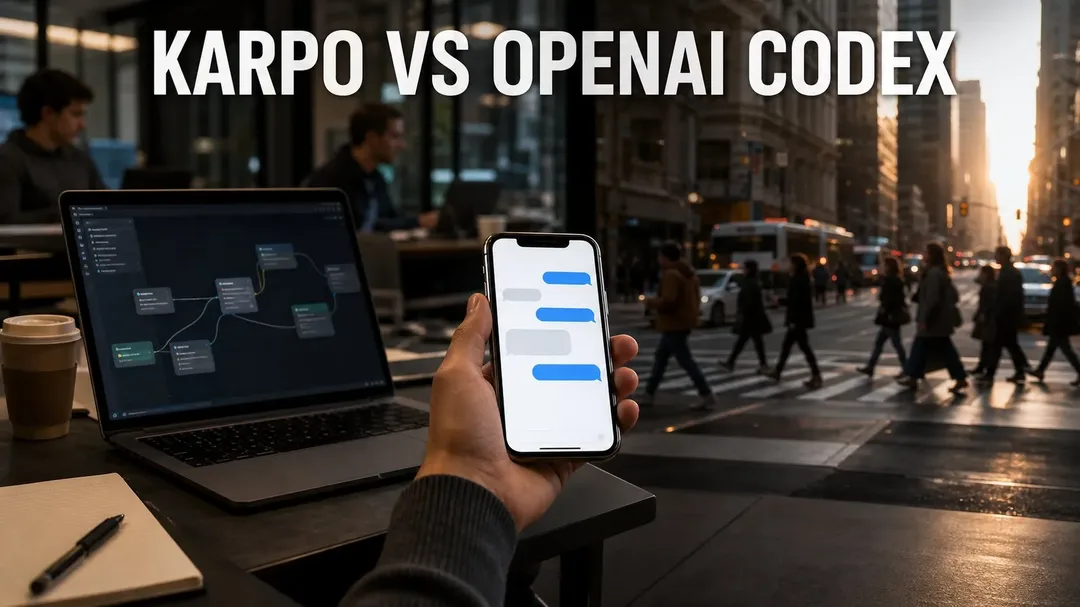
Karpo vs OpenAI Codex: From Saved Idea to City-Day Action
Karpo and OpenAI Codex both help people move from intention to output, but they operate in very different arenas: city coordination versus AI-assisted software work.
Verdict: From Saved Idea to City-Day Action
OpenAI Codex and Karpo should not be treated as direct substitutes. OpenAI Codex is an AI coding agent, with its official page at openai.com/codex, and the supplied verified snapshot does not provide details such as pricing, integrations, security certifications, supported platforms, or availability. Karpo is a proactive city sidekick in iMessage, meant to help narrow choices, coordinate context, and move everyday plans along. It is not a booking guarantee, transit authority, safety service, weather source, medical advisor, or financial planner. That boundary matters because a coding agent and a city-planning companion solve different versions of the same human problem: you saved an idea, now you need to do something useful with it.
Ask Karpo to turn the first paragraph of your city idea into a realistic set of options: neighborhoods to consider, timing tradeoffs, group preferences to clarify, and reminders about what still needs to be checked on official sources before you go.
Imagine a small creative team in Brooklyn with one free Saturday. A photographer has saved a mural walk, a strategist wants a café with outlets, a founder wants to test a landing-page idea, and two friends are joining after lunch. The group is not asking for a software agent to refactor code; they are trying to convert scattered intention into a workable day. Still, OpenAI Codex enters the comparison because one person may also need to turn field notes into a prototype or automate a small workflow later. The useful question is not which product is universally better. It is which one fits each stage: preparation, live execution, and follow-through.
The Field-Day Setup: One Saved Idea, Two Very Different Jobs
A creator or knowledge-worker field day usually starts as a vague saved note: “Do a city day for content, meetings, and fresh thinking.” That note may contain half a dozen locations, a few dietary preferences, a time window, a budget sensitivity, and a wish to avoid wasting the afternoon crossing town. Karpo is relevant here because the problem is urban context. It can help compare neighborhoods, surface the next question to ask the group, and keep the plan grounded in what people actually want from the day.
OpenAI Codex belongs to a different part of the saved-idea pipeline. As an AI coding agent, its natural strength is code-related work: helping a developer or technical builder move from a software task toward implementation. In this field-day scenario, Codex is not the tool that decides whether the team should start in Williamsburg or the Lower East Side. It becomes relevant if the founder wants to build a quick internal tool, explore a codebase, or turn a field-day insight into a software task. The shared theme is action, but the action is not the same kind.
Preparation: Karpo Organizes City Context Before the Day Starts
Before the day, Karpo’s advantage is that it can meet the plan where it lives: in conversation. A group can text about who is arriving when, whether they need quiet space, whether the day should favor photos, food, shopping, research, or rest, and which neighborhoods feel realistic. Karpo may help narrow choices and coordinate the surrounding context. It can be especially useful when people do not know what they should decide first: route shape, meeting point, energy level, backup ideas, or how much spontaneity to leave open.
OpenAI Codex is less relevant to that kind of preparation because city-day planning is not its core category. That is not a weakness in its own field; it is simply a mismatch. If preparation means writing a script, modifying an app, or working through a programming task before the outing, Codex may be the more serious tool. But if preparation means converting a saved restaurant, gallery, park, and café list into a coherent Saturday, a city sidekick is closer to the job. The important distinction is context type: code context versus lived urban context.
Live Execution: When the Plan Meets Crowds, Delays, and Group Drift
The live part of a city day is where neat plans begin to fray. Someone is late, a café looks full, the group’s energy dips, rain threatens, or the second stop suddenly feels too far. Karpo can be more relevant in the moment because it is oriented toward the changing needs of people moving through a city. It can help reframe choices: stay in the area, shift to a shorter loop, prioritize food before photos, or split the group and regroup later. It can also remind users to verify hours, transit, weather, and access through the appropriate official or live sources.
OpenAI Codex wins when live execution is actually a technical session. If the same group has booked a co-working block and wants to debug a prototype, review code, or experiment with a build, an AI coding agent is more aligned with the work. It is reasonable to credit Codex with real strengths: focus on software tasks, usefulness for technical builders, potential to speed up coding-related exploration, and relevance when the output is code rather than a route. In a live city outing, however, those strengths do not automatically translate into choosing the next stop or coordinating a mixed group.
Follow-Through: Turning the Day Into Notes, Tasks, or a Prototype
After the outing, Karpo can help the group make sense of what happened in ordinary human terms. What places worked for the group? Which neighborhood deserves a second visit? What should be saved for a future friend day, client lunch, content shoot, or solo reset? This is follow-through as memory and momentum. It is less about finalizing a perfect itinerary and more about preserving the useful context that usually disappears after everyone goes home.
OpenAI Codex can become valuable when follow-through becomes software creation. If the founder wants to turn observations into a small planning app, if a developer wants to automate note cleanup, or if the team wants to explore code changes inspired by the day, Codex is closer to the center of the task. This is the cleanest division in the comparison. Karpo helps carry a city idea through planning and lived use. OpenAI Codex helps when the next action is code. A productive team could use both without pretending they overlap more than they do.
Access, Pricing, and What the Official Snapshot Does Not Tell Us
The verified OpenAI Codex snapshot supplied for this comparison identifies the official URL as https://openai.com/codex and the product category as AI coding agent, but it does not include an official title, meta description, pricing, release details, regional availability, enterprise terms, security certifications, or integration list. Readers should check the official OpenAI Codex page for the latest access conditions and any requirements. It would be misleading to state exact costs, eligibility, or supported workflows from the limited snapshot alone.
Karpo should be judged with similar caution. It is a proactive city sidekick in iMessage, but it cannot guarantee that a restaurant has a table, that a museum is open, that a train is running, that a street feels safe, or that the weather will cooperate. Users should verify live details with official sources and local providers. The access question, then, is not only “What does it cost?” It is also “Can I use this in the moment where my problem appears?” For urban adults and groups, the convenience of planning inside a familiar texting flow may matter as much as a feature list.
Practical Verdict: Match the Tool to the Action You Need Next
Choose Karpo when the saved idea is a city experience and the next step is deciding what to do, where to start, how to coordinate people, and what to check before leaving. It fits travelers choosing a neighborhood, friends building a low-friction day, creators scouting content-friendly routes, and knowledge workers trying to combine meetings with a useful change of scene. It is especially relevant when the group’s needs are mixed: one person wants quiet, another wants food, another wants visual stops, and nobody wants to become the unpaid logistics manager.
Choose OpenAI Codex when the saved idea is or becomes a software task. Its category as an AI coding agent gives it a clear lane: technical assistance for people working with code. It is not fair to evaluate Codex by how well it plans a gallery crawl, just as it is not fair to ask Karpo to replace a coding agent’s core function. In the saved-idea-to-action test, the winner changes by phase. For the city day itself, Karpo is more relevant. For code implementation, Codex has the stronger claim.
This is an independent comparison of Karpo and OpenAI Codex based only on the supplied category and official-page snapshot for OpenAI Codex, not a claim of partnership, endorsement, feature parity, or complete product documentation.
FAQ
Does OpenAI Codex replace a city planner or local itinerary helper?
No. Based on the supplied verified snapshot, OpenAI Codex is an AI coding agent, not a city planner. It may be useful for software-related work, but users should not treat it as a dedicated tool for live urban coordination, bookings, hours, safety, or transit decisions.
Does Karpo replace OpenAI Codex’s core function?
No. Karpo is a proactive city sidekick in iMessage, not an AI coding agent. It can help narrow city choices and coordinate context, but it should not be expected to perform the core code-focused role associated with OpenAI Codex.
Can either Karpo or OpenAI Codex guarantee live details during a city day?
No. Karpo cannot guarantee bookings, opening hours, transit status, safety, weather, medical guidance, financial outcomes, or access. OpenAI Codex should also not be relied on as a live authority for city logistics unless users verify details through official and current sources.
Where does OpenAI Codex clearly win in this comparison?
OpenAI Codex wins when the task is software-related. If a creator, founder, or developer wants help moving a coding idea forward, an AI coding agent is more appropriate than a city sidekick.
Where is Karpo more relevant for urban adults and groups?
Karpo is more relevant when the problem is deciding how to use a city day. It can help people compare neighborhoods, balance preferences, shape a route, and keep the group aligned without turning one person into the coordinator for everything.
What privacy or safety habits should users keep in mind?
Users should avoid sharing sensitive personal, medical, financial, or security information unless they understand how a service handles it. For city plans, keep safety-critical decisions grounded in official sources, local judgment, and real-world conditions rather than relying on any AI tool alone.
Practical notes
For a realistic saved-idea-to-action workflow, start by naming the job. If the job is “help four people use a Saturday well,” use Karpo to clarify preferences, compare areas, create a loose sequence, and identify what must be verified. If the job is “turn this concept into working software,” OpenAI Codex is the more relevant category. Do not blur these roles just because both involve AI. A creator might use Karpo before and during a field day, then use a coding agent later if the day produces a product idea. Keep live details separate from suggestions: check official hours, booking pages, local transit, weather, and access information before relying on a plan.
Tags: #Karpo #OpenAICodex #AICodingAgent #CityPlanning #UrbanLife #CreatorWorkflow #KnowledgeWorkers #TravelPlanning #GroupPlans #SavedIdeas #iMessage #AIComparison #CityDay #Productivity
Sources consulted: OpenAI Codex official website · Karpo official website · Karpo scenarios · Karpo head-to-head collection
All trademarks are the property of their respective owners.
Ask Karpo first
Ask Karpo to help turn your saved city idea into a workable next step: who is going, what the day is for, which neighborhoods make sense, what tradeoffs matter, and which live details you still need to confirm before you commit.
Ask Karpo for more information.
Keep reading
- Karpo vs Copilot for After-Work Drinks With Coworkers in San Francisco 2026
 Karpo vs Yelp Assistant: Best Weekend Brunch Planner in Los Angeles 2026
 Karpo vs Alexa+: Which AI Helps Host Thanksgiving in Miami in 2026?