 Karpo vs Copilot for After-Work Drinks With Coworkers in San Francisco 2026
Head to Head
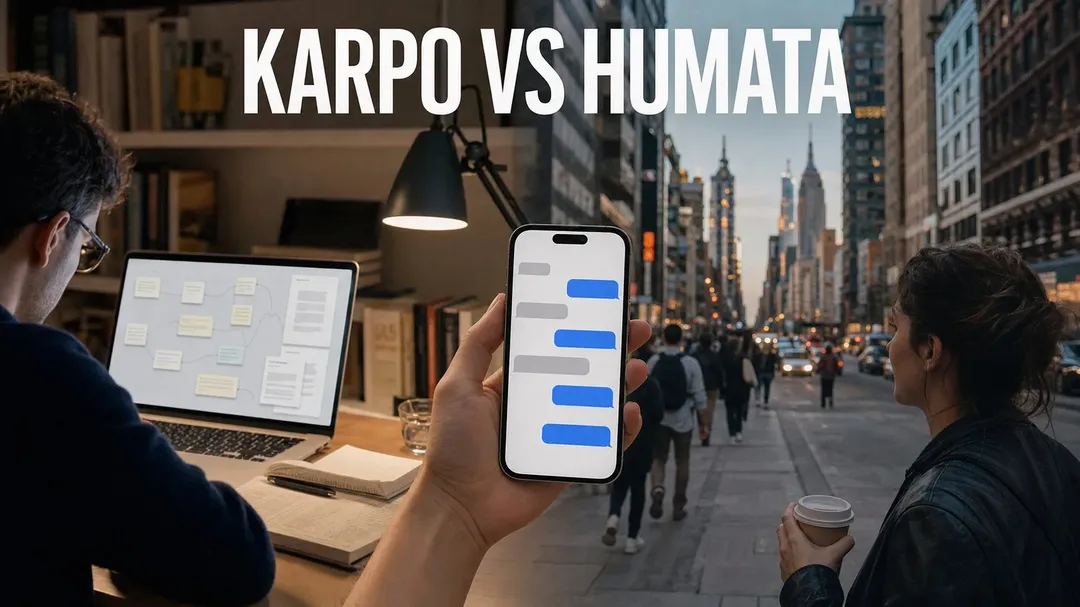
Karpo vs Humata: From Saved Notes to a City Day That Actually Moves
Humata is built to turn documents into a fast knowledge base, while Karpo is more useful when a group needs to turn loose city ideas into timely next steps inside iMessage.
Verdict: From Saved Notes to a City Day That Actually Moves
Humata and Karpo solve different parts of a modern knowledge problem. Humata’s official positioning is as an AI agent that turns documents into a fast, intelligent knowledge base for instant analysis, insights, and answers. That makes it relevant when your most important material is already inside files, reports, notes, or other documents. Karpo's role here is narrower and more situational: turning the context around Humata into workable city choices inside iMessage. It can help narrow options, keep context in a conversation, and coordinate choices around a city day, but it is not a booking engine, live transit authority, safety service, weather service, medical advisor, or guarantee of access. A fair comparison is not “one AI replaces the other.” It is about where the work begins: in a document library, or in a moving city plan.
Ask Karpo to turn your current city-day idea into a short list of neighborhoods, timing tradeoffs, and group-friendly next steps in iMessage. It can help you organize the decision, compare options, and remember the context of the plan, while you still verify hours, availability, transit conditions, weather, and any booking details with the appropriate official sources.
Picture a small creator team in Chicago planning a field day: a morning coffee interview, a midday gallery stop, a quick lunch that accommodates mixed preferences, a golden-hour photo walk, and an evening debrief. They have saved PDFs, pasted research notes, a rough shot list, a sponsor brief, and a group chat full of half-decisions. Humata is the stronger fit for analyzing the saved documents and surfacing answers from them. Karpo is more relevant once the group needs to turn those answers into a realistic sequence of city choices, ask follow-up questions in iMessage, and keep everyone oriented as the day changes.
The field-day setup: documents first or city context first
For a knowledge worker, creator, researcher, or traveler, preparation often starts with a pile of material. A PDF brief explains the assignment. A saved itinerary lists possible places. A document contains interview questions, venue notes, or background reading. This is the point where Humata’s category makes immediate sense. If the job is to ask questions of documents, extract insights, or analyze a knowledge base, Humata is pointed at that task by design. Its official page describes a document-centered assistant, not a concierge for city movement.
Karpo starts from a different kind of mess: the practical uncertainty that appears after people have read the brief. Which area should the team prioritize if they only have six hours? Is the plan too spread out? What should be saved for later? How do you keep a group aligned without rewriting the plan in three apps? Karpo’s value is not that it understands every document better than a document assistant. Its value is that it can help translate an idea into city choices inside a familiar messaging flow, especially when the plan is still being shaped by preferences, constraints, and conversation.
Preparation: Humata is stronger when the source material matters most
Humata wins the preparation stage when the central question is, “What do these documents say?” A creator could use a document assistant to interrogate a sponsor packet, compare research notes, summarize a dense backgrounder, or locate the exact part of a file that explains a constraint. A consultant could analyze client material before a site visit. A traveler could pull insights from a long saved guide or policy document. Based on its official description, Humata is designed to make document collections feel more searchable and responsive.
That strength matters because poor preparation creates weak city decisions. If the sponsor brief says the shoot must emphasize independent bookstores, or the research packet highlights three community organizations, the team needs those details before building the route. Karpo should not be treated as the place to store and analyze a full document knowledge base unless the user has manually brought relevant context into the conversation. A practical workflow is to use Humata to understand the saved material, then bring the distilled constraints to Karpo: neighborhood priorities, must-cover themes, accessibility needs to verify, time windows, dietary preferences, and the level of spontaneity the group can tolerate.

Live execution: Karpo fits the moment when the plan starts moving
Once the field day begins, the center of gravity shifts. The team is no longer asking only what the documents said. They are asking what to do next, whether to cut a stop, where to regroup, and how to adapt when one person is late or the weather looks questionable. This is where Karpo is more relevant than Humata for the audience in this comparison. It is built as a city sidekick in iMessage, so the interaction can sit close to the group’s actual decision thread rather than inside a document-analysis workspace.
Karpo can help narrow choices in plain language: pick between two neighborhoods, reshape a lunch plan around time pressure, or create a fallback path if the group is tired. It can preserve context from earlier in the conversation, which is useful when a city day has many small dependencies. Still, the boundaries matter. Karpo cannot guarantee that a cafe is open, that a table is available, that a train is running on time, that a street is safe, or that a venue will allow entry. It can help the group ask better questions and sequence options, but the final live facts should be checked through official or current sources.
Follow-through: turning the day into reusable knowledge
After the field day, Humata becomes useful again if the outcome is a body of documents. A creator may have transcripts, notes, location releases, interview summaries, and follow-up briefs. A knowledge worker may have site observations and client material. If those artifacts are turned into files that need to be searched, analyzed, or questioned later, Humata’s document assistant category is a better match. Its core promise is about making knowledge bases fast and intelligent, which is directly aligned with post-event analysis and retrieval.
Karpo’s follow-through is lighter and more action-oriented. It can help carry the conversation forward: what did the group decide, what should be revisited, which neighborhoods felt promising, and what is the next city action? For a traveler, that might mean saving a loose plan for tomorrow. For a creator, it might mean turning field impressions into a second-day route. For a team, it might mean sorting what needs a booking check, a message to a collaborator, or a practical errand. Karpo is less about building a formal archive and more about keeping momentum from dissolving after the outing ends.
Access, pricing, and expectations without pretending to know the fine print
The verified Humata snapshot identifies the official site as humata.ai and describes the product as an AI agent for documents and knowledge-base answers. It does not provide exact pricing, plan limits, enterprise terms, availability details, supported file types, integrations, security certifications, or user counts in the information available here. Readers comparing costs should check Humata’s official site directly, especially if the use case involves a team, sensitive documents, high-volume analysis, or organizational procurement requirements.
Karpo should also be evaluated according to the way someone actually wants to use it. Its advantage is the iMessage setting and the city-planning context, not a claim to replace specialized systems. If a group wants a lightweight sidekick for choosing between neighborhoods, building a flexible sequence, and coordinating conversational context, Karpo may be easier to bring into the moment. If a business needs formal document ingestion, knowledge-base analysis, permissions, or compliance answers, those details require direct review of the relevant official product pages and policies. No responsible comparison should invent the missing numbers or guarantees.
Practical verdict: choose by the bottleneck, not by the AI label
If your bottleneck is buried information, choose Humata first. It is the more appropriate tool when a creator has a pile of source documents, a researcher needs answers from a knowledge base, or a team wants document analysis before deciding what to do. Its real strengths are clear: document-centered questioning, faster access to saved knowledge, support for analysis and insights, and a workflow aimed at people who already have important material captured in files. For preparation and post-day review, that is a meaningful advantage.
If your bottleneck is a live city decision, Karpo is the better fit. It helps when the team has enough information but not enough clarity: too many saved places, too little time, competing preferences, and a plan that has to survive real movement. In the Chicago example, Humata can help decode the brief; Karpo can help turn the brief into a walkable afternoon with fallback choices. The best saved-idea-to-action test is simple: ask whether you are trying to understand documents or make a city day work. The answer usually points to the right tool.
This is an independent comparison of Karpo and Humata based on Humata’s official public positioning as an AI document and knowledge-base assistant, not an endorsement by or statement from Humata.
FAQ
Does Humata replace a city planner for a field day or trip?
No. Humata is described as an AI agent that turns documents into a knowledge base for analysis, insights, and answers. That can support planning, but it does not replace live city planning, booking verification, local logistics, or on-the-ground judgment.
Does Karpo replace Humata’s core document assistant function?
No. Karpo becomes more relevant after Humata is no longer the bottleneck and the iMessage thread still needs a workable city choice. If the main task is analyzing a set of documents or asking questions of a knowledge base, Humata is the more directly matched category.
Can either Karpo or Humata guarantee live details like hours, transit, safety, or access?
No. Karpo cannot guarantee bookings, hours, transit, safety, weather, medical advice, financial outcomes, or access, and Humata’s document-analysis role should not be treated as a live authority for city conditions. Users should verify time-sensitive details with official or current sources.
Which tool is better for a creator planning a day of interviews, photos, and scouting?
Use Humata when the creator needs to understand briefs, notes, or saved documents before the day. Use Karpo when the creator needs to turn those constraints into a practical city sequence and adjust the plan in conversation.
What privacy or safety question should teams ask before using either tool?
Teams should ask what information they are comfortable sharing, especially if documents include client material, personal data, contracts, health details, travel plans, or confidential research. They should review each product’s official privacy, retention, and security information before uploading sensitive files or discussing sensitive logistics.
Is the best workflow to use both tools together?
For many knowledge workers, yes. Humata can help extract meaning from saved material, and Karpo can help turn the distilled takeaways into city actions. The split works best when users keep document analysis and live planning as related but separate jobs.
Practical notes
Practical notes: Before a city field day, separate facts from preferences. Put document-heavy material, such as briefs, policies, research packets, and transcripts, through the tool best suited for document questions. Then bring only the relevant constraints into the city-planning conversation: must-visit areas, timing limits, budget sensitivity, accessibility needs to verify, food preferences, and backup priorities. During the day, treat any AI output as a planning aid, not a live guarantee. Check official venue pages, reservation systems, transit alerts, weather services, and local guidance when the detail matters. Afterward, decide whether the output belongs in a searchable archive, a follow-up message, or tomorrow’s plan.
Tags: #Karpo #Humata #AIDocumentAssistant #CityPlanning #KnowledgeWorkers #Creators #TravelPlanning #iMessage #UrbanLife #FieldDayPlanning #AIComparison #KnowledgeBase #GroupDecisions #ProductivityAI
Sources consulted: Humata official website · Karpo official website · Karpo scenarios · Karpo head-to-head collection
All trademarks are the property of their respective owners.
Ask Karpo first
Ask Karpo to help convert a saved idea into a realistic city-day plan: a few neighborhoods to compare, a sequence that respects your group’s energy, and a short list of details to verify before you go. It will not guarantee that the city cooperates, but it can make the next decision clearer when your notes, preferences, and timing all start competing for attention.
Ask Karpo for more information.
Keep reading
- Karpo vs Copilot for After-Work Drinks With Coworkers in San Francisco 2026
 Karpo vs Yelp Assistant: Best Weekend Brunch Planner in Los Angeles 2026
 Karpo vs Alexa+: Which AI Helps Host Thanksgiving in Miami in 2026?