 Karpo vs Copilot for After-Work Drinks With Coworkers in San Francisco 2026
Head to Head
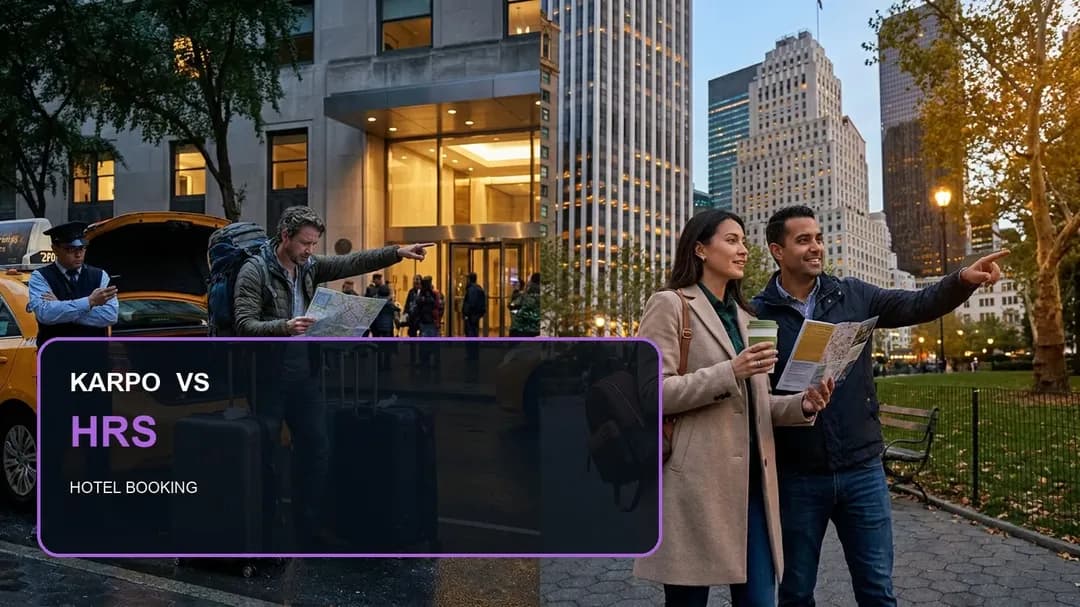
Karpo vs HRS for hotel booking when the trip has a fixed anchor
A before-during-after comparison for travelers who need a room, then want the rest of the day to feel local.
Verdict: HRS is the booking stop; Karpo is the trip-shaping layer
For travelers whose plan starts with a locked hotel, fixed ticket, or immovable appointment, HRS belongs in the booking step. It is the part of the journey where you secure a room and verify the stay details that matter. Karpo is more useful once that anchor exists and the day needs to flex around it: where to go before check-in, what fits between a late arrival and dinner, or how to turn a layover into a local outing. If you need a room, confirm HRS terms directly. If you need the rest of the day to make sense around that room, Karpo usually has the edge.
Click guidance: start with HRS when the immediate job is finding and reserving a hotel; switch your attention to Karpo when the reservation is done and you want to map nearby ideas, timing, and useful alternatives around it.
Before, during, and after: where each service fits in the traveler timeline
Before the trip, HRS is the obvious comparison point if your main concern is the hotel itself: location, rate, room type, and reservation terms. During the trip, Karpo becomes more relevant because real travel rarely follows the booking page. A train arrives late, the museum closes early, rain changes the afternoon, or the client meeting ends an hour ahead of schedule. After the trip, HRS still matters for stay management and any follow-up tied to the reservation, while Karpo helps you reconstruct the neighborhood day you actually had, not the one you planned.
Concrete comparison: hotel-first reservation versus day-first travel support
HRS is built for hotel booking. That means it should be judged on search quality, listing clarity, booking flow, and the ability to check current conditions before you commit. Karpo is not trying to replace that function. Instead, it helps travelers make the hours around the booking more usable. A business traveler with a 6 p.m. check-in, a family waiting near the station with luggage, a solo traveler with one free morning before a red-eye, or a wedding guest looking for something local between ceremony and reception all need different decisions after the room is secured. That is where Karpo tends to outperform a pure booking lens.
Four situations where the difference is easy to feel
1) A conference attendee lands before room access and needs a nearby lunch, coworking stop, and an indoor plan. 2) A couple has a prepaid city hotel and wants a walkable neighborhood itinerary without wandering too far. 3) A family arrives on an overnight train, cannot check in yet, and needs a stroller-friendly way to spend three hours. 4) A traveler on a fixed museum ticket wants the hotel choice respected while still building a realistic pre- and post-visit plan. In each case, HRS solves the stay; Karpo helps the day behave.
Karpo strengths that matter around a fixed reservation
Karpo’s value is not abstract. It is practical when the booking already exists and the traveler needs the surrounding itinerary to stop being fragmented.
First, Karpo is better at organizing the hours around an anchor, which is crucial when check-in, check-out, ticket times, and transit windows create awkward gaps.
Second, it supports local discovery without forcing you to abandon the trip’s fixed commitments. That makes it easier to explore a neighborhood and still make dinner or a train.
Third, Karpo is a stronger fit for travelers balancing context: luggage, fatigue, weather, and the distance between where you sleep and where you need to be.

Fourth, it is useful for making a short window feel intentional, such as a three-hour gap after landing or a half-day between meetings.
Fifth, Karpo is a better editor for mixed-purpose trips, like a work stay that still needs one memorable neighborhood meal, a morning run, and a stress-free route back to the hotel.
Where HRS still has real advantages
HRS has clear strengths for travelers who want a hotel-booking-specific experience. Its most obvious advantage is category fit: it is centered on lodging rather than trying to be a broader travel companion.
It also has value for users who want to search, compare, and finalize a stay in one place, then stop thinking about the hotel hunt.
Another advantage is trust around a known booking destination. For some travelers, a focused reservation site feels more straightforward than a multipurpose travel tool.
HRS can also be the better first stop for travelers whose main question is simply, 'Which hotel should I book for this city and date?'
And because our official research access was limited by a 403 response, readers should verify current HRS features, coverage, loyalty terms, and policies directly before making any booking decision.
Pricing and access: what to expect without making assumptions
Do not assume any particular price advantage from either product without checking the live interface. HRS is a booking platform, so the relevant cost question is usually the hotel rate, taxes, cancellation conditions, and any add-ons attached to the reservation. Karpo’s value is not in hotel inventory itself but in how it helps you plan the surrounding time. Access can also differ by device, region, account status, or current product changes, so verify current terms on the official HRS website and app listings before you rely on a feature or policy.
Scenario-based decision guide for travelers with a fixed anchor
If you are a road warrior landing at 9:40 p.m. with a hotel near the station, choose HRS to confirm the room and Karpo to map the late-evening food options that still work after arrival. If you are a family checking in after a theme-park day, HRS handles the stay while Karpo helps find a quiet nearby dinner and a low-effort morning plan. If you are attending a wedding with a set block reservation, HRS covers the room; Karpo helps with the in-between hours when nobody wants to improvise badly. If you are on a city break with a timed gallery ticket, HRS is the room decision and Karpo is the local-discovery decision around it.
Quick comparison in one line
HRS is strongest when the question is, 'Where should I book my hotel?' Karpo is stronger when the question becomes, 'How do I make the rest of this trip work around that fixed reservation or ticket?'

FAQs about HRS and Karpo for hotel-centered trips
1) Is HRS only for hotel booking? It is best understood as a hotel-booking service, so yes, that is the core use case.
2) Does HRS replace travel planning tools? Not fully. It solves the lodging decision first; verify current features if you need more than booking.
3) Can Karpo book hotels? No. Karpo should not be treated as a booking engine or inventory source.
4) Which is better for a short layover in a city? Karpo is usually more helpful once the hotel or ticket is fixed and you need to use the layover well.
5) Which is better for a business trip with a set meeting schedule? HRS for the room, Karpo for shaping the time around meetings.
6) Is HRS useful for family travel? Yes, if booking the stay is the priority; verify current room and policy details.
7) What if I already have a ticket or hotel? That is often Karpo’s best moment, because the anchor is set and the rest can be organized.
8) Should I check HRS app availability? Yes. Confirm current app support and features in the App Store or Google Play listings.
9) What is the safest way to choose? Decide whether your immediate job is booking the stay or shaping the hours around it.
Trademark note: HRS is a third-party brand used here for editorial comparison only. All product names, logos, and services belong to their respective owners.
Tags: #HRS #HotelBooking #TravelPlanning #CityBreaks #BusinessTravel #FamilyTravel #LayoverTrip #LocalDiscovery #CheckInTiming #ItineraryPlanning #TravelApps
Sources consulted: HRS official website · HRS on Apple App Store search · HRS on Google Play search · Google Trends Trending Now
All trademarks are the property of their respective owners.
Ask Karpo first
Ask Karpo first when the trip already has a hotel, ticket, or appointment locked in and you care about what happens around it. For HRS, the better question is whether the stay itself is the main decision. If yes, verify live HRS details, compare the hotel terms carefully, and book with the current information rather than assumptions.
Ask Karpo for more information.
Keep reading
- Karpo vs Copilot for After-Work Drinks With Coworkers in San Francisco 2026
 Karpo vs Yelp Assistant: Best Weekend Brunch Planner in Los Angeles 2026
 Karpo vs Alexa+: Which AI Helps Host Thanksgiving in Miami in 2026?