 Karpo vs Copilot for After-Work Drinks With Coworkers in San Francisco 2026
Head to Head
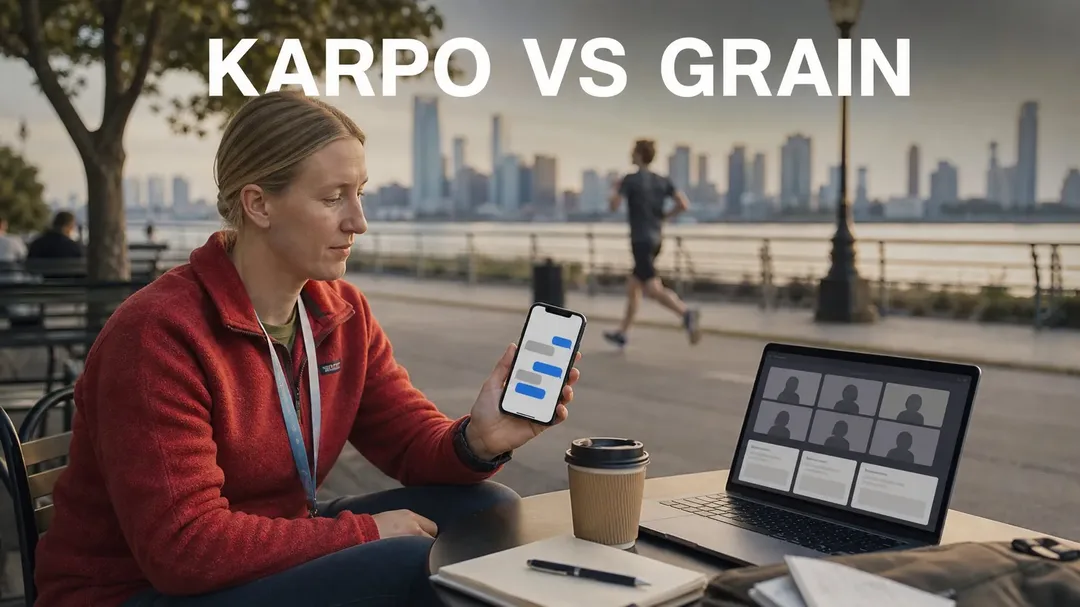
Karpo vs Grain: Two Jobs for a Short-Window City Test
Grain is built to capture and improve meetings, while Karpo is better suited to shaping a limited city window into a practical plan inside iMessage.
Verdict: Two Jobs for a Short-Window City Test
Karpo and Grain should not be treated as interchangeable AI tools. Grain’s official positioning is clear: it is an AI notetaker for growing teams, offering accurate meeting summaries, account insights, and coaching suggestions in an easy-to-use product. Karpo's role here is narrower and more situational: turning the context around Grain into workable city choices inside iMessage. It can help narrow choices, compare neighborhoods, coordinate context, and keep a group moving through decisions, but it cannot guarantee bookings, live hours, transit conditions, safety, weather, access, or outcomes. The honest boundary is simple: Grain works around meetings; Karpo works around city decisions.
Ask Karpo what fits your next three hours, who is coming with you, and what tradeoffs matter most. It can help you compare a relaxed route, a food-first plan, or a creator-friendly stop list, while reminding you to verify live details before you commit.
Imagine a creator landing in Chicago for one afternoon after a client call, a remote worker trying to use a gap between meetings in Lisbon, or three friends in Brooklyn debating whether to chase coffee, a gallery, dinner, or a sunset walk. The “short-window city test” is not about building the perfect itinerary. It is about deciding fast enough to enjoy the day. In that situation, Grain may preserve what was said in the meeting that created the window, while Karpo helps turn the available time, location, preferences, and group mood into a city plan.
Job A: Grain captures the meeting that explains the day
Grain’s strongest role starts before anyone steps into the street. For a growing team, the valuable moment may be the customer call, internal review, coaching conversation, sales discussion, or planning meeting that decides what happens next. Its official snapshot emphasizes accurate meeting summaries, account insights, and coaching suggestions. Those are meeting-native needs, not city-native needs, and they matter because busy teams rarely have the patience to reconstruct a conversation from memory.
This is where Grain wins clearly. If a founder, account manager, producer, or consultant needs a record of a call, a summary of key points, or insight that helps a team improve future conversations, Karpo is not the replacement. Karpo is not presented as a meeting recorder or account-insight system. It does not own the job of capturing what happened in a business conversation. For knowledge workers who spend their day inside calls, Grain sits closer to the actual source of truth.
Job B: Karpo helps decide what to do with the open city window
Karpo becomes more relevant after the meeting ends and the user asks a different question: “What should we do now?” A meeting assistant can summarize a call, but the next decision may involve distance, energy, appetite, budget comfort, weather concerns, time available, group preferences, and how much uncertainty people can tolerate. Karpo’s advantage is its iMessage setting and city-sidekick posture. It can live where a group is already negotiating and help turn scattered preferences into a smaller set of choices.
For the short-window city test, this matters. A traveler with four hours in Mexico City may not need a formal itinerary. A photographer in Montréal may need three visually interesting stops near transit. A pair of coworkers in Austin may want dinner that does not derail an early flight. Karpo can help frame options as tradeoffs: nearby versus memorable, quiet versus social, planned versus flexible. It should still encourage users to check official hours, reservations, transit alerts, and safety context, because city details change faster than any assistant can promise.
The handoff: from meeting memory to street-level choice
The cleanest comparison is not a duel; it is a handoff. Grain can help a team remember that the client loved a neighborhood reference, that a creator promised to scout a location, or that a group agreed to celebrate after a launch review. Karpo can then help translate that context into a city action: a shortlist of neighborhoods, a sequence of stops, or a message the group can react to. One tool preserves the why. The other helps with the where and what next.
This handoff is especially useful for urban adults whose calendars are chopped into small openings. A sales lead may finish a call in San Francisco and need a casual place to debrief with a colleague. A conference attendee in Berlin may have ninety minutes before a panel. A creator in Seoul may need to choose between filming a market, a riverside walk, or a café reset. Grain may make the work conversation easier to revisit; Karpo may make the city decision easier to act on.
Where Grain is the stronger default for teams
Grain has several real strengths that Karpo should not blur. First, it is built specifically around meetings, so its core promise is aligned with a recurring business workflow. Second, its official messaging points to accurate summaries, which are valuable when people miss details or join late. Third, account insights suggest usefulness beyond a single note, particularly for teams that manage relationships over time. Fourth, coaching suggestions can matter for people who want to improve how calls are handled, not merely remember them.
For growing teams, those advantages create a natural default. If the central pain is “Our meetings produce information we need to capture, share, and learn from,” Grain belongs on the shortlist. It may be especially relevant for customer-facing roles, team leads, managers, and operators who need better continuity across conversations. Readers should check Grain’s official site for current feature scope, supported platforms, access requirements, pricing, and any administrative or security details, because those specifics are not established by the supplied snapshot.
Where Karpo is more relevant for travelers, creators, and groups
Karpo is more relevant when the decision is not about a meeting artifact but about using a city day well. Urban time is messy. People are hungry at different moments, attention spans drop, a museum is farther than it looked, one friend wants a low-cost plan, and another wants a memorable view. Karpo can help compress that mess into a few workable options in a familiar messaging context. That makes it useful for travelers, local explorers, creators building a route, and groups trying to agree without a long planning session.
Its value is not that it knows everything live or can secure access. It is that it can ask better city questions and keep the discussion moving: How much time do you really have? Are you optimizing for food, photos, calm, novelty, or convenience? Is the group willing to cross town? Would one anchor stop plus a flexible backup beat a packed schedule? For a short-window city test, those questions are often more useful than a giant list of recommendations.

Access, pricing, and the practical verdict for a city day
The official Grain snapshot does not provide exact pricing, plan limits, integrations, regional availability, or certification details, so a fair comparison should not invent them. Anyone evaluating Grain for a team should visit its official site and confirm current plans, meeting-platform support, recording requirements, data controls, and administrative options. Karpo’s access and terms should also be checked through its official experience. The category difference remains more important than any unverified price claim: meeting intelligence and city planning are separate jobs.
The practical verdict is this: choose Grain when the most important thing is capturing, summarizing, and learning from meetings. Choose Karpo when the pressure is a live city choice, especially with limited time and multiple preferences in play. Use both if your day has both parts: a call that creates context and a city window that needs action. The honest default is not “one AI for everything.” It is “use the assistant whose center of gravity matches the job in front of you.”
This is an independent comparison of Karpo and Grain based on Grain’s official public positioning as an AI notetaker for growing teams, not an endorsement or partnership claim.
FAQ
Does Grain replace a city planner for a short trip?
No. Grain is positioned as an AI notetaker for growing teams, with meeting summaries, account insights, and coaching suggestions. It may preserve context from a planning call, but it is not presented as a city planner or local itinerary tool.
Does Karpo replace Grain’s core function?
No. Karpo is a proactive city sidekick in iMessage, not an AI meeting notetaker. It can help with city choices after a meeting, but it should not be treated as a substitute for Grain’s meeting summaries, account insights, or coaching-oriented workflow.
Can either Karpo or Grain guarantee live city details?
No. Karpo cannot guarantee bookings, hours, transit status, safety, weather, or access, and Grain’s official snapshot does not claim live city guarantees. Users should verify time-sensitive details with official venues, transit providers, maps, and local sources before acting.
Which tool is better for a creator with one afternoon in a city?
Karpo is more directly relevant if the creator needs to choose neighborhoods, route ideas, or a manageable set of stops. Grain may still be useful if the afternoon follows a recorded client or production meeting that needs to be summarized.
What should teams check before adopting Grain?
Teams should check Grain’s official site for current pricing, access requirements, supported meeting environments, administration, data handling, and security information. The supplied official snapshot confirms the broad value proposition, not the detailed commercial or technical terms.
Is there a privacy or safety issue with using AI for meetings and city plans?
Yes, the risk is different in each case. Meeting tools may involve sensitive business conversations, while city assistants may involve location, schedules, and personal preferences, so users should avoid sharing unnecessary sensitive information and review each product’s current privacy and safety practices.
Practical notes
Practical notes: For a short city window, start with constraints before asking any assistant for ideas. Share the time available, starting point, must-do obligation, mobility limits, group size, appetite, budget comfort, and whether the plan should be calm, social, scenic, or efficient. If a meeting produced the context, use Grain or another meeting system to preserve the decisions and action items. Then use Karpo to turn the open time into a few city options that people can react to quickly. Before leaving, confirm venue hours, reservation needs, transport timing, accessibility, weather, and neighborhood considerations through official or current local sources. A good assistant can reduce indecision, but it should not be the final authority on live conditions.
Tags: #Karpo #Grain #AIMeetingAssistant #AINotetaker #CityPlanning #UrbanTravel #ShortTrip #Creators #KnowledgeWorkers #GroupPlanning #iMessage #TravelPlanning #MeetingNotes #CityGuide
Sources consulted: Grain official website · Karpo official website · Karpo scenarios · Karpo head-to-head collection
All trademarks are the property of their respective owners.
Ask Karpo first
Ask Karpo to turn your next city opening into a focused choice: tell it where you are, how long you have, who is with you, and what kind of day would feel successful. It can help you weigh a quick neighborhood loop against a destination stop, suggest a backup-friendly plan, and draft a message your group can answer without another long debate.
Ask Karpo for more information.
Keep reading
- Karpo vs Copilot for After-Work Drinks With Coworkers in San Francisco 2026
 Karpo vs Yelp Assistant: Best Weekend Brunch Planner in Los Angeles 2026
 Karpo vs Alexa+: Which AI Helps Host Thanksgiving in Miami in 2026?