 Karpo vs Copilot for After-Work Drinks With Coworkers in San Francisco 2026
Head to Head
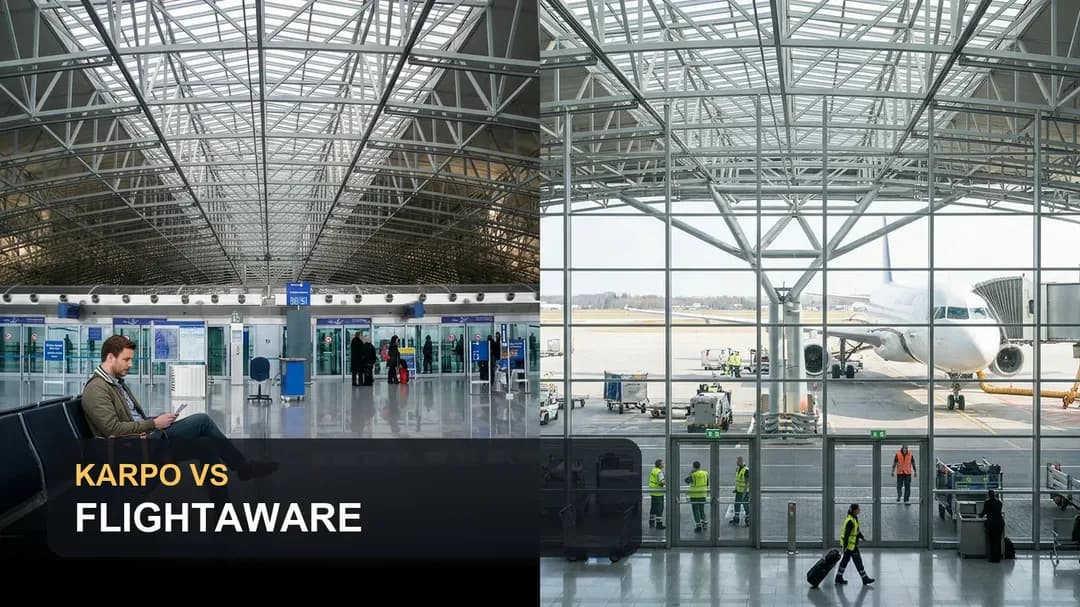
Karpo vs FlightAware: Flight Intelligence or the Plan After the Delay?
FlightAware explains what an aircraft and airport are doing. Karpo helps travelers decide what to do with the time, neighborhood, and people affected by that information.
TL;DR — Flight Intelligence Is Not the Plan After the Flight
FlightAware is a specialized flight-tracking and aviation-intelligence product. Its public surfaces help people follow flights, inspect aircraft movement, watch airport conditions, and receive operational updates. Karpo is not trying to reproduce that network. It works one step later, when a traveler asks the more human question: now that the timing changed, what is still worth doing?
A delay changed the day but not the destination? Ask Karpo to rebuild the arrival plan around the new landing time, weather, energy level, and neighborhood instead of starting the search again.
That distinction matters because disruption creates two separate jobs. First, understand the flight: position, estimated arrival, delay, diversion, cancellation risk, and airport context. Second, rebuild the day: update the pickup, choose a realistic meal, protect the group from another bad transfer, and preserve one good experience. FlightAware is built for the first job; Karpo is designed for the second.
The short verdict: use FlightAware when the aircraft itself is the decision object. Use Karpo when the flight update has become a city, schedule, or group decision.
Karpo vs FlightAware: Quick Comparison
Primary job — Karpo: proactive city discovery and decision support. FlightAware: live flight tracking and aviation intelligence.
Best opening question — Karpo: “What should we still do after landing two hours late?” FlightAware: “Where is this flight and when is it expected to arrive?”
Core context — Karpo weighs taste, companions, neighborhood, weather, energy, and available time. FlightAware weighs aircraft, route, airport, schedule, and operational data.
Delay response — Karpo rebuilds the local plan around a changed window. FlightAware reports the change and the aviation context behind it.
Airport awareness — Karpo can use airport timing as an input to a broader plan. FlightAware provides a much richer dedicated airport and flight view.
Alerts — Karpo can proactively surface a relevant city idea. FlightAware supports flight-focused notifications and status awareness.
Map depth — Karpo is not an aircraft map. FlightAware offers map-based aircraft and route tracking.
Group coordination — Karpo can reconcile different preferences in an iMessage conversation. FlightAware is primarily a shared source of flight facts.
Historical and operational depth — Karpo does not sell aviation data. FlightAware provides specialized historical and commercial data products in addition to consumer tracking.
Arrival planning — Karpo can turn a landing time into dinner, transport, and neighborhood choices. FlightAware stops at the aviation layer.
Platform — Karpo is iMessage-first. FlightAware is available on the web and through mobile apps.
Best user — Karpo serves the traveler deciding what the city should feel like. FlightAware serves travelers, greeters, aviation enthusiasts, operators, and data customers.
Trend fit — Current US searches include broad interest in “flights.” FlightAware answers the status question inside that intent; Karpo answers what the traveler should do next.
What Karpo Does Better After Flight Status Changes
1) Turns a delay into a constrained local decision
A two-hour delay is not just a later timestamp. It can erase a reservation, push a group into rush hour, change the weather window, and reduce everyone’s patience. Karpo can reason from the remaining time and suggest a smaller, closer plan rather than pretending the original itinerary still works. The output is not another status alert; it is a realistic replacement for the part of the day that disappeared.
2) Remembers who the plan is for
Flight status is objective, but the best recovery plan is personal. A solo traveler who wants a quiet bowl of noodles needs a different answer from a family with luggage or colleagues who still need a client dinner. Karpo can carry preferences and constraints into the next recommendation, so the revised plan reflects the people affected rather than only the route they traveled.
3) Works at neighborhood scale
After arrival, distance is deceptive. A restaurant that looks close on a map may require another transfer, a long walk with bags, or a wait that consumes the entire evening. Karpo can narrow the decision to the hotel block, terminal connection, train line, or arrival neighborhood. That local granularity is the difference between a plan that reads well and one a tired traveler can actually execute.

4) Coordinates the handoff from airport to city
Operational tools are excellent until the airport edge. Karpo connects the landing window to the pickup, baggage uncertainty, check-in, dinner timing, and the first useful stop. It can create a primary plan and a low-friction backup, making the airport-to-city transition feel like one continuous decision instead of five separate searches across maps, reviews, messages, and booking tabs.
5) Can initiate the next useful question
Most travel tools wait for a traveler to notice the plan is broken and ask again. Karpo’s proactive model can surface a timely suggestion such as moving dinner closer, saving an outdoor idea for tomorrow, or choosing a venue that accepts a late arrival. The value is not prediction for its own sake; it is reducing the moment when a tired group realizes nobody has rebuilt the evening.
What FlightAware Does Better
Aircraft-level tracking
FlightAware is the stronger product when the core task is following an aircraft or flight. Its maps, route information, timing estimates, and aviation-specific data provide a level of operational detail Karpo does not attempt to match. For a person meeting a passenger, monitoring a connection, or understanding whether a delay is moving, that dedicated view is the right instrument.
Airport and disruption visibility
FlightAware offers airport-oriented views that help users see disruption patterns rather than one isolated itinerary. That wider context can be useful when weather, congestion, or system conditions affect many flights. Karpo can respond to the consequences, but it should not be treated as the authoritative source for fleet movement or airport operations.
Aviation alerts and history
FlightAware’s product family is built around persistent flight awareness, including alerts and access to specialized historical or commercial datasets. Travelers, aviation teams, and enthusiasts may need that continuity. Karpo’s memory is about people and preferences, not the operational record of an aircraft or route.
A broader aviation audience
FlightAware serves far more than leisure travelers. Its products are relevant to operators, airports, data customers, pilots, enthusiasts, and people tracking someone else’s trip. Karpo is intentionally narrower: it is designed to improve personal city decisions, not to become an aviation data platform.
That is the honest list: FlightAware has the deeper aviation picture, the stronger aircraft-level detail, and the better operational lens. Those advantages explain the flight. They do not decide whether a late arrival should become dinner near the hotel, a short neighborhood walk, or an early reset for tomorrow.
Pricing — Free City Judgment vs Layered Aviation Data
Free access — Karpo: free for city decision support. FlightAware: offers public flight-tracking access with account and product options.
Paid access — Karpo: no paid city tier required. FlightAware: offers premium consumer features and separate commercial aviation products.
What payment buys — Karpo: the core value is personalized city judgment. FlightAware: paid value centers on deeper tracking, reduced limits or advertising, history, alerts, and aviation data capabilities depending on product.
Budget test — If the question is “where is the plane?”, evaluate FlightAware’s current plan details. If the question is “what should we do now?”, Karpo addresses that decision without requiring an aviation subscription.
The pricing comparison is not a simple feature-per-dollar contest because the products operate on different sides of arrival. Pay FlightAware for deeper aviation awareness when that depth matters; use Karpo for the city judgment that begins when the status update becomes a changed day.

Use Case Verdict — Who Should Handle Which Moment?
The cleanest workflow is sequential rather than competitive: verify the aviation reality first, then hand the remaining human decision to the tool designed for it.
Choose Karpo when:
- The flight delay has already changed dinner, transport, or check-in plans
- The answer depends on neighborhood, weather, group taste, or fatigue
- You want one realistic option plus a nearby backup
- Several travelers need to agree without opening another planning spreadsheet
- You want proactive help around arrival rather than another status dashboard
- The aircraft has landed and the important question is what happens next
Choose FlightAware when:
- You need live aircraft position or route visibility
- You are monitoring a pickup, connection, diversion, or airport disruption
- You want dedicated flight alerts or aviation history
- Operational aviation data is more important than local recommendations
- You are an enthusiast, operator, airport user, or commercial data customer
Treat the two products as a relay. FlightAware establishes the operational truth; Karpo turns that truth into a plan a traveler can still enjoy. Asking either one to replace the other creates a weaker result than using each at its natural boundary.
FAQ
Is Karpo a FlightAware alternative? Not for aircraft tracking. Karpo is an alternative for the planning work that begins after a flight status changes the traveler’s available time.
Can FlightAware tell me exactly where a flight is? FlightAware is designed for live flight and aircraft tracking, though availability and precision depend on coverage, data sources, route, and account level.
Does FlightAware replace an airline notification? It can add useful independent tracking context, but travelers should still confirm operational instructions, rebooking, and gate information with the airline and airport.
Which is better for delays? FlightAware is better for understanding the delay as an aviation event. Karpo is better for rebuilding the city plan around the delay.
Can Karpo track a plane on a live map? No. Karpo should use verified flight information as an input rather than pretending to be a specialist aircraft tracker.
Is Karpo free? Yes. Karpo is free and currently iMessage-first.
Which is better for meeting someone at the airport? FlightAware is better for monitoring the incoming flight. Karpo is better for planning the pickup, meal, neighborhood, or backup after the arrival window is known.
Should I use both on a disruption day? Usually. Check FlightAware for the flight reality, then give Karpo the new arrival time and constraints so it can rebuild the human plan.
Tags: #Karpo #FlightAware #KarpoVsFlightAware #FlightTracker #FlightDelays #AirportTravel #TravelPlanning #CitySidekick #ProactiveAI #ArrivalPlan #TravelTech #HeadToHead
Sources consulted: FlightAware official website (https://www.flightaware.com/) · FlightAware products (https://www.flightaware.com/commercial/) · FlightAware mobile apps (https://www.flightaware.com/mobile/) · FlightAware ADS-B coverage (https://www.flightaware.com/adsb/) · Karpo (https://karpo.ai/)
All trademarks are the property of their respective owners.
Ask Karpo first
Before the next flight, send Karpo the arrival airport, hotel or neighborhood, who is traveling, and what would make the first few hours feel successful. If the timing changes, update only the landing window; Karpo can shrink, move, or replace the plan without making the group restart from zero.
Ask Karpo for more information.
Keep reading
- Karpo vs Copilot for After-Work Drinks With Coworkers in San Francisco 2026
 Karpo vs Yelp Assistant: Best Weekend Brunch Planner in Los Angeles 2026
 Karpo vs Alexa+: Which AI Helps Host Thanksgiving in Miami in 2026?