 Karpo vs Copilot for After-Work Drinks With Coworkers in San Francisco 2026
Head to Head
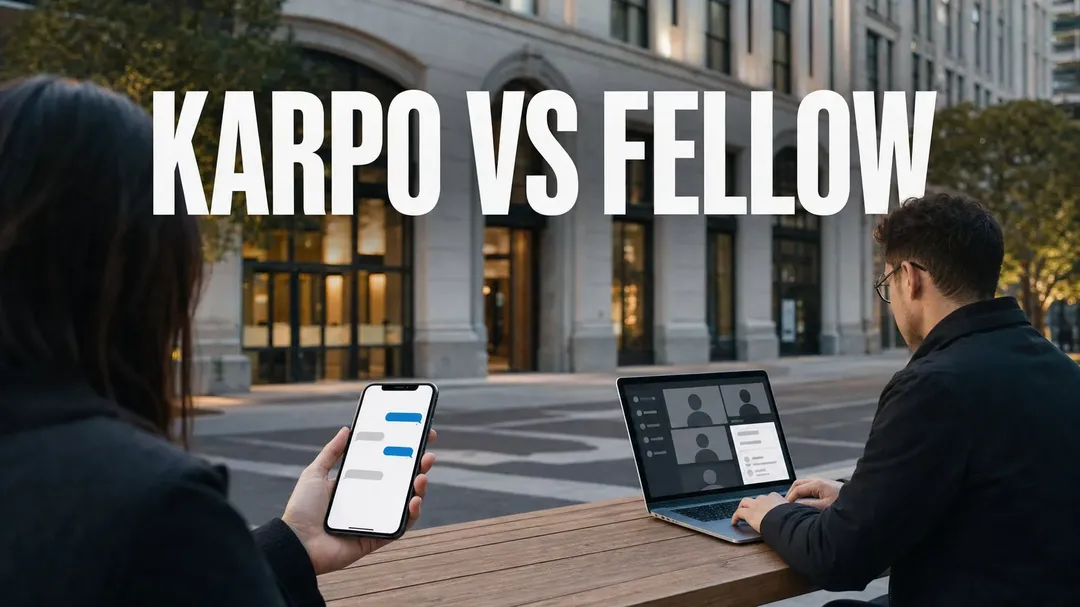
Karpo vs Fellow: Field Notes on the Handoff After the Workshop
Fellow helps teams remember what happened in the room; Karpo helps people use selected context when the next decision happens out in the city.
Verdict: Field Notes on the Handoff After the Workshop
The most useful way to compare Karpo and Fellow is to follow a team after the formal work is over. Imagine a group leaving a half-day workshop in a city they do not fully know. Fellow has a clear role during and around the session: its official positioning describes an AI meeting assistant and notetaker that can take meeting notes, transcribe, summarize, and gather insights. That is meeting memory. Karpo serves a different moment. It is an iMessage-based city sidekick for contextual, time-bound decisions, useful when people need to narrow urban choices and keep a group aligned in plain language.
Ask Karpo at the moment the workshop notes become a local choice. Send the usable constraints from the group chat, such as “four people, 90 minutes before the train, near the waterfront, one person avoiding stairs, quiet enough to talk,” then treat the response as decision support to verify against current venue, route, safety, and access information.
This distinction matters because the hard part often begins after the notes are produced. The workshop may have created fixed commitments: a client dinner, a location scout, a team debrief, a free afternoon, or a promise to meet somewhere walkable before a train. Fellow can help preserve what was said and what was assigned. Karpo becomes relevant when those commitments have to become local decisions inside a real city, with preferences, fatigue, weather, access needs, timing, and uncertainty in play. Karpo can support the decision, but it does not guarantee bookings, live hours, transit reliability, safety, weather, medical advice, financial outcomes, or access.
Field note 1: the fixed commitments come first
A traveling team rarely leaves a workshop with a blank slate. There are commitments already set by the day: the facilitator needs to send a recap, two people must catch evening trains, the client wants an informal follow-up, and the producer promised to scout one nearby street before dark. These are not vague lifestyle preferences; they are constraints. Fellow is well suited to capturing the source of those commitments because its official AI meeting assistant positioning centers on notes, transcription, summaries, and insights. If the team needs to know who agreed to what, Fellow belongs close to the meeting.
Karpo enters after the group decides that a commitment needs a city-shaped answer. A note that says “find a calmer place for the debrief” still leaves open where, how far, what mood, and whether the group can realistically get there. Inside iMessage, Karpo can help turn the fixed facts into a smaller decision: stay near the venue, move toward the station, prioritize a quiet table, avoid a long walk, or split the plan into two stops. It should not be treated as a reservation system or an authority on changing real-time conditions. Its value is in structuring the choice before the group verifies the details.
Field note 2: meeting memory is a product job, not a side benefit
Fellow deserves credit where the job is meeting memory. Workshops, client calls, sprint reviews, editorial meetings, and planning sessions produce details that are easy to lose: decisions, objections, next steps, timelines, owners, and unresolved questions. A dedicated AI meeting assistant and notetaker is built for that environment. Based on its official page, Fellow can take meeting notes, transcribe, summarize, and gather insights. For teams that live in recurring calls, that record can reduce confusion and make follow-up less dependent on one person’s memory.
Karpo should not be stretched into that role. It is not a dedicated AI notetaker, transcript engine, or meeting archive. If a team needs a structured record of a workshop, a clean summary for absent stakeholders, or continuity across recurring business conversations, Fellow is the more direct product to evaluate. The practical test is the deliverable. If the deliverable is a meeting artifact, use a meeting tool. If the deliverable is a city decision after the artifact exists, Karpo may be useful for the next stage.

Field note 3: the handoff into local decisions is where plans get fragile
The transition from “we agreed on this” to “we are doing this now” is usually where a tidy summary stops being enough. A meeting recap might say that the team will hold a debrief near the conference center, but it may not account for the group’s energy after standing all day, the person with a mobility constraint, the collaborator who needs vegetarian options nearby, or the fact that everyone is messaging while walking. Meeting output can be accurate and still incomplete for street-level action.
Karpo is designed for this handoff because it works with conversational context in iMessage. A user can bring the relevant fragments forward: time window, neighborhood, mood, group size, noise preference, food constraints, transit deadline, or whether the team wants to keep talking or simply decompress. Karpo can help compare tradeoffs without asking the group to reopen the entire meeting. Still, the city is not a static document. Users should check opening hours, reservation availability, route conditions, local rules, weather, accessibility, and safety through current or official sources before acting.
Field note 4: what breaks when Fellow is asked to be Karpo
Fellow’s strength is not the same as a live local coordination layer. If a team asks a meeting assistant to solve the whole afternoon, the result may look organized while leaving the hardest judgments untouched. A transcript can preserve that someone suggested “somewhere relaxed near the museum,” and a summary can turn that into an action item. But the group still needs to decide what relaxed means, how much walking is acceptable, whether the route is sensible, and whether the choice fits the people present.
That does not make Fellow weak; it means its center of gravity is different. It is valuable for accountability, continuity, and reducing meeting follow-up friction. It can help a manager, consultant, producer, or project lead avoid losing the thread of a conversation. But when the team is outside the venue, checking the clock, and trying to decide between staying nearby or moving toward dinner, Fellow’s meeting artifact is only one input. The city decision still needs a tool or process built around context, tradeoffs, and group coordination.
Field note 5: what breaks when Karpo is asked to be Fellow
The opposite mistake is just as important. A city sidekick is not a substitute for a dedicated meeting assistant. If a workshop includes contractual decisions, client feedback, project assignments, or sensitive internal discussion, the team should not rely on informal city-planning messages as its system of record. Karpo can help interpret selected context for a next move, but it is not positioned as the place to capture full transcripts, produce formal meeting summaries, or manage recurring meeting knowledge.
This boundary protects the user as much as the product. A team that needs documentation should evaluate Fellow’s official workflow, confirm current capabilities, and review the details that matter to the organization, including supported environments, privacy terms, administrative controls, consent expectations, and any account-level options. A group using Karpo should be equally thoughtful about what it shares in messages. Avoid unnecessary sensitive personal information, especially around health, finances, identity documents, private addresses, or safety-critical details. Use the minimum context needed to make the city choice.

Field note 6: access, adoption, and the practical split
Access and pricing should be checked at the source rather than assumed. The verified Fellow snapshot says “Start for free,” but exact plan details, limits, paid tiers, supported meeting environments, and account features are not established here. The real cost of a meeting assistant can include more than a price page: setup habits, calendar behavior, participant comfort, permissions, and whether the organization has rules about recording, transcription, or AI processing of meeting content. Those questions matter because Fellow touches the meeting itself.
Karpo’s adoption pattern is different because it lives in iMessage as a city sidekick. The commitment is less about adding meeting infrastructure and more about whether the group wants help where coordination already happens. A realistic split for the traveling team is straightforward: use Fellow for the workshop record, then bring only the relevant constraints into Karpo when the day turns into a local decision. One product helps preserve the conversation; the other helps make the next urban move more manageable. Neither should be asked to perform the other’s core job.
This is an independent comparison of Karpo and Fellow based on Fellow’s official AI meeting assistant positioning and Karpo’s role as a proactive city sidekick in iMessage.
FAQ
When does Fellow make the most sense in a post-workshop workflow?
Fellow makes the most sense when the important task is preserving and organizing the meeting itself. Its official positioning is as an AI meeting assistant and notetaker that can take meeting notes, transcribe, summarize, and gather insights. If the team needs a record of decisions, owners, follow-ups, or recurring discussion history, Fellow is the product to evaluate first.
When does Karpo become useful after the meeting ends?
Karpo becomes useful when the team has enough context to act but still needs to make a city decision. That might mean choosing a debrief location, finding a practical neighborhood for dinner, planning a short scouting route, or balancing group preferences before a train. It helps narrow choices in iMessage, but users should verify live details before relying on any suggestion.
Can Karpo create meeting transcripts or replace Fellow’s notes?
No. Karpo is not a dedicated AI meeting assistant, transcript tool, or formal meeting record system. If the primary need is meeting notes, summaries, transcription, or meeting insights, Fellow is the more relevant product based on its official positioning.
Can Fellow act as a live local guide for city plans?
Fellow should not be treated as a city planner, booking service, or live local guide. It may help capture a discussion in which people agree to make a city plan, but that does not mean it resolves the changing local details involved in routes, venues, timing, access, or group preferences.
What should users verify before acting on a city suggestion?
Users should independently confirm time-sensitive and safety-relevant details, including opening hours, reservation availability, route conditions, transit reliability, accessibility, weather, local rules, and safety considerations. Karpo can support decision-making, but it does not guarantee bookings, live hours, transit, safety, weather, medical advice, financial outcomes, or access.
What privacy and consent questions matter in this comparison?
For Fellow, teams should ask what meeting content is captured, how notes or transcripts are handled, whether participants need notice or consent, and what account controls are available. For Karpo, users should avoid sharing unnecessary sensitive personal details in city-planning messages and should keep safety-critical decisions grounded in current, official information and human judgment.
Practical notes
Practical notes from the field: start by identifying the job at hand. If your team is still inside the workshop, client call, planning session, or recurring meeting, prioritize meeting memory. Fellow is built around that category, and users should review its official site for current capabilities, plan details, supported environments, privacy terms, and administrative controls. If the meeting has ended and the question is now local—where to debrief, how to fill two hours, whether to stay near the venue, or how to balance a group’s constraints—Karpo can help narrow the decision inside iMessage. Do not treat a meeting summary as a finished city plan, and do not treat a city suggestion as a verified live fact. Confirm opening hours, bookings, accessibility, route conditions, weather, transit, local rules, and safety with current or official sources. For work teams, consider participant comfort and consent when using any meeting assistant. For travelers, creators, and friend groups, share only the context needed for the decision and keep a backup plan when timing, mobility, or safety matters.
Tags: #Karpo #FellowAI #AIMeetingAssistant #MeetingNotes #MeetingSummaries #CityDecisions #PostWorkshopPlanning #TravelTeams #GroupCoordination #UrbanPlanning #iMessage #ProductivityTools #AIComparison #RealWorldHandoffs
Sources consulted: Fellow official website · Karpo official website · Karpo scenarios · Karpo head-to-head collection
All trademarks are the property of their respective owners.
Ask Karpo first
Ask Karpo after the recap has done its job and the group still has to choose what happens next in the city. Bring over only the practical pieces: neighborhood, time window, group size, energy level, walking tolerance, food preferences, noise preference, mobility considerations, weather concern, and any hard deadline. Use Karpo to make the decision smaller, then check the current facts before you go. It is most useful as a conversational handoff from meeting memory to local action, not as a guarantee that a venue, route, reservation, or condition will work exactly as hoped.
Ask Karpo for more information.
Keep reading
- Karpo vs Copilot for After-Work Drinks With Coworkers in San Francisco 2026
 Karpo vs Yelp Assistant: Best Weekend Brunch Planner in Los Angeles 2026
 Karpo vs Alexa+: Which AI Helps Host Thanksgiving in Miami in 2026?