 Karpo vs Copilot for After-Work Drinks With Coworkers in San Francisco 2026
Head to Head
Karpo vs Consensus: From Research Answer to City-Day Handoff
Consensus is built for academic-search style answers, while Karpo is built to help people turn city context into practical next moves inside iMessage.
Verdict: From Research Answer to City-Day Handoff
Consensus and Karpo do not solve the same core problem. Consensus belongs to the AI academic search category, so its natural home is the moment when someone wants to explore research-grounded information rather than rely on a casual web answer. Karpo is a proactive city sidekick in iMessage, so its useful territory is narrower and more physical: helping people coordinate context, narrow city choices, and move from intention to action. That boundary matters. Karpo is not a replacement for an academic-search tool, and Consensus should not be treated as a city concierge unless its official site says so for a specific feature.
Ask Karpo to turn your city-day constraints into a short set of options you can discuss in iMessage: neighborhood, time window, group size, mood, budget comfort, and what you want to avoid. Karpo can help organize the decision, but you should still confirm live hours, availability, transit conditions, weather, and any access requirements before committing.
Picture a Saturday in Chicago with three friends, one visitor, one local creator filming a neighborhood guide, and one knowledge worker who wants a low-friction day after a conference. Someone may start with a research question: Is walking after a long flight helpful? Are museum visits linked with better mood? Which public-space design ideas support social connection? Consensus is the more relevant place for academic search. But once the group is standing near the hotel, deciding between a gallery, a river walk, coffee, food, and a backup plan if energy drops, the task changes. The question is no longer just “what does research suggest?” It becomes “what should we do next, and how do we coordinate it without turning the group chat into a planning meeting?”
Before the day begins: evidence search versus city intent
The strongest case for Consensus appears before the itinerary gets practical. If your first need is to examine academic literature, compare study-backed claims, or look for research around a topic, an AI academic search product is a better conceptual fit than a city sidekick. For creators, analysts, students, and curious professionals, that can be valuable because the starting point is not a restaurant, venue, or route. The starting point is a claim that needs better grounding.
Karpo enters when the intent is already moving toward a place-based choice. Instead of asking Karpo to replace research review, you might bring the takeaway into iMessage and ask, “Given that we want a calmer afternoon and a walkable plan, what are three neighborhoods that fit?” That handoff is the central contrast. Consensus helps with digital knowledge discovery in an academic-search frame; Karpo helps translate personal context into city options that real people can react to.
During research: where Consensus has the cleaner job
Consensus wins when the job is clearly academic search. Its category gives it a direct purpose: helping users look for information across research-oriented material. That makes it especially relevant for a creator drafting an evidence-aware script, a knowledge worker preparing a presentation, a traveler curious about jet lag or urban walking, or a group member who wants to bring more than vibes into the planning conversation. When the desired output is a research-informed answer, Consensus has the cleaner lane.
There are also practical strengths in that focus. A dedicated academic-search experience can reduce the scatter of ordinary web browsing, encourage more disciplined questions, and keep the user anchored in a research mindset. It may help separate “I heard this online” from “this appears in academic discussion,” although readers should still evaluate details on the official site and within the source material itself. Karpo should not be stretched into that role. It can help you use conclusions in a city context, but it is not the tool to depend on for academic search as its core function.

The handoff moment: when a digital answer meets sidewalks, schedules, and people
The real-world handoff is where many planning sessions break down. A person gets a useful answer from an academic-search tool, then the group still has to choose a neighborhood, find a realistic sequence, handle different energy levels, and keep everyone informed. A digital output can say that social connection, movement, or exposure to public spaces may be worth considering, but it will not automatically resolve whether your group should go to a waterfront path now, hold dinner for later, or pick a museum because one person has bad shoes.
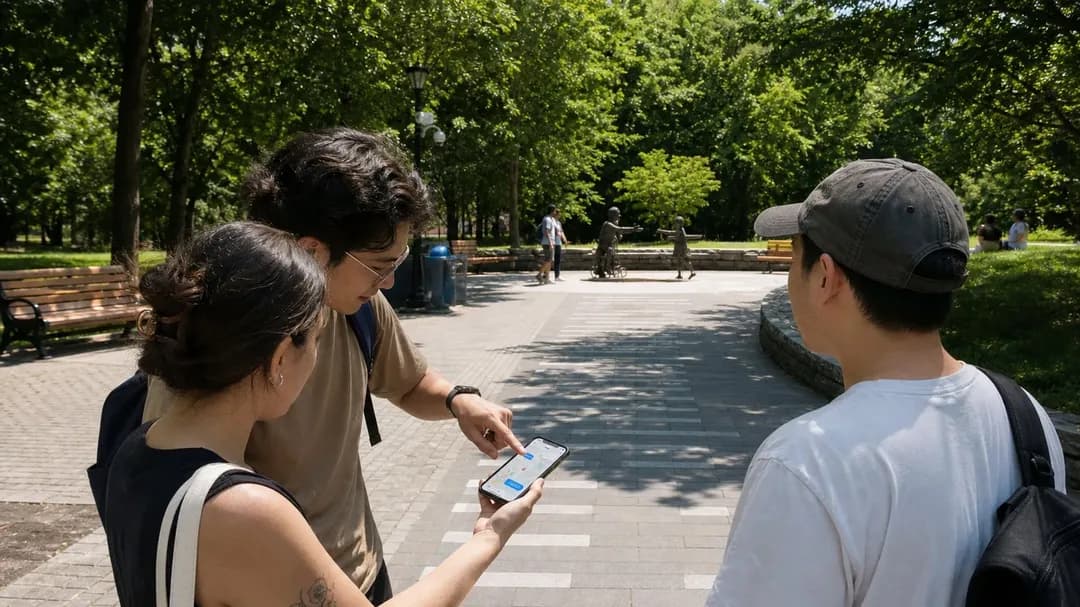
Karpo is more relevant at that messy point because it lives closer to the conversation. In iMessage, the planning unit is not an abstract query; it is a thread with preferences, hesitations, screenshots, time pressure, and a few people who may not want another app. Karpo can help narrow choices and coordinate context in plain language. It cannot guarantee bookings, hours, transit, safety, weather, or access, but it can reduce the friction between “interesting idea” and “here are two realistic plans we can vote on.”
After the choice: follow-through, reminders, and limits in the city
After the group picks a plan, the difference becomes even clearer. Consensus-style research is mostly upstream of action. It can inform why a plan might be worthwhile, but once people are moving through a city, the useful layer is coordination: where to meet, what the backup is, who needs a quieter option, and what to check before leaving. That does not make academic search less valuable; it means its output needs another layer before it becomes a day that works for a mixed group.
Karpo’s advantage is not omniscience. It is contextual continuity. A visitor in Boston might ask for a plan that avoids steep walks, a creator in Los Angeles might need photogenic but not overrun locations, and a remote worker in Amsterdam might want a two-hour reset between calls. Karpo can help shape those constraints into options and next steps. Still, users should confirm live details with official venue, transit, weather, and booking sources. City life changes quickly, and no planning assistant should be treated as a guarantee.
Access and pricing: check the official pages before deciding
The supplied official snapshot for Consensus does not include plan names, prices, availability terms, integrations, or security certifications. Because of that, a careful comparison should not invent them. If Consensus is on your shortlist, check its official website for current access, supported regions if relevant, account requirements, paid features, and any usage limits. The same caution applies whenever an AI product changes plans or packaging over time.
Karpo’s access pattern is different in spirit because it is designed around iMessage use, but users should still verify the current experience, availability, and any account or device requirements directly. For decision-making, avoid reducing the comparison to price alone. Ask what you are buying time back from. Consensus may save time in literature-oriented discovery. Karpo may save time in group coordination and city-choice narrowing. Those are different kinds of time, and the better value depends on whether your bottleneck is knowledge or action.
Practical verdict: pair them, separate them, or choose one
Choose Consensus first when the question is evidence-facing: “What does research say?” “Which studies discuss this topic?” “How should I understand an academic claim before using it?” It is the stronger fit for students, creators, researchers, and professionals who need an academic-search starting point. In a city-day scenario, it can be the tool you use the night before to shape a theme, test a claim, or avoid planning around a weak assumption.
Choose Karpo when the question is situational: “What should we do with the next four hours?” “How do we make this neighborhood plan work for a mixed group?” “What is a reasonable backup if the first idea fails?” For many urban adults and travelers, the best workflow is not either-or. Use Consensus to sharpen the research-backed idea, then bring the practical constraints to Karpo. The key is to respect the handoff: academic search produces insight, while city planning requires context, tradeoffs, and confirmation in the real world.
This is an independent comparison based on the supplied Consensus category and official-page snapshot, not a claim of endorsement, partnership, or verified feature parity with Consensus.
FAQ
Does Consensus replace a city planner for a real day out?
No. Consensus is best understood from the supplied information as an AI academic search product, not a city-planning service. It may help with research-oriented questions, but a real city day still needs live checks for hours, tickets, routes, weather, access, and group preferences.
Does Karpo replace Consensus’s core academic-search function?
No. Karpo is a proactive city sidekick in iMessage, not a dedicated academic-search product. It can help you apply an idea to a city plan, but users should rely on an appropriate research tool like Consensus for academic-search needs and verify source material themselves.
Can either Karpo or Consensus guarantee live city details?
No. Karpo cannot guarantee bookings, business hours, transit conditions, safety, weather, medical advice, financial outcomes, or access. Consensus should also not be assumed to guarantee live city details unless its official site states a specific current feature, and even then users should confirm with primary sources.
When is Karpo more useful than Consensus?
Karpo is more useful when the problem is coordination in a city: choosing among neighborhoods, shaping a short plan, adapting to group constraints, or turning a loose idea into next steps. It is especially relevant once people are already in a chat and need a decision they can act on.
When is Consensus more useful than Karpo?
Consensus is more useful when the question is about academic research rather than logistics. If you are preparing a creator script, checking a claim, exploring a topic for work, or trying to understand research discussions before planning, Consensus has the more appropriate category fit.
Which privacy and safety boundaries should someone review before using Consensus with Karpo?
Do not share sensitive personal, medical, financial, or location details with any AI tool unless you understand how the service handles that information. For city plans, keep safety decisions grounded in current local conditions, official sources, and personal judgment rather than relying solely on an AI-generated suggestion.
Practical notes
A sensible handoff starts with the question type. If you need to understand research, start with an academic-search tool and read carefully before drawing conclusions. If you need to decide what to do in a city, bring only the useful takeaway into the planning conversation: time available, neighborhood, mobility needs, budget comfort, energy level, weather tolerance, and must-avoid constraints. Karpo can help compress that context into options your group can compare. Before leaving, confirm the fragile details yourself: opening hours, reservations, transit disruptions, accessibility, neighborhood conditions, and cancellation rules. Treat AI output as planning support, not permission to skip judgment.
Tags: #Karpo #Consensus #AIAcademicSearch #CityPlanning #IMessageAssistant #UrbanLife #KnowledgeWorkers #Creators #TravelPlanning #GroupPlanning #ResearchToAction #CityGuide #PracticalAI #DecisionSupport
Sources consulted: Consensus official website · Karpo official website · Karpo scenarios · Karpo head-to-head collection
All trademarks are the property of their respective owners.
Ask Karpo first
Ask Karpo for a realistic city-day handoff: paste the research takeaway you want to act on, add your group’s constraints, and request two or three plans with tradeoffs, fallback ideas, and the live details you still need to verify before you go.
Ask Karpo for more information.
Keep reading
- Karpo vs Copilot for After-Work Drinks With Coworkers in San Francisco 2026
 Karpo vs Yelp Assistant: Best Weekend Brunch Planner in Los Angeles 2026
 Karpo vs Alexa+: Which AI Helps Host Thanksgiving in Miami in 2026?