 Karpo vs Copilot for After-Work Drinks With Coworkers in San Francisco 2026
Head to Head
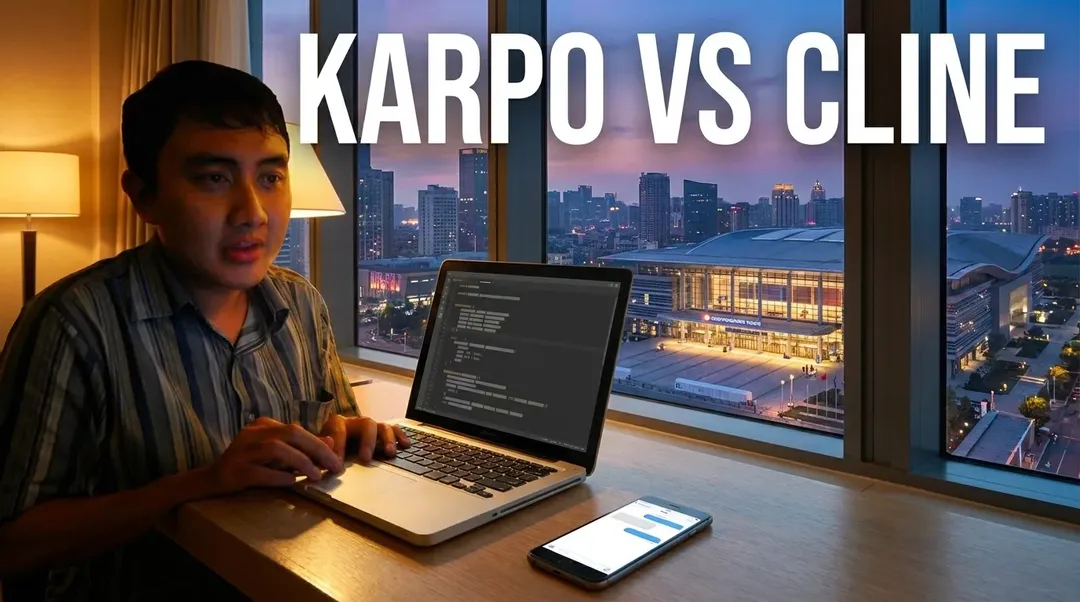
Karpo vs Cline: When a Coding Agent Leaves the Terminal
Cline helps developers plan and execute software work in their coding environment; Karpo helps the same people make practical decisions once the problem moves into a real city.
Start with the boundary, not the benchmark
Cline and Karpo can both be described as AI agents, but that label hides the most useful distinction. Cline is an open coding agent built to work where software is made: the IDE, terminal, CLI, and embedded developer surfaces. Karpo works where a person’s day becomes physical: neighborhoods, time windows, group preferences, transit choices, food, events, and backup plans. Cline can inspect a project and help execute technical steps. Karpo can inspect the context of a city day and help narrow what the human should do next. The right comparison is not which agent is smarter; it is which environment contains the decision.
Give Karpo the public venue, available window, group size, dietary or mobility constraints, and the next fixed commitment. It can help turn a developer meetup gap into a plan that the group can actually follow.
Scenario one: the bug is fixed, the evening is not
A developer lands in London for a conference and spends the afternoon repairing a demo. Cline belongs in the first half of that story. Its official product positioning emphasizes an open coding agent that can operate through the editor and terminal, use models and tools selected by the user, and extend workflows through integrations such as MCP. The developer can ask it to understand a codebase, propose changes, run commands, and iterate with review.
At 6:10, the demo passes. Four teammates now have ninety minutes before a community event across town. One person is vegetarian, another wants somewhere quiet enough to debrief, and nobody wants a complicated transfer with laptops. The repository contains none of those facts. Karpo belongs in this half of the story because the objective has changed from “make the software work” to “make the group’s remaining city time work.”

What Cline can own inside the development loop
Cline’s advantage is operational proximity to code. A general chat assistant can suggest a function, but an agent in the development environment can inspect surrounding files, understand project structure, propose a multi-step plan, edit code, invoke tools, and observe the results. The user still needs to review changes, permissions, commands, secrets, licenses, tests, and deployment impact. Agentic convenience is not a reason to surrender engineering judgment.
Its open positioning also matters to technical teams that care about model choice and workflow control. Cline’s official site highlights IDE, CLI, and SDK surfaces and an ecosystem around MCP. That can support a range of use cases—from repository work to repeatable internal tooling—without requiring developers to treat one hosted interface as the entire product. Exact supported models, provider costs, enterprise features, and usage behavior can change, so teams should verify current documentation before standardizing.
For an individual developer, Cline is most valuable when the task has enough context and execution steps that copying fragments into a generic chat becomes inefficient. For a team, the evaluation should include security review, data boundaries, approval controls, reproducibility, code quality, and the total cost of model usage—not only how quickly the first patch appears.
What Karpo can own outside the development loop
Developer travel creates oddly specific planning problems. The group may be near a convention center, carrying hardware, splitting after dinner, and working around a keynote, a customer meeting, or a train. Generic maps can reveal nearby venues, but they do not naturally rank the trade-offs around energy, noise, conversation, route simplicity, and the next commitment.
Karpo can help convert those constraints into a short decision set. A useful request might say: “Five developers near Moscone Center, two hours before a 9 p.m. event, one vegan, backpacks and one demo kit, quiet enough to talk, no reservation if possible, and keep us within a simple ride of the venue.” The important feature is not a huge list. It is a plan with fewer moving parts and an explicit fallback.

Scenario two: planning a developer field day
Suppose a team wants to combine a morning architecture session, a hardware store stop, lunch, and an evening meetup. Cline can help build the internal tool that gathers RSVPs or formats the schedule. It can help debug the map integration in that tool. But it should not be asked to impersonate current local knowledge it does not have. Karpo can help arrange the real-world sequence, while official venue pages, transit operators, weather services, and reservation providers remain the sources to confirm.
This separation prevents a common agent mistake: treating every problem as text that can be solved in the same interface. Software agents reason over repositories and tool outputs. City decisions involve people, changing conditions, personal taste, public rules, and consequences that may not appear in a neat API response. The best workflow uses the coding agent to construct or repair the digital system and the city sidekick to reduce friction in the lived schedule around it.
Cost and access are not directly comparable
Cline’s cost depends partly on how it is configured, including the models and providers a developer uses, plus any team or enterprise arrangements. Karpo should be judged as a local decision service rather than a development platform. Comparing one subscription line to another without considering the task is misleading. The more useful calculation is the recurring waste removed: engineering time lost to fragmented context on one side, and group time lost to poor city decisions on the other.
Decision guide
Choose Cline when the next artifact is code, a command, a test result, a repository change, or an automated developer workflow. Choose Karpo when the next artifact is a meetable plan: where the group goes, how the stops fit, what works for the people involved, and what to do if the first option breaks. A developer on a work trip may need both within the same hour, but never for the same task.
FAQ
Is Cline a travel or city-planning agent?
No. Cline is positioned as an open coding agent for developer environments. It can help build travel software, but that is different from providing a current, personalized local plan.
Can Karpo read and modify a repository?
No. Karpo is not a coding agent or IDE extension. Use Cline or another dedicated developer tool for repository work and command execution.
Does Cline support the terminal and CLI?
Cline’s official site currently presents IDE, CLI, SDK, terminal, and embedded surfaces. Verify current installation options and platform requirements in the official documentation.
Which product is better for conference logistics?
Karpo is the relevant choice for meals, neighborhoods, flexible time, route simplicity, and local backups. Cline is relevant if the conference work itself includes software development.
Should an agent be allowed to run every command automatically?
No. Developers should apply least privilege, review proposed actions, protect secrets, inspect diffs, run tests, and follow organizational security and deployment policies.
Can Karpo guarantee a venue will have space?
No. Confirm hours, reservations, event access, capacity, transit, pricing, and accessibility with official providers.
How can a team use both safely?
Keep code and technical secrets in approved developer workflows. Give Karpo only the public location and personal constraints needed for the city plan. Do not paste private customer, employee, or itinerary data into either tool without authorization.
A better evaluation exercise
Give Cline a contained repository task with tests, permissions, and a clear review standard. Measure accepted changes, correction time, model cost, and security friction. Give Karpo a real two-hour group window with conflicting preferences. Measure whether the proposed sequence is coherent, verifiable, and easier to execute than the team’s usual chat thread. The products should win on different scorecards.
Cline is a trademark of its respective owner. This independent editorial comparison is not affiliated with, endorsed by, or sponsored by Cline.
Tags: #Karpo #Cline #CodingAgent #DeveloperTools #AIAgent #CityPlanning #ConferenceTravel #TeamMeetup #OpenSourceAI #TravelTech #ProactiveAI #AIComparison
Sources consulted: Cline official website · Cline documentation · Cline GitHub organization · Karpo official website · Karpo scenarios
All trademarks are the property of their respective owners.
Ask Karpo first
Ask Karpo first after the build passes and the group still needs a plan. Share the public conference area, usable time, people constraints, desired atmosphere, equipment burden, and next hard deadline to get a local sequence with fewer failure points.
Ask Karpo for more information.
Keep reading
- Karpo vs Copilot for After-Work Drinks With Coworkers in San Francisco 2026
 Karpo vs Yelp Assistant: Best Weekend Brunch Planner in Los Angeles 2026
 Karpo vs Alexa+: Which AI Helps Host Thanksgiving in Miami in 2026?