 Karpo vs Copilot for After-Work Drinks With Coworkers in San Francisco 2026
Head to Head
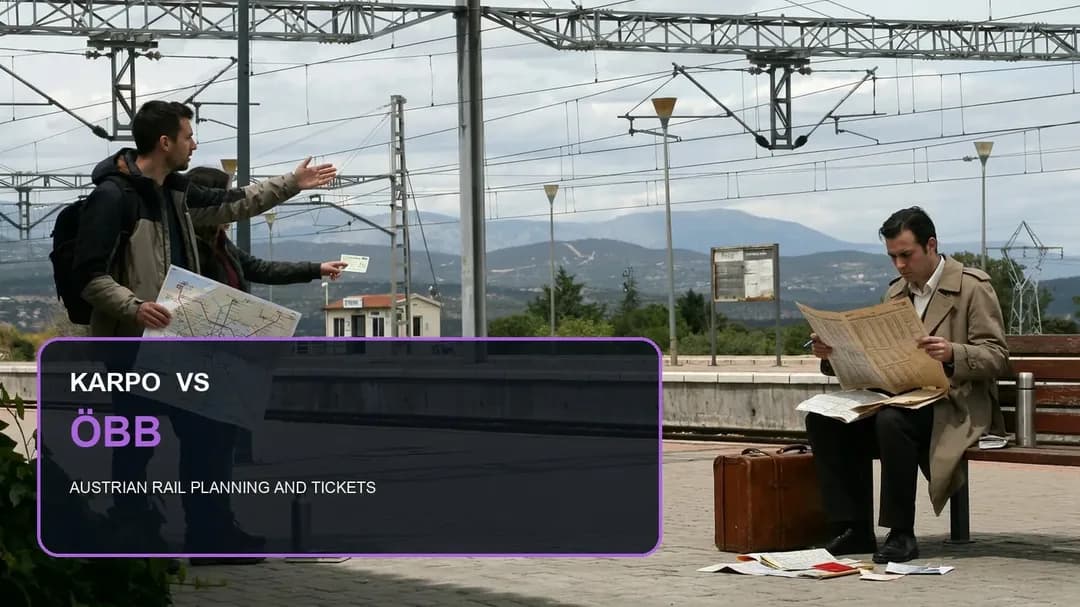
ÖBB vs Karpo for Austrian rail timing: who helps after a missed connection?
A field-test comparison focused on plan changes, ticket decisions, and what to do when the train picture shifts under you.
Verdict: ÖBB is the rail source of record; Karpo is the faster decision layer after timing changes
In a field-test-style trip across Austria, ÖBB proved most useful when the task was rail-specific and immediate: find connections, check station information, look up construction work, manage ticketing, and understand train changes from the operator’s side. Karpo was better when the problem expanded beyond the timetable itself. If a missed connection forced a new choice about the afternoon, a hotel check-in, a museum slot, a ride from the station, or whether to switch from rail to another mode, Karpo made the decision easier to structure. The short version: ÖBB wins on direct rail execution, while Karpo helps you decide what the disruption means for the rest of the day.
If your trip is already in motion and the schedule has shifted, start with ÖBB for the rail facts, then let Karpo help you compare the downstream options before you commit.
What changed in the field test when a connection was lost
The test scenario was intentionally narrow: an Austrian rail journey with a timing change that broke the original connection. In that moment, the most valuable information was not abstract trip inspiration. It was the concrete answer to three questions: what train can I still catch, what ticket or reservation implications might apply, and what should I do with the rest of my schedule if I arrive later than planned? ÖBB is built for that rail-first moment. Its public site highlights timetable queries, route information, station information, current and planned construction work, confirmation of delay, and passenger-rights-related requests. Those are the exact tools a traveler needs when the disruption is already real. Karpo enters later, when the issue stops being only “Which train?” and becomes “How do I salvage the day?”
Concrete comparison: rail execution versus plan recovery
ÖBB is the stronger comparator when you need the rail network itself to answer. It is the operator, with official timetable and service information, online and mobile ticketing, station support, and after-trip processes like requests for fare payment, feedback, and lost-and-found. Karpo is the stronger comparator when the traveler is not just booking transport but deciding among competing recovery paths. For example, if a late arrival means missing a dinner reservation in Salzburg, Karpo can help weigh a later train plus a taxi against a different routing and a trimmed evening. If a Vienna commuter misses a meeting because of a delay, Karpo can frame the next-best sequence of actions instead of only showing the next departure. That difference matters because missed connections create a planning problem, not just a transport problem.
Where ÖBB clearly wins
ÖBB wins when the traveler wants first-hand rail infrastructure and ticketing support from the operator. Its official channels cover Austria and Europe ticketing, ÖBB App and Account access, timetable search, delay confirmation, and station-level help. If you need to know whether a specific connection is still viable or where to handle a rail ticket issue, that is the place to verify current terms.
Where Karpo adds more value

Karpo adds value when timing changes ripple into the rest of the day. It is less about replacing rail tools and more about reducing the mental load of re-planning after the disruption has already happened.
Karpo advantages for disrupted travel planning
1) It helps turn a rail delay into a broader decision, not a panic. 2) It is better suited to comparing alternatives once the original connection is gone. 3) It works well when your trip includes more than one objective, such as a train plus a meeting, event, or check-in. 4) It can help you think through the order of operations after the schedule changes. 5) It is useful when you are deciding whether to keep the trip, shorten it, reroute it, or change the rest of the day.
That matters in real situations. A traveler landing in Innsbruck with a missed onward train may need to decide whether to wait for the next rail option or shift to a local transfer to reach a mountain tour. A family arriving late into Vienna might need to choose between protecting a children’s activity, moving dinner, or abandoning part of the original plan. A business traveler on a cross-border Austria trip may care more about preserving a client meeting than about the fastest single connection. Karpo is most helpful when those tradeoffs are the real problem.
ÖBB advantages that still matter most on the platform
ÖBB has several strengths that a rail traveler should not overlook. First, it is the official operator and the most direct place to check Austrian rail information. Second, the site surfaces timetable, route, station, construction, and delay-related information in one ecosystem. Third, ticketing and account functions are integrated into the same official environment. Fourth, the operator also points to travel categories beyond basic point-to-point rail, including discounts, passes, business travel, and regional offers. Fifth, after-trip support such as feedback, delay confirmation, and lost-and-found is part of the same service landscape. Verify current terms and service details before you buy or rely on a specific policy.
One more practical strength: ÖBB gives you a rail-native way to check whether a connection change is merely inconvenient or actually disruptive enough to justify a new plan. For anyone who prefers one official source for the train itself, that reliability is hard to beat.
Tickets, access, and pricing: what you can verify before you commit
ÖBB’s public site shows a broad set of access points rather than a single fixed offer. You can use the website, the ÖBB App, the ÖBB Account, online and mobile ticketing, ticket machines, and sales partners. The site also lists special products and categories such as discounts, travel passes, regional offers, and leisure or business-related options. Exact prices are not stated in the excerpt, and rail pricing can change by route, date, product, and availability. If a missed connection forces a new booking choice, verify current fare conditions, reservation rules, and any compensation or delay-related terms directly on ÖBB before deciding.
Karpo is not the ticket issuer here, and it should not be treated as one. Its value is in helping you decide what the timing shift means. ÖBB remains the place to verify the actual ticketing and service terms.
Scenario guide: which traveler should start with ÖBB, and when Karpo becomes the better second step

Scenario 1: You miss a Vienna-to-Linz connection because the inbound train is delayed. Start with ÖBB to inspect route information, delay confirmation, and the next rail options. Move to Karpo if the late arrival changes your business meeting, hotel arrival, or dinner timing.
Scenario 2: You are traveling from Salzburg with a child and a stroller, and construction affects your line. ÖBB is the right first stop for station, route, and construction updates. Karpo becomes useful if the delay means you must reshape nap time, meals, and a planned activity.
Scenario 3: A weekend traveler in Graz wants to keep a concert and a late-night return on the same day. ÖBB helps with the rail schedule and ticketing reality; Karpo helps decide whether the return trip still fits or whether the evening needs to be shortened.
Scenario 4: A cross-border passenger heading into Austria loses a connection and is deciding between waiting, rerouting, or taking a local transfer. ÖBB gives the rail facts. Karpo helps compare the practical fallout of each choice.
FAQs about Karpo vs ÖBB for Austrian rail planning
1) Is ÖBB the official Austrian rail source? Yes. The official website presents ÖBB as the rail operator and service provider. 2) Can ÖBB help with ticketing? Yes, the site lists online and mobile ticketing, ticket machines, partners, and account access. 3) Does ÖBB show timetable and construction information? Yes, those are highlighted in the public navigation and homepage content. 4) Can ÖBB help after a delay? The site includes confirmation of delay and passenger-rights-related requests, but verify current terms. 5) Is Karpo a replacement for booking? No. 6) Is Karpo better when a missed connection affects the rest of the day? Often yes. 7) Which should I open first after a timing change? Open ÖBB first for rail facts, then Karpo if you need to rework the larger plan. 8) Do prices stay the same across all ÖBB tickets? No public page excerpt supports that; fares can vary, so check current conditions.
Trademarks and names belong to their respective owners. This article is an editorial comparison and does not imply endorsement, affiliation, or a complete statement of either product’s current capabilities.
Tags: #ÖBB #AustrianRail #RailPlanning #TrainTickets #MissedConnection #DelayRecovery #Timetable #AustriaTravel #TransportApps #JourneyPlanning #Mobility
Sources consulted: ÖBB official website · ÖBB on Apple App Store search · ÖBB on Google Play search · Google Trends Trending Now
All trademarks are the property of their respective owners.
Ask Karpo first
If your Austrian rail day is already broken by a delay, ask Karpo about the downstream choices first: what to save, what to drop, and what can still fit after the missed connection. For the actual train, ticket, and station facts, verify ÖBB directly so you can move from uncertainty to a current rail decision.
Ask Karpo for more information.
Keep reading
- Karpo vs Copilot for After-Work Drinks With Coworkers in San Francisco 2026
 Karpo vs Yelp Assistant: Best Weekend Brunch Planner in Los Angeles 2026
 Karpo vs Alexa+: Which AI Helps Host Thanksgiving in Miami in 2026?