A Walk That Spans Two Geographies
This is a walk through two parks that, together, hold more of Manhattan's natural and architectural history than any other two miles in the city. The starting point is Inwood Hill Park — the small wedge at the northern tip of the island, the only place in Manhattan where you can stand in an old-growth forest. The endpoint is the Met Cloisters — the medieval-art museum that was assembled in 1938 from the dismantled stone bones of five European monasteries.
The walk takes you from a forest the Lenape harvested in the seventeenth century to a museum that holds twelfth-century French capitals. The total distance is about two miles. The elevation change is meaningful but never extreme — you climb roughly 150 feet from the river to the top of Fort Tryon, then descend slightly into the Cloisters.
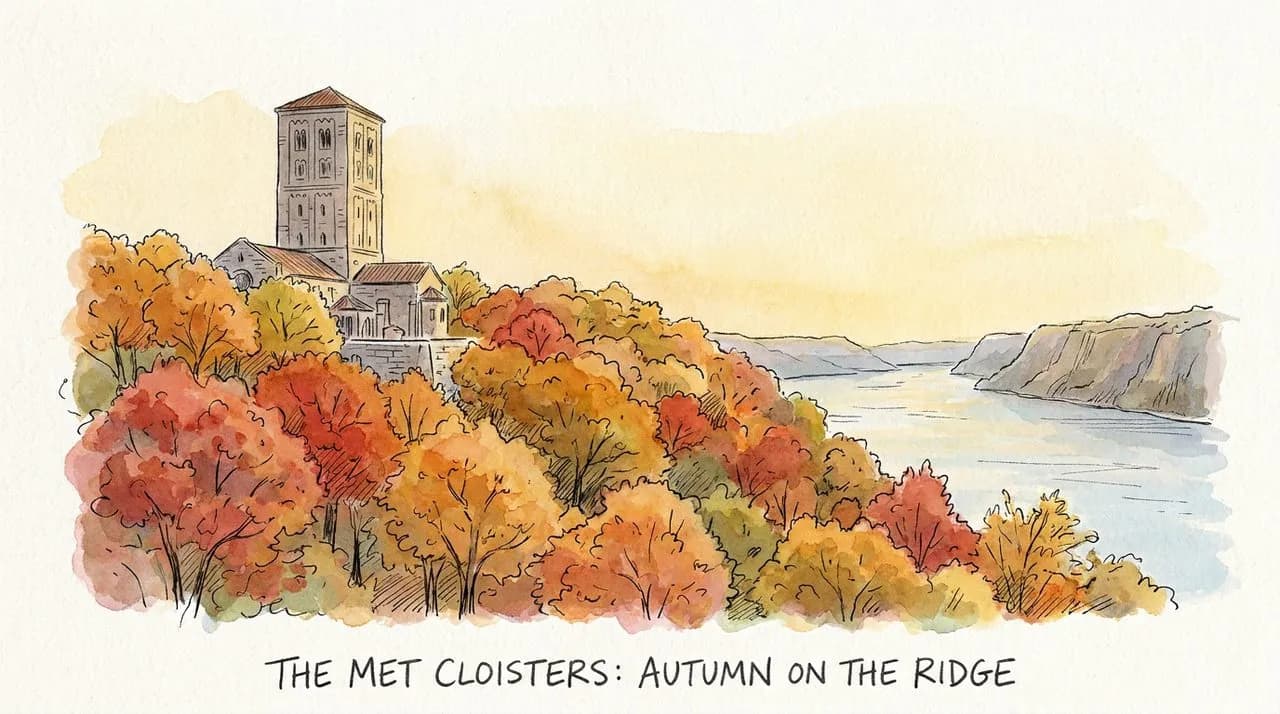
The walk works year-round. It is at its best in mid-October, when the ridge of Fort Tryon turns red, and in early May, when the bonnefont herb garden inside the Cloisters comes into bloom.
Where to Start
The walk begins at the 207th Street A train station — the last A train stop in Manhattan, the northern terminus of the line. From the station, walk west on West 207th Street toward the river. After three blocks you cross Seaman Avenue and enter Inwood Hill Park at the open lawn near the salt marsh.
The salt marsh is the first thing to see. It is the last remaining natural salt marsh in Manhattan — the rest were filled in during the nineteenth and twentieth centuries — and it sits at the confluence of the Hudson and the Harlem rivers. The marsh is a working ecosystem: blue crabs, killifish, herons, and the occasional egret. You can stand at the railing for ten minutes and watch the tide move through.
From the marsh, the trail enters the forest.
Through Inwood Hill
The forest in Inwood Hill is the only old-growth forest on Manhattan island. Some of the tulip trees are over two hundred years old; the oldest hemlocks date to before European colonization. The Lenape word Shorakapok — the village that occupied this peninsula until the 1620s — is preserved on the park signage.
The trail through the forest is unpaved and narrow. It climbs gradually from the marsh up to the ridge, gaining about 100 feet over half a mile. At the top of the ridge you reach the Indian Caves — a series of natural rock shelters used by the Lenape for camping and ceremonial purposes for at least three thousand years.
The Indian Caves are not signed. There is a small interpretive plaque at the trail junction. You will likely have the caves to yourself.
The trail continues along the ridge for another quarter mile, with intermittent views west across the Hudson to the Palisades. The path is well-defined but rooty. Wear shoes that can handle uneven ground.
The Crossing into Fort Tryon
The transition from Inwood Hill to Fort Tryon Park is via a short walk along Dyckman Street, then up through the Linden Terrace entrance to Fort Tryon. The two parks were once continuous public land; they were separated in the early twentieth century when Dyckman Street was widened. The walk across is about ten minutes and not particularly scenic — it is the only stretch of the route that goes through traffic.
Once back in the parkland, the path climbs Fort Tryon's ridge. The park was designed in 1935 by Frederick Law Olmsted, Jr. — son of the more famous Frederick Law Olmsted — on land donated by John D. Rockefeller, Jr. Rockefeller had bought up the entire ridge in the early 1900s to prevent its development and then donated it to the city as a park.
The park's design is one of the most ambitious works of American landscape architecture. The trail follows the natural contour of the ridge, climbing through stone retaining walls, terraces, and viewpoints. The Heather Garden — a three-acre formal garden on the south side of the ridge — is at its peak in May and August.
The high point of Fort Tryon — Linden Terrace — gives you a panoramic view: the Hudson and the Palisades to the west, the George Washington Bridge to the south, the Harlem River to the east, and Inwood Hill in the distance to the north. This is the highest natural point in Manhattan. Take fifteen minutes.
The Cloisters
The trail from Linden Terrace descends into a small valley and ends at the entrance of the Met Cloisters. The museum opened in 1938 in a custom-designed building that incorporates the actual architectural elements of five medieval European cloisters — from the abbeys of Saint-Michel-de-Cuxa in the French Pyrenees, Saint-Guilhem-le-Désert in Languedoc, Bonnefont-en-Comminges, Trie-sur-Baïse in the Pyrenees, and Froville in Lorraine. The stones were dismantled in Europe, shipped to New York, and reassembled in Fort Tryon Park over a period of seven years.
The collection inside is the Metropolitan Museum's medieval-art holdings: about five thousand works from the European Middle Ages, including the Unicorn Tapestries, the Mérode Altarpiece, the Bury St. Edmunds Cross, and a long catalogue of illuminated manuscripts, reliquaries, and stained glass.
The building is, in essential ways, a working medieval cloister. The four interior gardens — Cuxa, Bonnefont, Trie, and the Judy Black Garden — are planted with the same species that would have been grown in medieval monastic gardens: medicinal herbs, dye plants, vegetables, and ornamentals documented in twelfth- and thirteenth-century herbals.
The walk through the museum takes ninety minutes to three hours, depending on pace. The Unicorn Tapestries — seven Flemish wall hangings from around 1500 — are in the Unicorn Room on the upper level. They are the museum's most famous holding and worth a slow visit.
What to Skip
The Cloisters is small enough that you can see everything. There is nothing to skip. The temptation to rush — the museum is often quieter than expected, the rooms are small — should be resisted. The point of the walk is the slow approach.
How to Get Back
The 190th Street A train station is two minutes from the Cloisters' exit. The walk to the station is downhill through the southern part of Fort Tryon Park, on a paved path. The A train runs every five to eight minutes during the day. The trip back to midtown takes about twenty-five minutes.
If you want to extend the day, the walk south from the Cloisters along the Hudson — through Fort Washington Park, under the George Washington Bridge, along the river path — can take you all the way to 79th Street in about three hours. This is the long version. The short version ends at the A train.
When to Walk It
Mid-October is the spectacle. The ridge of Fort Tryon turns red and yellow, the views from Linden Terrace are at their widest, and the museum's Unicorn Tapestries feel correctly set against the season.
Early May is the quieter alternative. The Heather Garden is in its first bloom, the Cloisters' herb gardens are coming online, and the trail through Inwood Hill is alive with bird migration.
A summer Sunday morning, starting at 8:00 a.m. at 207th Street, is the calmest version of the walk. You will have the Inwood Hill forest mostly to yourself and you will arrive at the Cloisters around 10:00 a.m., just as the museum opens.
The worst window is a Saturday afternoon in October, when the foliage hits and the entire Upper Manhattan day-trip crowd shows up. The trails are still walkable, but the Cloisters will be crowded.
Practical notes
- Start: 207th Street A train station. Walk west to Inwood Hill Park's salt marsh entrance.
- End: The Met Cloisters, 99 Margaret Corbin Drive, New York, NY 10040.
- Return: 190th Street A train station, two minutes from the Cloisters exit.
- Distance: ~2 miles. ~90 minutes walking, plus museum time.
- Cloisters admission: $30 general adult, $17 NYC residents (pay-what-you-wish for NY, NJ, CT residents).
- Don't miss: The salt marsh, the Indian Caves, Linden Terrace, the Unicorn Tapestries.
#cloisters #inwoodhill #forttryonpark #upperManhattan #nycparks #medievalart #longwayhome #manhattannyc #nychiking #karpofinds #nyclocalknowledge #hiddennyc #weekendnyc #metmuseum #fallnyc
Sources consulted: The Metropolitan Museum of Art · NYC Parks · The New York Times · Atlas Obscura · Wikipedia
All trademarks are the property of their respective owners.