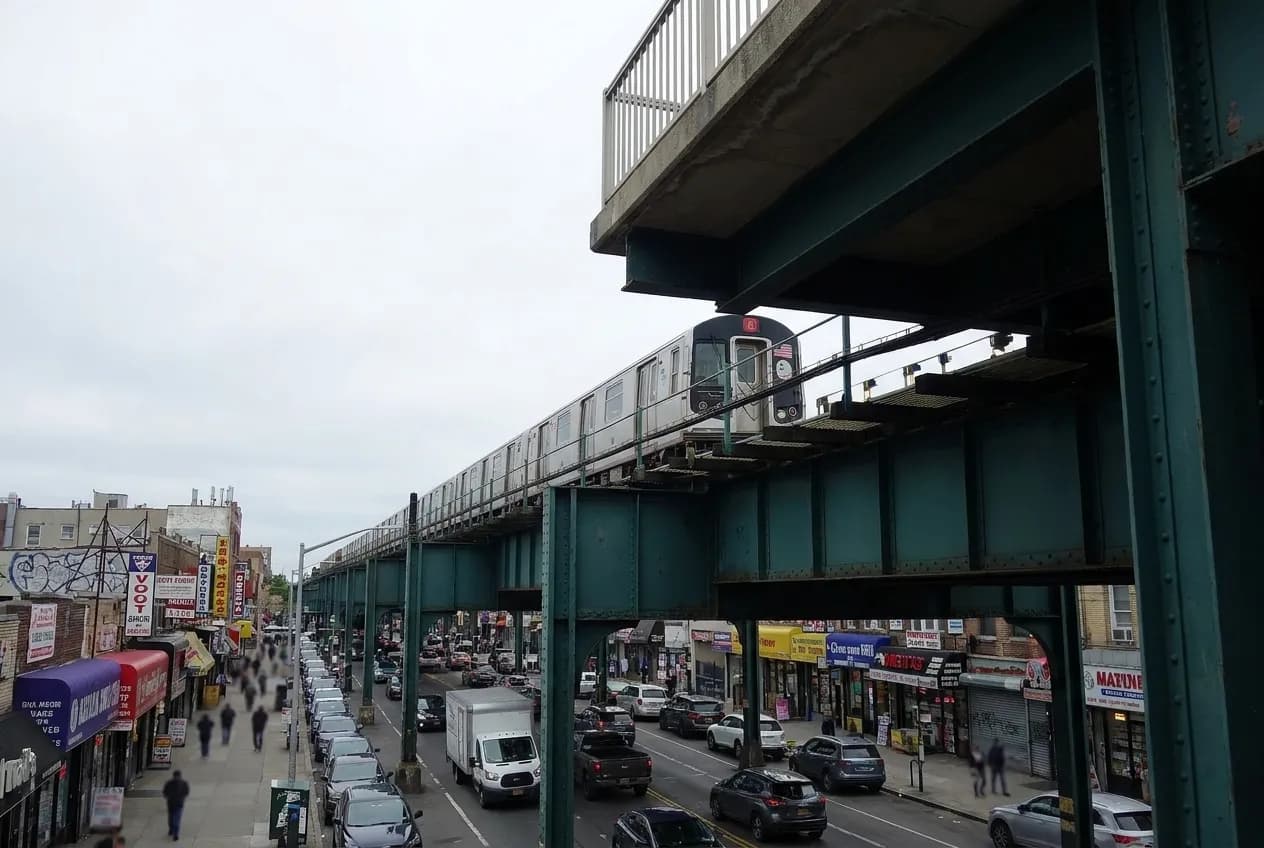
The subway ride to the top of Manhattan takes forty minutes, but the real distance reveals itself when you step onto the Blue Trail and the sound of traffic dissolves into leaf rustle and birdsong. Inwood Hill Park's 196 acres shelter the only natural forest remaining in Manhattan—tulip trees that predate the grid, ridgelines shaped by glaciers, and trails that climb from the Harlem River waterfront to overlooks where the Hudson bends north and the Palisades rise like ramparts. It's one of the city's most generous free things to do, and one of its best-kept secrets.
Finding the trailhead
The park’s main entrance is at Indian Road and Dyckman Street / 218th Street area, near the A train, but not as a precise Blue Trail trailhead address. A wooden kiosk with hand-drawn maps marks the spot—charmingly analog, occasionally weather-worn, always reassuring. The maps are surprisingly detailed, though the trail itself is well-blazed with blue markers painted on trees and rocks. You'll know you're in the right place when pavement gives way to packed earth and the canopy thickens overhead.
This northern entrance bypasses the playing fields and picnic areas that occupy the park's southern end, dropping you straight into the forest. On weekday afternoons, especially, foot traffic thins to near-solitude. You might pass a trail runner, a dog walker, the occasional birder with binoculars, but long stretches belong to you and the trees. The transition from urban to wild happens within a dozen steps—a compression of zones that would take miles in most cities.
The forest itself
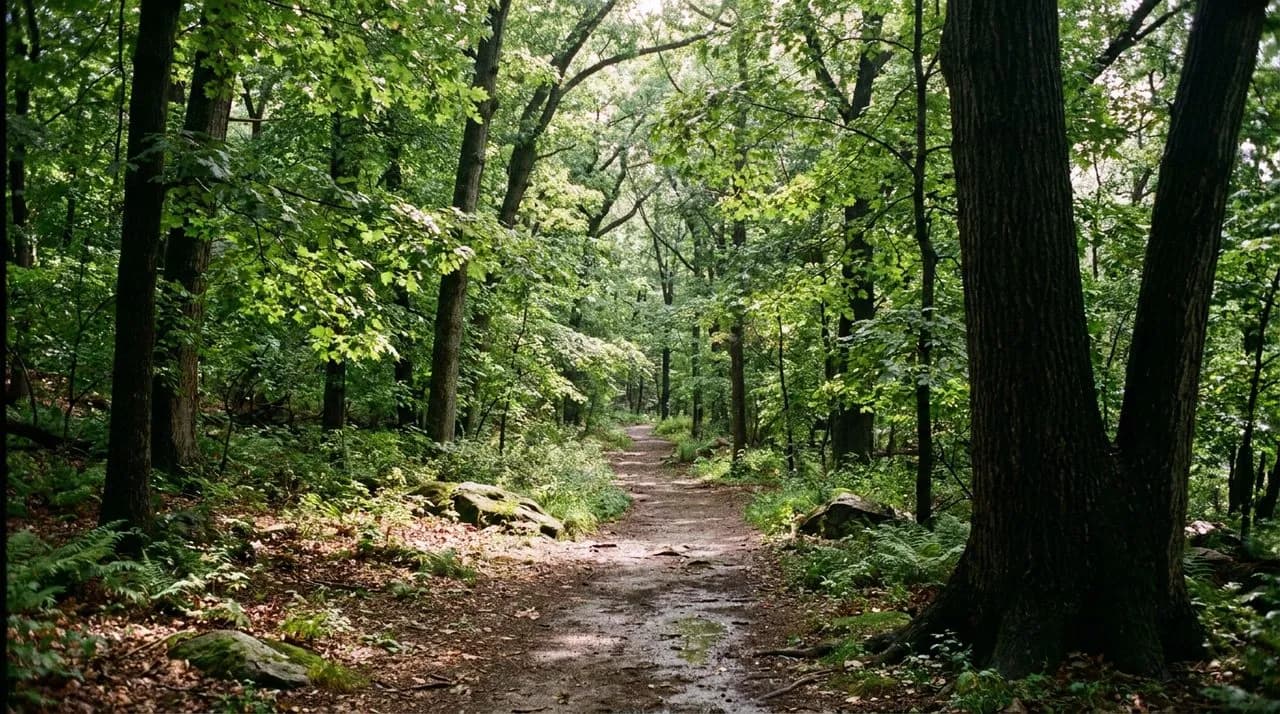
Old-growth is a term that carries weight. These aren't the spindly saplings of a replanted grove or the ornamental rows of a planned park. The tulip trees here—some more than two centuries old—spread their branches in the irregular, generous shapes that come from growing without human interference. Oak and hickory fill in the canopy. In spring the understory greens in waves: skunk cabbage first, then trillium, mayapple, and jack-in-the-pulpit. The air smells of loam and last year's leaves.
Glacial erratics—boulders dragged here by ice sheets and left behind when they melted—punctuate the trail. Some have been worn smooth by ten thousand years of weather. Others form small caves and overhangs, cool pockets where the temperature drops a few degrees even in summer. The trail weaves among them, rising steadily through switchbacks that are steep enough to feel like work but never punishing. The rock formations create natural landmarks—you learn to navigate by them, the same way the Lenape must have, long before street signs and GPS.
The ridge and the view
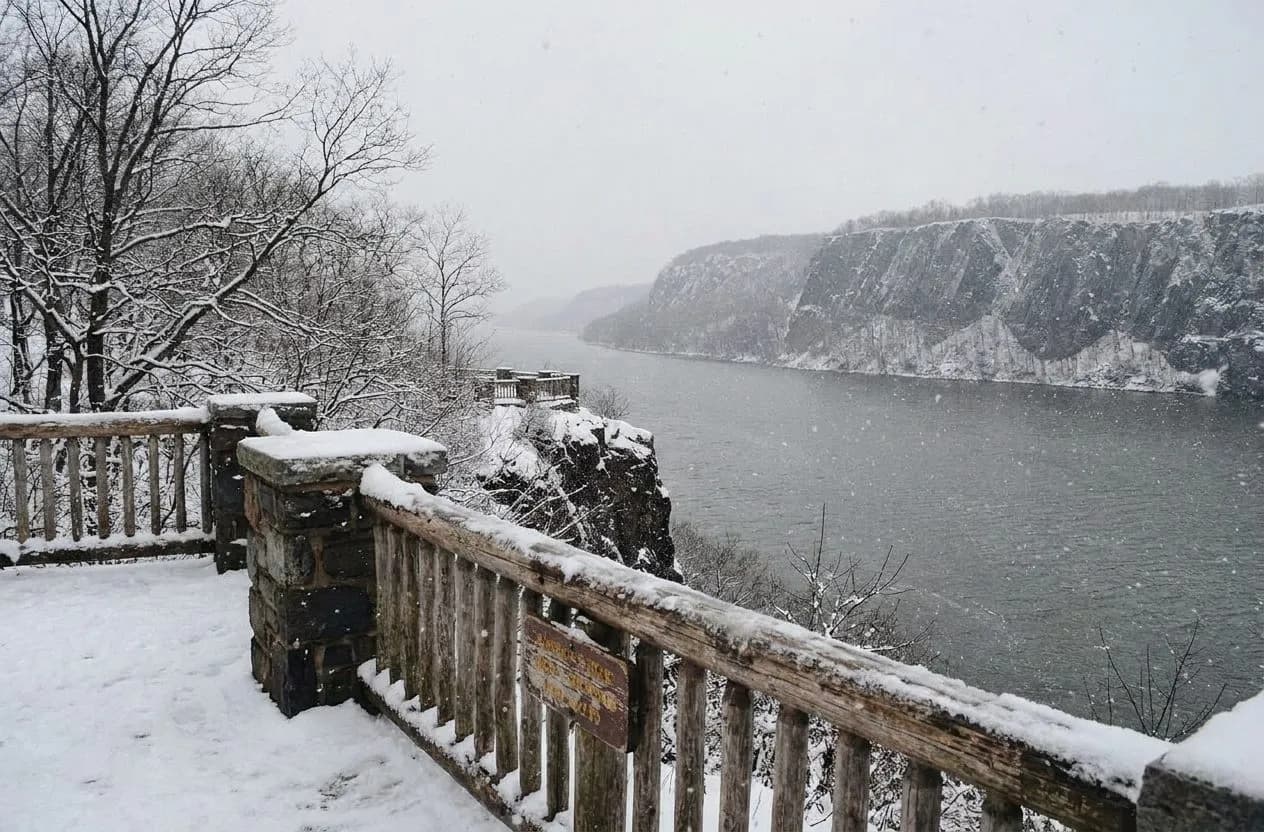
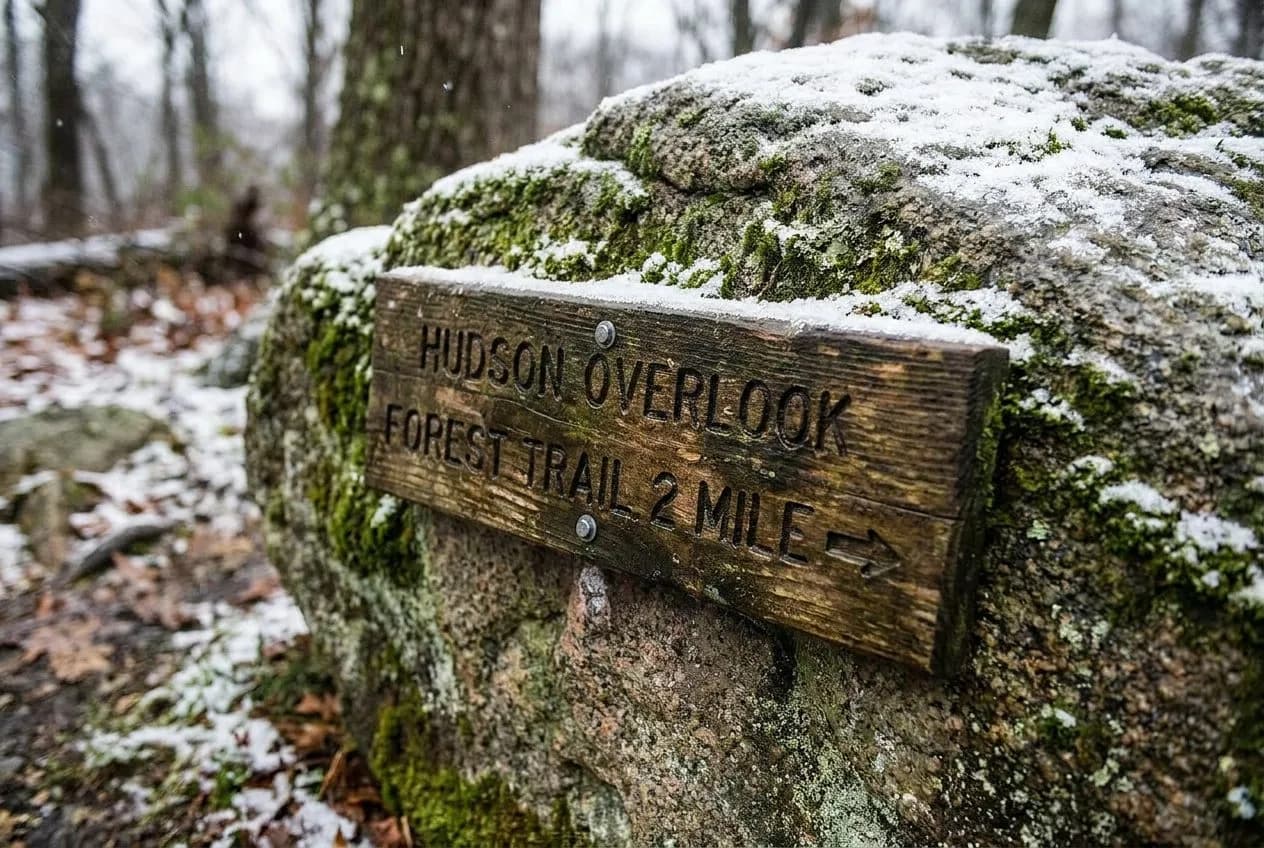
The overlook ridge at the trail's highest point sits roughly 200 feet above the river, and the view opens with sudden generosity. The Hudson stretches wide and silver to the north, the George Washington Bridge spans the gap to the south, and directly across, the Palisades rise in their familiar dark green wall. Early morning offers the clearest views, especially before tree leaf-out in late April, when branches are still bare and the sight lines extend uninterrupted.
There's a clearing here—part natural, part maintained—with a few flat rocks that serve as impromptu benches. It's the kind of spot that invites a long pause. The scale of the view rewrites your sense of where you are. Two hundred blocks south, Manhattan is all verticality and compression. Here, the island reveals its width, its relationship to the river, its bones. On clear days, you can trace the Henry Hudson Parkway threading along the shoreline below, watch barges push upstream against the current, see joggers and cyclists reduced to tiny figures on the waterfront path.
Seasonal shifts and wildlife
The forest transforms through the seasons with a clarity that most of Manhattan's built environment obscures. In autumn, the canopy turns in reliable succession—hickory yellowing first, then oak bronzing, the understory blazing red where Virginia creeper climbs the trunks. Winter strips the view to essentials: bare branch architecture, exposed rock faces, the grey ribbon of the Hudson cutting between banks of snow. Spring brings not just wildflowers but migratory birds—warblers passing through in waves, thrushes calling from the undergrowth, hawks riding thermals above the ridge.
The park supports wildlife populations that seem implausible for upper Manhattan. Red-tailed hawks nest in the tall trees. Eastern grey squirrels are abundant, but patient observers spot chipmunks, raccoons, and the occasional possum. Woodpeckers—downies, hairies, and the occasional red-bellied—drum on dead snags. The forest floor shows signs of foraging: overturned leaves, scattered acorn shells, the shallow scrapes where something dug for grubs. It's not wilderness in the capital-W sense, but it's wilder than anywhere else on the island, and that distinction matters.
Loop logistics
The Blue Trail loop is approximately 1.2 miles and typically takes about 45 minutes at a moderate pace. The trail descends from the ridge through a different section of forest, passing stone markers that commemorate the Lenape presence here and a plaque marking the approximate site where, according to tradition, Peter Minuit conducted his infamous purchase in 1626. The historicity is debatable; the symbolism is not.
The descent is gentler than the climb, winding through groves of younger trees before rejoining the wider paths near the waterfront. You can extend the walk by heading south along the river, where paved trails offer views of the Harlem River and the Columbia University boathouse, or loop back to the trailhead and call it done. Either way, you'll exit into the neighborhood feeling like you've traveled farther than the map suggests.
The neighborhood that frames it
Inwood itself deserves attention—not as an afterthought to the park, but as the kind of neighborhood that makes the park matter more. This is the northernmost reach of Manhattan, where the Dominican community has deep roots, where corner bodegas sell mangú and yaroa alongside bagels, where apartment buildings from the 1920s and '30s still have art deco details above their doorways. The streets around the park—Dyckman, Broadway, Indian Road—feel simultaneously urban and village-like, crowded but navigable, alive with street life that doesn't perform for tourists because there aren't many tourists this far north.
After a morning on the trails, the neighborhood provides easy re-entry. Cafés along Dyckman serve strong coffee and pastelitos. Remove the specific business reference unless verified current; use a general phrase such as "nearby cafés". The contrast between forest solitude and neighborhood bustle isn't jarring—it's complementary, a reminder that the city's best experiences are rarely one-dimensional. You come for the trees and stay for the empanadas, or vice versa, and both feel like authentic expressions of what upper Manhattan offers when you take the time to explore it.
What the forest teaches
Inwood Hill Park offers a particular kind of solace that city parks with grand lawns and formal gardens cannot. It's wilder, more self-sufficient, less concerned with being picturesque. The trails don't promise views at every turn. The forest closes in, opens up, closes in again. You walk for the sake of walking, for the rhythm of it, for the way attention narrows to root placement and bird call.
By late 2026, as the city continues its complicated recovery and reinvention, this constancy matters. The forest was here before the grid, before the skyscrapers, before any of the arguments about what New York should be. It will be here after. That's not romanticism—it's geology and biology, the patient work of trees and time.
Practical notes
Inwood Hill Park occupies the northwest corner of Manhattan, bounded by the Hudson and Harlem Rivers. The Blue Trail trailhead is at 218th Street and Indian Road; take the A train to 207th Street or Dyckman Street and walk north. Street parking is available but competitive on weekends. The park is open dawn to dusk year-round. Trails are unpaved and can be muddy after rain; wear sturdy shoes with tread. Bring water—there are no facilities on the trail itself. The terrain involves steady climbs and uneven footing; accessibility is limited. Verify current trail conditions with NYC Parks before visiting.
Tags: #InwoodHillPark #ManhattanHiking #NYCTrails #HudsonRiver #OldGrowthForest #TheLongWayHome #FreeNYC #InwoodNYC #PalisadesViews #UrbanNature #SpringHiking #NYCOutdoors #HiddenManhattan #WashingtonHeights #NYCParks
Sources consulted: Inwood Hill Park - Wikipedia · NYC Parks - Inwood Hill Park · MTA - Transit Directions · Time Out New York - Inwood Hill Park · Inwood, Manhattan - Wikipedia
All trademarks are the property of their respective owners.