A Cabinet That Became a Museum
In the second half of the eighteenth century, the Scottish surgeon John Hunter built one of the most consequential private collections in the history of medicine. He worked, dissected, and taught from his Leicester Square house. He collected what he cut. By the time he died in 1793 he had amassed roughly fourteen thousand anatomical specimens — human, animal, botanical, pathological — arranged according to a logic he was still developing about what life was, how disease worked, and how surgery might do less harm.
The collection was bought by the British government in 1799 and gifted to what became the Royal College of Surgeons. It has been on Lincoln's Inn Fields ever since. The 1941 Blitz destroyed about two-thirds of the original specimens. The remaining third, plus accessions, is the heart of the Hunterian Museum.
The museum closed in 2017 for a top-to-bottom refit of the Royal College building. It reopened in May 2023. Free admission, timed entry, no line.
What's in the Cases
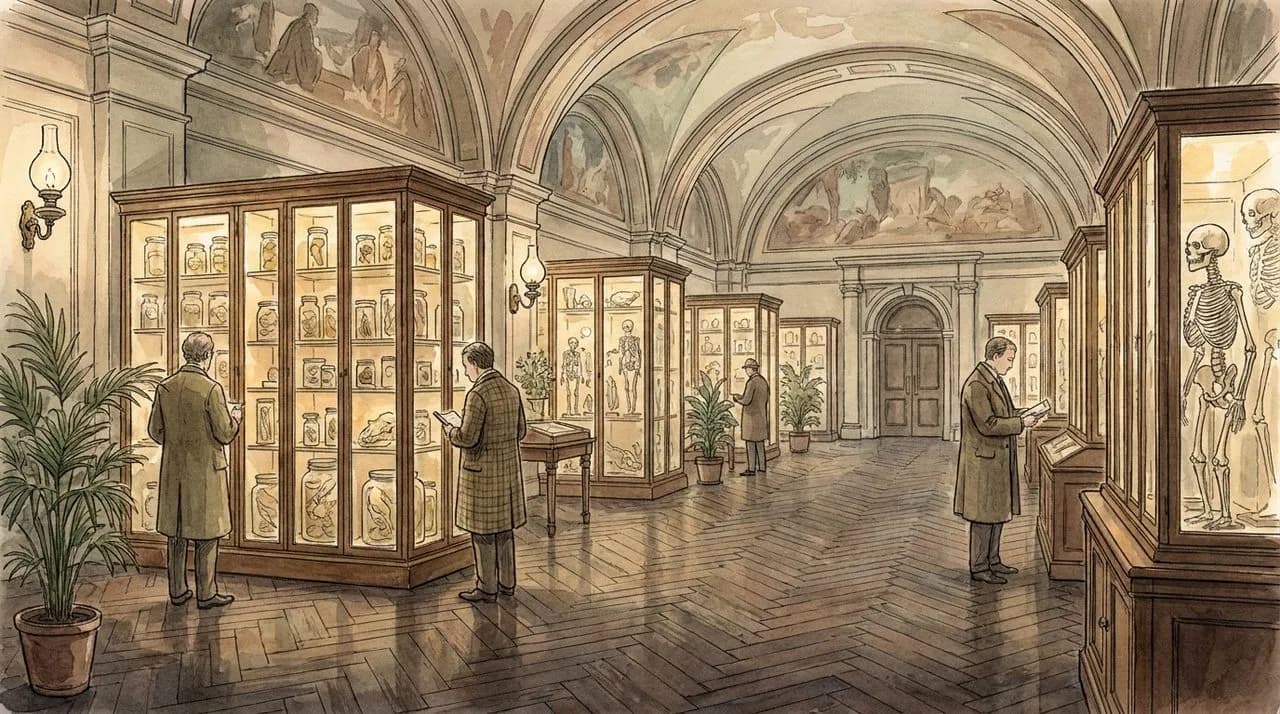
Two long rooms, end to end. The first room is Hunter's working logic: how he sorted what he found. Cases of comparative anatomy — a human jaw beside a tiger's, a hummingbird's heart beside an elephant's, a row of fetuses across mammalian species. The case labels are written for a literate non-medical visitor. They are also, by museum-text standards, unusually direct about what the specimens are.
The second room is the consequence: pathology. Tumors in glass. Aneurysms in their original wax-injected vessels. The skeleton of Charles Byrne — the eighteenth-century "Irish Giant" — was, until 2023, on display in the museum. As of the reopening, Byrne's skeleton has been removed from public display in line with his recorded wish to be buried at sea. The decision was the subject of a long ethics review and is now one of the museum's most important wall texts.
There are also surgical instruments — Lister's first antiseptic carbolic spray, Florence Nightingale's notes on Crimean wound dressings, the field tools of nineteenth-century military surgeons — that trace the path from Hunter's dissecting table to the present-day operating theater.
What the Refit Changed
The six-year closure was not cosmetic. The Royal College building, designed by Charles Barry in 1813 and rebuilt after the Blitz, was structurally and environmentally unfit for modern conservation standards. The refit added climate control, accessible entry, repaired the dome, and rebuilt the museum's two galleries with new casework and new lighting.
The curatorial work was more sensitive. The pre-2017 museum had been criticized for displaying human remains without context or consent. The reopened museum is built on the opposite principle: every human specimen has a labeled provenance, the ethics of its acquisition is part of the display, and visitors are warned at the entry of what is inside. The Byrne case is the museum's most public reckoning, but it is not the only one.
How to Visit
The museum is on the first floor of the Royal College of Surgeons at 38–43 Lincoln's Inn Fields, Holborn. Free admission, but timed tickets are required and book up about two weeks in advance for weekend slots. Weekday mornings often have same-day availability.
A visit takes ninety minutes if you read every label, an hour if you walk briskly. There are no formal guided tours, but the volunteer docents — often medical students or retired surgeons — will answer questions in unusual depth.
Photography is allowed in the cabinet halls without flash. The gift shop is small and good. The café in the building's atrium is open to visitors and is one of the quieter lunch spots in Holborn.
Who It's For
The Hunterian is not a hospital museum. It is also not a freak show. It sits at the precise intersection of those two things and refuses both. The visitor it suits best is the curious adult — a doctor on a day off, a biology student, a writer working on a novel, the kind of museum-goer who reads labels.
It is harder for children. Some of the specimens are graphic. The museum advises caution for under-twelves; many parents bring older children anyway, and the kids do fine, but it is worth previewing.
For tourists who have already done the British Museum and the V&A, the Hunterian is the third Wednesday choice — smaller, free, less crowded, more substantive per square foot than any other London collection.
Walking Distance
The museum's Holborn location is one of its assets. Within a fifteen-minute walk: Sir John Soane's Museum at 13 Lincoln's Inn Fields (also free, also one of the strangest collections in Europe), the Inns of Court, the British Museum on Great Russell Street, and Somerset House on the Strand. A full day, all free, all walking, is one of London's better self-organized itineraries.
If you want the contrast, pair the Hunterian with the Wellcome Collection on Euston Road. Both are about the body, about medicine, about what gets kept and why. The Hunterian is the eighteenth century. The Wellcome is the twentieth and after.
The Argument the Museum Makes
The most interesting thing about the Hunterian is not the specimens — extraordinary as they are. It is what the reopened museum says by how it displays them. The pre-2017 cabinet was a Victorian-style room: a vault of human curiosities, lightly labeled, no questions asked. The post-2023 cabinet is a different thing. It tells you who Hunter was, how he got his specimens, who refused consent, what was lost in the Blitz, and what should never have been displayed.
It is, in other words, a working museum about the ethics of being a museum. That is rare. It is also, for the body of work it sits on top of, exactly the right move.
Practical notes
- Address: 38–43 Lincoln's Inn Fields, Holborn, London WC2A 3PE.
- Getting there: Tube to Holborn (Central, Piccadilly) — five-minute walk. Or Chancery Lane (Central) — eight minutes.
- Hours: Tuesday to Saturday, 10 a.m. to 5 p.m. Closed Sunday and Monday.
- Admission: Free, but timed tickets required. Book at hunterianmuseum.org.
- Don't miss: The comparative anatomy room, the wall text on Charles Byrne, Lister's carbolic spray.
- Pairs well with: Sir John Soane's Museum next door, the Wellcome Collection on Euston Road, lunch at one of the Inns of Court pubs.
#hunterianmuseum #londonmuseums #holbornlondon #lincolnsinnfields #freelondon #londonart #medicalmuseum #londonhistory #ukmuseums #oddedit #karpofinds #londontravel #localknowledge #hiddenlondon #weekendlondon
Sources consulted: Royal College of Surgeons · Hunterian Museum · The Guardian · Wellcome Collection · British Medical Journal
All trademarks are the property of their respective owners.