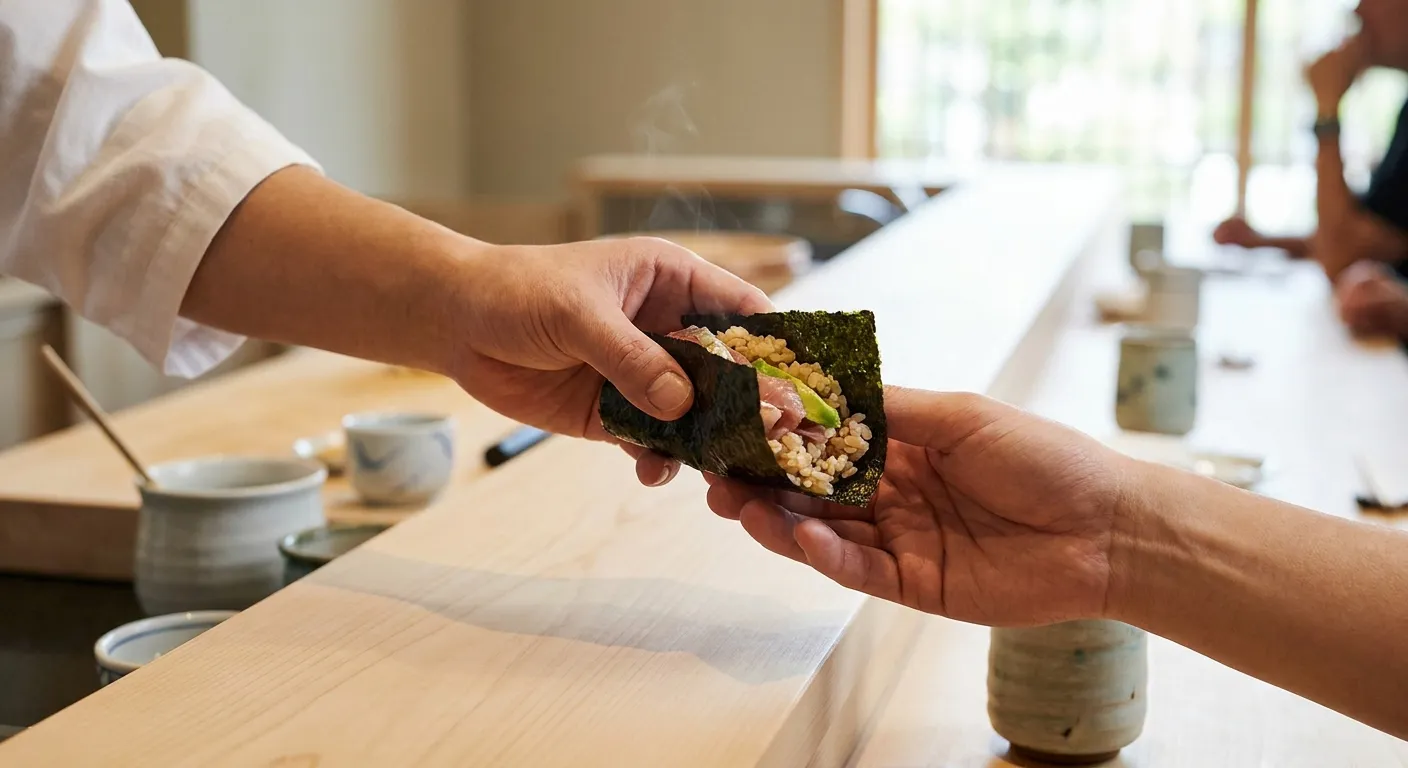
A handroll is sushi with a countdown clock. The moment warm seasoned rice touches crisp nori, physics starts working against you: steam softens the seaweed, and the window where everything is perfect — shattering nori, warm rice, cool fish — lasts maybe a minute. That's why the handroll bar exists as its own format. You sit at the counter, a chef rolls, you eat immediately, repeat. No platters, no waiting for the whole table's order, no soggy compromises.
San Francisco caught the temaki-bar wave a few years back, and after some churn — more on that below — the city has settled into a solid roster of counters where the format is done right. Here's where to go, how to behave when you get there, and which spots justify standing in line.
Why a Handroll Beats a Cut Roll
A cut roll is engineered for sharing and for sitting on a plate. A temaki is engineered for the exact opposite: one cone or cylinder, one person, right now. Because it's eaten seconds after rolling, the rice can be served body-warm instead of refrigerator-cold, which completely changes how the fish tastes. And because the nori never sits, you get that crackle a pre-made roll physically cannot deliver. Once you've had a proper one, supermarket sushi becomes an act of self-harm.
Counter Etiquette: The Thirty-Second Rule
Handroll bars run on tempo, and there's really only one commandment: eat it the moment it lands. Everything else is detail.
- When the chef hands you a roll, it goes into your mouth within about thirty seconds. Photos first is fine — fast photos.
- Don't stack orders. Rolls come one at a time so each stays crisp; order sets and let the kitchen set the pace.
- No soy-sauce dunking unless the chef suggests it — most rolls come already seasoned.
- Counters are small and turnover matters. Linger over the last roll and a drink, not over roll number two.
- Walk-in-only is common. Go early, go solo or as a pair, and treat the line as part of the ritual.
Saru Handroll Bar: Russian Hill's Straight Shooter
Saru Handroll Bar on Polk Street is the purest expression of the format in the city: a walk-in-only counter from the team behind the former Michelin-starred Kinjo, open since late 2022. There are no foams, no gold flakes, no caviar theatrics — just house-seasoned rice, pristine fish, and crisp nori, rolled to order. Order a la carte from a list running shrimp tempura through eel to uni, or commit to the set of three, four, or five and let the counter do the thinking. Weekend prime time brings waits in the thirty-to-forty-five-minute range, which tells you everything about how the neighborhood feels about it.
The Roll: Edomae Discipline on Folsom Street
The Roll, at 921 Folsom in SoMa, comes from the executive chef of Sushi Hakko Omakase, and it shows: both the rice and the fish are handled in the traditional Edomae style, which means real technique underneath a casual format. Temaki share the menu with futomaki, nigiri, chirashi-style kaisen don, and proper Japanese sides, so it flexes from quick counter snack to full dinner. It runs lunch and dinner service most days and stays open late on Friday and Saturday nights — a rarity worth knowing in this town — though it takes Mondays off.
Bubu: The Happy Hour Cheat Code
Bubu in Lower Pacific Heights is the value play that went deservedly viral: a sushi-izakaya hybrid where the happy hour prices handrolls at two for five dollars. The lineup runs from spicy salmon skin and jalapeño hamachi to negitoro — fatty tuna with onion — and the quality holds up far better than the math suggests. The catch is that everyone in the neighborhood knows it, so tables vanish fast; show up right at opening or be ready to hover. As of 2025 the happy hour ran twice daily, but deals like this evolve — check before you build your evening around it.
Oma San Francisco Station: The Japantown Counter Finish
Oma San Francisco Station is not a handroll bar, strictly — it's an eight-seat omakase counter the size of a kiosk inside the Japan Center mall — but it earns its place here because the handroll is the star of its most accessible move: a shorter five-course option, around thirty dollars per recent menus, that closes with a chopped bluefin tuna handroll sharpened with pickled yellow daikon. It's one of the best single bites in Japantown, served steps from the mall's bookstore-and-mochi bustle. Full omakase menus run considerably higher; check current pricing when you book.
The One That Started It, and the East Bay Detour
A moment of silence for Handroll Project, the Mission counter from the Ju-Ni team that kicked off SF's temaki wave in 2022 and closed in August 2025 — its space is becoming a burger spot from the same owners. Its legacy lives on across the bay, where the format is thriving: Yonsei Handrolls runs counters in Uptown Oakland and Albany with a menu of eighteen temaki, from salmon belly to jellyfish with sesame and chili, plus sake and Japanese-inspired cocktails. And Kuidaore Handroll Bar on Jack London Square's main plaza is bar-seating only, sixteen handrolls deep, and calibrated for the in-and-out-in-thirty-minutes solo dinner. Both are a straightforward BART-and-walk from the city, and both are worth it.
Handroll FAQs
What's the difference between a handroll and a cut roll?
A cut roll (maki) is rolled in a cylinder, sliced into pieces, and served on a plate, usually with cold rice. A handroll (temaki) is a single-serving cone or cylinder rolled to order and handed straight to you, typically with warm rice and unsliced nori. The point of a handroll is immediacy — it's built to be eaten in the first minute of its life.
Do SF handroll bars take reservations?
Mostly no — walk-in counters are the norm, and lines at peak hours are part of the deal. Saru is explicitly walk-in only, and Bubu's happy hour rush rewards arriving at opening. The exceptions are the more restaurant-shaped spots like The Roll and omakase counters like Oma, where booking ahead is either possible or essential. When in doubt, check the spot's site before you head out.
How many handrolls make a meal?
Most people land between four and six, which is why set menus cluster there. A three-roll set is a snack; five rolls with a side or a drink is a satisfying dinner. Since rolls arrive one at a time, you can start with a set and keep ordering a la carte until your appetite votes to stop. Ask Karpo which counter is closest when the craving hits.