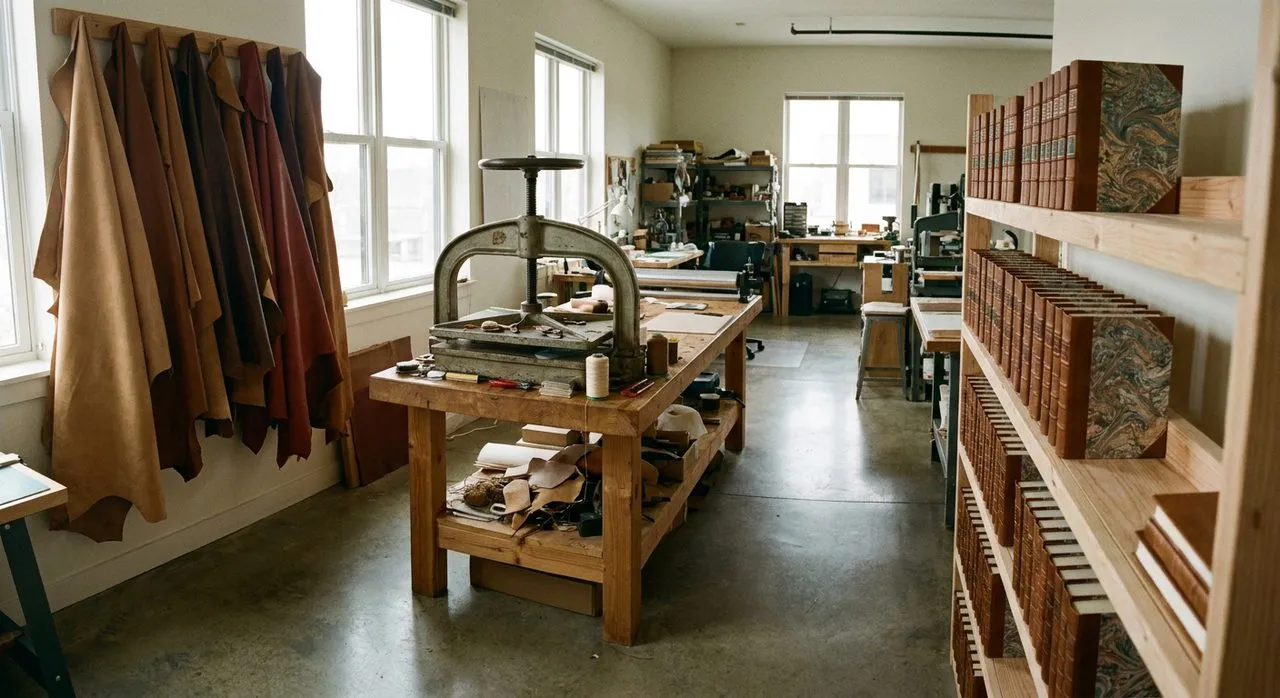
The finishing press arrived in pieces from a London auction house nearly three decades ago, shipped across the Atlantic in a crate lined with newsprint from 1998. It still works—cast iron, brass fittings, the maker's plate intact—and on Thursday afternoons it clamps down on spines while gold leaf catches the late light through the windows of a Forest Hills apartment that smells perpetually of beeswax and leather dressing. This is not a shop. There is no storefront, no sandwich board, no Instagram grid of aspirational flat-lays. It is a working bindery where vegetable-tanned cowhide becomes something permanent, and where the craft moves at the pace it has always moved: slowly, by hand, with heat and pressure and patience.
The tools and the work
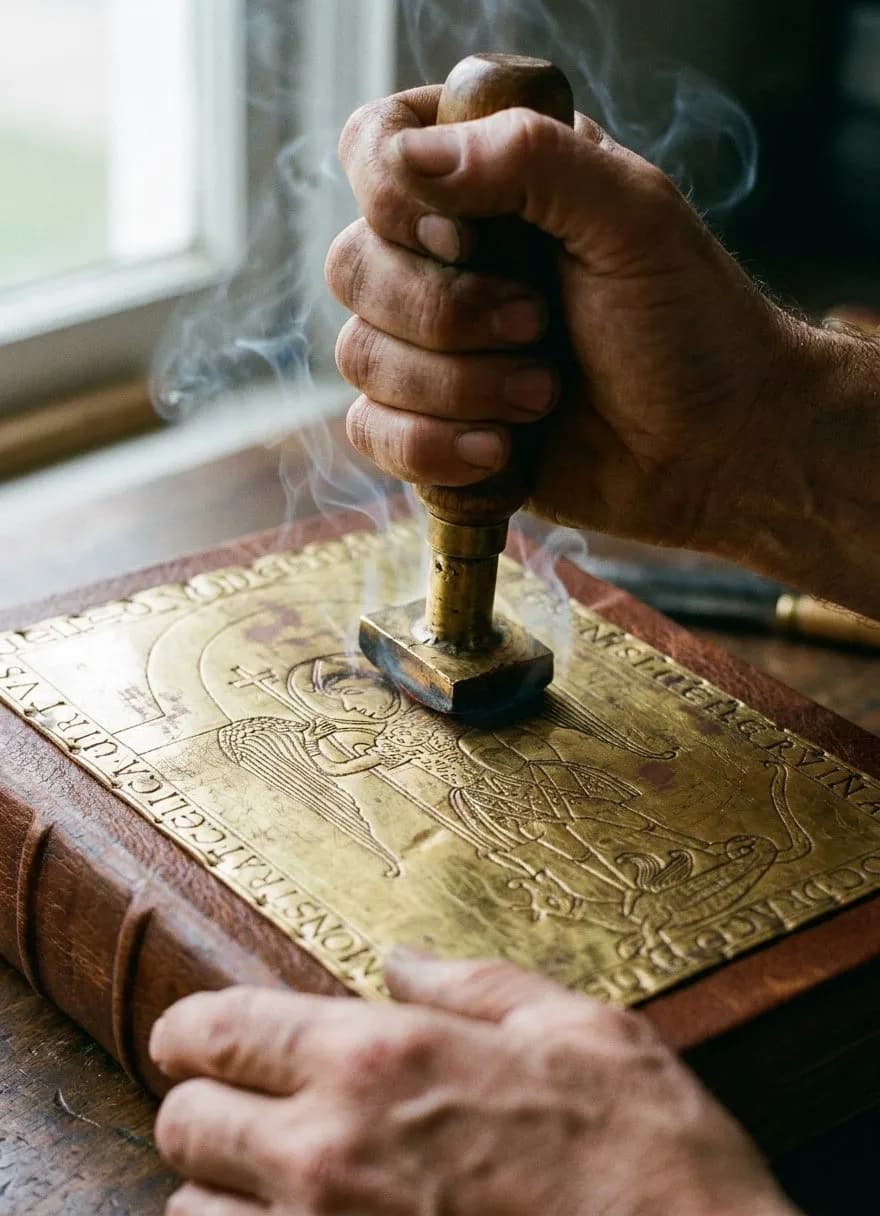
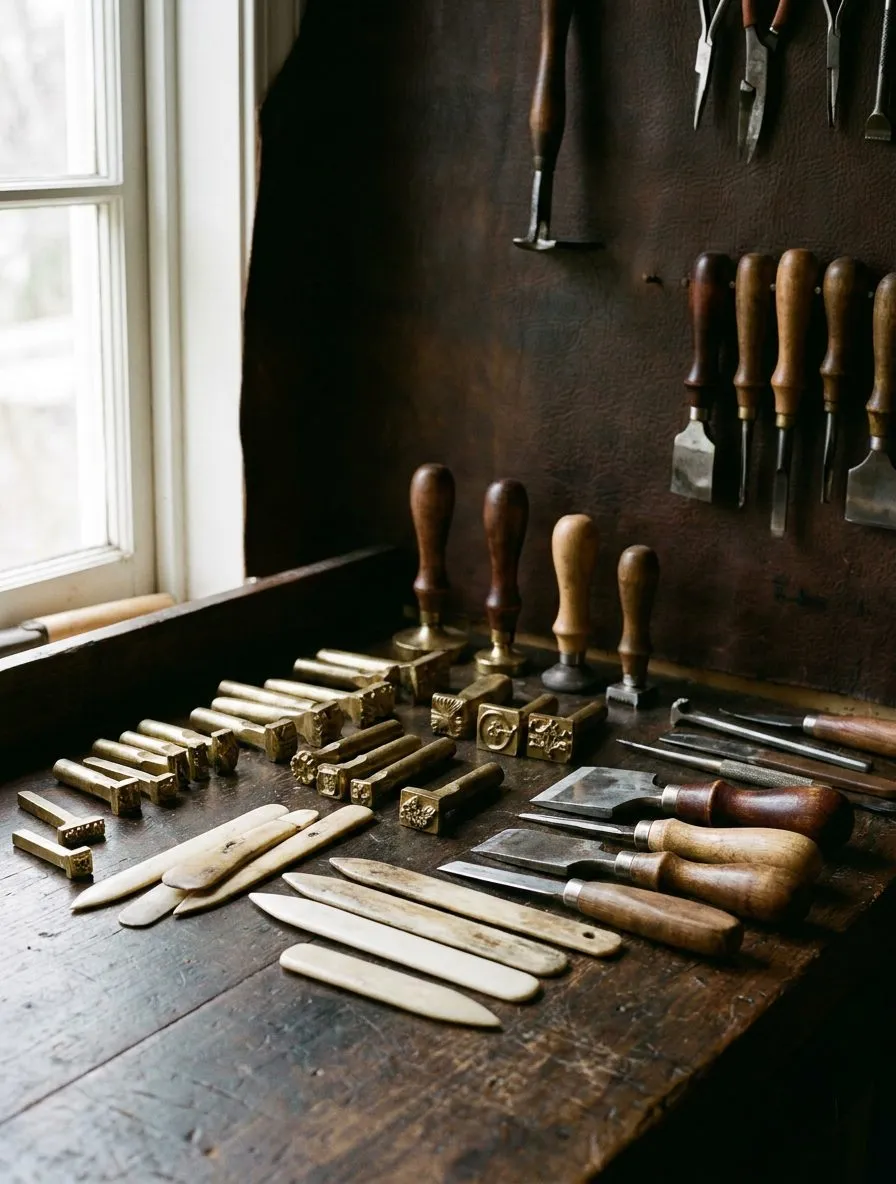
The press itself is the centerpiece. Purchased at that London auction in 1998, it still bears the maker's plate from a Bloomsbury bindery that closed in 1947, a relic of an era when such equipment was built to outlast its makers. The binder uses it for spine lettering and edge work, applying steady pressure while heated brass stamps sink into leather that has been dampened, tooled, and prepared. The stamps themselves are Victorian—some floral, some geometric, a few Art Nouveau flourishes—and they live in shallow drawers organized by motif and scale.
Bone folders rest on the worktable alongside edge bevelers, awls, and a gilder's knife so sharp it lives in its own wooden sheath. The hides arrive as full sides, pale and supple, then are cut, skived, pared down to the right thickness for covering boards or wrapping spines. Each project begins with measuring, then templating, then the careful marriage of leather to book block. The apartment hums with the small sounds of this work: the tick of a heated stamp, the rasp of a bone folder smoothing a seam, the faint creak of the press as it tightens.
Commissions and clients
The clientele skews toward collectors, private library curators, and the kind of reader who cannot abide a cracked hinge or a peeling spine. Vintage Penguins arrive for rebinding in leather dyed to match the original covers. Family Bibles, their spines split and their pages loose, are rebuilt with new endpapers and reinforced bindings. Custom journals are made to order, tooled with initials or crests or patterns chosen from reference albums kept on a shelf near the window.
Most commissions require four to six weeks, and clients are asked to provide a cloth or paper binding sample for sizing. The work is exacting. A spine must be measured twice, sometimes three times. Leather stretches as it dries; margins shift. There is no undo button, no digital safety net. What gets tooled stays tooled. What gets glued is permanent. This is part of the appeal for those who seek it out—the knowledge that the object being made will outlast trends, platforms, and possibly the person commissioning it.
Thursday consultations
Thursday appointments include a consultation where clients choose leather color, stamp patterns, and spine lettering style from reference albums that have grown thick over the years with swatches, sketches, and photographs of past work. The binder walks clients through the options: blind tooling versus gold, raised bands versus flat spines, natural edge finish versus dyed. Some clients arrive with clear vision. Others need coaxing, the kind of quiet guidance that comes from years of knowing what will wear well and what will look fussy in five years.
Gold leaf and patient hands
Gold leaf application is its own discipline. The binder works with 23-karat sheets, impossibly thin, cut into 1/8-inch strips using a gilder's knife that requires a steady hand and good light. One sheet covers approximately six spine titles, depending on the size of the lettering and the complexity of the design. The strips are laid onto leather that has been tooled and sized with glaire, then pressed with heated type. The excess is brushed away with a soft cloth, leaving only the gold sunk into the impression.
It is finicky work. Humidity affects adhesion. A tremor in the hand can ruin a strip. The gold itself is so light it will lift and float on a breath, which is why the windows stay closed during application and why fans are never used, even in summer. The result, when it works, is a spine that glows under gallery lighting or catches the sun on a library shelf—subtle, expensive, unmistakably hand-done.
The apartment as studio
Forest Hills is not the first neighborhood that comes to mind when you think of craft studios, but the apartment works precisely because it is unremarkable from the outside. A quiet block, a walk-up, a door that could belong to anyone. Inside, the space has been adapted with racks for curing bindings near the windows, flat storage for works in progress between boards, and shelves for the growing archive of completed commissions photographed for reference.
There is no signage, no retail hours, no drop-in traffic. Clients find the studio by referral or by the kind of quiet word-of-mouth that moves through circles of book collectors and antiquarian dealers. It is open by appointment on Thursdays and by appointment on select days, and the calendar fills weeks in advance. This is by design. The work requires focus, and focus requires boundaries.
What endures
Leather bindings were once the default, the standard method for preserving and protecting text. Now they are a luxury, a choice made by those who want their books to last not just years but generations. The binder in Forest Hills is not trying to revive a lost tradition so much as continue one that never fully disappeared, only narrowed. The clients who seek this work understand that they are commissioning something that will outlive them. The books return to shelves heavier, sturdier, more themselves. They smell of beeswax and tannin. They age well.
There is something both quaint and radical about a craft practiced this way in 2026—no CNC mills, no laser cutters, no algorithmic recommendations. Just hands, tools, leather, and the stubborn insistence that some things should not be rushed. The bindery will not scale. It will not franchise. It will continue, quietly, in a Forest Hills apartment, making one book at a time until the work is done or the maker is.
Practical notes
The bindery operates by appointment only, Thursday through Saturday. Contact information is shared by referral; inquiries can be made through antiquarian book dealers or private library consultants in the city. The studio is located in Forest Hills, Queens, accessible via the E and F trains to Forest Hills–71st Avenue; street parking may be limited on surrounding blocks. Clients should bring a cloth or paper binding sample for sizing and be prepared to discuss timeline and budget during the initial consultation. Projects typically require four to six weeks. The studio is a walk-up apartment and not ADA-accessible. Verify availability and scheduling directly before planning a visit.
Tags: #HandTooledLeather #BookBinding #ForestHills #TheOddEdit #NYCCraft #PrivateLibraries #LeatherWork #CustomBindings #VictorianTools #ArtisanStudio #QueensNYC #BookCollectors #GoldLeaf #Summer2026 #BespokeBooks
Sources consulted: Bookbinding · Leather Crafting · Forest Hills Area Parks · Forest Hills Transit · NYPL Preservation & Conservation
All trademarks are the property of their respective owners.