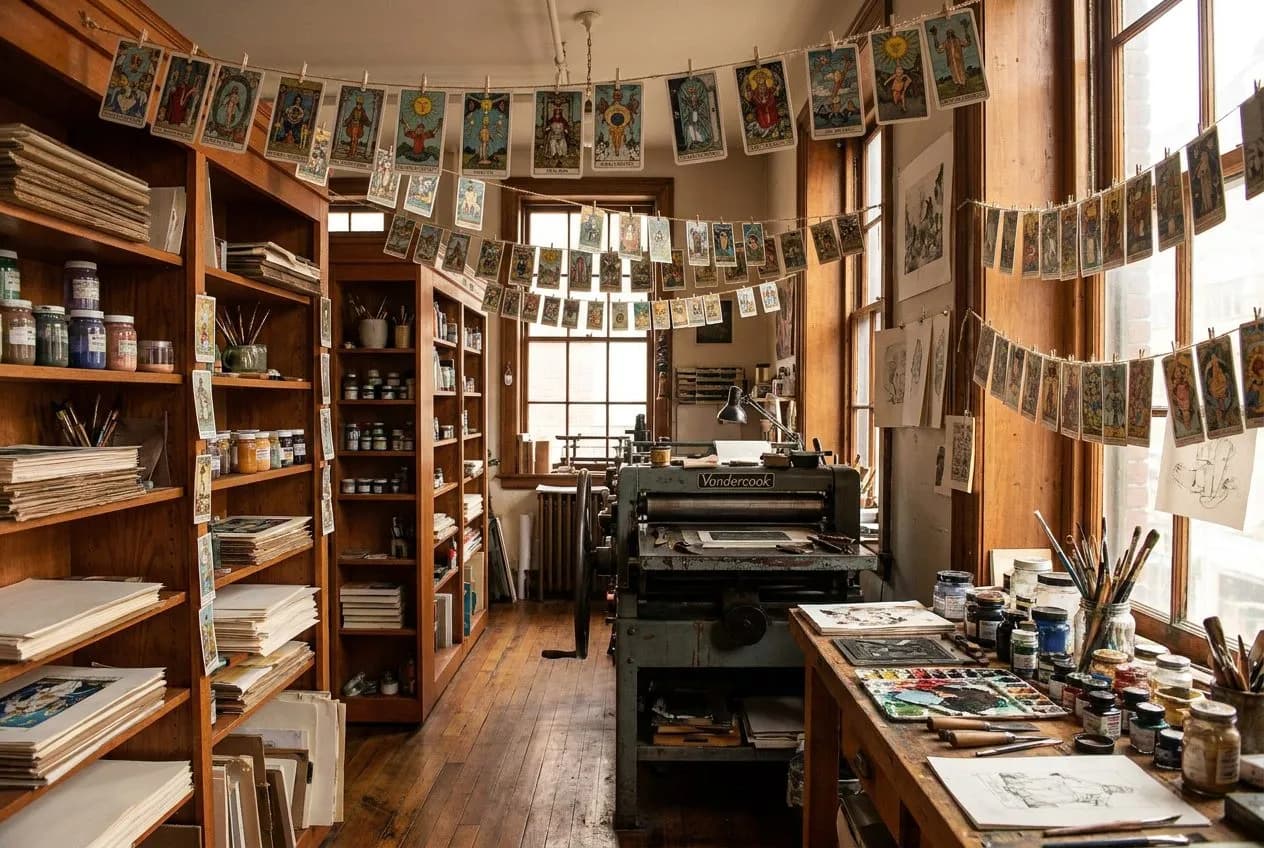
The stairwell smells of linseed oil before you reach the second-floor landing. Inside, a Vandercook proof press stands against exposed brick, its black iron frame catching afternoon light through tall windows. Clotheslines strung across the studio hold tarot illustrations drying in neat rows—the Magician, the High Priestess, the Fool—each one painted in gouache on heavy cotton paper. This is where one illustrator transforms the seventy-eight cards of the tarot into bespoke objects, working slowly and deliberately through commissions that can take half a year to complete. There are no walk-ins here, no browsing. Just the quiet accumulation of paint, ink, and gold.
The commission structure
Custom tarot decks begin at twelve hundred dollars for a full seventy-eight-card set. Gold leaf edging—applied by hand to each card after the paint has dried—adds another hundred and fifty. A hand-sewn companion guidebook, bound with linen thread and printed on the same cotton stock, adds eighty more. The math is straightforward, but the real cost is time. Each deck is a singular object, painted to order, and the waitlist is maintained in a cloth-bound ledger that sits on a corner of the worktable. Names are added in pencil, dates noted, preliminary conversations summarized in tidy script.
The illustrator does not take on more than a handful of commissions at once. The process requires sustained attention—weeks spent on the Major Arcana alone, then the patient repetition of the Minor suits. Clients who arrive expecting a quick turnaround are politely redirected. This is work measured in seasons, not weeks, and the pace reflects that. By late 2026, the ledger has entries stretching well into the following year.
Saturday afternoons in the studio
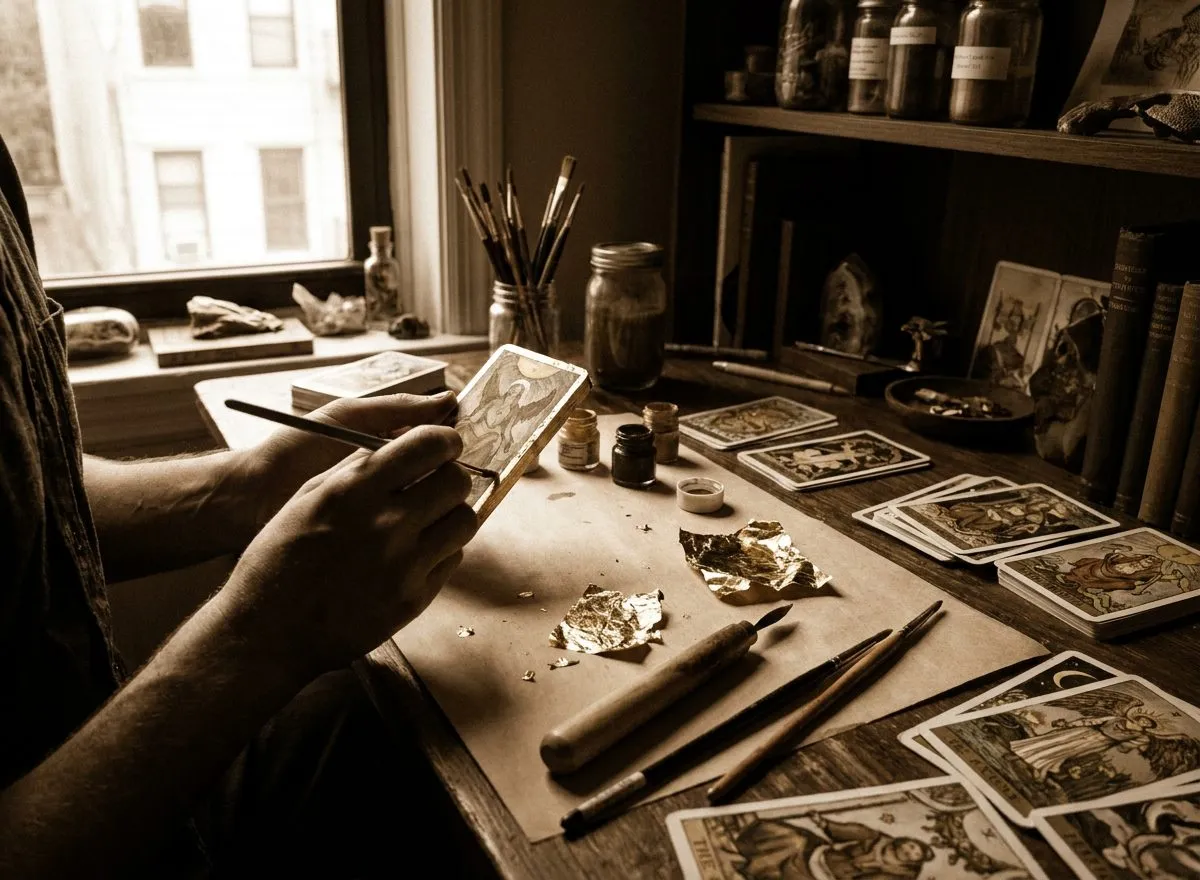
Studio visits happen by appointment only, scheduled for Saturday afternoons when the light is best. Prospective clients are invited to see work-in-progress cards spread across the drafting table, to discuss symbolism choices and palette preferences. Some arrive with reference images—a particular flower for the Empress, a specific shade of blue for the Star. Others prefer to leave the interpretation entirely to the illustrator, trusting the visual language that has developed over years of practice. These consultations are unhurried, often stretching past an hour as conversations wind through mythology, color theory, and personal associations with individual cards.
The studio itself becomes part of the conversation. Visitors notice the rows of gouache tubes lined up by hue, the jars of brushes sorted by size, the stack of cotton paper waiting to be cut. It is a working space, not a gallery, and the evidence of ongoing projects is everywhere. If your weekend plans can accommodate a trip to Astoria and you have been thinking about commissioning a deck, this is where that process begins—not with a transaction, but with a dialogue about what the cards might mean and how they might look.
The reference deck above the press
Hanging on the wall above the Vandercook is the illustrator's personal deck, a reference set that changes each year. Each iteration is painted in a different palette—one year all earth tones and ochres, another in cool grays and indigos—and serves as a testing ground for new gouache pigments and gold leaf techniques. The cards are pinned directly to the brick, unframed, close enough to the press that flecks of ink occasionally land on the edges. It is both archive and laboratory, a record of evolving craft and a reminder that even the illustrator returns to the same seventy-eight images again and again, finding something new each time.
Clients sometimes ask to purchase one of these reference decks, but they are not for sale. They document technical experiments—a new way of layering translucent washes, a different adhesive for the gold leaf—and remain in the studio as benchmarks. The current year's version is always incomplete, a work in progress that will be finished only when the next year's iteration begins.
The Vandercook and limited editions
The proof press is not just a studio fixture; it is the means by which small print runs are produced. Once a commissioned deck is complete, the illustrator photographs each card, prepares plates, and prints a limited edition—typically no more than fifty sets—on the same cotton paper used for the originals. These printed decks lack the hand-painted texture and individual variation of the commissioned work, but they carry the weight and feel of letterpress, each card showing a slight impression from the press bed. The process is slow, deliberate, and requires constant adjustment. A full run can take days.
Companion guidebooks are printed on the Vandercook as well, then hand-sewn with a simple pamphlet stitch. Each booklet explains the symbolism embedded in the deck, offers interpretations for each card, and sometimes includes notes on the commission process itself—what the client requested, what the illustrator chose to emphasize. The finished decks and guidebooks are slipped into linen drawstring bags and tied with cotton cord. They are objects made to last, to be handled, to accumulate the patina of use.
Gouache, gold, and the small rituals of making
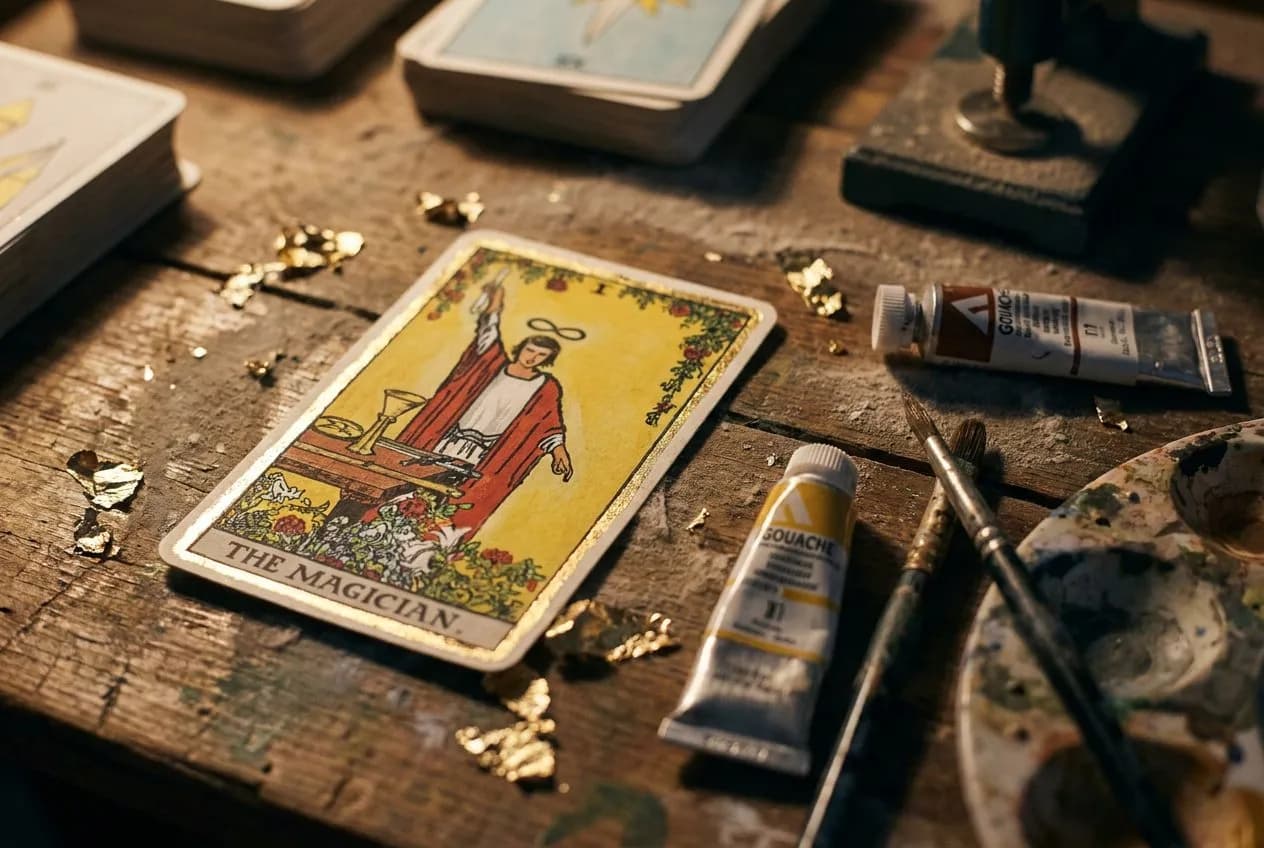
Gouache dries matte and opaque, which gives the cards a soft, chalky finish distinct from watercolor or acrylic. The illustrator works in layers, building up color gradually, allowing each coat to dry before adding the next. Gold leaf is applied last, burnished onto the edges or onto specific details within the illustration—a crown, a star, the rim of a chalice. The process is finicky and unforgiving; a misplaced breath can send the delicate sheets skittering across the table. But when it works, the result is a shimmer that shifts with the light, a small bit of luxury embedded in the everyday object of a playing card.
The studio smells of linseed oil because it is used to clean brushes and occasionally mixed into the paint to extend drying time. There is also the sharper scent of printing ink, a petroleum-based smell that clings to the press and to the hands. These are the olfactory markers of the space, as much a part of the experience as the visual clutter of drying cards and stacked paper. The work is physical, repetitive, and oddly meditative. Hours pass. Cards accumulate.
Why commission a deck
There are hundreds of tarot decks available for purchase, many of them beautifully illustrated and printed. So why spend a year on a waitlist and over a thousand dollars for a custom set? The answer, for those who do it, is specificity. A commissioned deck can reflect personal symbolism, incorporate imagery that resonates with a particular practice or philosophy, and exist as a singular object rather than one of thousands. It is the difference between owning a print and owning the painting. Both are valid, but the relationship to the object shifts.
Some clients commission decks as gifts—for a partner, a mentor, a child coming of age. Others are collectors who already own dozens of decks and want something that cannot be found anywhere else. A few are practitioners who have been reading tarot for years and have a precise vision of what their ideal deck would look like. The illustrator accommodates all of these motivations, though the process remains the same: consultation, sketch approval, months of painting, and finally the delivery of a linen bag containing seventy-eight cards and a guidebook, made slowly and with care.
Practical notes
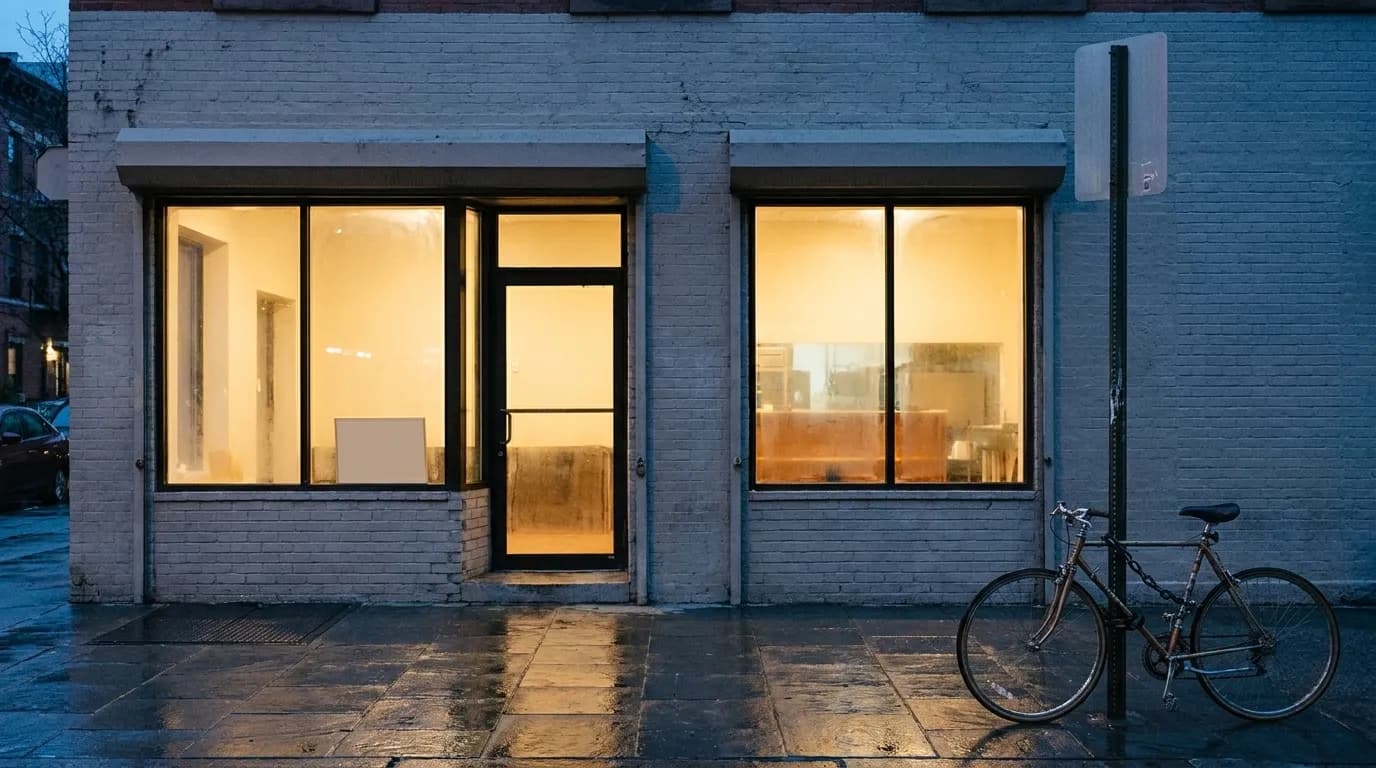
The studio is in Astoria; the exact address is provided upon booking an appointment. The nearest subway is the N or W to Astoria Boulevard, within walking distance. Street parking is typically available on weekends. Visits are by appointment only; inquiries can be made via the studio's website or Instagram. The space is not wheelchair accessible due to the stairwell. Bring reference images if you have specific visual ideas, but also be prepared to trust the illustrator's judgment. Commissioned decks take approximately six months from deposit to delivery; pricing starts at twelve hundred dollars for the full set. Verify current availability and lead times directly before planning.
Tags: #HandPaintedTarot #AstoriaStudio #CustomTarotDeck #GouachePainting #VandercookPress #GoldLeafArt #SmallPress #TheOddEdit #NYCMakers #TarotArt #BookbindingArts #LetterpressNYC #BespokeIllustration #FallInNYC #WeekendPlansNYC
Sources consulted: Tarot · Gouache · Astoria, Queens · Time Out Astoria Guide · NY Times Arts
All trademarks are the property of their respective owners.