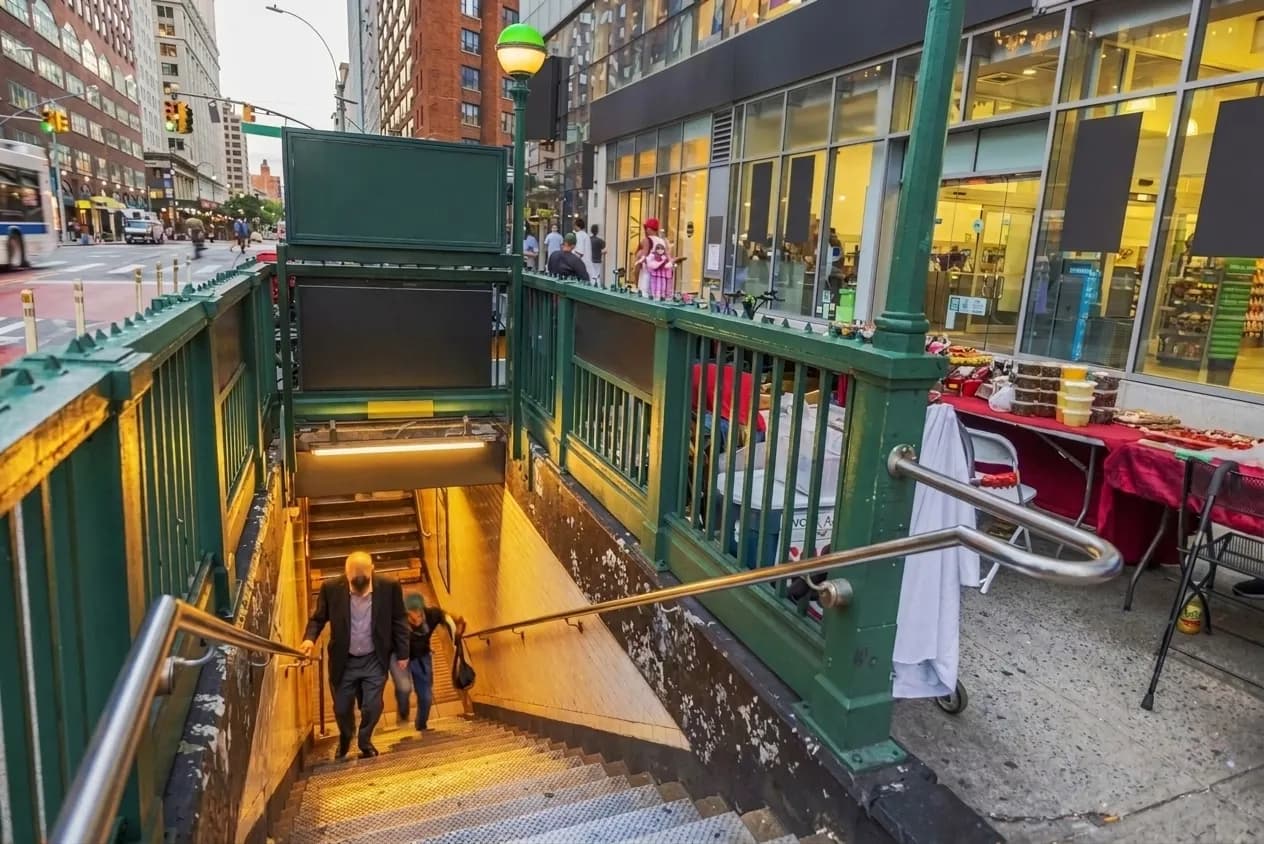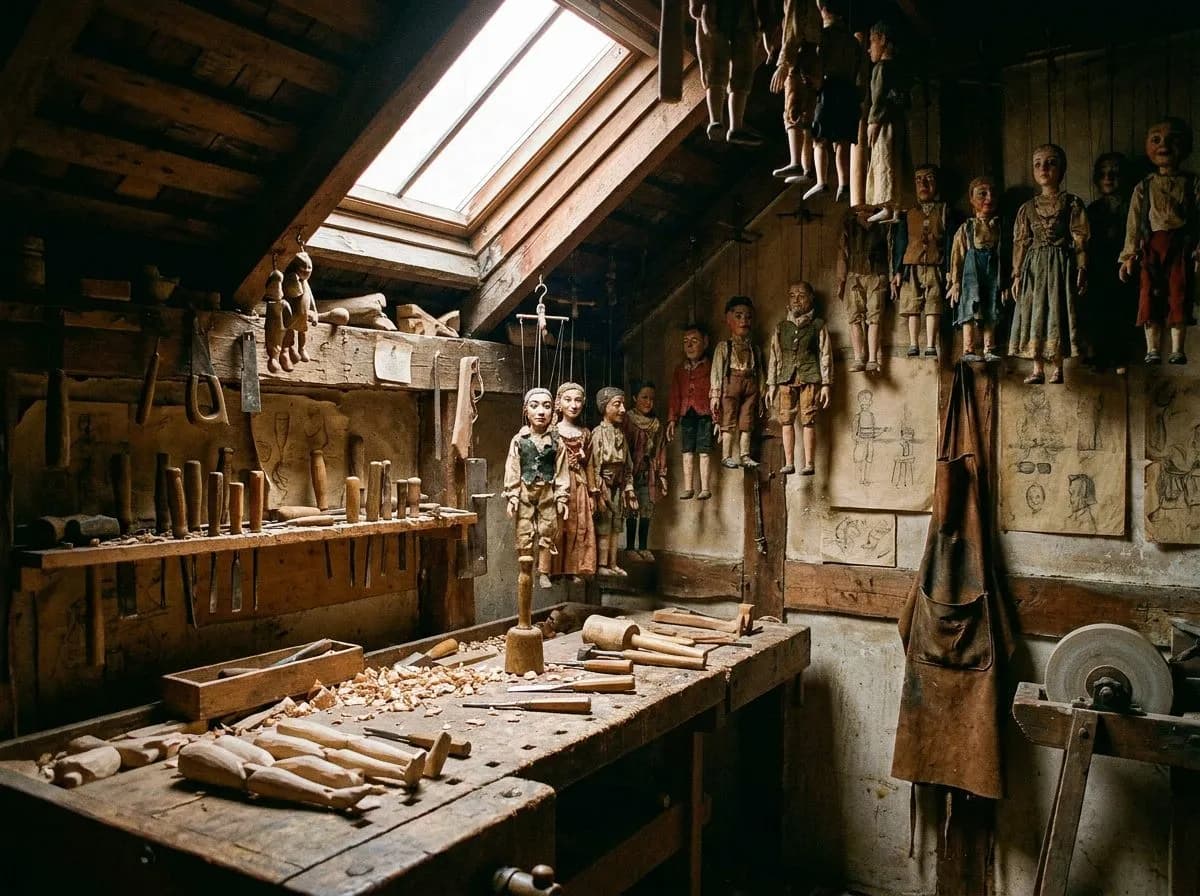
The sixth-floor walk-up on Dyckman Street announces itself with creaking risers and a faint scent of linseed oil that grows stronger as you climb. At the top, beneath a door marked only by a hand-painted eye, lies an attic workshop where marionettes hang like a suspended theater—commedia harlequins, abstract figures with articulated spines, a fox in Victorian dress. Basswood shavings carpet the floor. Jars of acrylic paint line makeshift shelves. This is the domain of a puppeteer who carves, strings, and animates wooden figures with the kind of patient obsession that feels increasingly rare in a city governed by speed. It's the sort of discovery that makes Inwood feel less like the edge of Manhattan and more like its best-kept annex.
The Workshop Itself
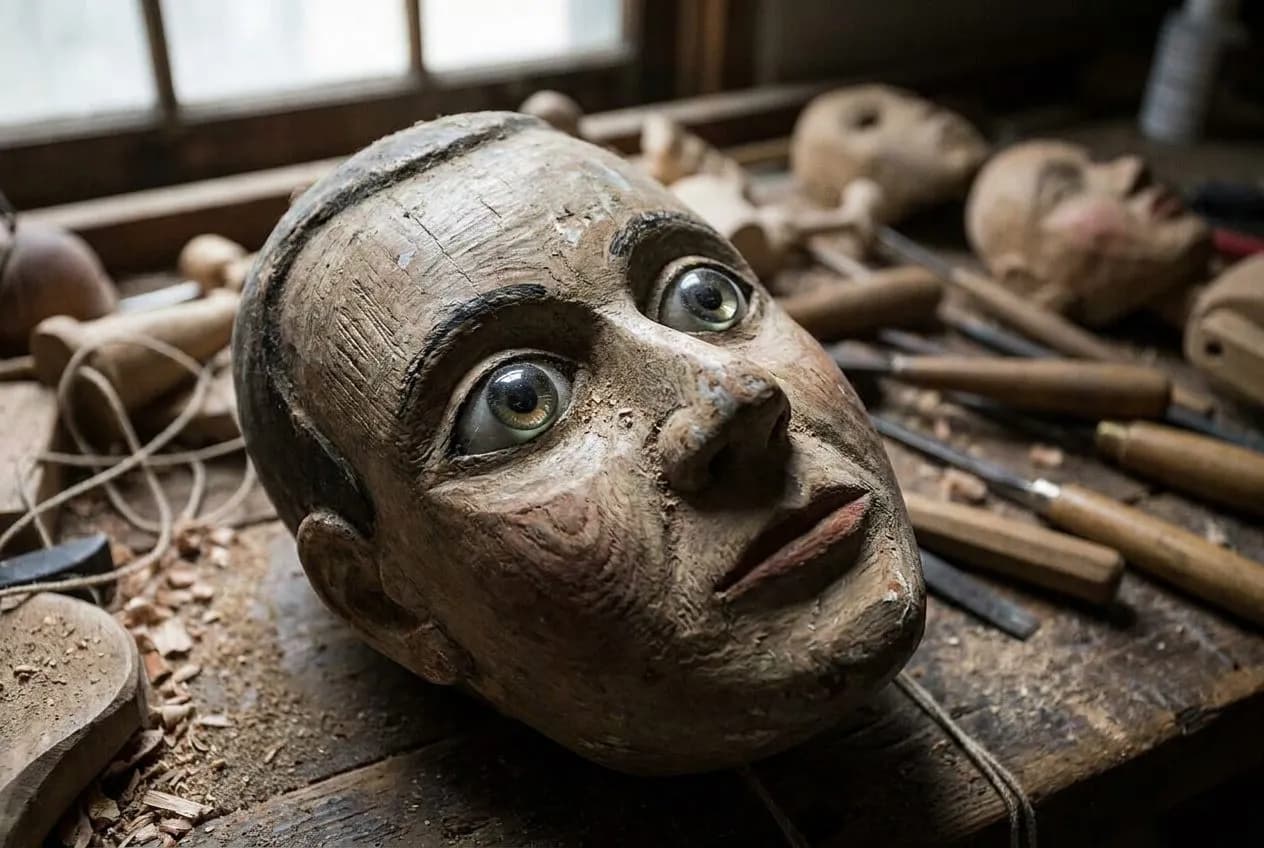
The attic's geometry is all compromise: slanted ceilings, dormer windows that let in sharp afternoon light, exposed beams hung with marionettes in various states of completion. Some dangle from S-hooks, limbs swaying gently when the radiator kicks on. Others rest on a worktable scarred by chisel marks, their control bars laid beside them like surgical instruments. The puppeteer works in a rotating circuit—carving jointed limbs one week, stringing braided nylon through drilled holes the next, testing movement by the glow of an old brass lamp that casts exaggerated shadows on the sloped walls.
Materials accumulate in logical clusters: blocks of basswood stacked by the east window, jars of miniature brass hinges, spools of thread in jewel tones. The air smells of wood dust and paint thinner, occasionally cut by the sharp tang of varnish. In late spring, when the dormer windows crack open, the sounds of Dyckman Street—car horns, cumbia from a passing radio—drift up and mingle with the soft clatter of carved hands being fitted to wrists.
A Signature Piece That Never Performs
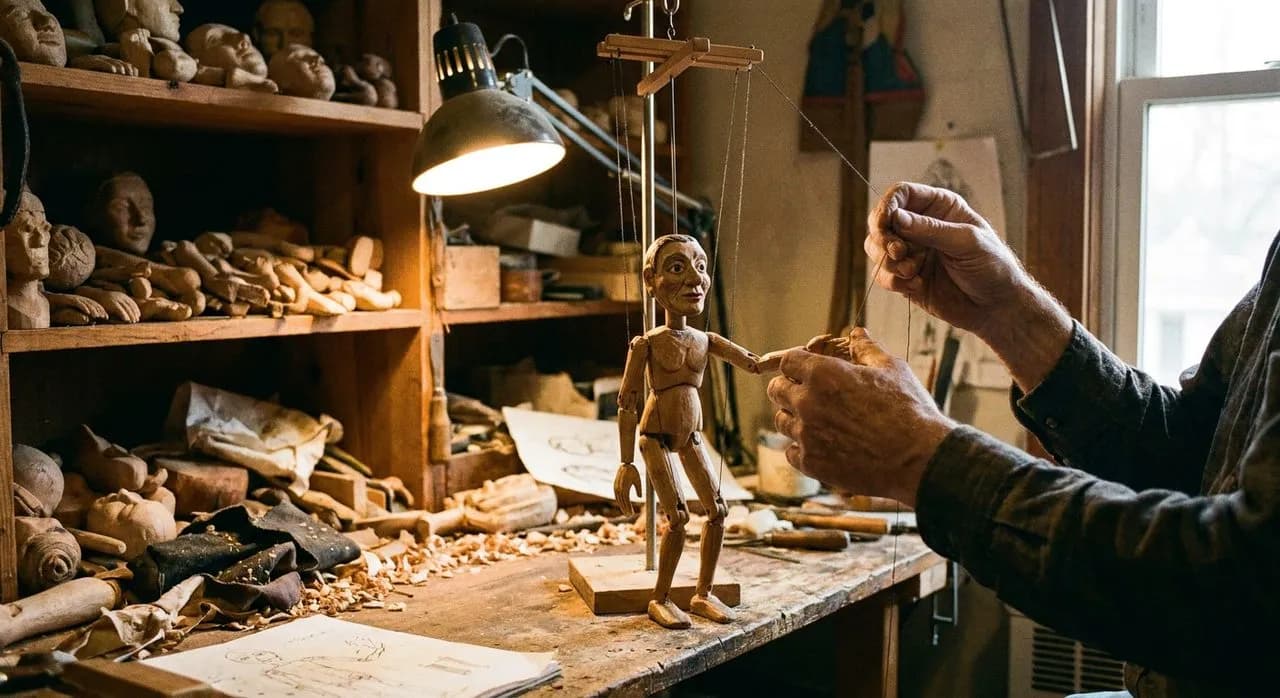
Near the west window hangs a harlequin marionette that commands immediate attention: diamond-patterned motley in faded reds and golds, a porcelain-white face with arched brows, hands carved in a gesture of theatrical surprise. This is the puppeteer's signature piece, used to test new stringing techniques and calibrate the tension of control bars before applying those lessons to commissioned works. Its limbs move with uncanny fluidity, joints articulated to a degree that borders on the eerie.
Yet this harlequin has never been performed publicly. It remains a studio fixture, a kind of living notebook where experiments in weight distribution and pivot points are logged in wood and string rather than ink. Visitors often ask if it's for sale; the answer is always a polite shake of the head. Some tools are too useful to let go.
Monthly Performances for Eight
Once a month, the attic transforms. Floor cushions appear in a semicircle. A portable lamp rig is clamped to a beam. Private marionette performances are scheduled the third Saturday of each month at seven p.m., with seating limited to eight guests on those same cushions. The performances unfold without amplification or recorded sound—just the creak of control bars, the soft tap of wooden feet on a makeshift stage, and occasional live narration in a low, unhurried voice.
Repertoire varies. One evening might feature a wordless adaptation of a commedia scenario; another, an original piece involving abstract figures that suggests emotion through posture and rhythm alone. The intimacy is unavoidable. You can see the puppeteer's fingers adjust tension mid-scene, hear the faint whisper of nylon against wood. It's theater at its most elemental, and the slanted ceiling makes every movement feel magnified.
For those plotting summer travel itineraries, these monthly slots book quickly—often weeks in advance. The format makes spontaneity difficult, but the payoff is an experience that feels handmade in every sense.
The Postcard Protocol
There is no website, no email address, no DM portal. Inquiries are accepted by mail, with contact details provided separately. Responses typically arrive within two weeks, handwritten in fountain pen on heavy cardstock. The script is precise, almost calligraphic, and includes available dates, a gentle reminder about the eight-person cap, and directions for the final flight of stairs.
The analog barrier filters for a certain kind of visitor: those willing to write by hand, affix a stamp, and wait. It also lends the whole enterprise a storybook quality, as though you've stumbled into correspondence with a character from another century. In practice, it's simply a way to manage demand without the noise of modern booking platforms.
Commedia Roots and Abstract Departures
The marionettes themselves span a stylistic range. Commedia dell'arte figures—Pulcinella with his hooked nose, Columbina in ruffled skirts—populate one corner of the workshop, their proportions exaggerated for comic effect. Elsewhere, abstract pieces experiment with form: a figure composed entirely of interlocking geometric shapes, another with limbs that taper into ribbons. All are carved from basswood, chosen for its fine grain and ease of detailing.
Painting happens in stages. Base coats dry on a rack near the window; finer details—eyelashes, the dapple of light on a cheek—are applied under magnification. Some faces are realistic, others stylized to the point of mask-like abstraction. The puppeteer's aesthetic leans toward the theatrical rather than the sentimental; these are performers, not toys.
Why Inwood, Why Now
Inwood's affordability and relative quiet make it hospitable to projects that require both space and concentration. The neighborhood lacks the foot traffic of lower Manhattan, but that's precisely the point. This attic studio exists because rents elsewhere would crush it, and because the puppeteer values the kind of slow, iterative work that doesn't play well with constant interruption.
In the broader landscape of late-2026 New York—where artisan revivals and analog counter-movements continue to gather momentum—places like this feel both anachronistic and oddly prescient. The city's most compelling creative work often happens in margins like these: walk-ups, attics, borrowed basements. You just have to know where to climb.
Practical notes
The attic studio is located in Inwood; the precise street number is not specified. Nearest subway: the Inwood area is served by the A train at Dyckman Street, then a short walk. Street parking is typically available along side streets. The sixth-floor walk-up has no elevator; accessibility is limited. Performances occur monthly on the third Saturday at 7 p.m., seating eight. Send postcard inquiries to 'Attic Marionettes' with return postage; responses arrive handwritten within two weeks. Bring curiosity and patience; the climb is worth it.
Tags: #HandCarvedPuppetry #MarionetteWorkshop #InwoodNYC #AtticStudio #TheOddEdit #HiddenNewYork #PuppetTheater #ArtisanCraft #DyckmanStreet #NYCMarionettes #UpperManhattan #IntimatePerformance #WoodenMarionettes #SpringInNYC #SlowCraft
Sources consulted: Marionette · Inwood, Manhattan · Theater in NYC · Inwood Hill Park · MTA Maps
All trademarks are the property of their respective owners.