The stairwell smells of linen and hide glue. Four flights up from the sidewalk chaos of West 38th Street, past garment wholesalers and delivery carts, a narrow door opens onto a loft where every horizontal surface holds bone folders, thread spools, and stacks of buckram waiting to be cut. This is not a gallery disguised as a workshop. It is a working bindery—one artisan, a few hundred square feet, and the patient accumulation of tools that have outlasted their original owners.
The room and its rhythms
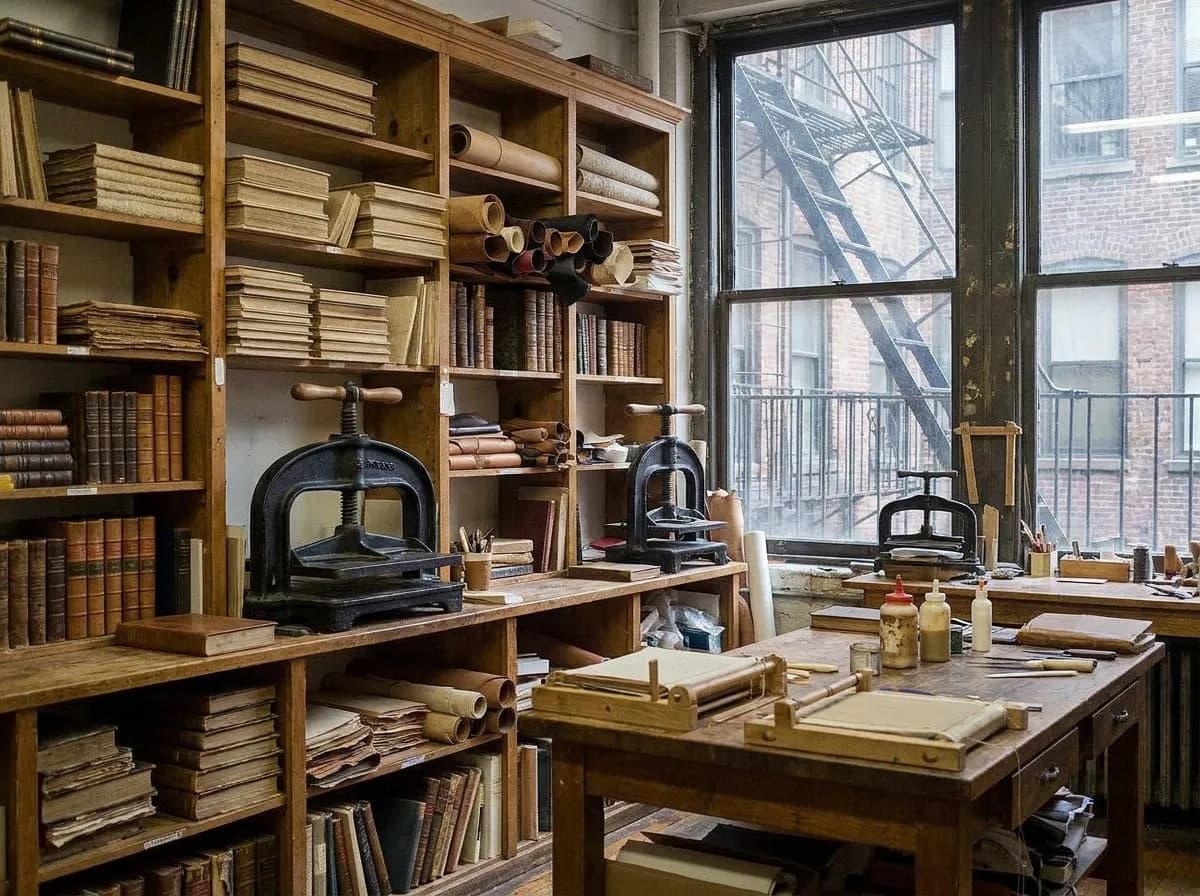
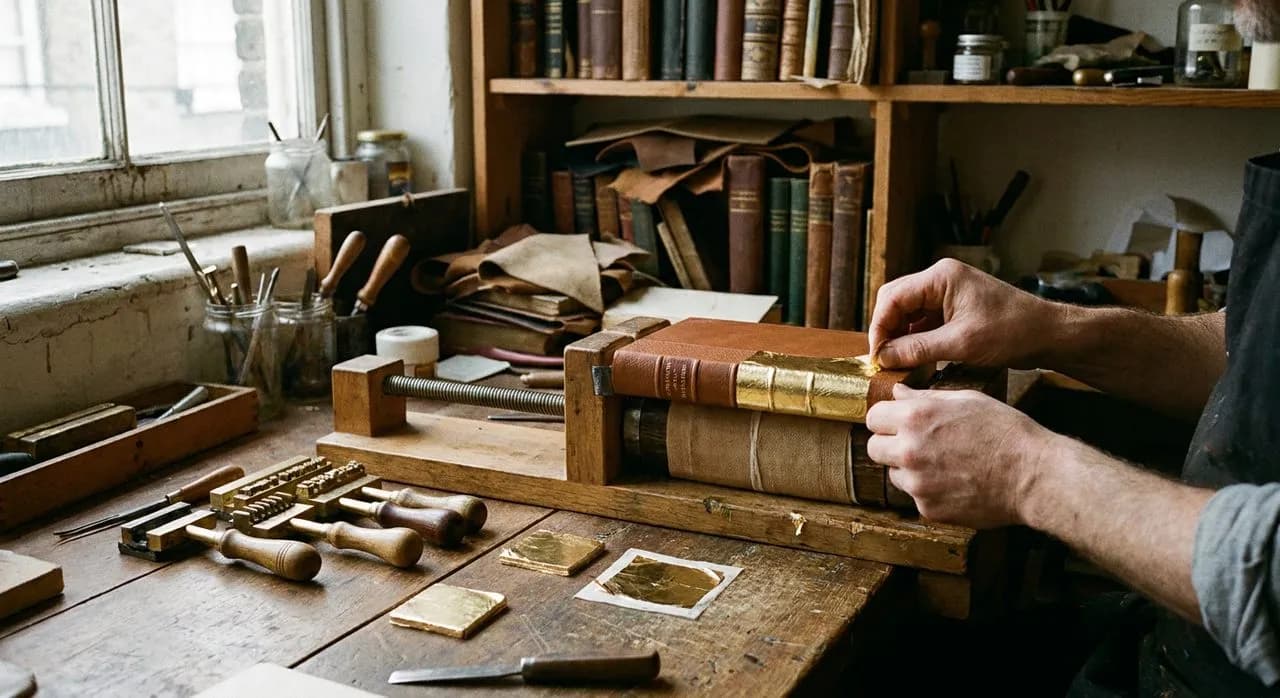
Afternoon light slants through tall west-facing windows, catching the iron frame of an 1890s Vandercook proof press that still earns its keep. The press sits near the glass, a monument to an era when printing and binding occupied the same room. Today it foil-stamps title panels onto custom archival boxes—brass type locked into the chase, gold leaf applied with the kind of pressure that makes the whole frame shudder slightly. The scent is part metal, part beeswax, part old paper.
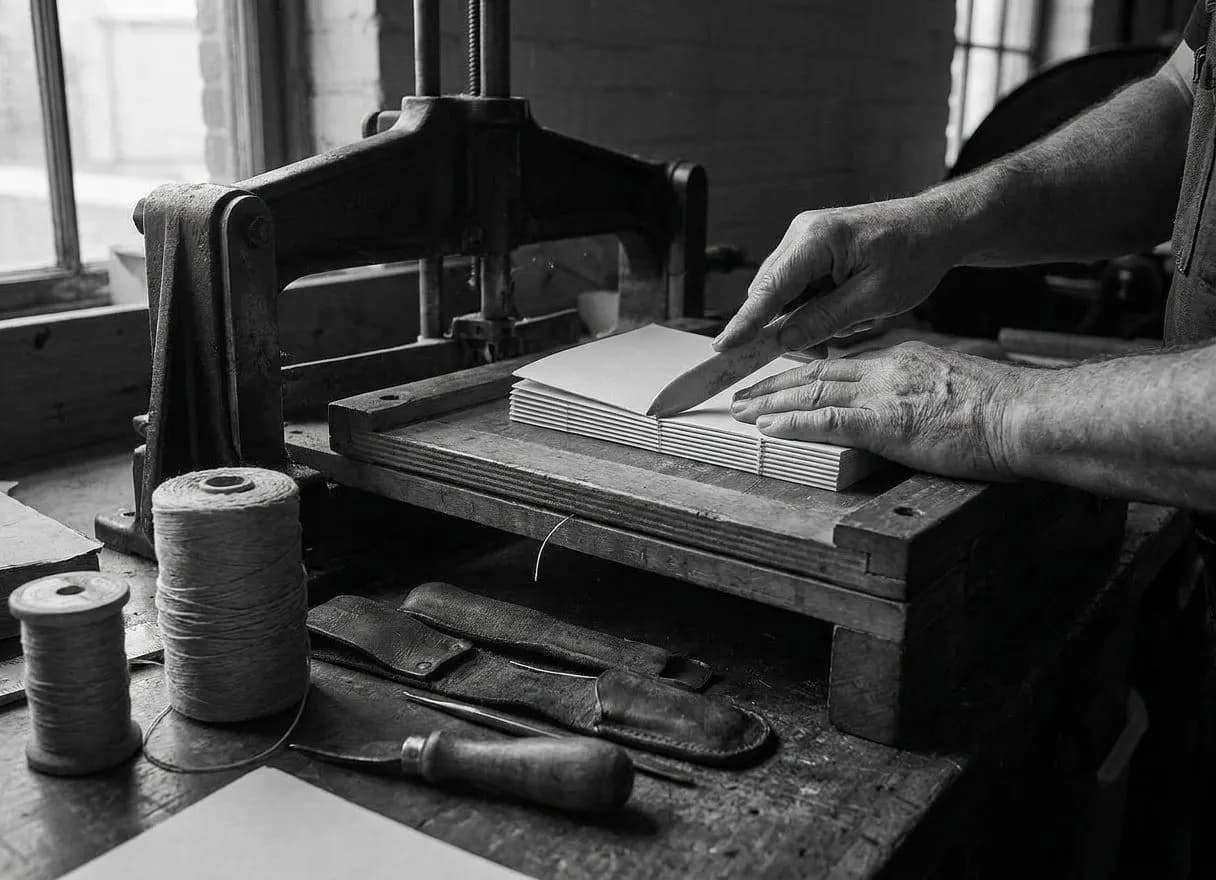
Surrounding the press: a nipping press for flattening sewn signatures, a guillotine trimmer with a foot pedal, jars of wheat paste, rolls of Japanese tissue for mending torn leaves. Everything here has a function. Nothing is ornamental. The winter light in late 2026 feels appropriate—this kind of book conservation work has always been a cold-season trade, when humidity drops and leather behaves.
What arrives for repair
The work ranges from pragmatic to precious. Family Bibles with detached boards. Mid-century first editions whose spines have given way. Nineteenth-century ledgers from estate sales, their pages still foxed but structurally sound enough to warrant a second binding. Occasionally, a private library sends over a folio that needs re-backing or a new slipcase. The artisan does not advertise. Word moves through antiquarian dealers, auction house staff, and the small cohort of collectors who care about endpapers.
This is not fast work. A full rebind can take weeks. Sewing on linen tapes. Reinforcing the spine with mull. Shaping new boards. Paring leather so the turn-ins lie flat. The bindery operates on a timeline that pre-dates overnight shipping, and clients who find their way here understand that.
The house style
Ask for quarter-leather with marbled endpapers, and you will receive the house style—a treatment that balances durability with a certain restrained elegance. The leather runs along the spine and corners; cloth or decorative paper covers the boards. Marbled endpapers, hand-combed in traditional patterns, line the interior. Pricing varies by job; verify current rates directly before publishing. It is not inexpensive. It is also not mass production.
The marbled papers come from a supplier in Brooklyn who still uses carrageenan size and oil paints floated on water. The leathers—goat, calf, occasionally morocco—are sourced through a tannery that serves theatrical costume shops and museum conservators. The result is a binding that will outlast its owner, assuming reasonable care.
Walking in
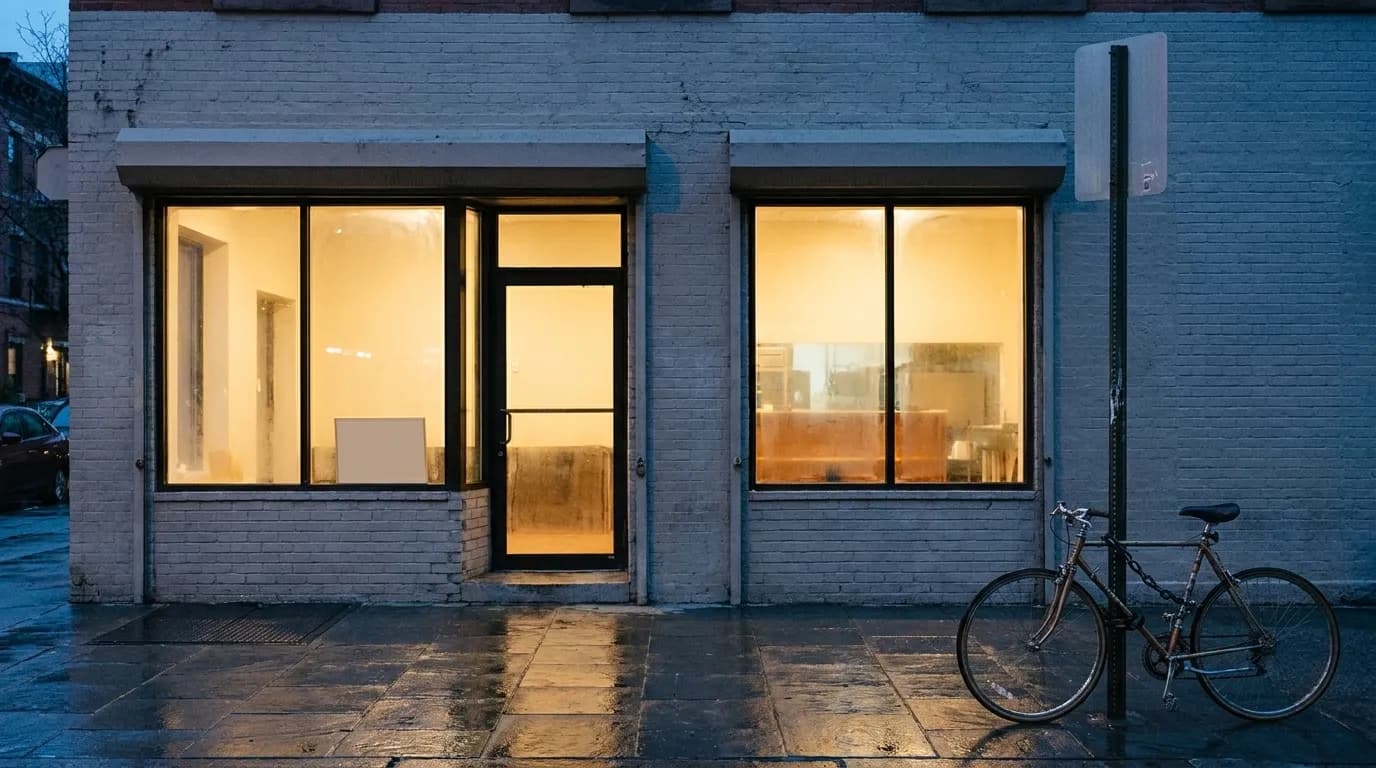
This is not a storefront. There is no bell. On Tuesdays and Thursdays between two and five in the afternoon, walk-in consultation hours are observed—knock, wait, and if the artisan is not mid-bind, the door opens. Other days require an appointment, and the appointment system is itself a throwback: you send a query by mail, and if the work fits the schedule, a handwritten postcard arrives in return with a date and time. No email. No online booking. The system filters for a certain kind of client.
During walk-in hours, bring the book or a clear photograph if the volume is too fragile to transport. Be prepared to discuss the intended use. A display-only rebind can prioritize aesthetics; a working ledger needs a different spine structure. The conversation is technical but not condescending. This is someone who has spent years learning to read the way a text block sits in its case, and who trusts you to know what you need.
Tools as inheritance
Many of the tools here are older than the building. Bone folders worn smooth by decades of hands. A cast-iron finishing press with brass accents, still capable of even pressure across a full folio width. Typeholder and finishing tools—small brass stamps for borders and corner ornaments—stored in wooden trays that suggest apothecary more than print shop. The Vandercook is the star, but these smaller instruments do much of the daily work.
There is no romance in calling this an artisan bindery if you mean something quaint or boutique. It is artisan in the older sense: mastery of a specialized trade, maintained through repetition and a refusal to shortcuts. The work is manual, material, and utterly unscalable. Which is, depending on your disposition, either a fatal flaw or the entire point.
Why it persists
By late 2026, most commercial binding happens overseas or via print-on-demand lines that can case a book in seconds. What survives here is the work that resists automation—repairs that require judgment, custom dimensions, materials that do not come in bulk. The clientele skews toward private collectors, rare book dealers, and the occasional institution willing to pay for conservation-grade treatment. It is a narrow niche. It is also, evidently, enough.
The garment district context matters. This neighborhood has always housed trades that deal in material and hand skill—patternmakers, sample makers, people who solve problems with fabric and thread. A bookbinder fits. The rent, while not cheap, remains more plausible than a ground-floor storefront in a gentrified corridor. The walk-up keeps out the casual browser. What remains is a practice, steady and unshowy, doing what it has always done.
Practical notes
The bindery occupies a loft in Manhattan’s Garment District; verify the exact street address before publishing. Nearest subway: verify stations and service lines directly before publishing. Street parking is difficult; garage rates nearby run $30–$45 for a few hours. Walk-in consultation: Tuesdays and Thursdays, 2–5 p.m.; other times by mailed appointment only. No elevator; four-flight walk-up. Bring the book or detailed photographs, and patience. Cash or check preferred. Verify current hours and appointment protocol directly before visiting.
Tags: #HandBoundLedger #GarmentDistrict #ArtisanBindery #BookConservation #NYCCraftsmen #TheOddEdit #WinterInNYC #MidtownManhattan #RareBooks #TraditionalCrafts #BookRepair #FolioBindery #NYCHiddenGems #VintagePress #SlowCraft
Sources consulted: Bookbinding · Garment District, Manhattan · NYC Garment District · Time Out New York Shopping · New York Times - NY Region
All trademarks are the property of their respective owners.