A Walk That Uses the City's Geometry
The Brooklyn waterfront from Greenpoint south to the Williamsburg Bridge is, on a map, a long shoreline that runs roughly two miles along the East River. On the ground, it is one of the city's most dramatic transitions: from a working industrial port to a converted post-industrial waterfront to a residential neighborhood to the foot of one of the city's three iconic East River bridges.
This walk uses that transition. It starts on a ferry — which is the part of the walk that gets you to the start without taxis or trains — and ends with a bridge crossing into Manhattan. The middle is two miles of waterfront promenade.
Total walking time: about 90 minutes including the bridge crossing. Total cost: the ferry fare ($4.50) and a coffee. Best executed on a Saturday late afternoon, ending on the bridge at sunset.
Why the Ferry First
The East River Ferry's Greenpoint stop is at the foot of India Street, on a small pier built in 2010 as part of the city's NYC Ferry network expansion. The ferry from Wall Street's Pier 11 to India Street takes about twenty minutes and runs every twenty to thirty minutes through the day.
The point of starting on the ferry is the angle of arrival. By the time you land at India Street, you have crossed the East River from the south, passed under the Williamsburg Bridge, and watched the Greenpoint waterfront rise up from the water. The walk south, starting on land, is then a slow reapproach to the bridge you have just passed under.
The other option is to take the G train to Greenpoint Avenue and walk to the pier. This works, but you miss the part of the experience where the route is framed by water.
Greenpoint's Waterfront
Greenpoint is the northernmost neighborhood in Brooklyn — a long peninsula bordered by Newtown Creek to the north and the East River to the west. It has been an industrial neighborhood since the 1860s, when shipbuilding and oil refining moved in. The Greenpoint Manufacturing and Design Center, the Greenpoint Renaissance Enterprise Corporation, and a number of converted-warehouse residential and commercial buildings still occupy the waterfront.
The walk south from the India Street pier picks up the WNYC Transmitter Park first — a small waterfront park on the site of an old radio transmitter complex, opened in 2012 — then continues through a series of newer waterfront developments. The walk is along the East River Esplanade where it has been built, with some short detours through neighborhood streets where the esplanade has not yet been completed.
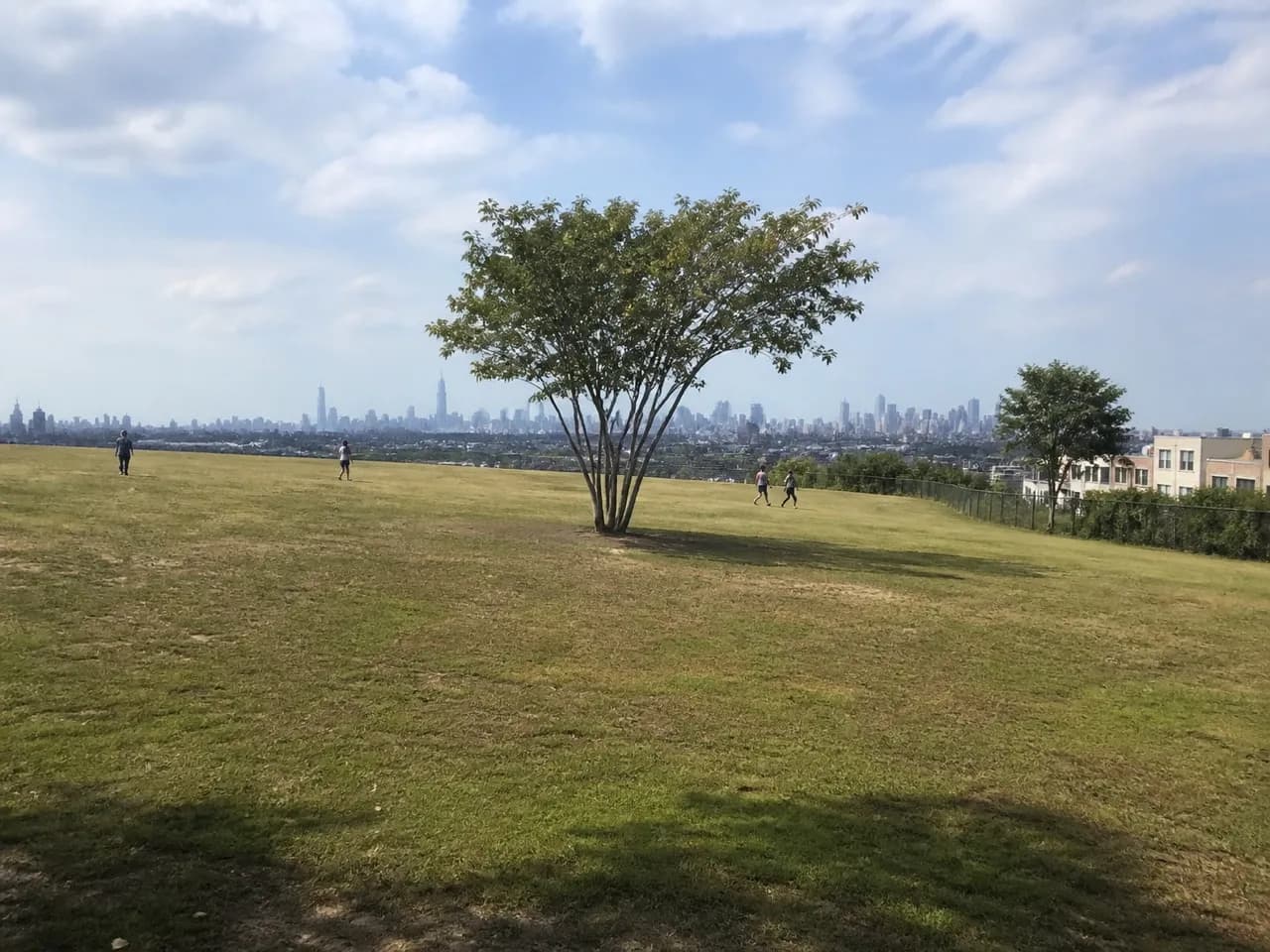
The most distinctive thing about the Greenpoint stretch is the views west. Manhattan is directly across the river. The Empire State Building, the Chrysler, the One World Trade — the entire Midtown and Lower Manhattan skylines are in view, framed across about half a mile of water. The angle of view is unusual: most Brooklyn waterfront walks look at Manhattan diagonally. This one looks at it head-on.
At the south end of the Greenpoint stretch, around Quay Street, the walk transitions into Williamsburg.
Williamsburg's Waterfront
Williamsburg's waterfront has gone through three lives in the past century: industrial (sugar refining, shipbuilding, oil), abandoned (1970s-2000s), and converted (2010s onward). The current state is the third life — a continuous strip of new luxury residential development on the inland side, fronting onto a public waterfront esplanade that has been built incrementally over the past fifteen years.
The most photographed building on this stretch is the Domino Park — the converted Domino Sugar Refinery, whose 1882 brick syrup-house has been preserved as a public sculpture against the surrounding new towers. Domino Park itself, designed by James Corner Field Operations (the firm that did the High Line), opened in 2018 and runs about a quarter-mile along the river.
The park is the heart of the walk. The design uses the salvaged industrial equipment from the sugar refinery — the bucket cranes, the syrup tanks, the conveyor systems — as the park's furniture. Some of the equipment is functional (the kids' splash pad runs through old sugar piping), some of it is purely sculptural (the row of derelict cranes that frames the eastern edge of the park).
The food kiosks in Domino Park — Tacocina, the food trucks at the southern end — are reliable. The lawn is open. The view across to Manhattan is, like in Greenpoint, head-on.
The North 5th Street Stretch
South of Domino, the waterfront walk passes through a series of newer parks and esplanades — Bushwick Inlet Park's western edge, the Marsha P. Johnson State Park (formerly East River State Park, renamed in 2020 for the Stonewall-era activist), and the smaller waterfront slivers along the East River.
Marsha P. Johnson State Park is the largest of these. It was the site of the original Brooklyn Brewery beer-and-barbecue Saturdays in the 2000s before it became a state park, and the lawn still has the loose, communal feeling of those earlier years. The park is busy on a summer Saturday. It is quieter on a Sunday morning.
The Smorgasburg market, when it is running (Saturdays April through October), takes over Marsha P. Johnson State Park from 11:00 a.m. to 6:00 p.m. The market is the city's largest open-air food market — about a hundred vendors, mostly Brooklyn operators. If your walk lands on a Saturday, build in an hour for lunch.
The Approach to the Bridge
South of Marsha P. Johnson, the waterfront walk thins out. The esplanade transitions back to street walking — Kent Avenue and then North 6th — for a few blocks before you reach the Williamsburg Bridge's pedestrian entrance at South 5th Street and Bedford Avenue.
The bridge entrance is on the south side of South 5th, just west of Berry Street. The entrance is signed but not obvious; look for the steel walkway ramp on the south side of the street.
The pedestrian walkway runs the full length of the bridge — about 1.5 miles from the Williamsburg entrance to the Delancey/Essex entrance on the Manhattan side. The walkway is wide, separated from car traffic by a fence, and has its own staircase. Bicycles use a separate lane on the bridge's north side.
Crossing the Bridge
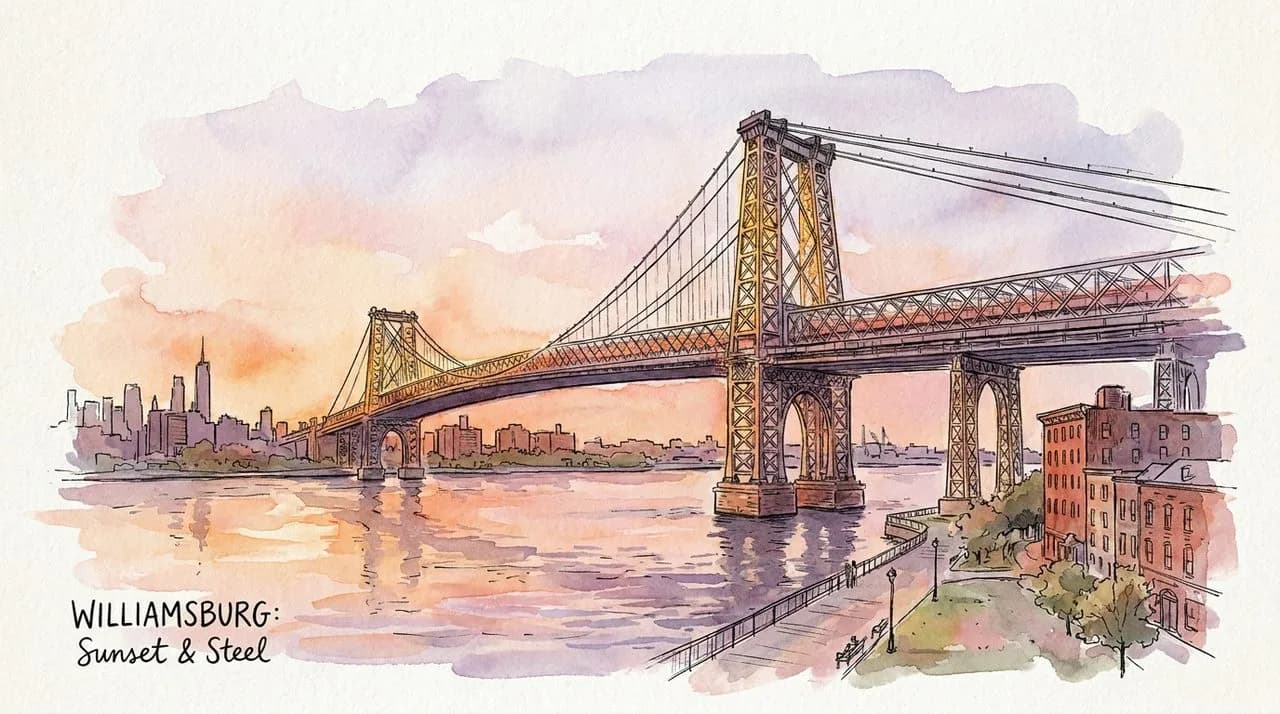
The Williamsburg Bridge opened in 1903 as the second of the three East River suspension bridges. It is the longest of the three by span — 1,600 feet between towers — and the most industrial in design: lattice-steel towers, exposed structure, none of the masonry that gives the Brooklyn Bridge its monumental feel. Its design language is, in its own way, the more honest architectural statement.
The crossing on foot takes about 25 minutes at an unhurried pace. The walkway climbs gradually to the center of the bridge, where you are about 130 feet above the river. The views from the center span are wide: the Brooklyn Bridge to the south, the Manhattan Bridge between, the Manhattan skyline directly ahead, the Domino Park you just walked through behind.
The middle of the bridge is the photograph. The sunset, on a Saturday in summer, hits the steel towers and the Manhattan skyline behind them at about 8:00 p.m. The walkway is a public space — you can stop, lean on the railing, take twenty minutes. There is no rule against it.
The Manhattan exit drops you onto Delancey Street, on the Lower East Side. The Essex-Delancey F/M/J/Z station is a two-minute walk west. The walk into the East Village or to a slice of pizza at Joe's on Carmine Street is fifteen to twenty minutes south.
When to Walk It
Late afternoon, ending on the bridge at sunset, is the canonical version. Start the ferry around 5:30 p.m. Arrive at Greenpoint by 6:00. Walk south, with stops at Domino and Marsha P. Johnson, ending at the bridge entrance around 7:30. Cross the bridge by 8:15. Arrive on the Lower East Side just after sunset.
For the morning version, start the ferry at 9:00 a.m. The walk is quieter, the parks are emptier, and the Williamsburg coffee shops are doing their best business. End on the bridge by 11:00 a.m. and have an early lunch on the Lower East Side.
For the rain version, the route still works — the bridge's pedestrian walkway is partially covered in spots and the parks have indoor coffee shops nearby. Bring a jacket.
Why It Holds
The walk holds because it gives you New York from three angles: the city seen across water from a boat, the city walked through at the level of the new development, and the city crossed on foot via the bridge that connects the two boroughs. Most New York walks give you one of those. This one gives you all three in 90 minutes.
It is also, importantly, a walk on the kind of public infrastructure — ferries, riverfront parks, pedestrian bridges — that the city has been building incrementally for the past twenty years and that mostly does not get celebrated. The route exists because of a long series of small public-works decisions. It is worth using.
Practical notes
- Start: Wall Street/Pier 11 ferry to India Street, Greenpoint. East River Ferry, $4.50.
- End: Williamsburg Bridge Manhattan entrance at Delancey/Essex. F/M/J/Z subway.
- Distance: ~3.5 miles total including bridge. ~90 minutes walking.
- Don't miss: Domino Park's preserved sugar refinery, Marsha P. Johnson State Park lawn, the bridge center span.
- Best time: Saturday late afternoon ending on the bridge at sunset.
- Pairs well with: Smorgasburg at Marsha P. Johnson (Saturdays April–October), dinner on the LES after.
#williamsburgbridge #greenpoint #williamsburgnyc #dominopark #brooklynnyc #longwayhome #nycwalking #eastriver #nycwalkways #karpofinds #nyclocalknowledge #hiddennyc #weekendnyc #brooklynculture #nycparks
Sources consulted: NYC Ferry · Brooklyn Bridge Park Conservancy · NYC Parks · The New York Times · Curbed NY
All trademarks are the property of their respective owners.