When grasshopper fire headlines remind renters that wildfire season demands action, San Francisco Public Library branches provide a practical starting point for first-time preparedness planning. Across the city's twenty-eight neighborhood locations—from the Main branch at 100 Larkin Street to smaller outposts like Ocean View at 345 Randolph Street—free wildfire-preparedness resource corners offer printed guides, evacuation-checklist handouts, and air-quality monitor lending programs designed for patrons who've never assembled an emergency kit. For renters sharing apartments and coordinating weekend afternoon planning sessions with roommates, these library resources eliminate the guesswork of what belongs in a go-bag, though the anxious-but-organized beginner should verify branch hours, equipment availability, and whether air-quality monitors require library-card holds or deposits before making the trip.
Text Karpo your SF neighborhood, whether you need Spanish or Chinese materials, and if you want to borrow an air-quality monitor. We'll send three library branches with wildfire-resource corners and current lending availability, plus one online preparedness checklist if branches are closed.

What Library Preparedness Corners Actually Stock
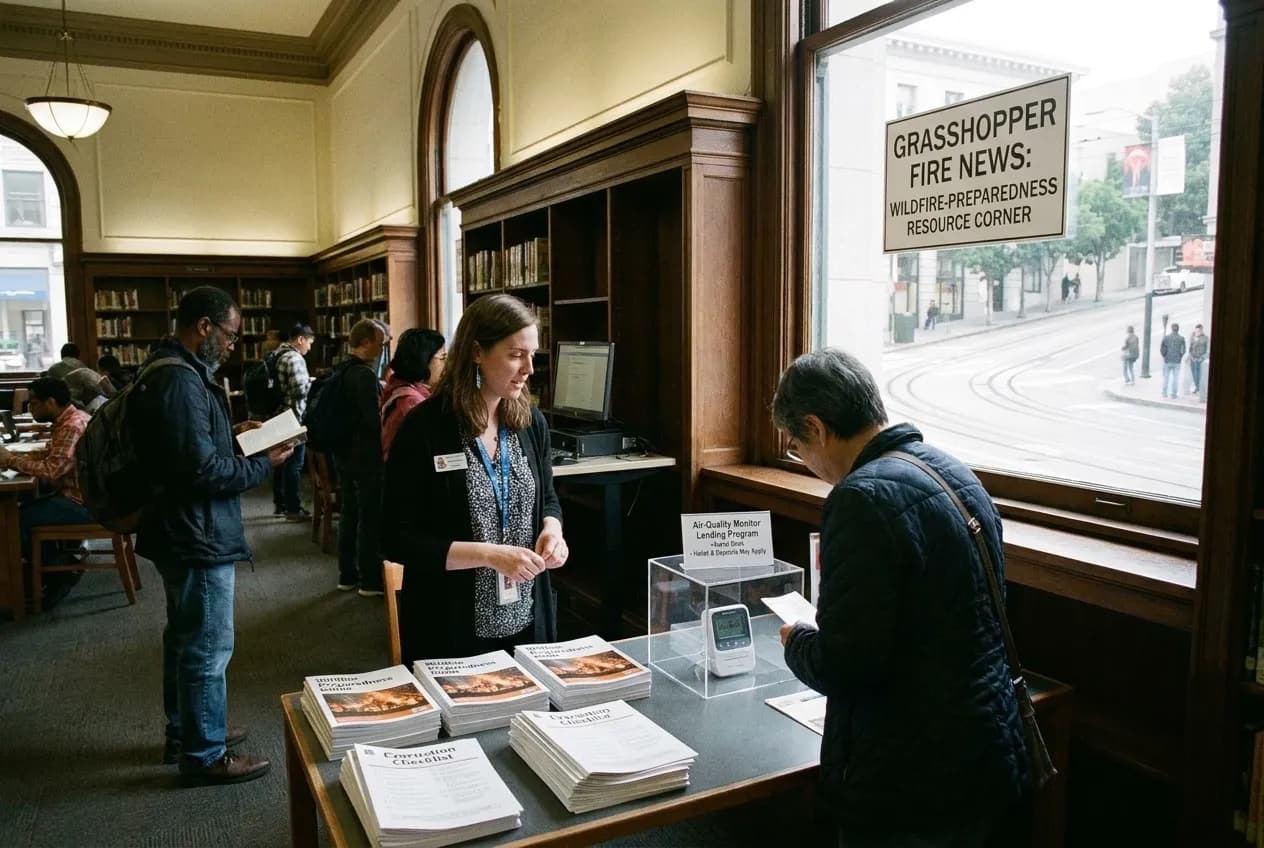
San Francisco branch libraries maintain wildfire-preparedness resource corners with printed evacuation checklists, neighborhood-specific hazard maps, and multilingual guides that outline essential go-bag contents—flashlights, batteries, first-aid supplies, copies of rental agreements, and three days of non-perishable food. These materials cost nothing and require no library card to take home, making them accessible to renters who've just moved to the city or those building their first emergency kit on a weekend afternoon. The tradeoff: printed guides can't answer specific questions about your building's evacuation plan or whether your landlord maintains fire-safety equipment, so renters should treat library materials as a foundation rather than a complete solution.
Air-quality monitor lending programs represent the library system's most distinctive preparedness resource, allowing patrons to borrow portable devices that measure particulate matter during wildfire-smoke events. However, availability varies by branch, and some locations require a library card in good standing, a deposit, or advance reservation during peak fire season. Renters planning a Saturday visit to Bayview (5075 3rd Street, open 10–6) or Excelsior (4400 Mission Street, open 10–6) should call ahead to confirm whether monitors are in stock and what the checkout process entails, since walking away empty-handed after a cross-town Muni trip defeats the purpose of organized preparedness planning.

Navigating Branch Hours and Geographic Spread
San Francisco Public Library's twenty-eight branches follow varied schedules, with most neighborhood locations opening at 10 a.m. or later on weekdays and closing between 6 and 8 p.m. depending on the day. Sunday hours typically run 1–5 p.m., while Saturday schedules mirror weekday patterns—a consideration for renters whose weekend afternoon planning window might conflict with branch closures. The Main branch at 100 Larkin Street offers the longest hours (Monday and Tuesday through Thursday 9 a.m.–8 p.m., Sunday noon–6 p.m.), but its downtown location may require a longer Muni commute than a neighborhood branch near your rental apartment.
Geographic spread matters when you're balancing preparedness tasks with other weekend errands. A renter in the Richmond District can walk to Richmond branch (351 9th Avenue) or Anza branch (550 37th Avenue), while someone in the Mission might choose between Mission branch (1234 Valencia Street) and Bernal Heights (500 Cortland Avenue). The tradeoff between proximity and resource depth: smaller branches may stock fewer air-quality monitors or have limited copies of specialized guides, while larger branches like Main or Mission Bay (960 4th Street) typically maintain deeper inventories but draw larger crowds. Calling ahead confirms whether your nearest branch has the specific materials you need, avoiding a wasted trip during your limited planning time.
Library Card Requirements and Deposit Policies
Most printed wildfire-preparedness materials require no library card—you can walk into any branch, pick up evacuation checklists and go-bag guides, and leave without registering. Air-quality monitor lending programs, however, often require a San Francisco Public Library card in good standing, meaning no overdue items or unpaid fines. Renters who've never used the library system should budget extra time on their first visit to register for a card, which typically requires proof of San Francisco residency such as a lease agreement, utility bill, or California ID showing a local address. Roommates can each obtain individual cards, allowing both to borrow monitors if your apartment needs multiple devices for different rooms.
Deposit policies for air-quality monitors vary by branch and aren't uniformly documented online, creating uncertainty for first-time borrowers. Some locations hold a credit card authorization or require a cash deposit refunded upon return, while others simply check out the device like a book with a due date. This inconsistency means calling your target branch—using the phone numbers listed on the library's website—becomes essential preparation before your weekend visit. Renters without credit cards or spare cash for deposits should ask whether alternative arrangements exist, or consider visiting a branch with more flexible policies if the first location's requirements don't match your financial situation.
Coordinating Roommate Visits and Shared Planning
Building a go-bag with a roommate introduces coordination questions that library resources can help answer but not fully resolve. Evacuation checklists typically assume individual preparedness, so renters sharing an apartment must decide whether to pack duplicate supplies (two flashlights, two first-aid kits) or divide responsibilities (one person handles food, the other handles documents). Visiting the library together on a weekend afternoon lets both roommates review the same printed guides and discuss these tradeoffs in real time, rather than one person interpreting the materials and relaying information later. The shared visit also clarifies whether you'll borrow one air-quality monitor for common areas or two for separate bedrooms.
The anxious-but-organized beginner benefits from treating the library trip as a planning session rather than just a materials pickup. Bring a notebook to jot down checklist items you already own versus what you need to purchase, and use the library's quiet space to compare your rental lease's evacuation procedures against the library's generic guidance. Some branches offer study tables near the preparedness resource corners, making it easy to spread out guides and have a focused conversation with your roommate about who's responsible for grabbing the go-bag if you're home at different times during an emergency. This upfront coordination reduces confusion when actual wildfire smoke arrives and decisions must happen quickly.
Verification Steps Before and After Your Visit
Before visiting any branch, confirm current hours on the San Francisco Public Library website, since schedules occasionally shift for maintenance or staffing changes. The site lists phone numbers for each location—Richmond branch at 415-355-5600, Sunset at 415-355-2808, Chinatown at 415-355-2888—allowing you to call and ask whether wildfire-preparedness materials are currently stocked and whether air-quality monitors are available for checkout. This five-minute phone call prevents a wasted Muni trip and lets you adjust your weekend plans if your preferred branch is closed or out of the specific resources you need. Renters should also verify whether the branch participates in the air-quality monitor program, since not all twenty-eight locations offer the same lending inventory.
After picking up materials, cross-reference the library's evacuation checklists against your building's specific requirements. Does your landlord require tenants to know the location of fire extinguishers or emergency exits? Do you live in a multi-story building where stairwell access matters more than the generic 'have a flashlight' advice? The library guides provide a baseline, but renters must adapt recommendations to their actual living situation—a ground-floor apartment in the Sunset faces different evacuation logistics than a fourth-floor walkup in North Beach. If the borrowed air-quality monitor reveals poor indoor air during a smoke event, the library's guides won't tell you whether to shelter in place or evacuate; that decision depends on your building's ventilation, your health conditions, and real-time official guidance. Treat library resources as one input in a larger preparedness system, not a complete answer to every wildfire scenario.
Tags: #wildfirepreparedness #SanFranciscolibraries #emergencyplanning #airqualitymonitors #renterresources #gobagchecklist #freeresources #neighborhoodbranches #evacuationplanning #fireseasonreadiness
Sources consulted: Source 1: sf.gov · Source 2: sfmta.com · Source 3: sfpl.org · Source 4: sf.gov
All trademarks are the property of their respective owners.
Ask Karpo first
Ask Karpo to turn this San Francisco idea into a current plan for your date, budget, companion, transit preference, and energy level. Karpo can narrow the route and flag what to verify before you go.