A Route the Park Was Built For
Riverside Park is the long, narrow ribbon of green that runs four miles along the Hudson, from 72nd Street up to 158th. Frederick Law Olmsted began it in 1875. Robert Moses, in the 1930s, pushed it west over the railroad tracks and gave it the lawn-and-promenade form it still has. The southern third — between roughly 72nd Street and the George Washington Bridge — is the part most New Yorkers know.
The route the run uses is the lower promenade: a flat, paved path that hugs the river at the water's edge, separated from West Side Highway traffic by a planted berm. From 79th Street, where the Boat Basin sits with its handful of moored sailboats, it runs almost arrow-straight north for three miles to Riverside Drive at 122nd Street, where Grant's Tomb is.
The route is flat. Total elevation change: about thirty feet. Total distance: three miles. Total time, at an unhurried pace: about thirty minutes. Total people you will pass before 6:00 a.m. on a weekday: between two and twelve, almost all of them running too.
Why It's the Cleanest Run in Manhattan
The lower promenade is one of the few continuous, traffic-free, well-lit paved miles in Manhattan. The path is wide enough for two runners abreast plus a passing cyclist. It is fenced from the river on the west side, the West Side Highway is below your sight line to the east, and the only places you cross a roadway are at the path's two underpasses, both signed.
The pavement is in good condition. The lighting, replaced in the late 2010s, is even. The water fountains run April through October. The bathrooms at the Boat Basin and at the 96th Street footbridge are open during park hours, but the path itself is officially open 24 hours.
Most importantly, the route is visible. The Hudson is on your left. The Palisades — the dark wall of basalt cliffs on the Jersey side — fill the western horizon. The sky between them lightens about thirty-five minutes before official sunrise. By the time you reach Grant's Tomb, the sun is clearing the cliffs and the river underneath you turns from gray to gold.
The Sequence
From 79th Street, the path runs through the Boat Basin's marina, past the Soldiers' and Sailors' Monument up on the bluff (1902, marble, easy to miss in the dark), past the 96th Street pedestrian bridge, past the 100th Street community garden, past the spot where Riverside Park widens and you can see the George Washington Bridge clear to the north.
At 110th the path lifts onto a wider esplanade. The Riverside Skate Park is on your right. You are now running along the upper boundary of the Cherry Walk — a half-mile stretch where Japanese cherry trees, planted by a Japanese-American friendship society in 1909 and replanted twice since, are at their best in early April.
At 116th the path curls inland slightly to skirt the West 125th Sewage Treatment Plant — which, on a southerly wind, you may smell — and at 122nd Street you exit the lower path, cross Riverside Drive at the marked crosswalk, and arrive at the foot of Grant's Tomb.
The Tomb Itself
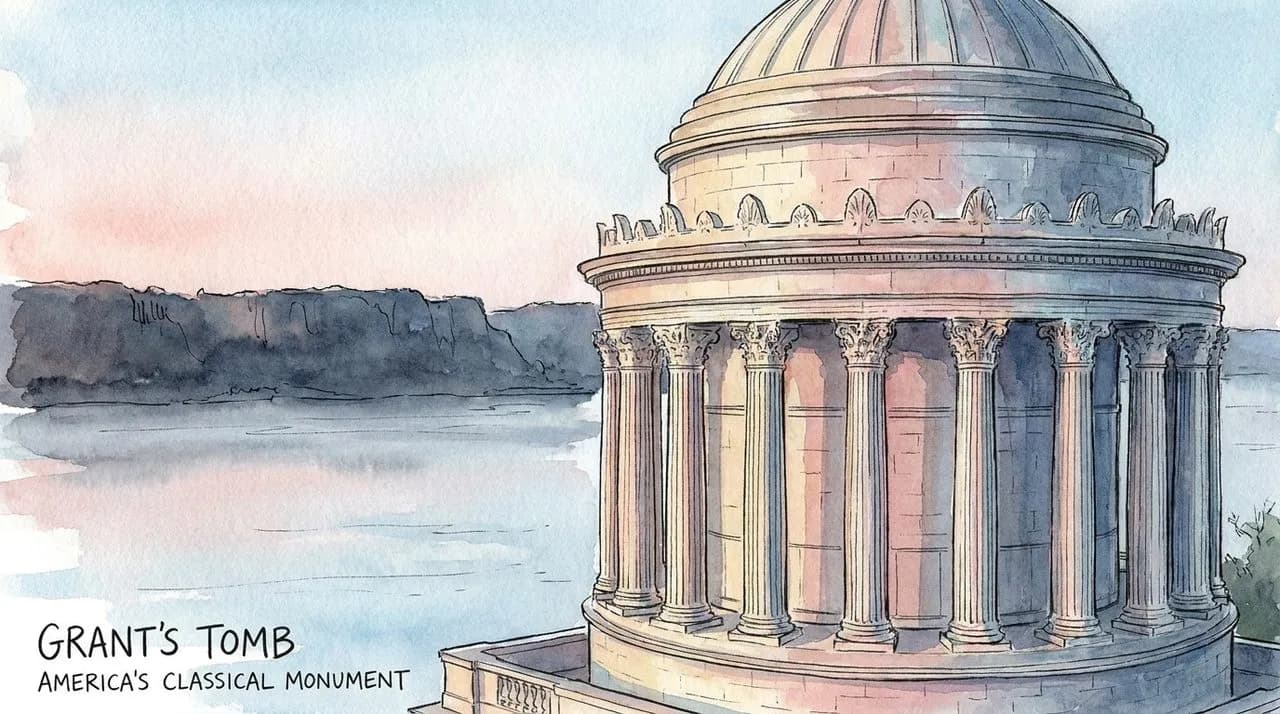
The General Grant National Memorial — its official name — was completed on April 27, 1897, on what would have been Grant's 75th birthday, and dedicated to a crowd estimated at one million people. The architect was John H. Duncan, who modeled the building on the Mausoleum at Halicarnassus, which was one of the seven wonders of the ancient world and which Duncan had never seen because it had been rubble since the fifteenth century.
The result is a granite cube with a Corinthian portico and a saucer dome, sitting on a wide stepped plaza facing the river. Grant and his wife Julia are entombed inside in matching red-granite sarcophagi at the basement level. The interior is open Wednesday through Sunday, 10:00 a.m. to 4:00 p.m. — too late for the dawn route — but the exterior and plaza are open at all hours.
Which is the point. At 6:00 a.m. you finish the run on the steps of the tomb. The plaza is empty. The dome catches the morning sun about ten minutes before the surrounding apartment buildings do. The view back down the Hudson is wide open. You sit on the stairs. You drink the water you brought.
The Mosaic Benches You Probably Missed
Behind the tomb, in a semicircle facing the plaza, runs a continuous mosaic-tile bench by the artist Pedro Silva, completed in 1972 as part of a CETA-funded Bronx-Manhattan public art commission. The bench is one of the city's most overlooked pieces of community-made art — over twenty thousand tiles, made by hundreds of neighborhood residents and schoolchildren over two years, depicting everything from Civil War scenes to local subway maps to a portrait of Bella Abzug.
It is a strange and joyous counterpoint to the formal classicism of the tomb itself. The contrast is what most visitors remember.
How to Get Back
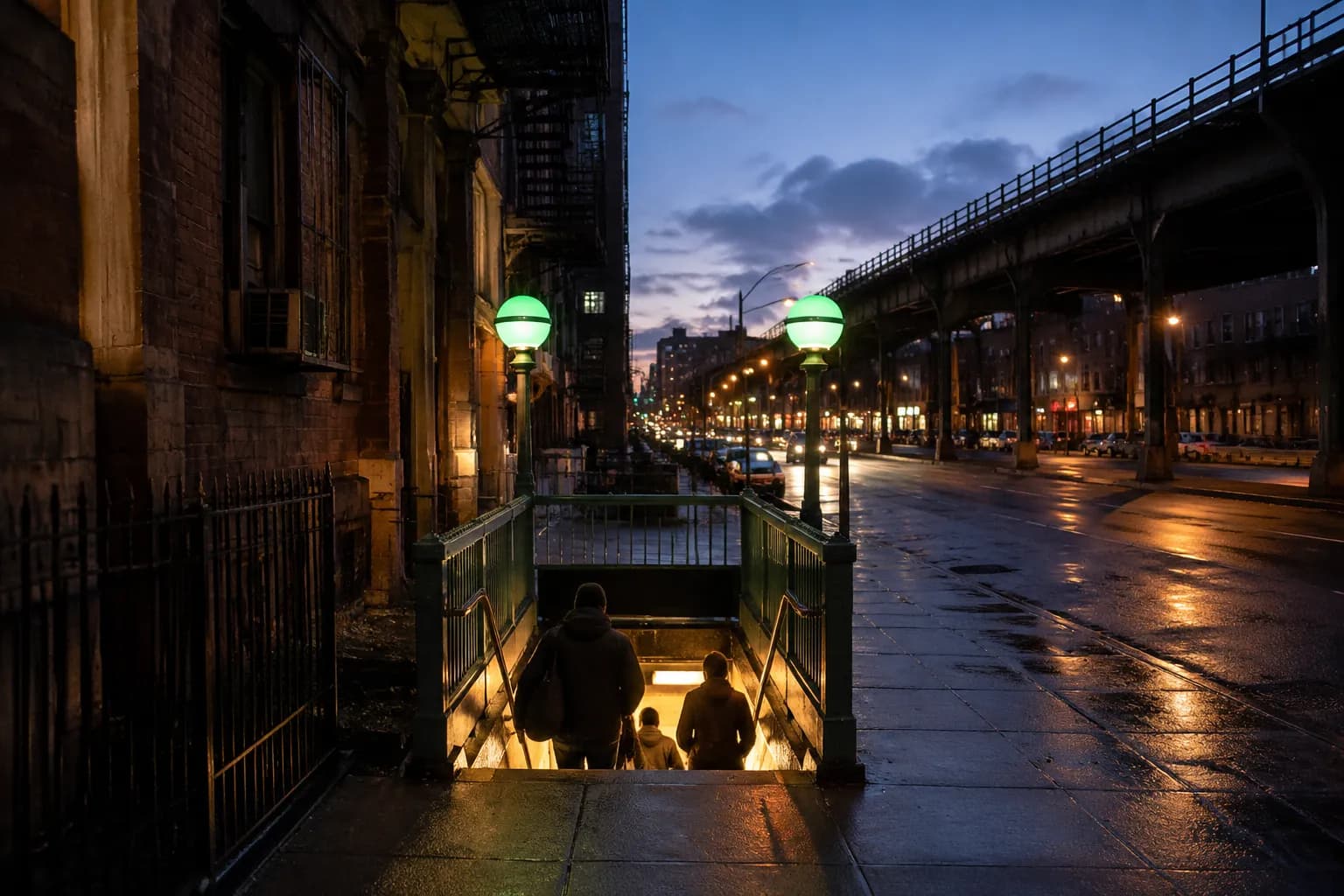
The simplest return is the 1 train at 125th Street, three blocks east. The elevated platform at 125th is a small piece of Manhattan civic engineering that is worth the climb on its own — built in 1904 as part of the original IRT, restored in 2004, with a view back over the Hudson and Harlem.
The other option is to run back. The southbound run is the same three miles, with the sun rising behind you the whole way. You finish at the Boat Basin around 7:00 a.m. The coffee carts at the 79th Street rotunda are open by then.
For the full out-and-back, six miles, plan ninety minutes door-to-door from a Manhattan apartment. For the one-way version with a subway return, sixty minutes is reasonable.
What Pre-Dawn Riverside Park Sounds Like
There are not many places in Manhattan where the dominant sound is the river. The lower promenade is one of them. The West Side Highway is muted by the berm. The buildings of Riverside Drive are eighty feet up the bluff. The river hits the rocks with a sound you would not associate with Manhattan if you were not standing there.
Add to that the Hudson Line of Metro-North on the far shore, the lit windows of a single tugboat passing under the GW Bridge, and the gulls. That is the soundtrack of the run.
It is the closest the island gets to being early. It is over by seven.
Practical notes
- Address: Grant's Tomb / General Grant National Memorial, Riverside Drive at 122nd Street, New York, NY 10027. Run starts at the 79th Street Boat Basin entrance.
- Getting there: Start: 1 to 79th Street, walk one block west into Riverside Park. Return: 1 from 125th Street.
- Hours: Park and lower promenade open 24 hours. Tomb interior Wed–Sun 10 a.m. to 4 p.m.
- Distance: ~3 miles one-way. Flat. Paved throughout.
- Don't miss: The Pedro Silva mosaic benches behind the tomb.
- Pairs well with: Coffee at the 79th Street rotunda after, or a 1-train ride to West 110th and breakfast at Tom's.
#grantstomb #riversidepark #morningsidenyc #nycrunning #freenyc #hudsonriver #firstlight #nycparks #manhattannyc #nycwalkways #karpofinds #nyclocalknowledge #weekendnyc #upperwestside #nationalparks
Sources consulted: National Park Service · NYC Parks · Grant Monument Association · Riverside Park Conservancy · The New York Times
All trademarks are the property of their respective owners.