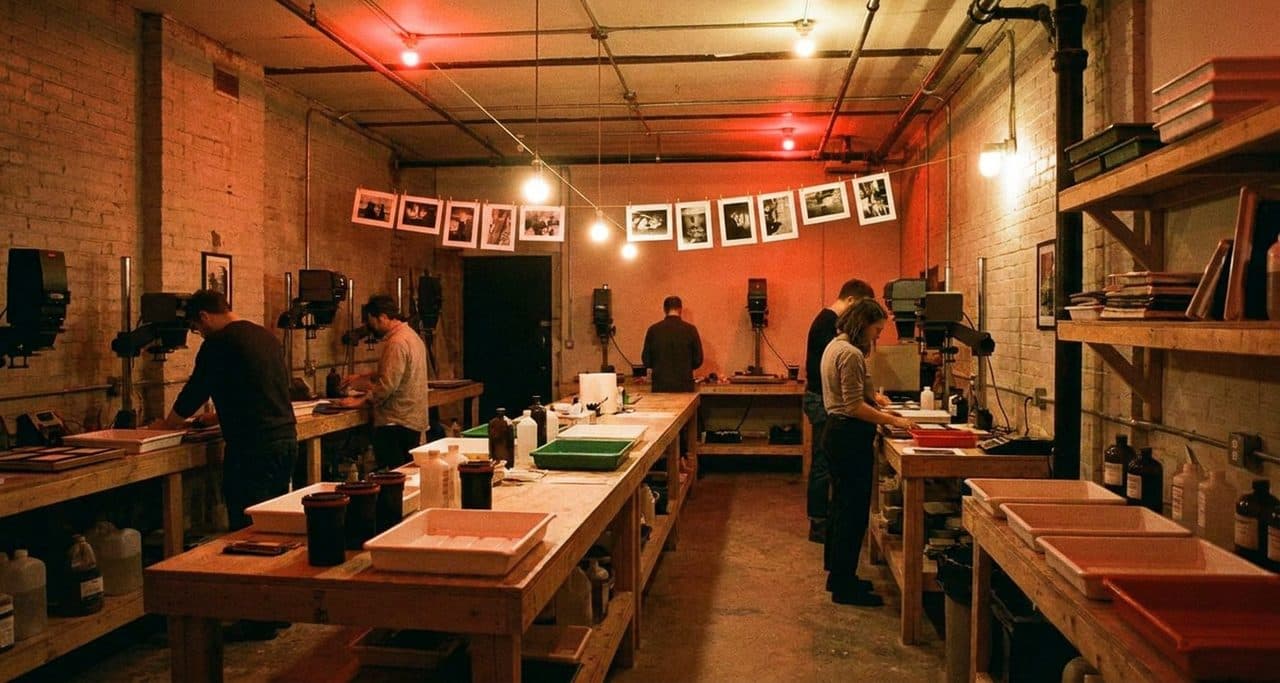
The door opens onto a hallway that still smells faintly of machine oil, a leftover from whatever factory once filled this corner of Gowanus. Past the second landing, red light seeps under a threshold, and the chemical tang of fixer solution cuts through the industrial mustiness. Inside, a community darkroom hums with the particular quiet of photographers who've found what they've been looking for—a place where film still matters, where the canal outside the window reflects the same analog patience that governs the work inside.
The Space Between Exposure and Image
The room divides itself naturally: enlargers line one wall, each station claimed by someone bent over a test strip or waiting for a timer to chime. The wet side runs along the opposite wall, three trays in sequence—developer, stop bath, fixer—arranged on counters salvaged from a shuttered lab in Red Hook. Prints hang from clotheslines strung across the ceiling, black-and-white images swaying slightly whenever someone crosses from dry to wet. The red safelight bathes everything in a photographer's glow, the kind of illumination that makes time feel negotiable. First-timers often pause just inside the door, adjusting to the dimness and the realization that phones stay in pockets here—screens ruin night vision, and the etiquette is older than the building.
The Regulars and the Rhythm
The crowd skews toward those who learned on film and never fully migrated, though younger photographers show up with increasing frequency, often carrying cameras inherited from parents or bought cheap at estate sales. A regular in his sixties works the same enlarger most evenings, printing contact sheets with the methodical pace of someone who's done this for decades. Across the room, a design student from Pratt dodges and burns a portrait, her hands moving quickly under the enlarger's light. The rhythm of the space is set by timers—thirty seconds in developer, ten in stop, five minutes in fixer—and by the soft shuffle of feet moving between stations. Conversation happens in low tones, mostly technical: grain structure, paper choice, whether to push the film an extra stop. The kind of shop talk that sounds like a different language until it suddenly doesn't.
What the Canal Teaches
Two windows face the Gowanus Canal, and on clear days the water reflects enough light to read by, even through the red filter taped over the glass. The view offers a strange counterpoint to the work inside—a waterway once choked with industrial runoff, now slowly recovering, watched over by a roomful of people committed to an older, slower process. Those who arrive early sometimes stand at the window before starting, watching the surface catch the last daylight. The canal's history—dredging, cleanup, the ongoing effort to restore what was damaged—maps onto the darkroom's mission in ways the founders probably didn't plan but have come to appreciate. Both require patience, both resist shortcuts, both insist that some things can't be fixed digitally.
The Equipment and the Unspoken Rules
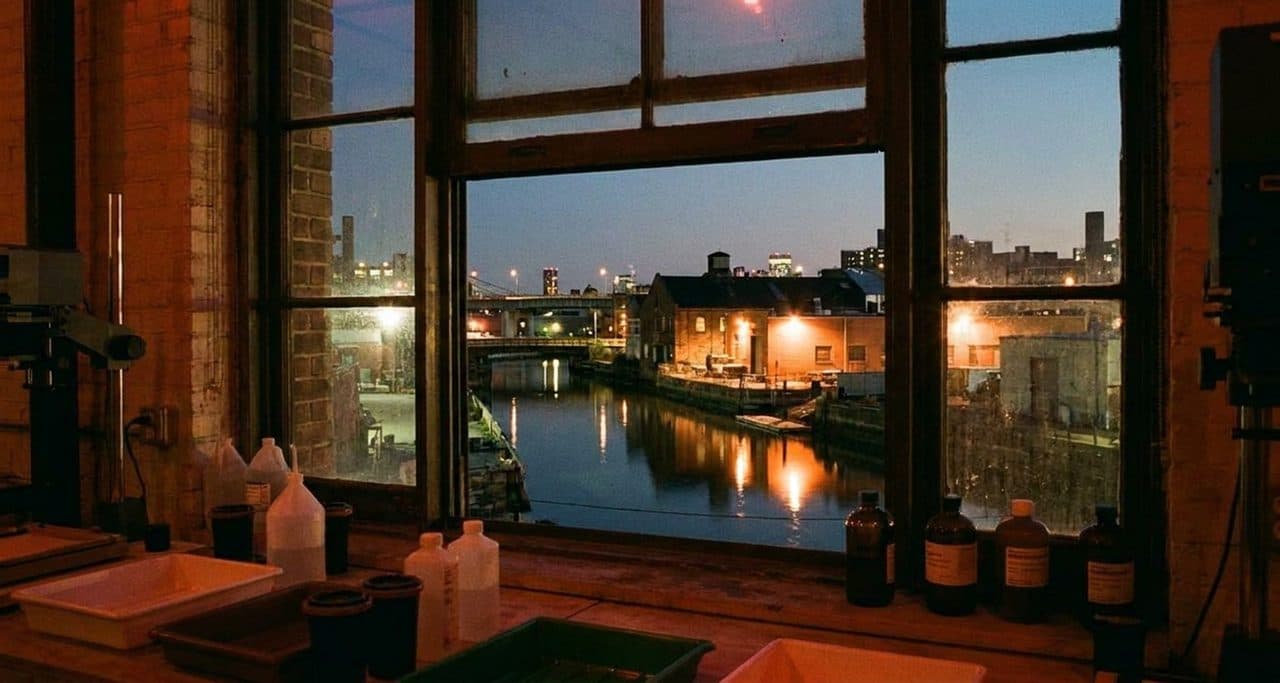
Four Beseler enlargers anchor the dry side, each one a workhorse model from the 1980s, maintained with the care usually reserved for vintage motorcycles. The enlarger lenses are sharp enough that grain becomes a choice rather than an accident. Paper gets stored in light-tight drawers beneath each station, sorted by grade and finish—glossy, matte, fiber, resin-coated. The wet side chemistry gets mixed fresh twice a week, and a small chalkboard near the trays lists the current dilutions and temperatures. No one enforces the rules posted on the wall—clean up after each session, label film canisters, don't hog the enlargers during peak hours—but everyone follows them anyway. The space runs on the assumption that people who seek out a darkroom in 2025 understand what it takes to keep one running.
The Smell and the Memory
Fixer solution has a smell that never quite leaves—sharp, slightly sweet, unmistakable to anyone who's spent time in a darkroom. It clings to clothes and hair, a chemical signature that marks someone as part of a particular tribe. The smell triggers memory in ways that digital workflows never manage: late nights in college darkrooms, the first print that came out right, the particular frustration of a negative that refuses to cooperate. Newcomers wrinkle their noses initially, but within a few sessions they stop noticing, or start associating it with the satisfaction of pulling a good print from the fixer tray. The olfactory dimension of the work matters more than most expect—it's part of the ritual, the sensory confirmation that this process is physical, that images emerge from chemistry and time rather than algorithms.
The Moment the Image Appears
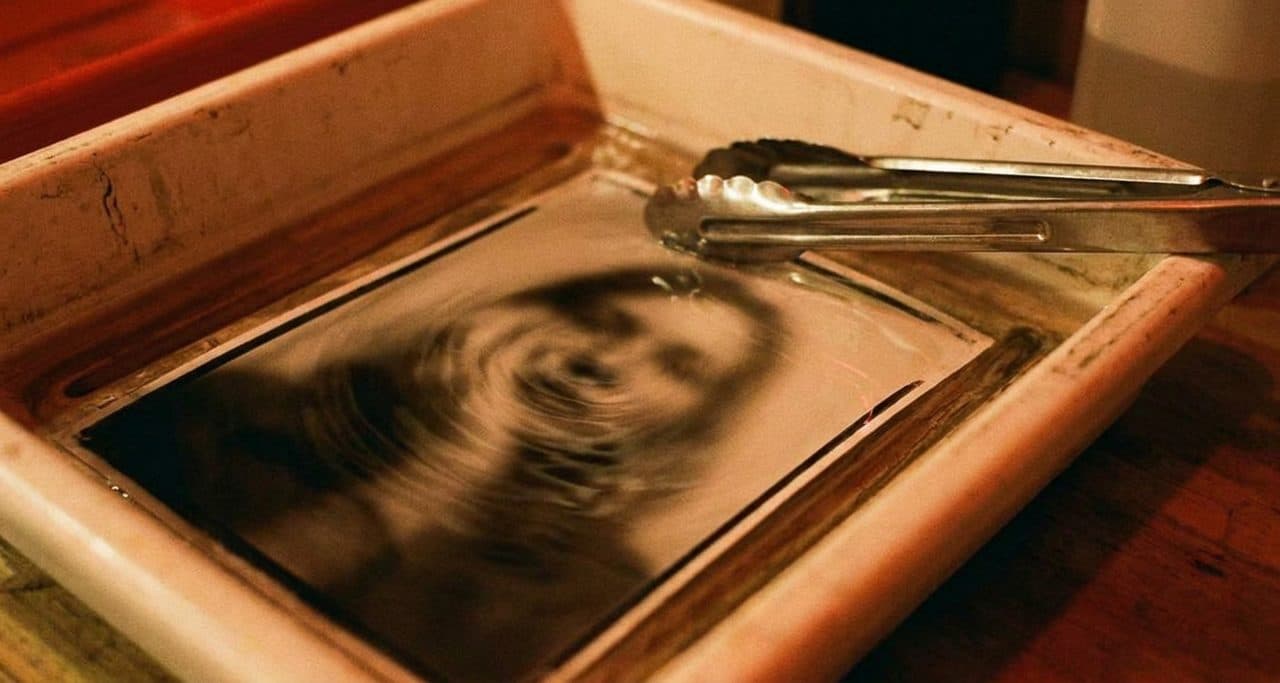
Developer works its magic in the first tray, and watching an image emerge never gets old—the highlights appear first, then midtones, then shadows, the full tonal range blooming across the paper in thirty seconds. Photographers lean over the tray, sometimes rocking it gently to ensure even development, waiting for that moment when the image declares itself finished. Too long and the blacks go muddy; too short and the print lacks depth. The judgment call happens in real time, under red light, guided by experience and instinct. Those who've been printing for years can read a developing image the way a chef reads a sauce reducing, making micro-adjustments that separate a good print from a great one. First-timers get guidance from whoever's nearby, the knowledge passed laterally in the moment it's needed.
Practical Notes
The darkroom sits in a former industrial building near the Carroll Street bridge, accessible via the F or G train to Carroll Street, then a ten-minute walk along the canal. Sessions run most evenings from six until midnight, with weekend afternoon slots available for those who prefer natural light through the windows before switching to safelight. Walk-ins are welcome when stations are available, though regulars suggest checking the shared calendar online to avoid the busiest times—Thursday evenings and Sunday afternoons tend to fill up. Membership runs on a sliding scale, with single-session rates available for visitors or those testing the waters. Bring film and paper, or purchase from the modest stock kept on hand. The space provides chemistry, enlargers, and timers. First-timers receive a brief orientation covering the basics and the layout—fifteen minutes that prevents most rookie mistakes.
Tags: #GowanusNYC #FilmPhotography #DarkroomCommunity #AnalogProcess #BrooklynArtSpaces #FilmIsNotDead #CommunityDarkroom #GowanusCanal #BlackAndWhitePrint #ChemicalProcess #PhotographyStudio #BrooklynCreatives #FilmDevelopment #IndustrialSpaces #RightOnTime
Sources consulted: timeout.com · secretnyc.co · thrillist.com
All trademarks are the property of their respective owners.
Ask Karpo first
Want to know how to access the Gowanus darkroom and what equipment they have available?
Ask Karpo for darkroom membership details and session timing before you head out.