# Fresh Kills Park on a Sunday Where Silence Does Not Feel Earned But Is
The former landfill that once received half the city's garbage now stretches as restored grassland and tidal wetland across Staten Island's western shore, and the quiet that settles over Fresh Kills Park on a Sunday morning arrives without the self-conscious hush of a museum or the enforced calm of a meditation retreat. The trails wind through terrain that looks like prairie, feels like coastal heath, and carries the specific weight of transformation that cannot be rushed.
The First Hundred Yards Off the Parking Lot
The entrance at Schmul Park—one of the few public access points currently open—does not announce itself with grand signage or interpretive displays. A gravel lot gives way to a mowed path, and within a hundred yards the city noise fades not because distance has swallowed it but because the landscape absorbs sound differently here. The grasslands roll in gentle swells, punctuated by stands of young trees that were saplings when the closure happened in 2001. First-timers often pause at the threshold where pavement ends, recalibrating expectations: this is not a groomed urban park with benches every fifty feet, but something closer to a nature reserve that happens to sit on engineered ground. The trails are wide enough for maintenance vehicles, surfaced in compacted stone dust that drains quickly after rain. Early arrivals—the ones who time it for the hour after sunrise—report a quality of light that skims horizontally across the grasses, turning seed heads into a low shimmer that moves with the wind off the Arthur Kill.
The Boardwalk That Crosses What Used to Be Mound 6

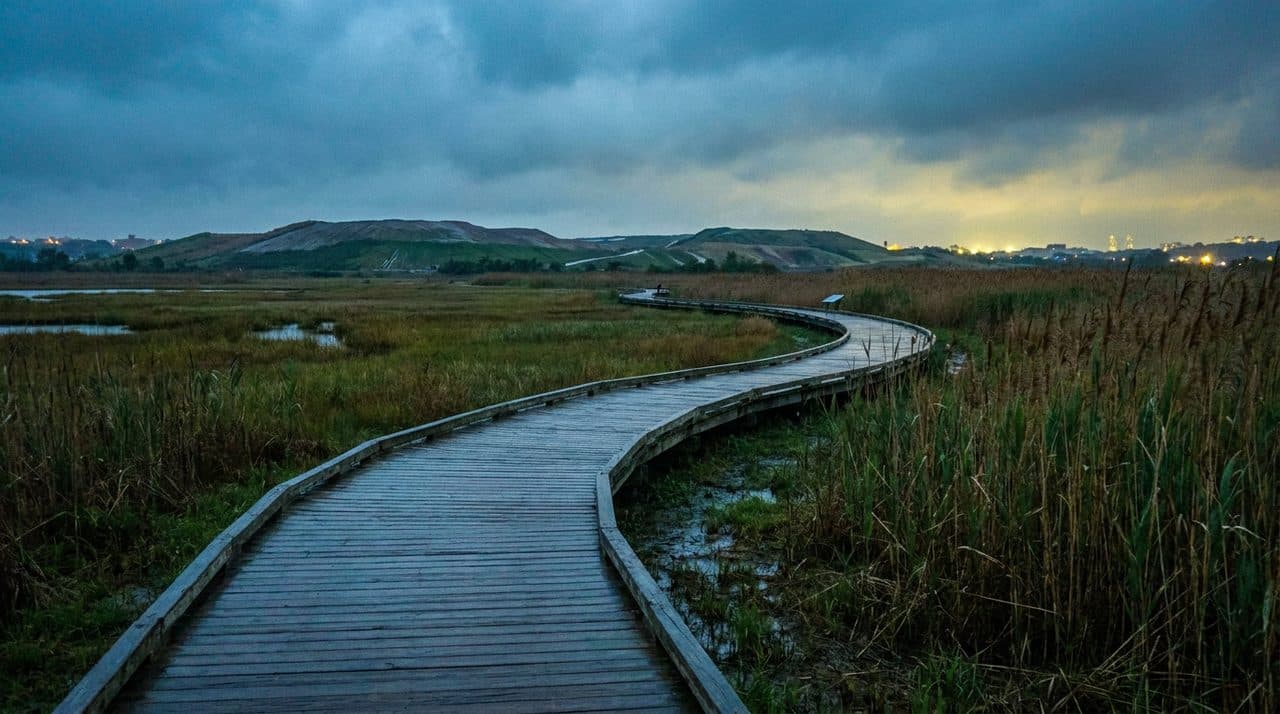
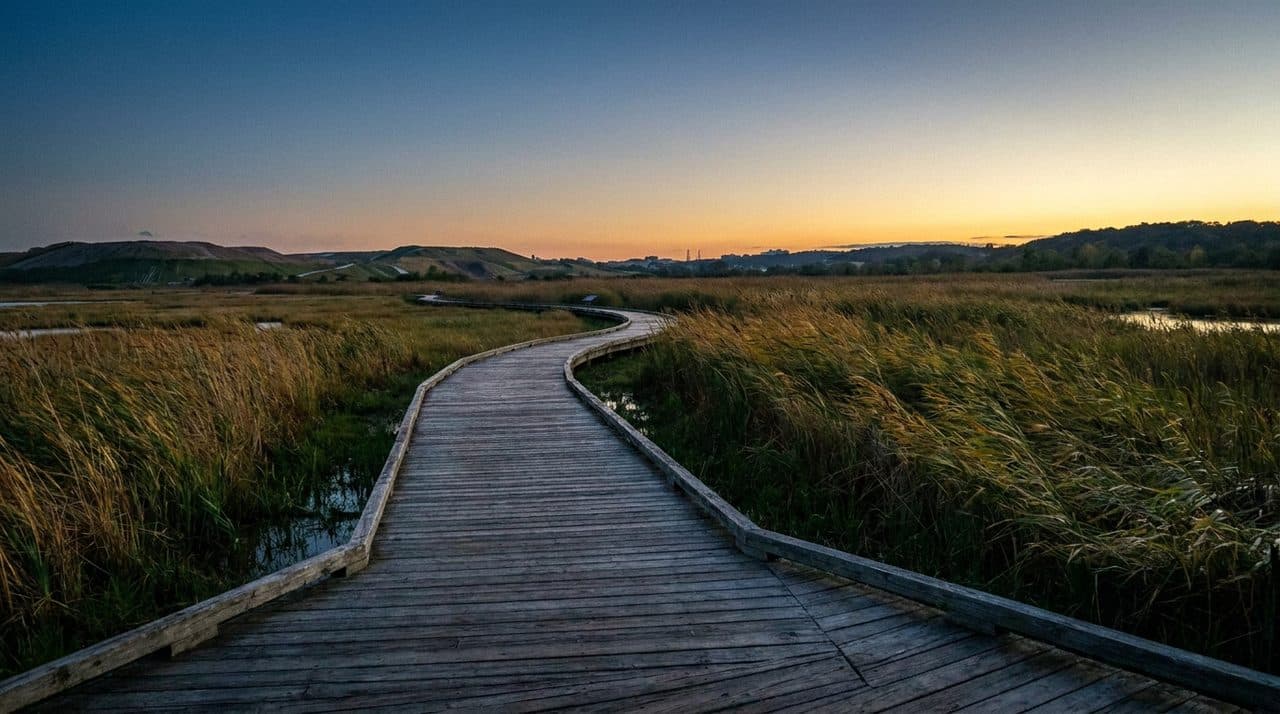
A quarter-mile in, the path reaches a boardwalk section that extends over wetland restoration zones where phragmites and native spartina grass grow in tidal rhythms. This elevated walkway crosses what was once Mound 6, one of four massive waste mounds that defined the site's previous life. The boardwalk sits high enough that walkers can see across to the water, but the view does not read as scenic overlook—it reads as vantage point over an ongoing experiment. Methane venting systems still dot the landscape, low concrete structures that release gas from decomposition layers thirty feet below. The park's phased opening means large sections remain closed, visible in the distance as fenced grassland waiting for soil stability tests and final capping work to finish. Those who walk the boardwalk on weekend mornings encounter a steady trickle of others: runners doing long loops, birdwatchers with scopes trained on the marsh edges, families with young children who treat the wide-open space as permission to range farther than usual. The demographic skew runs local—Staten Island residents who have watched this transformation unfold in real time, who remember when the Fresh Kills name meant something entirely different.
The Sound Texture of Restored Grassland
What strikes most visitors after twenty minutes is not the silence itself but the particular quality of sound that fills it. Wind moves through tall grasses with a dry rustle distinct from the whoosh of tree canopy. Birdsong carries farther here than in wooded parks—meadowlarks, red-winged blackbirds, the occasional harrier cruising low over the marsh. On calm days, the hum of the nearby West Shore Expressway becomes audible as a distant constant, a reminder that this is not wilderness but reclaimed industrial ground within city limits. The park's 2,200 acres make it nearly three times the size of Central Park, but the accessible portions currently open represent a fraction of that total. The trails do not loop back on themselves in tidy circuits; they tend to run linear, encouraging an out-and-back rhythm that builds a different relationship to distance. Regulars learn to gauge their turnaround point by time rather than landmarks, since the grassland vistas offer few dramatic shifts in scenery—just gradual transitions from drier upland meadow to wetter tidal edge.
The Crowd That Finds It Worth the Trip
The visitor profile skews toward those comfortable with unfinished landscapes and deferred payoffs. Cyclists use the smooth, car-free paths for training rides. Ecological tourists come with field guides and an interest in brownfield reclamation case studies. Families from the North Shore make the drive for the sheer expanse of runnable space, a commodity rare enough in the city to justify the trek. There is little in the way of amenities—no cafes, no playgrounds, no restroom facilities beyond portable units at trailheads. This self-selects for people who pack water, plan their visit around the lack of infrastructure, and find value in the experience of space itself rather than programmed activity. On Sundays, the flow increases slightly but never approaches crowding. The park absorbs visitors into its scale, rendering even a busy morning sparse by urban standards. Dog walkers favor the early hours before heat builds. Photographers arrive for the long light of late afternoon when shadows stretch across the mounds and the grasses glow amber.
What the Interpretive Markers Do Not Say
Scattered along the main trails, a handful of interpretive signs outline the site's history and the engineering involved in its transformation. They mention the methane collection system, the layers of soil and geotextile that cap the waste, the timeline for full buildout extending into the 2030s. What they do not convey is the cognitive dissonance of standing on ground that holds decades of the city's discarded matter, now growing native warm-season grasses and hosting nesting birds. The park's design does not erase this history or prettify it into easy redemption narrative. The mounds remain visible as topographic features—gentle hills that do not occur naturally in this coastal plain geography. Venting pipes rise at regular intervals, functional infrastructure left exposed rather than hidden. This honesty about the site's past gives the present landscape a specific texture, a sense of being mid-process rather than finished product. Those who return multiple times begin to notice shifts: new sections of trail opened, additional plantings establishing themselves, the gradual thickening of tree cover in restoration zones. The park operates on ecological time, a pace that resists the usual urban hunger for immediate transformation.
Practical Notes
Fresh Kills Park remains in phased development with limited public access. The Schmul Park entrance on Brielle Avenue provides the most consistent entry point for trails and the boardwalk section. No public transit reaches the park directly; visitors typically drive or arrange rideshare to the trailhead. The site opens dawn to dusk, though specific hours shift seasonally and some areas close for maintenance or wildlife management. No entrance fee applies. Bring water, sun protection, and an acceptance of minimal facilities. The terrain is largely flat and accessible, though trail surfaces vary from paved to compacted stone dust. Cell service is reliable. The park hosts occasional guided tours and volunteer events—checking the official NYC Parks calendar before visiting can surface opportunities to access areas not typically open. Weekday mornings offer the quietest experience; Sunday midday sees the highest traffic, though "high" remains relative in a park of this scale.
The Walk Back Toward the Parking Lot
The return trip along the same trail reads differently than the outbound journey, a function of shifting light and the way familiarity changes perception. Details emerge that were missed on the first pass: the subtle grade changes that indicate where mound edges transition to natural grade, the variety within what initially looked like uniform grassland, the sight lines that open and close as the path curves. The quiet that seemed notable at the start now registers as baseline, the default condition rather than an event. Leaving the park does not feel like exiting a destination so much as stepping out of a longer timeline back into the city's usual tempo. The traffic noise of the expressway returns in stages, and with it the reminder that this landscape exists not apart from the city but woven into its fabric, a slow-motion reclamation happening in plain sight for those willing to meet it on its own terms.
Tags: #FreshKillsPark #StatenIsland #NYCParks #ReclaimedLandscape #UrbanNature #NewYorkCity #GrasslandRestoration #WetlandTrails #LandfillTransformation #SlowTravel #RightOnTime #NYCHiddenGems #EcologicalTime #OpenSkyWalking #CityReporter
Sources consulted: timeout.com · secretnyc.co · thrillist.com
All trademarks are the property of their respective owners.
Ask Karpo first
Want to know when Fresh Kills is open and which trails are accessible?
Ask Karpo for the park's access schedule and boardwalk trail details before you head out.