A Suburb Designed by the Russell Sage Foundation
Forest Hills Gardens was designed in 1909 by the Russell Sage Foundation — a philanthropic organization founded by Olivia Sage with the bequest of her husband, the railroad financier Russell Sage. The Foundation hired the architects Grosvenor Atterbury and the landscape architects Frederick Law Olmsted Jr. to create what Sage envisioned as a model suburb: well-built homes for middle-class workers, surrounded by gardens and parks, with private streets to keep the character intact.
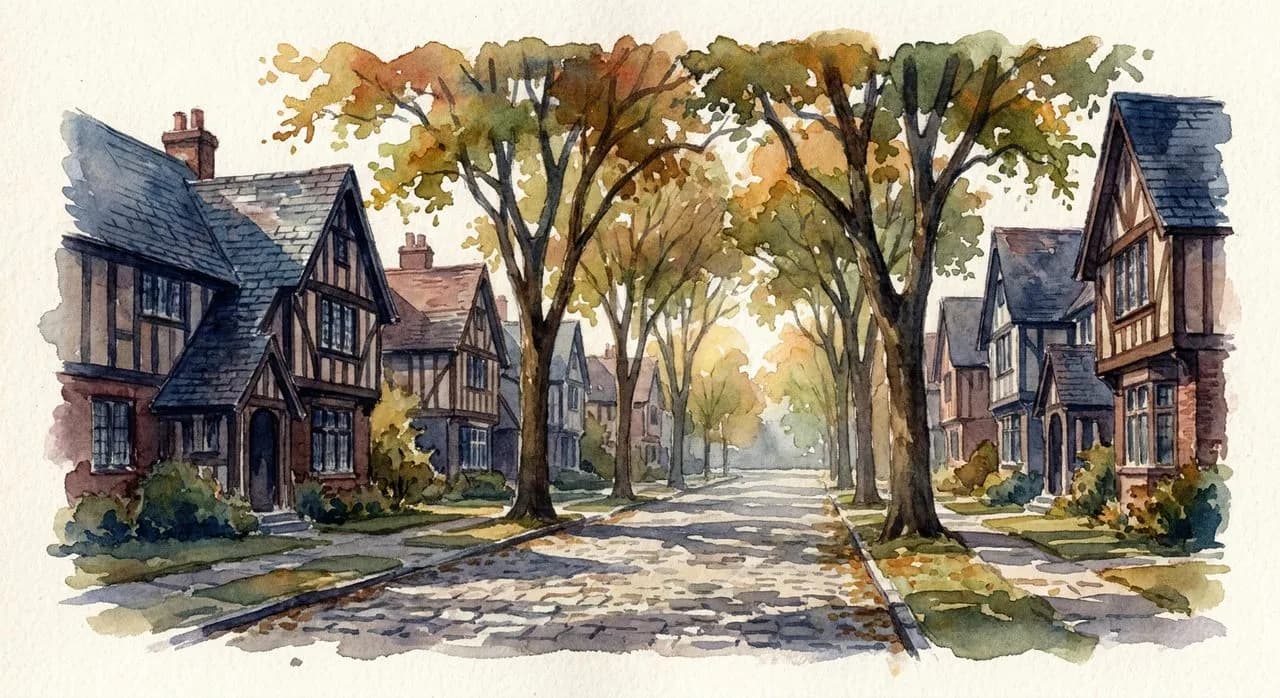
The 142-acre development was the Foundation's first major project and remained its flagship for the next thirty years. About 800 individual homes were built between 1909 and 1929, all in English Tudor or Arts & Crafts revival styles, with slate roofs, leaded glass windows, half-timbered exteriors, and small private gardens.
The whole development is still operated by a residents' association — the Forest Hills Gardens Corporation — that maintains the private streets, the gardens, and the architectural standards. The development has been listed on the National Register of Historic Places since 1986. It looks today almost exactly as it did in 1929.
The Walk From the LIRR Station
Forest Hills station on the Long Island Rail Road sits at the southeastern edge of Forest Hills Gardens. From the station's southern exit, walk one block south on Continental Avenue and you reach Station Square — the design's central plaza, with the Forest Hills Inn (now condo apartments) on one side and the Tudor archway entrance to the Gardens on the other.
The Tudor archway has a small bronze plaque indicating that the streets beyond are private property and that visitors are welcome to walk through respectfully. The Foundation built the streets explicitly with the intention of allowing public passage but reserving control over noise, parking, and commerce.
The Streets Inside the Gardens
Walk through the archway into Tennis Place. The street runs north between rows of detached and semi-detached Tudor homes, each set back about 20 feet behind a small front garden. The street pavement is granite block, restored in the 2010s. The lampposts are copper-and-glass reproductions of the 1909 originals.
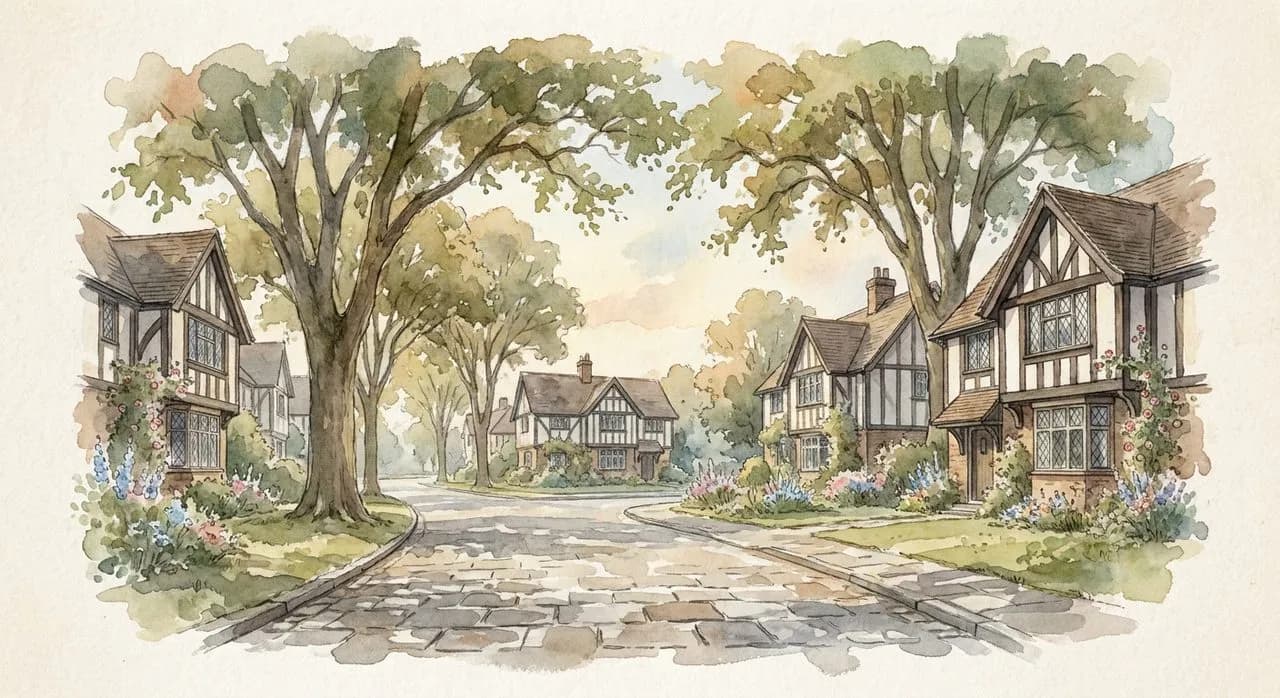
Tennis Place leads into Greenway North, the development's main spine. From Greenway North, smaller side streets — Wendover Road, Olive Place, Beechknoll Road — branch off into the residential heart of the Gardens. The architectural variation is gentle but real: each street has its own identifiable character. The Olmsted plan for the streets is one of the few intact examples of Frederick Law Olmsted Jr.'s independent suburban design work.
The Forest Hills Tennis Stadium — site of the U.S. Open from 1923 to 1977 — sits at the development's southwestern edge, a 14,000-seat horseshoe stadium that's now a concert venue (Bob Dylan, Mumford & Sons, the National have all played here). The stadium's brick facade is visible from several of the Gardens' western streets.
Why It Stayed Tudor
The architectural standards were written into the original deed restrictions. New construction must be approved by the Forest Hills Gardens Corporation's architectural committee. Renovations need permits. The slate roofs (a major maintenance issue) are subsidized through a residents' fund.
The result is a 142-acre district that has resisted the Queens-wide trend of small-house demolition and large-house infill. Where neighboring Forest Hills proper (outside the Gardens) has lost much of its 1920s housing stock, the Gardens has kept theirs. The architectural integrity is the development's quiet pride.
Mile 1.2 — Through Markwood Road and Out
Continue north through the Gardens via Markwood Road, then west along Greenway South. The route takes you past the original Russell Sage Foundation building (now a private home), the Garden's central park (Hawthorne Park, two acres of mature elms and a small fountain), and the Garden's most photographed corner — the intersection of Slocum Crescent and Greenway South.
Exit the Gardens at the western end of Greenway South, where it meets Continental Avenue. Walk north on Continental for one block to reach the modern commercial Forest Hills district.
Mile 1.5 — Austin Street's 21st Century
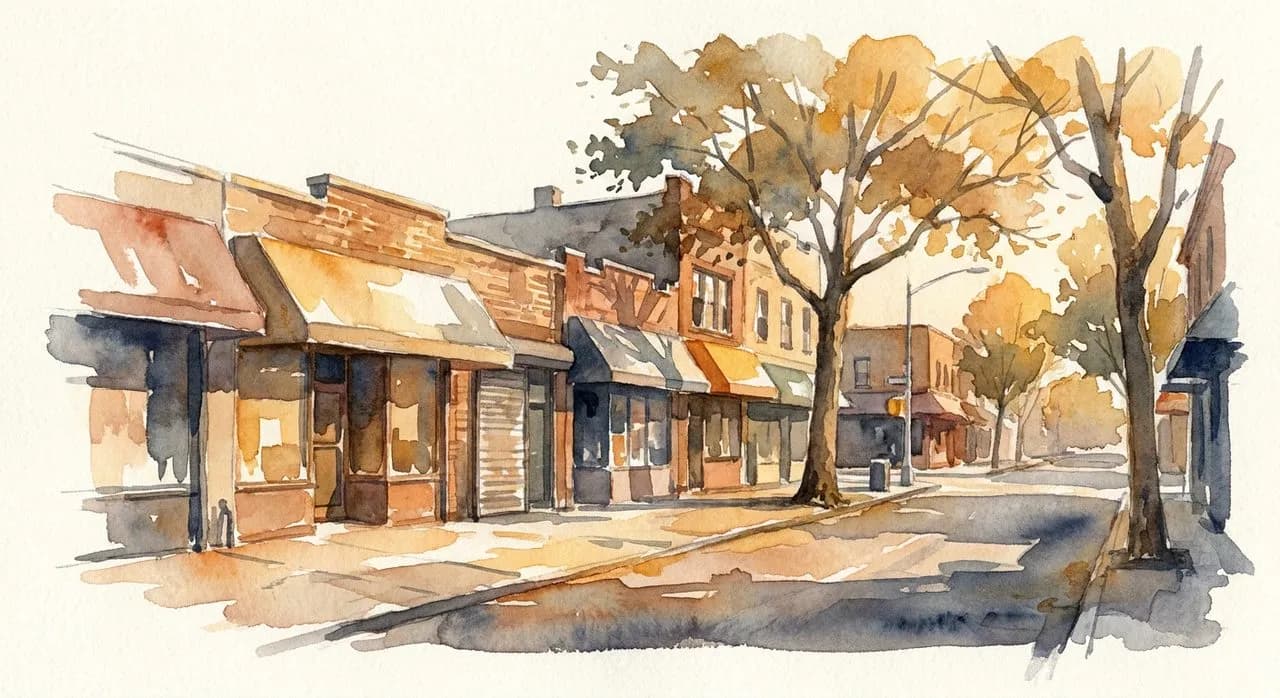
Austin Street is the commercial heart of Forest Hills proper. Two blocks of small storefronts, with chain banks, bagel shops, dry cleaners, and a row of restaurants. The contrast with the Gardens is immediate: where the Gardens are quiet and orderly, Austin Street is busy and miscellaneous. The transition is meant to be jarring.
The walk concludes at Austin Street and 71st Avenue, where the Forest Hills Bagels (since 1969) sits at the corner. A bagel sandwich on the front steps is the traditional reward for completing the walk.
What to Look For Architecturally
The Tudor revival style of the Gardens is varied. Some houses are full half-timbered, with exposed dark wood beams over white plaster walls. Others are stone-clad, with steeply pitched slate roofs and small rounded turrets. A few are pure Arts & Crafts, with smaller scale and simpler finishes.
The leaded glass windows on most homes are original. The hardware (door knockers, mailbox slots, hinges) is often original brass that's been polished for a century. Look at the lamppost bases — most have small bronze plaques with the lamppost installation date.
Practical notes
- Address: Start at Forest Hills LIRR station, Continental Avenue at Burns Street; finish at Austin Street and 71st Avenue, Forest Hills, Queens
- Getting there: LIRR to Forest Hills (15 minutes from Penn Station); E/F/M/R to Forest Hills–71st Avenue
- Go for: The 1909 Tudor revival architecture, the private granite block streets, Forest Hills Bagels at the end
- Size / timing: 1.5 miles, 50 minutes at a moderate pace, 75 minutes with stops at Hawthorne Park and the architectural details. Best in autumn for the elm canopy.
- Photograph it, but know this: Residents have asked photographers to avoid pointing cameras into windows. Frame on the street facades, gardens, and architectural details. The bronze street plaques are publicly fair game.
Forest Hills Gardens is one of the last places in New York where you can walk through what middle-class American suburbia was supposed to look like in the 1909 reformist imagination. The Russell Sage Foundation's experiment in social housing produced an enclave that survived because the residents' association kept the standards. Walk through respectfully. The architectural detail rewards a slow pace. The transition to Austin Street at the end is the entire point of the route.
#foresthillsgardens #queensny #tudorrevival #russellsagefoundation #frederickolmstedjr #queenswalk #longwayhome #nycarchitecture #foresthills #austinstreet #nycculture #historicdistrict #insidernyc #queenstour #garderfencity
Sources consulted: Forest Hills Gardens Corporation · The New York Times · National Register of Historic Places · Atlas Obscura · Untapped Cities
All trademarks are the property of their respective owners.