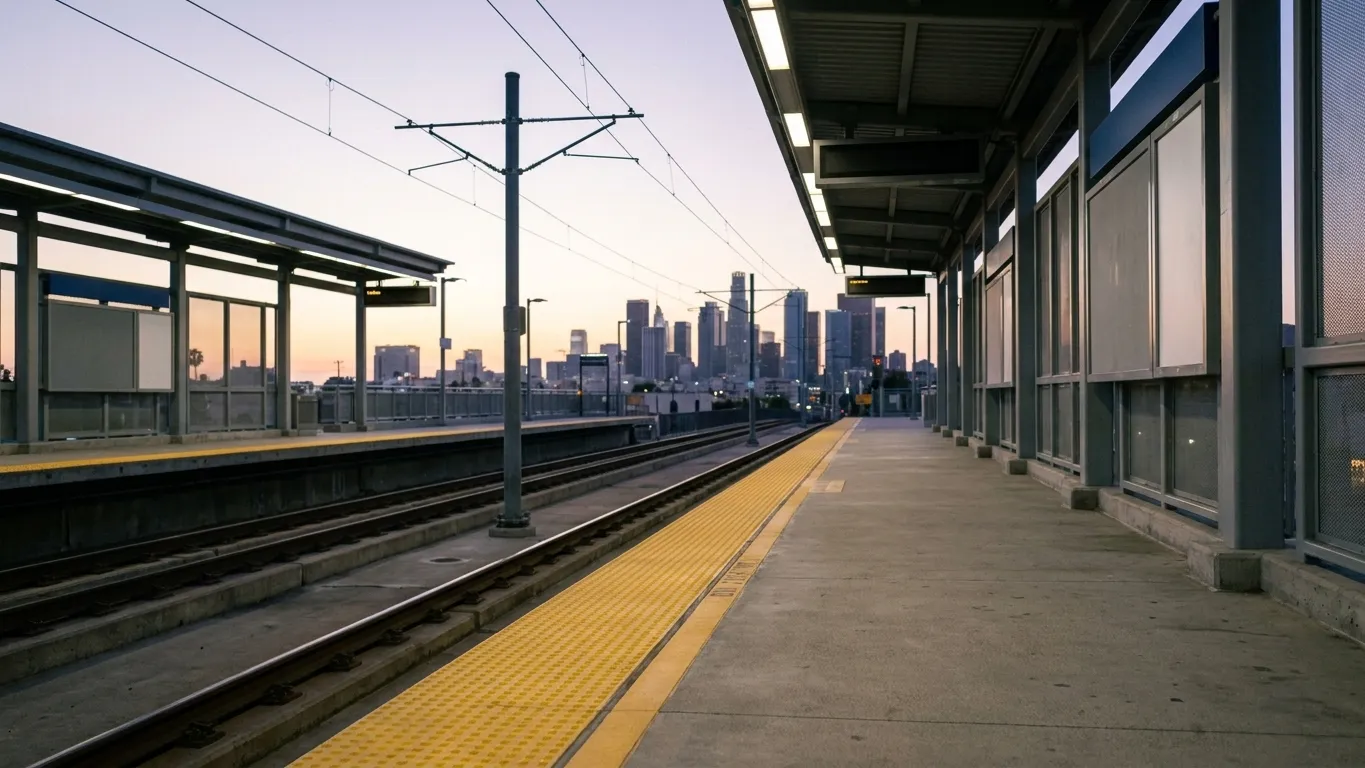
The received wisdom is that Los Angeles requires a car, and for most purposes that is still true. For eating, it is much less true than it used to be. The rail network now reaches Koreatown, Thai Town, Little Tokyo, Chinatown, Leimert Park, Long Beach and Santa Monica, and once you stop thinking of it as commuting infrastructure and start thinking of it as a list of neighbourhoods it becomes genuinely useful. If you are new here, without a car, or simply unwilling to spend an evening deciding who is driving, this is the version of the city that works.
A rail-based food plan lives or dies on timing, because service thins after about ten in the evening and the last train is earlier than the last kitchen. Tell Karpo which line you are on and how late you can stay out, and it will find somewhere that fits both.
The B line is the strongest food line in the city
Running from Union Station through downtown, Westlake, Koreatown and up into Hollywood, the B line touches more distinct food neighbourhoods than any other. Westlake/MacArthur Park puts you in the middle of the Central American corridor - pupusas, Guatemalan and Salvadoran cooking. Wilshire/Vermont and Wilshire/Normandie drop you into Koreatown proper.
Further north, Hollywood/Western is the eastern edge of Thai Town and Hollywood/Vermont the western. Four genuinely different cuisines within twenty minutes of track, none of which requires a car at either end.
The A line reaches further than people think
The A line runs from the north end of the county down through downtown to Long Beach, and its useful food stops are at the ends rather than the middle. Chinatown and Little Tokyo sit at the downtown segment, and the southern end opens up Long Beach - which has a substantial Cambodian community and a food scene most Angelenos have never eaten in.
It is a long ride and that is the honest caveat. Treat the southern end as a day trip rather than a dinner plan.
The K line and Leimert Park
The K line's arrival gave rail access to the Crenshaw corridor and Leimert Park, which is one of the more significant recent changes to the map. Leimert Park Village is a short walk from the station and holds soul food, Caribbean cooking, coffee and a genuinely important cultural district.
It also connects to the E line and the C line, which makes cross-town trips that used to be unthinkable without a car merely slow rather than impossible.
The E line is the Westside answer
The E line runs from downtown out to Santa Monica, passing through the Arts District edge, USC, Culver City and Expo Park. Culver City station is the practical stop - the downtown Culver City restaurant cluster is a short walk and it is one of the better dinner districts on the line.
Santa Monica at the far end is more about the walk and the pier than the food, though the Wednesday and Saturday farmers' markets near the terminus are genuinely worth the ride.
The D line and where it is going
The D line currently runs a short distance through Koreatown along Wilshire and is being extended west, which will eventually put Miracle Mile, Beverly Hills and Westwood on the network. Until then its main use is as a second way into Koreatown from downtown.
Worth knowing if you are planning around future openings: the extension changes the Persian food in Westwood from a driving trip to a train ride, which is the single biggest food-related improvement the network has coming.
Eating on the platform side of the trip
One underrated advantage of the rail approach is that several stations sit on top of food rather than near it. Union Station has a proper hall of counters, Little Tokyo puts you inside a dense grid of restaurants within two minutes of the platform, and Grand Central Market is a short walk from two lines.
That matters because it removes the worst part of a car-free evening, which is a fifteen-minute walk at the far end when you are already hungry. Building a plan around stations that are themselves destinations makes the whole thing considerably less effortful.
Buses do the parts rail does not
The rail map has large holes - the San Gabriel Valley, the Eastside beyond Boyle Heights, most of the Valley - and the honest answer for those is the bus, which is slower but far more comprehensive. The lines running along Wilshire, Vermont and Sunset are frequent enough to use without planning.
The rapid buses along the major boulevards are the ones to learn. Combining one rail leg with one bus leg opens up most of the central city and it is the standard way people without cars actually move here.
The timing rules that make it work
Rail service in Los Angeles runs frequently through the evening and then thins noticeably after about ten, with the last trains varying by line. A dinner that ends at eleven-thirty is usually fine; one that ends at one in the morning is not, and that is the constraint to design around.
Two habits fix most problems: check the last departure before you sit down rather than after, and load a fare card in advance so a delayed decision does not become a queue. Beyond that, the network is more usable than its reputation, and eating is the best possible reason to find that out.
Tags: #FoodNearMe #LosAngeles #LAMetro #WithoutACar #BackToSchool #Koreatown #LeimertPark #PublicTransport #LAFood #LAEats
All trademarks are the property of their respective owners.
Ask Karpo first
The train reaches more of the good food in Los Angeles than almost anyone assumes. Ask Karpo what is worth getting off for on the line you are already on.