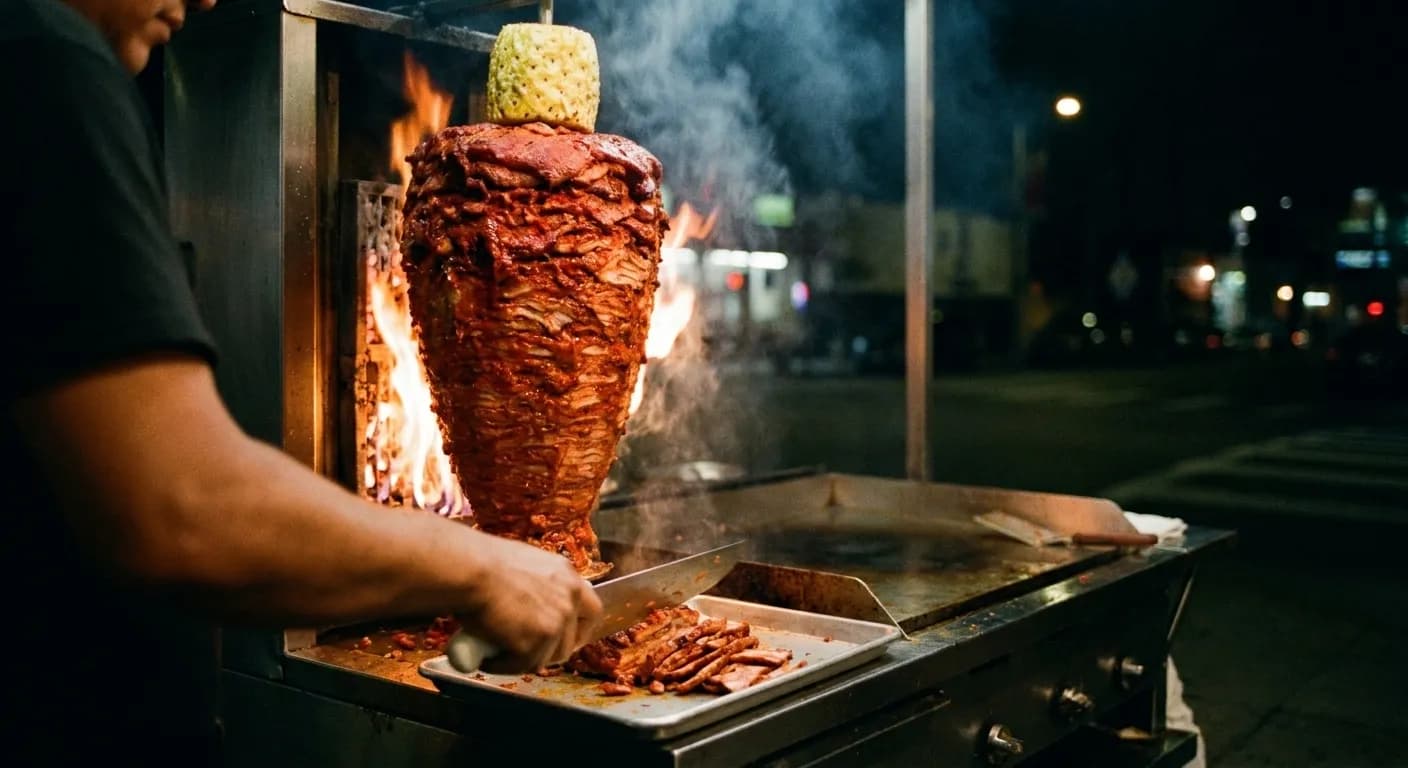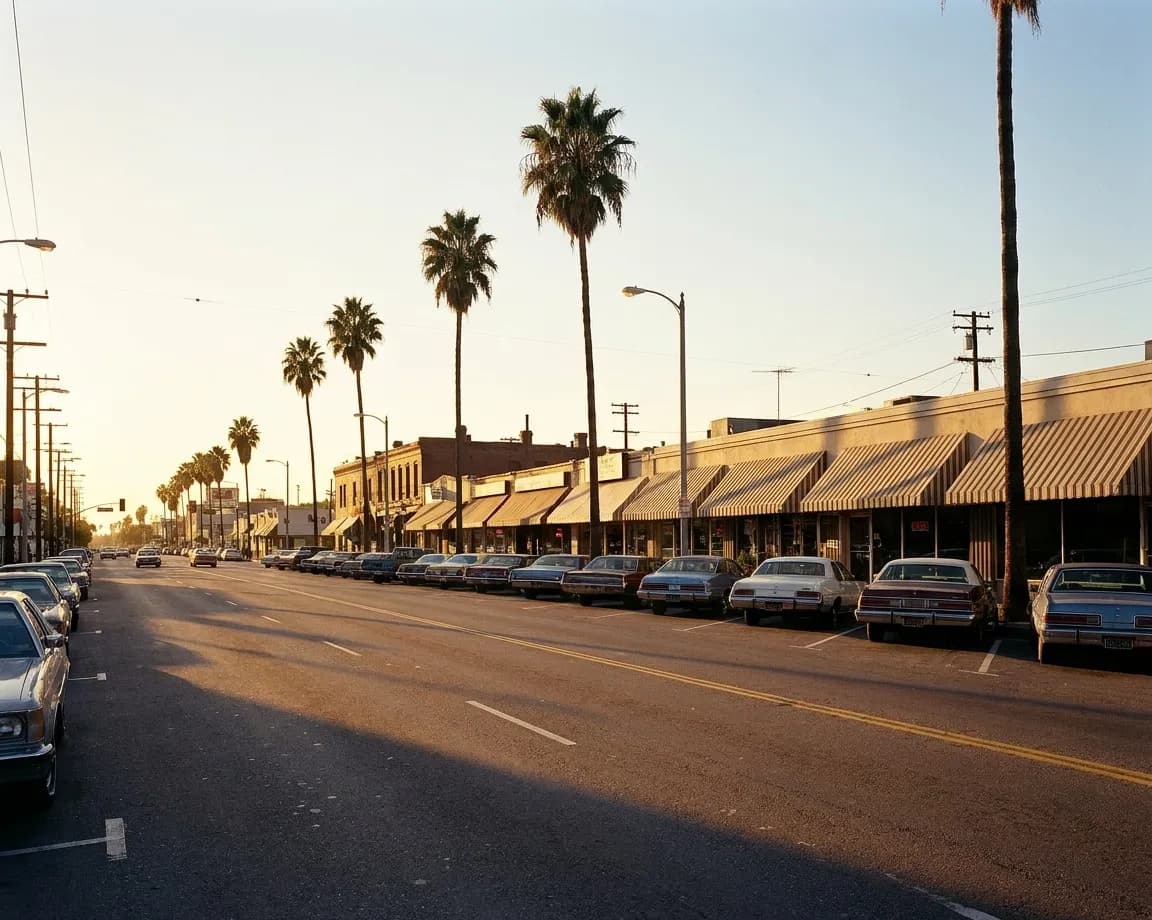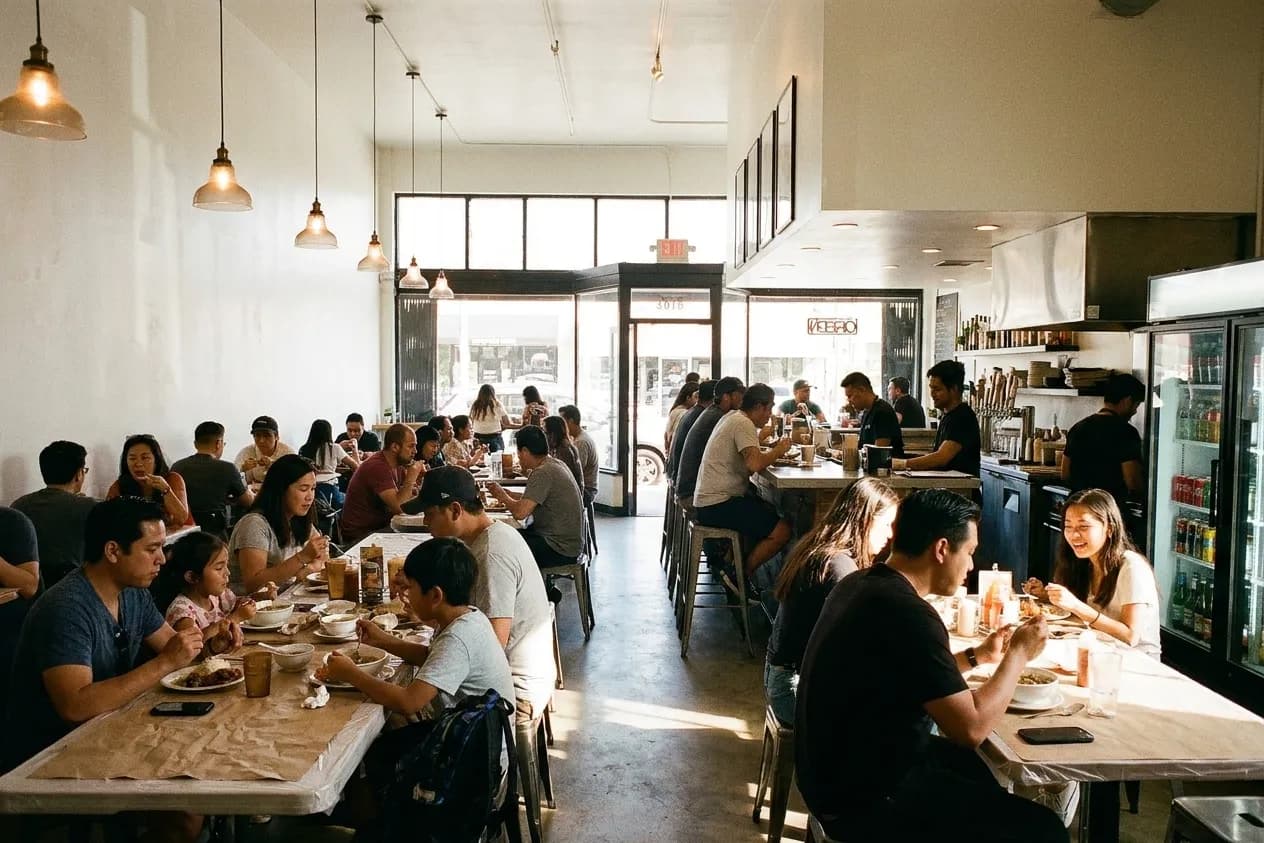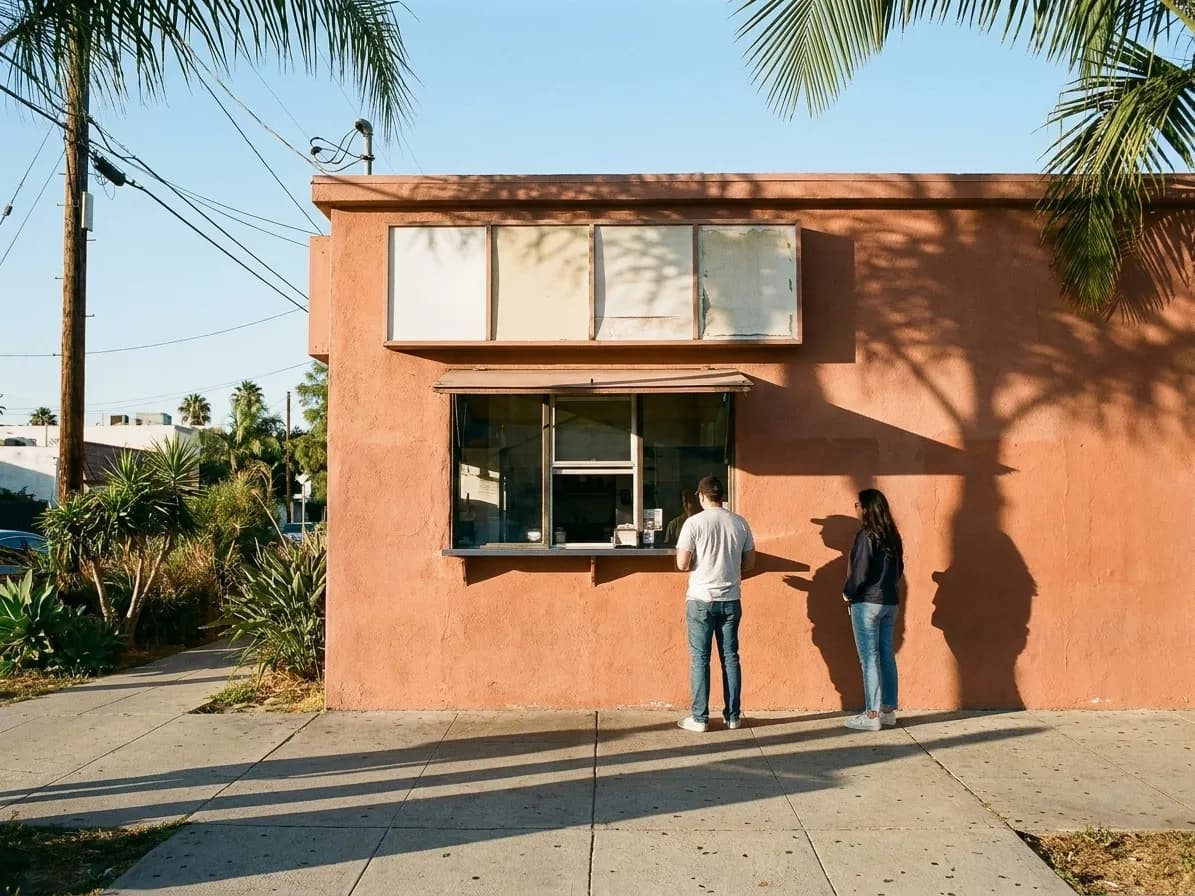
Searching for fast food near me in Los Angeles returns a map full of pins that all look equivalent and are not. This city runs three separate fast food economies that happen to share a category name: the drive-thru, the walk-up window, and the counter. Each one shapes the food that comes out of it, and knowing which format you are heading into tells you more about your meal than any star rating. Pick the format first, then pick the place.
Fast food in Los Angeles is a geography problem as much as a taste one: the right window is the one you can actually reach without sitting through a light cycle three times. Tell Karpo where you are and how long you have, and it will sort the options by format.
The drive-thru: built for the car, not the food
A drive-thru kitchen is designed around a queue that cannot stop moving. Everything on the menu has to survive being assembled in under ninety seconds and eaten twenty minutes later at a different address. That constraint is why drive-thru food skews toward things that hold — fried items, griddled patties, wrapped burritos — and away from anything that goes soft or separates.
The practical consequence is that a drive-thru's best item is nearly always the one it sells the most of, because volume equals turnover equals freshness. Ordering the unusual thing at a drive-thru is a mistake almost everywhere in Los Angeles: you are asking a system optimised for repetition to do something it does rarely. Order the obvious item, and order it at a busy hour rather than a quiet one.
The walk-up window: the format LA does better than anywhere
The walk-up window — a hatch in a wall, a taco stand, a burger shack with no indoor seating — is the format Los Angeles genuinely leads on, and it is where the city's best cheap food lives. There is no dining room to maintain and no server payroll, so nearly all of the money goes into the ingredients and the person cooking. Food comes out faster than at a drive-thru because there is no queue of cars gating the pass.
Windows also tell you the truth about themselves in a way that is easy to read. A short menu written by hand and changed often, a line of people who clearly work nearby rather than tourists, and a griddle or plancha in view are all reliable signals. Long photo-illustrated menus offering food from four different cuisines are the opposite signal, and that holds across the whole county.
The counter: the slowest fast food, and often the best
Counter-service places — order at the till, sit down, food is brought out — occupy the middle ground and are where the local joints tend to beat the chains outright. Because the customer is already seated, the kitchen gets a few extra minutes, which is enough to cook to order rather than hold under a lamp. Anything involving rice, stew, grilled meat or a fried item that needs to arrive crisp is better here by a wide margin.
The trade is time. A counter meal in Los Angeles realistically costs you twenty to thirty minutes door to door, which makes it a lunch-break option rather than a between-errands one. If your window is genuinely fifteen minutes, a walk-up is the honest choice and you will be happier for making it deliberately.
Chains versus local: not the fight people think it is
The chain-versus-independent framing does not map cleanly onto quality in Los Angeles, because the region's chains grew out of exactly the same walk-up and drive-thru traditions as the independents. A regional chain with a dozen locations is frequently run by the family that started it, buys from the same suppliers as the single-location places around it, and cooks to order. A national chain is a different animal — consistent, predictable, and engineered to be identical in Ohio.
The useful distinction is regional versus national rather than chain versus independent. Regional operators are competing against their own neighbourhoods, which keeps them honest. National operators are competing against a corporate playbook, which keeps them uniform. Both have a place; they just answer different questions.
How to choose in thirty seconds
If you are eating in the car, take a drive-thru and order its signature item. If you have ten minutes and can stand up, take a walk-up window with a short menu and a working queue. If you have half an hour and want the food to be genuinely good, take a counter place and order the thing that has to be cooked fresh. That single decision does more for the meal than driving an extra fifteen minutes to a higher-rated pin.
Hours across all three formats move around in Los Angeles, especially late at night and on Sundays, and posted times are frequently out of date. Check before you commit to a drive, and have a second option in the same few blocks.
The hours nobody publishes accurately
Fast food hours in Los Angeles are unusually unreliable in listings because so many of the best operators are small enough that hours follow the family rather than a policy. A window that says it closes at 9 may pull the shutter at 8 on a slow Monday, and a taco stand that shows no hours at all may run until 2am on a Friday. The number posted online is frequently the number that was true when the listing was created.
Where it matters most is the late shift and the Sunday shift. Late-night fast food in this county concentrates in a few corridors rather than spreading evenly, so the practical approach after about 10pm is to pick a corridor with several options and accept whichever is open rather than driving twenty minutes to a specific pin.
Tags: #LosAngeles #LA #SoCal #Restaurants #WhereToEat #Dining #FastFood #LAEats #LAGuide #ExploreLA #LALocal #LAWeekend #LANights #LAFood
Sources consulted: laist.com · eater.com · latimes.com
All trademarks are the property of their respective owners.
Ask Karpo first
Karpo is a proactive AI assistant that lives in iMessage. Tell it your format and your time budget, and it will find the window.