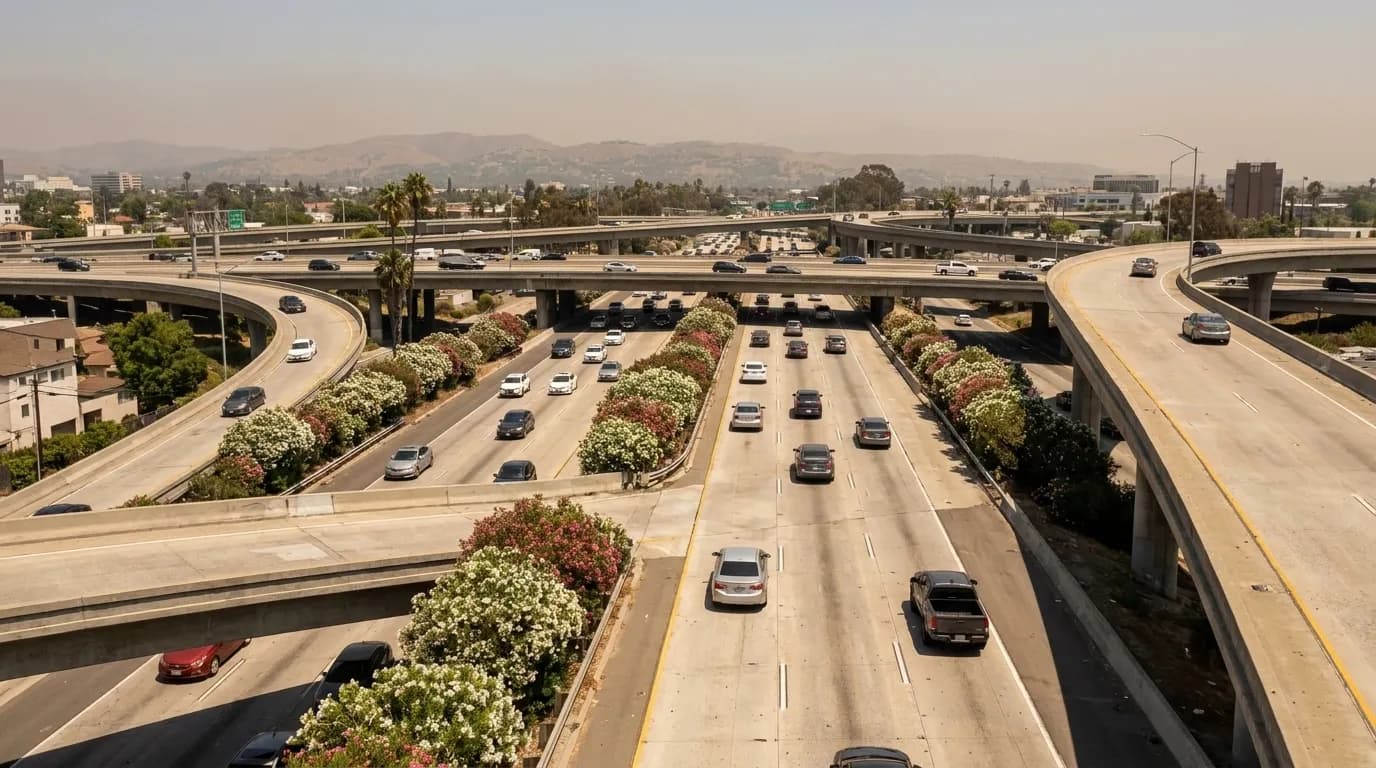
California's urban freeways have no service stations. Unlike the toll roads of the east coast or the motorway network in Europe, the interstate system through Los Angeles was built without food or fuel on the right of way, which means every meal on a drive here requires leaving the freeway, navigating a surface street, and getting back on. That single fact governs everything about eating on the road in this county.
Which exit is worth taking depends on the direction, the hour and the traffic behind you. Ask Karpo what is close to your route right now.
Why the exit matters more than the restaurant
The cost of a stop in Los Angeles is not the food, it is the re-entry. An exit that leads to a signalised arterial with a left turn across four lanes to get back to the on-ramp can cost fifteen minutes at the wrong hour. An exit with a cluster of businesses in the first block and a simple right-turn loop back can cost five. The difference between those two is larger than the difference between any two restaurants.
The pattern to look for is a diamond interchange with commercial development immediately adjacent on both sides and an on-ramp accessible without crossing traffic. Those exist and they are worth remembering. The pattern to avoid is an exit where the food is a mile up the arterial, which the map will show as close and which will not be.
Which corridors have what
The 5 through the northern Valley and out towards Santa Clarita has the most conventional cluster development, with several exits carrying a full range of quick-service options in a compact area. The 405 through the Valley and the Westside is the opposite — dense urban development with limited parking and difficult re-entry, and probably the worst freeway in the county to try to eat on. The 10 east of Downtown and the 60 have good clusters around the San Gabriel Valley exits, which is the rare case where the freeway food is genuinely worth eating.
The 101 through Hollywood and the Valley is mixed: some excellent exits, several that drop you into congested neighbourhood streets. The 110 and the 105 are thin. And the 15 heading out towards the desert, plus the far end of the 5 in both directions, are where the actual road-trip clusters are, with the large multi-brand plazas that people picture when they think of highway food.
The In-N-Out question
Any conversation about roadside food in Southern California arrives at In-N-Out, and there is a practical reason beyond loyalty: its locations are disproportionately sited near freeway interchanges with good parking and simple re-entry, the menu is short so the queue moves, and everything is cooked to order. The queue at peak is long and moves fast, which is a different thing from a short queue that does not move.
The known variation — the not-secret menu, with animal style and protein style and the rest — is worth knowing simply because ordering it is normal rather than clever. If speed is the priority, the drive-thru at a busy location is often slower than parking and using the counter, which is true of most quick-service restaurants and particularly true of the busiest ones.
The better version of a pit stop
If you have twenty minutes rather than ten, the San Gabriel Valley exits off the 10 and the 60 give you access to some of the best food in the country within two minutes of the freeway, and the strip malls there have enormous free parking. The same is true of the taquerias along the arterials near the 5 in the south-east county. A stop that is barely longer than a drive-thru queue can be a genuinely good meal rather than a serviceable one.
The other move is to plan the stop rather than react to hunger. Deciding on an exit before you set off, based on where you will actually be at the time you will want to eat, removes the improvisation that produces bad stops. In a county this large that is a five-minute planning exercise that saves half an hour.
What to carry
Two things make a long drive across Los Angeles County meaningfully better and neither is food. Water, because the climate is drier than it feels and the distances are longer than they look; and cash, because the best roadside food here is at trucks and small counters that occasionally have a card minimum. A cool bag in the boot is the third, and it changes what a stop can be — buying properly from a San Gabriel Valley bakery or a South Bay market and eating it later beats anything you will get from a lane.
Timing the drive
Los Angeles traffic peaks roughly seven to ten in the morning and three to seven in the evening, and during those windows a stop costs far more than the clock time because re-entering the freeway is genuinely difficult. Outside them the county is fast and a stop is cheap. If the drive can be shifted, shifting it is worth more than any route optimisation.
Late at night the calculus reverses entirely. The roads are empty, re-entry is trivial, and the constraint becomes what is open — which in most of the county after midnight means a chain lane, a doughnut shop, or a detour to Koreatown.
Practical notes
Check the exit rather than the restaurant when planning a stop; re-entry is the real cost. Avoid the 405 for food stops if there is any alternative. Fuel and food at the same stop saves a second exit. Many quick-service locations near freeways have separate lanes for the drive-thru queue that back up onto the surface street at peak, so parking is often faster. Keep a little cash for the smaller independent counters. And if you are crossing the whole county, plan the stop for the San Gabriel Valley or the south-east side, where the food near the freeway is best.
Tags: #LosAngeles #LAFood #RoadTrip #Freeway #FastFood #SanGabrielValley #SanFernandoValley #InterstateFive #FoodNearMe #LAEats #DriveThru #PitStop #NeighborhoodGuide
All trademarks are the property of their respective owners.
Ask Karpo first
Want to know which exit ahead of you has food with easy re-entry, what is open at this hour, and how bad the traffic is on your route? Ask Karpo before you take the next off-ramp.