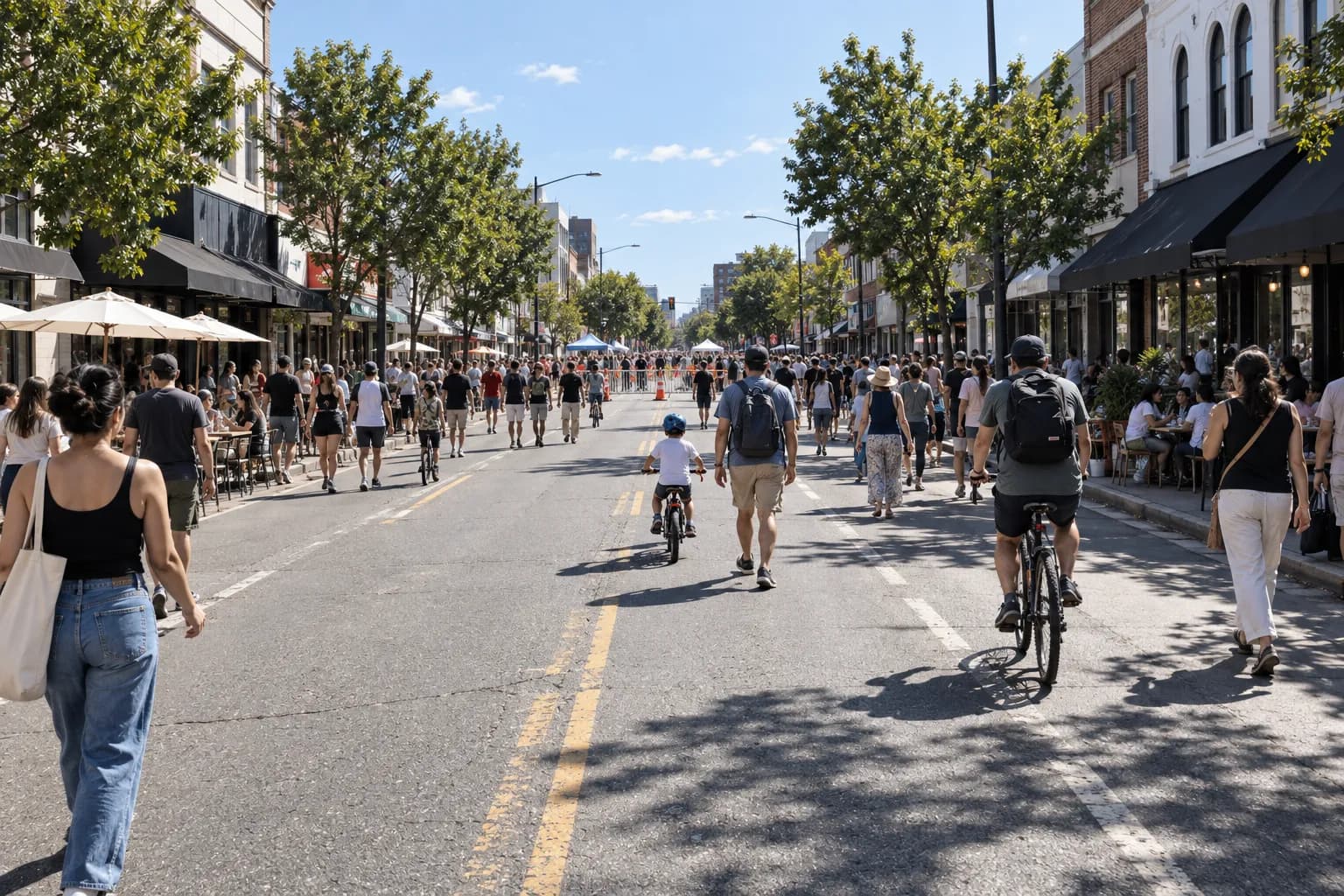
The most interesting thing that happens in San Francisco on certain Sundays is that a mile or two of ordinary street stops being a road. Sunday Streets closes a route to traffic for an afternoon and hands it to whoever turns up, which produces a version of the city that is otherwise impossible to see: a commercial corridor at walking pace, with the asphalt full of people rather than parked cars.
Each event lands in a different neighbourhood on a different Sunday, so the route you want may be nowhere near the one running this week. Ask Karpo where the streets are closed this weekend.
How the programme works
It is an open-streets programme rather than a festival, run across a season of separate events in different parts of the city. Each one takes a defined stretch of road, removes vehicles for a set number of hours in the middle of the day, and fills it with a mix of neighbourhood businesses, community stalls, music and activities organised largely by whoever is based along that route.
That local sourcing is the reason each edition feels different. A Mission route and a Bayview route are not the same event in a different postcode; they reflect the organisations, shops and demographics of the corridor they run on, and the character shifts accordingly.
Which routes are which
Over the years the programme has run along Valencia Street and Mission Street, through the Bayview along Third Street, in the Tenderloin, in the Excelsior along Mission's southern end, in the Western Addition, and out on the Great Highway. The roster changes between seasons and not every route runs every year.
The Valencia and Mission routes are the busiest and the easiest to reach, with the densest run of shops and restaurants along them. The Bayview and Excelsior editions are quieter and are the more interesting ones if you want to see a part of San Francisco that visitors, and a lot of residents, never get to.
What it is actually like
Less organised than a street fair and more open than a festival. There is no gate, no programme you have to follow and no central stage that everything orients around. You walk in at any point along the route, move in either direction, and encounter things — a band, a bike repair stand, a stall run by a neighbourhood clinic, a restaurant that has put tables in the road.
The dominant impression is spatial rather than programmatic. Standing in the middle of a four-lane commercial street with no cars on it rearranges how the buildings on either side read, and that is genuinely the point. Most people spend the first ten minutes just noticing the width of the road.
Coming with children
This is one of the best things in the city for small children and it is the reason a large share of the crowd is families. A closed street is a safe surface for a first bicycle or a scooter, and the events typically include activity zones aimed squarely at the under-tens.
Bring the bike rather than renting one. Rental is possible but the whole appeal is a child riding a familiar bicycle on a road, and the routes are flat enough on most editions to make that workable for a couple of miles.
Eating along the way
The correct approach is not to plan a meal. The restaurants along the route are open and generally busier than usual, several put tables outside, and there are food stalls in the road, so the better technique is to eat in three or four small stages as you walk rather than committing to a sit-down lunch in the middle.
On the Mission routes this is particularly rewarding, because the corridor has one of the highest concentrations of good cheap food in the city and being able to walk down the middle of it eating a taco is an unusually direct way to experience that.
Timing and the weather
The events run in the middle of the day and the first hour is noticeably quieter than the last two. If you want the atmosphere, come late; if you want to actually browse the stalls and talk to people, come early. Both are reasonable and they are different experiences.
San Francisco microclimates apply. A route in the Mission will be twenty degrees warmer and sunnier than one on the Great Highway on the same afternoon, and the western routes can be genuinely cold and foggy while the eastern ones are in full sun. Check the neighbourhood forecast rather than the city one.
Getting there
Public transport is the only sensible approach, both because the route itself is closed and because the streets around it absorb the displaced traffic. BART serves the Mission routes directly, Muni serves everything, and the closures are designed to keep transit lines running on adjacent corridors.
If you are cycling in, the route is the easiest riding you will get in San Francisco all year. If you are driving, park well away from the closure and walk in; attempting to get close will cost more time than the walk saves.
Why it matters beyond the day
Programmes like this exist partly to demonstrate something: that a street can carry more people without cars than with them, and that the businesses along it do better rather than worse. San Francisco has been running the argument for long enough that several of the corridors involved have since won permanent changes.
Whether or not that interests you, it does change how the day feels. This is not a closed-off entertainment zone dropped into a neighbourhood; it is the neighbourhood using its own street differently for an afternoon, which is why the crowd looks like the people who live there.
Practical notes
Sunday Streets is San Francisco's open-streets programme, running a series of separate Sunday events across different neighbourhoods through the warmer months rather than one fixed festival. Routes have included Valencia and Mission Streets, the Bayview along Third Street, the Tenderloin, the Excelsior, the Western Addition and the Great Highway, and the roster changes each season — check which route is running before you travel. It is free with no gate; walk in anywhere along the closure. Bring a bike for children. Eat in stages from the businesses along the route rather than planning a sit-down meal. Come early to browse or late for atmosphere, check the neighbourhood-specific forecast, and use BART or Muni rather than driving.
Tags: #SanFrancisco #SundayStreets #EventsNearMe #FreeThingsToDo #MissionDistrict #SFEvents #OpenStreets #SFWeekend #ValenciaStreet #Bayview #SFThingsToDo #CarFree #SFFamilies #BayAreaEvents
All trademarks are the property of their respective owners.
Ask Karpo first
Want to know which route is closed this Sunday, what the weather is doing in that specific neighbourhood and where to eat along the way? Ask Karpo for a live read before you head out.