San Francisco residents searching for eclipse solar free viewing this week need a decision guide more than a hype list. As of Tuesday, August 4, 2026, the next eclipse listed for San Francisco by Timeanddate is a partial lunar eclipse on August 28, 2026, while the next solar eclipse visible from the city is listed as January 14, 2029. That means the practical move now is preparation: know where free public viewing makes sense, how to verify an actual solar event before you go, and which places offer open sky without forcing a difficult climb, paid admission, or unsafe improvising with cameras and binoculars.
Want a city-specific eclipse plan without chasing stale event posts? Text Karpo for verified San Francisco viewing spots, transit-friendly backups, and safe-viewing reminders before you head out.

Grandview Open Space at 15th Avenue and Noriega
Grandview Open Space is the clearest first pick for people who want height, neighborhood scale, and no admission gate. San Francisco Recreation and Park lists the site at 15th Avenue and Noriega, with park hours from 5 a.m. to midnight and restroom hours from 8 a.m. to 8 p.m. The tradeoff is terrain: the stairs and slopes make it better for steady walkers than for strollers, wheelchairs, or anyone avoiding uneven climbs.
For a solar event, Grandview works only if the timing and sky direction match the open sightline you can safely use from a stable spot. Do not crowd stair landings, block residential sidewalks, or set up tripods where people must pass. If fog is sitting on the Inner Sunset or ocean side, shift early rather than waiting for a miracle clearing at peak viewing time.
Presidio Tunnel Tops and the Main Post Lawns
Presidio Tunnel Tops is the more accessible free choice, especially for families, visitors, and groups that need restrooms, transit, benches, and level gathering space. The Presidio describes Tunnel Tops as free and open daily, with accessible restrooms, accessible parking, wheelchair-accessible picnic tables, public lawns, and direct access near the Presidio Visitor Center at 210 Lincoln Boulevard. It is less dramatic than a hilltop, but easier to manage.
The failure mode here is assuming a scenic overlook equals an eclipse program. Treat the lawns as a free public viewing base unless an official event is separately posted by the Presidio, National Park Service, Exploratorium, or another named institution. Bring your own compliant solar viewers, keep kids away from unattended optics, and use the Presidio Visitor Center as a practical checkpoint when it is open.
Crissy Field When Fog Favors the Bay
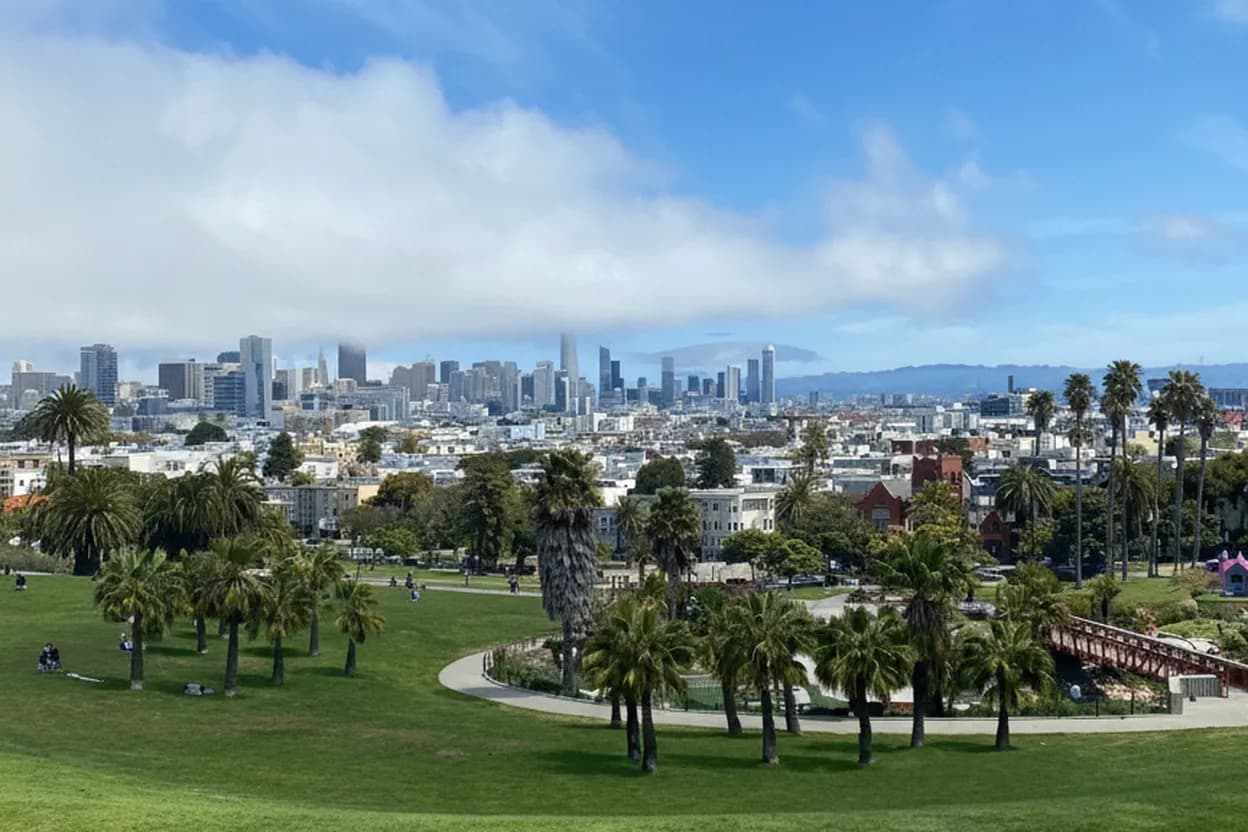
Crissy Field can beat western hills when marine layer hangs over the Sunset but the bayfront opens. Its advantage is space: people can spread out, avoid blocking paths, and choose a flat place away from cyclists and joggers. Its weakness is wind, glare, and fast-changing cloud. For a low-elevation partial solar eclipse, a waterfront plan should include layers, a hat, water, and a firm decision time for leaving.
Pair Crissy Field with Tunnel Tops rather than treating them as separate trips. If the bayfront is clear, stay low and keep the group comfortable; if the breeze is too strong for paper viewers or projection cards, walk back toward the Main Post lawns. For accessibility, this is usually kinder than Grandview, but confirm current parking, restroom access, and any temporary closures before relying on it.
Muni 43 Masonic, 30 Stockton, and the No-Car Plan
For most San Franciscans, the no-car plan is the resilient plan. The Presidio lists Muni Route 43 Masonic to the Presidio Transit Center and Route 30 Stockton to the Sports Basement parking lot for Tunnel Tops access. SFMTA fare information is current enough to check payment methods, but service alerts can change day by day, so do not build an eclipse outing around an old screenshot.
Use transit for the Presidio, walking for neighborhood parks, and rideshare only as a backup after the viewing window. Solar events compress movement into a short period; everyone tries to arrive just before the same sky moment. If a bus delay would make you miss the peak, choose the closer open-space option, even if the view is less iconic. The best free plan is the one you can actually reach calmly.
NASA Glasses Rule for Cameras, Binoculars, and Kids
The safety rule is simple but unforgiving: for any partial solar eclipse, there is no safe naked-eye moment. NASA says eclipse glasses or handheld solar viewers are required for direct viewing, and regular sunglasses are not safe. NASA also warns that cameras, binoculars, and telescopes need special solar filters fixed over the front of the optics; eclipse glasses worn at your eyes do not make those devices safe.
The American Astronomical Society adds a practical buying rule: use manufacturers or authorized dealers that can be traced, and avoid random marketplace listings when the seller cannot show solar-viewer expertise. Inspect viewers before use and discard damaged ones. For children, assign one adult to eye safety rather than assuming every adult is watching. A pinhole projector or colander shadow is the right fallback when glasses are uncertain.
Exploratorium Eclipse Page and Livestream Backup
The Exploratorium is San Francisco’s strongest local astronomy reference for eclipse education, but its eclipse page should be treated as a live verification stop, not proof that a free in-person program exists on a given date. If the city has no visible solar eclipse that day, a livestream from a scientific source may be the better experience than standing in fog with unsafe borrowed gear.
This matters in August 2026 because the widely discussed August 12 total solar eclipse is not listed by Timeanddate as visible from San Francisco. Search interest can be national while the local sky gives nothing. If you want the learning moment, use a reputable livestream indoors, then plan an outdoor practice session later with safe viewers, shadows, and a public park that matches the next verified local date.
Check Timeanddate, NASA, Park Pages, and SFMTA Before Leaving
Your final verification action should happen the same day you leave, not the night before. Check Timeanddate for San Francisco visibility and timing, NASA for safety guidance, the park or agency page for access rules, and SFMTA for route or fare changes. If any one of those pieces is missing, downgrade the plan from event outing to casual park visit with optional sky education.
The San Francisco decision is not simply where to stand; it is whether the event is real locally, whether the sky is open, whether the route is manageable, and whether every viewer is safe. Choose Grandview for height, Tunnel Tops for access, Crissy Field for space, and an official livestream when the city is outside the path. Then recheck the source pages before you walk out the door.
Tags: #AskKarpo #BeforeYouGo #SanFrancisco #SFEvents #FreeThingsToDo #SolarEclipse #EclipseViewing #Skywatching #NASA #Presidio #GrandviewPark #CrissyField #Muni #BayArea
Sources consulted: Source 1: timeanddate.com · Source 2: science.nasa.gov · Source 3: eclipse.aas.org · Source 4: sfrecpark.org · Source 5: presidio.gov · Source 6: sfmta.com
All trademarks are the property of their respective owners.
Ask Karpo first
Tell Karpo your date, group size, budget, and starting point. We’ll check current access, timing, transit, and the cleanest San Francisco plan for Public parks, open spaces, observatories before you head out.