New York has three Chinatowns and most people only ever walk through one of them. Manhattan's is the oldest and the most photographed. Flushing is the largest and by now the best documented. Sunset Park, running up Eighth Avenue from around 42nd Street to the low 60s in Brooklyn, is the one that has stayed a working neighbourhood rather than becoming a destination - which means the prices never moved and nobody is waiting for a table. It is about forty minutes from Manhattan on the N or D and it is the best dumpling walk in the city.
Eighth Avenue is twenty blocks of storefronts with the signage mostly not in English, which is wonderful to walk and hard to plan. Tell Karpo where on the avenue you have got to and what you want next, and it will keep you moving instead of standing on a corner reading windows.
Get off at the right end
The N stops at Eighth Avenue and 62nd Street, the D at New Utrecht nearby, and the R runs along Fourth Avenue which is a long walk east. The useful move is to start at the 62nd Street end and walk downhill toward the 40s, because the density increases as you go and you want the good stops in the second half rather than the first.
Doing it in the other direction is the common mistake. You fill up in the quieter blocks and arrive at the busiest stretch with no appetite left, which is a genuinely annoying way to spend a Saturday.
First stop: buy frozen, before you eat anything
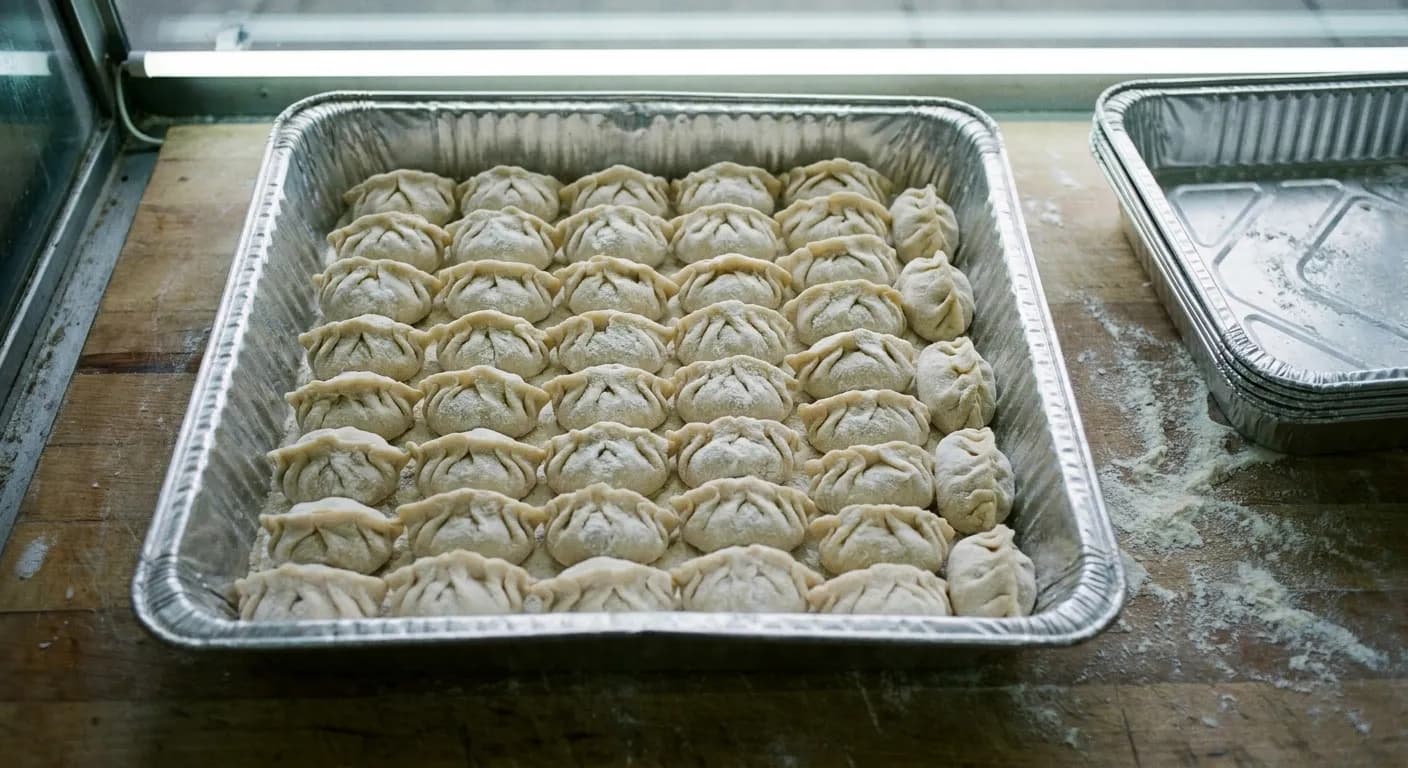
This is counterintuitive and it is the correct order. Several shops on the avenue sell trays of hand-folded raw dumplings by the fifty, made that morning, at a price that is roughly a third of anything comparable in Manhattan. Buy them first, while your bag is empty and your judgement is not yet clouded by having eaten four lunches.
Ask for them packed with ice if you are heading back into the city - it is a normal request and usually free. Pork and chive is the baseline; lamb and coriander is the one worth trying if a shop has it, and the shops that make it tend to be northern-run and worth marking for the next stop.
Second stop: the pan-fried counter
Somewhere in the 50s there will be a narrow shop with a flat pan the size of a manhole cover going continuously and a queue of four people. This is the guotie stop. They come out joined by a lacy crisp sheet of starch and they must be eaten standing up within about two minutes, which the shop assumes and which is why there is a ledge rather than a table.
Order six, not twelve. Twelve is a meal and this is stop two of five. The vinegar and chilli oil are on the counter to be mixed yourself, and the mix is roughly three parts black vinegar to one of chilli oil, with soy used sparingly if at all.
Third stop: soup dumplings, sat down
The Shanghainese rooms on the avenue do xiao long bao at a price that makes the Midtown queue look absurd, and there is generally no wait outside of Sunday lunch. This is the one stop to actually sit for. One basket between two, plus a plate of greens with garlic to break up the fat.
Look for sheng jian bao on the same menu - thicker doughed, leavened, fried flat-side down. If both are available, get four of those instead of a second basket of XLB. They are the better item and almost nobody orders them.
Fourth stop: wontons in soup, for contrast
The Cantonese side of the neighbourhood, concentrated toward the lower blocks, does wonton noodle soup properly - thin springy alkaline noodles, a broth built on dried flounder, and loose trailing parcels with whole shrimp inside. After two fried stops this resets everything.
Judge it on the noodles rather than the wontons. They should still be slightly resistant when they arrive, and they should be sitting under the broth rather than dissolved into it. A small bowl is enough here; you are close to the end of the walk.
Fifth stop: the bakery, and then go home
Finish at one of the Cantonese bakeries in the low 50s for an egg tart and a milk tea, or a pork floss bun if you want something savoury for the train. This is a two or three dollar stop and it is the correct ending because it takes no decision-making at a point in the afternoon when you have none left.
Total spend for the walk, including the fifty frozen dumplings you bought at the start, runs around thirty-five to forty-five dollars a head. The same afternoon in Manhattan's Chinatown costs half as much again and involves considerably more queueing.
When to go
Saturday and Sunday mornings are when the avenue is fullest and most of the trays are freshest, though the sit-down rooms get busy from about half past twelve. A weekday late morning is the calmest version and everything is still open. Most of the small counters close earlier than you expect - by seven or eight - so this is a daytime walk rather than an evening one.
Cash is still useful here. Card acceptance has improved but the smallest and best counters remain cash-preferred, and several have a ten dollar card minimum that is awkward when you only want six dumplings.
Tags: #SunsetPark #BrooklynChinatown #DumplingCrawl #NewYorkCity #NYCFood #EighthAvenueBrooklyn #Dumplings #BrooklynFood #NYCNeighborhoods #CheapEatsNYC
All trademarks are the property of their respective owners.
Ask Karpo first
Sunset Park works because nothing on the avenue is trying to be a destination. Ask Karpo what is open on the blocks around you and what each counter actually specialises in, and let the walk do the rest.