A Doughnut Plant Started in a Garage
In 1994, Mark Israel started Doughnut Plant in the basement of his grandfather's old LES apartment building on Grand Street. He had inherited his grandfather's doughnut recipes — Herman Israel had been a baker on the Lower East Side — and his initial business model was a bicycle-delivery operation: at four in the morning, Israel would fry a few dozen doughnuts, load them onto a bicycle basket, and deliver them to coffee shops around the neighborhood by six.
It worked. By 2000 the operation outgrew the basement and Israel opened the first proper retail storefront at 379 Grand Street, on the corner of Norfolk, three blocks from the original delivery basement. The storefront is still there. The same Mark Israel runs it. The basement fryers still run at 4:00 a.m.
What changed is the menu. The original recipe was a classic American yeast doughnut with a glaze made from natural ingredients — no preservatives, no shortening. Over the next two decades, Israel built around that base. The Tres Leches square. The crème brûlée square. The Brooklyn Blackout cake-doughnut. The seasonal coconut, the seasonal peanut butter and jelly.
Why Square
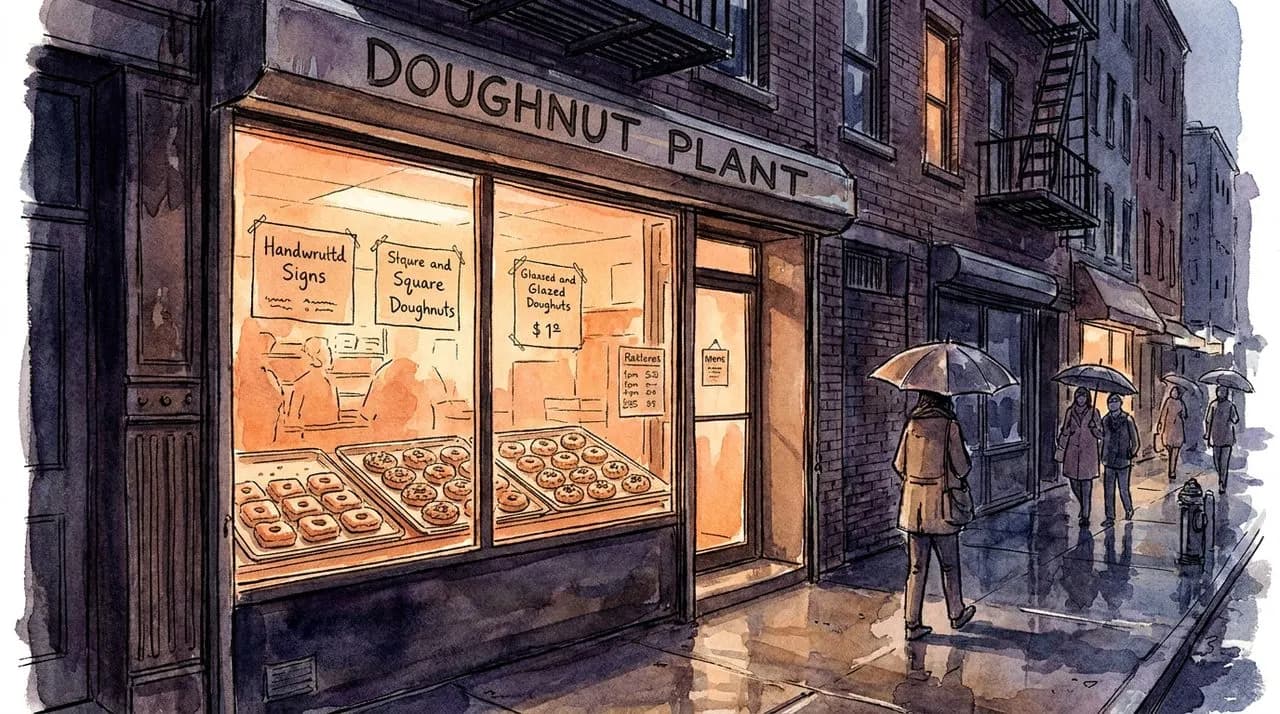
The square shape is the part of the menu most people remember. It is not a gimmick. Israel began making square doughnuts in the early 2000s to solve a specific problem: filled doughnuts, when round, deliver their filling unevenly. A round jam doughnut has a sweet center and dry edges. A square doughnut, filled corner to corner, gives you the same proportion of dough to filling on every bite.
The Tres Leches is the cleanest demonstration of the principle. It is a yeast square, soaked through with three-milk syrup, dusted with milk powder. Light pressure on the doughnut and the syrup runs. It is the closest thing the city has to a single object that justifies an alarm before five.
The crème brûlée square is the second case. A custard center inside a yeast square, topped with a torched sugar crust that crackles like the dessert. The torch is done in-house. The crackle is real.
What Time to Show Up
The storefront opens at 6:30 a.m., Wednesday through Sunday. But the fryers are running by 4:00 a.m., and the smell on Grand Street between Essex and Norfolk is at its peak between 5:00 a.m. and 5:45 a.m. The smell is the part of the experience that doesn't make it into reviews. It is sugar, yeast, hot oil, glaze cooling on racks. It carries half a block in either direction. At that hour the LES is quiet enough that you notice it from the subway exit at Delancey-Essex.
The doors open at 6:30 sharp. The first customers are usually two or three runners on their way back, a couple of restaurant cooks coming off the overnight shift, and a small line of regulars who have figured out that the first hour of service is when the squares are freshest. By 7:30 the line is out the door and the tres leches has been re-glazed twice.
The trick, if you are coming once and want it right, is to arrive at 6:25 a.m. The doors open as you finish your coffee from the bodega next door. You order three squares — tres leches, crème brûlée, a third you let the counter recommend. You eat the tres leches standing on the corner of Grand and Norfolk. The other two you carry home or eat on the F train.
The Block at Dawn
Grand Street at 5:30 a.m. is a New York that is mostly gone elsewhere. The block still has the bones of the old Jewish Lower East Side — the Kossar's bialy shop is two blocks east, opening at 6:00 a.m. The Streit's matzo factory was here until 2015. Yonah Schimmel's knish bakery is six blocks north on Houston, still in its 1910 location.
The Lower East Side has gentrified hard — the wine bars and high-rent retail spaces are obvious — but the food block of Grand has, in places, held its line. Doughnut Plant is the youngest of the LES dawn bakeries, but it operates the same way the older ones do. One product. Made overnight. Sold from a small storefront. Closed by mid-afternoon.
The other thing that holds at dawn is the social mix. The 5:45 line, when it forms, is mostly Asian-American grandmothers from the surrounding co-ops picking up boxes for family events, a few East Village finance types, and the occasional tourist who has done the reading. Nobody is on their phone.
How to Order
The default order is a tres leches and a coffee. Coffee is by Stumptown, drip and espresso, fine. The doughnut is the point. If you can only have one thing, this is it.
The Brooklyn Blackout is the better choice if you don't like custard. It is a cake doughnut — denser, less light — with a dark chocolate pudding inside and chocolate cake crumbs on top. It is closer to a small cake than a breakfast item, but at 6:30 a.m. nobody is judging.
The peanut butter and jelly square is a hand-friendly version of the same engineering: a yeast square, half peanut butter glaze, half a seasonal-fruit jam. It is the doughnut for people who do not normally like doughnuts.
Boxes are sold by the half-dozen and dozen. The boxes hold up for about four hours at room temperature. The glaze hardens slightly past then, and the squares are at their best within ninety minutes of frying.
The Other Locations, and Why This One Matters
Doughnut Plant has expanded — there are outposts in Chelsea on West 23rd Street, in Brooklyn at Grand Central Market, in Tokyo, in Seoul. The Grand Street original is, by some quirk of ownership, still the only one with the basement fryer that runs from 4:00 a.m. The doughnuts at the other locations are made overnight at Grand Street and shipped at dawn.
If you want them at the freshest possible point in their short life, Grand Street between 6:30 and 8:00 a.m. is the only place to be. The walk from the F train at Delancey takes four minutes. The whole thing — train in, doughnut, train out — is a forty-five-minute round trip from most of Manhattan.
It is an unusually good use of forty-five minutes.
The Argument
The argument the Doughnut Plant makes, against most of what doughnuts are in 2026, is that doughnuts should be a serious food. Not a novelty. Not a flavor-of-the-month, food-coloring, cereal-topped product. A serious food, the way a croissant is a serious food in Paris.
Israel has been making the argument for thirty-one years. He is, by his own description, still refining the dough. The square is the most visible part of the work. The freshness window is the deeper part.
Five a.m. is when the argument is at its sharpest.
Practical notes
- Address: 379 Grand Street, New York, NY 10002. Corner of Grand and Norfolk.
- Getting there: F to Delancey-Essex, four-minute walk south. Or B/D to Grand Street.
- Hours: Wednesday–Sunday, 6:30 a.m. to 7:00 p.m. (often sold out earlier on weekends).
- Order: Tres Leches square first. Crème brûlée second. Coffee, fine.
- Don't miss: The first batch of the day — be at the door by 6:25 a.m.
- Pairs well with: Kossar's Bialys two blocks east, a walk to Seward Park, the East River esplanade.
#doughnutplant #lowereastside #lesnyc #nycbakeries #nycdoughnuts #grandstreet #manhattannyc #earlymorningnyc #firstlight #nycfood #karpofinds #nyclocalknowledge #hiddennyc #weekendnyc #nycmornings
Sources consulted: Doughnut Plant · The Village Voice · Eater NY · The New York Times · NYC Tourism
All trademarks are the property of their respective owners.