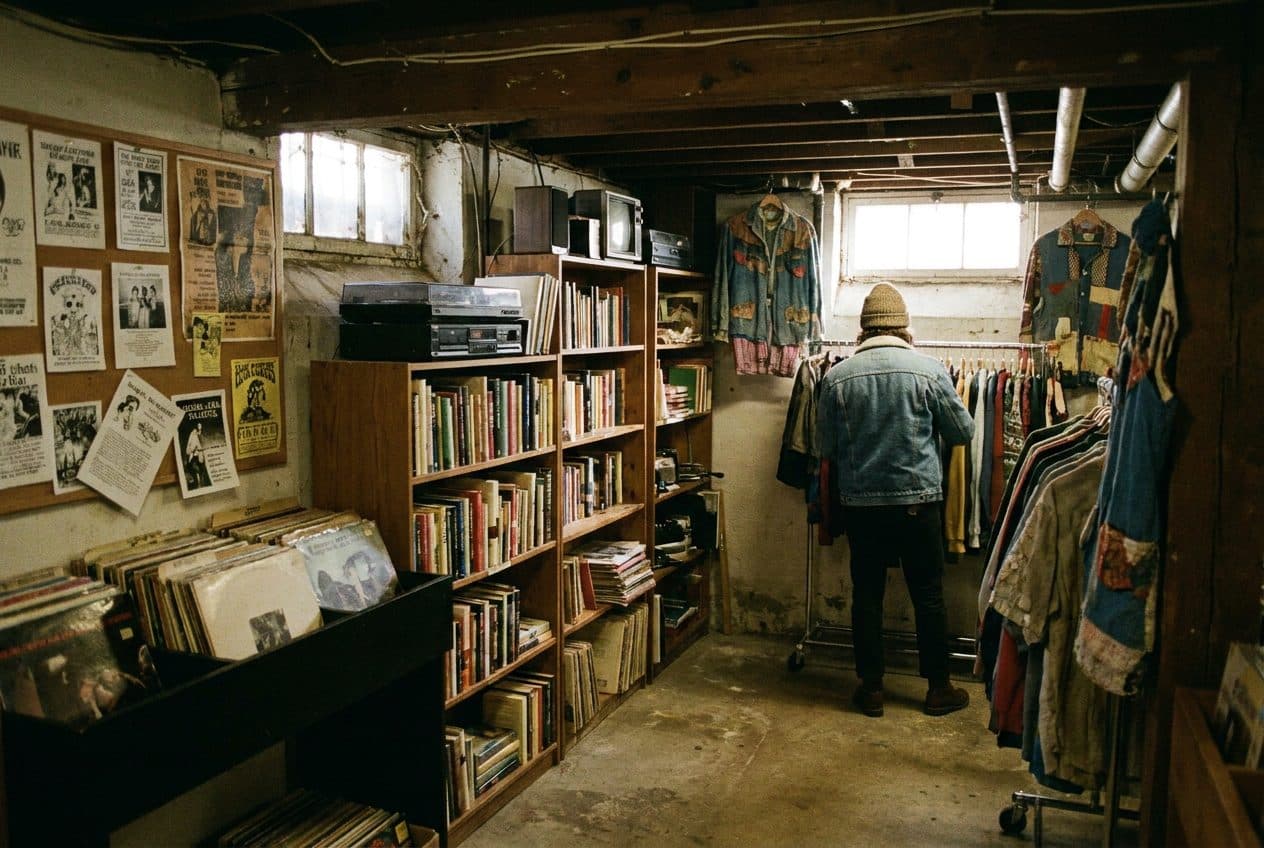
You know that feeling when a video game drops you into a side room with no quest marker, just ambient hum and the sense that something's here if you poke around? The Lower East Side still has pockets like that—basement zines, narrow galleries behind unmarked doors, shops that feel like someone's bedroom spilled into retail. You're not hunting Instagram moments. You're following a vibe that doesn't announce itself.
The Staircase That Smells Like Old Newsprint and Someone's Jasmine Tea
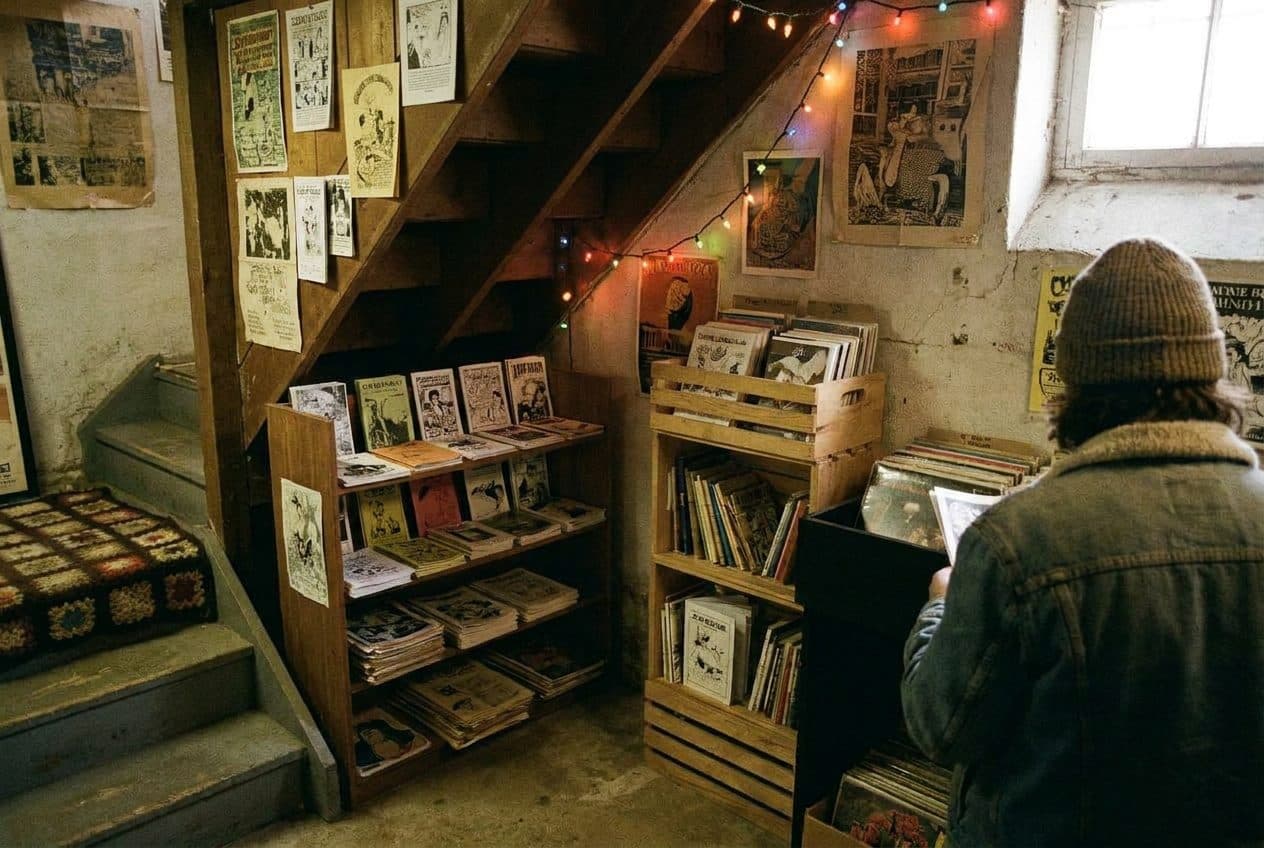
There's a zine library tucked below street level near the Delancey corridor, and you'll know you're close when the sidewalk grate starts exhaling this specific mix of paper dust and whatever the volunteer upstairs is drinking. The room itself runs long and narrow, fluorescent tubes casting that greenish non-time glow over milk crates stuffed with photocopied chapbooks. You flip through hand-stapled manifestos about pigeon taxonomy, breakup comics drawn on receipt paper, someone's decade-long documentation of bodega cat hierarchies. The carpet's worn thin enough that you feel the concrete underneath. No one's selling you anything. A kid in a too-big hoodie reshelf things using a system that makes sense only to them. You stay longer than you planned because the rhythm here—pages turning, the radiator ticking, the muffled thump of bass from the bar next door—puts you in a trance state. It's the same energy as wandering off-map in a game, finding the room that's just atmosphere and texture.
Vintage Hardware That Doubles As Accidental Sculpture
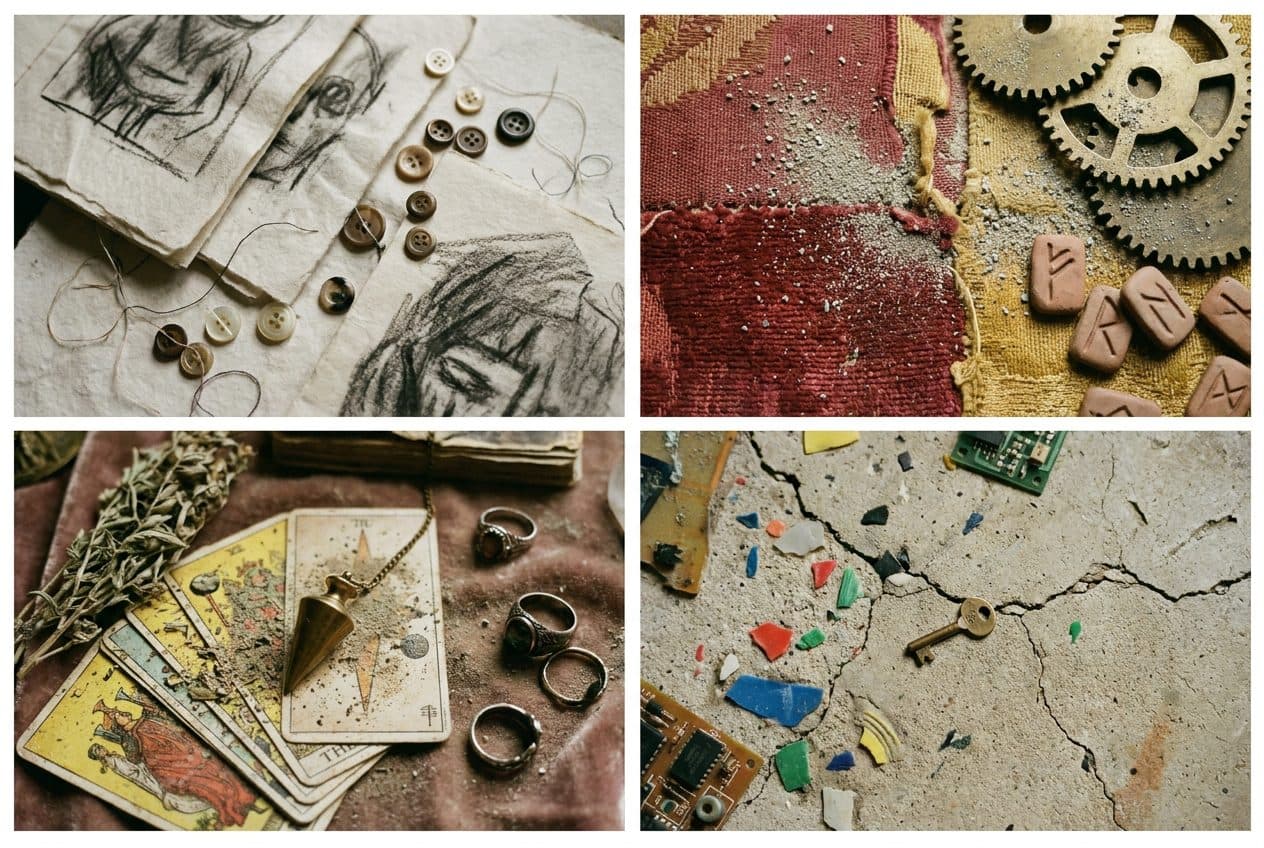
A few blocks toward the river, there's a shop that started as a locksmith's overflow and evolved into something harder to categorize. The front window's stacked with typewriter guts, rotary phone shells, boxes of unsorted keys that catch afternoon light like a brass chandelier. Inside, it smells like machine oil and decades of cigarette smoke baked into wood. The guy working the counter—always a different guy, never the same twice—will let you sift through drawers of Soviet-era camera parts, clock mechanisms, hinges from buildings that no longer exist. Nothing's labeled with prices. You ask, they squint, they name a figure that feels based on how long you've been looking. It's less shopping than archaeology. You leave with a brass gear the size of your palm, no idea what it originally turned, but it sits on your desk now like a talisman from a place that operates on dream logic.
The Café Where Everyone's Drawing the Same Corner
There's a coffee spot on a side street that's 70% regulars, 30% people who stumbled in looking for a bathroom and stayed. The corner booth has this quality of light around 3pm—something about the angle and the yellowed shade on the window—that turns everyone into a Hopper painting. You'll see the same four or five people camped there with sketchbooks, all rendering that exact spot from slightly different angles, none of them talking to each other. The coffee's fine, not transcendent, served in mugs that don't match. What matters is the vibe of collective solitary focus, the way the espresso machine hisses every seven minutes like punctuation, the fact that the bathroom's wallpapered with Xeroxed zine pages from the '90s that you can read while you wait in line. The barista rotates which local artist's work hangs on the back wall, and there's never an opening reception, just new drawings appearing one morning like someone redecorated a dream.
Thrift Racks That Require a Saving Throw
The thrift situation down here isn't the curated vintage boutique experience. It's the kind of place where you push through a heavy door, get hit with the smell of mothballs and old leather, and face racks so dense you need both hands to part the hangers. The lighting's bad on purpose or by neglect—hard to tell. You're digging through polyester button-downs and pleather jackets, and then your hand hits something that doesn't belong: a silk bomber with hand-embroidered koi, a wool coat with toggles carved from actual horn, a T-shirt from a band that broke up before you were born. The dressing room's a curtain hung on a tension rod. You can hear someone else in the next stall debating with their friend about whether a pair of pants is "avant-garde or just damaged." The whole operation runs on the principle that if you're willing to spend forty minutes in here, you've earned whatever you find. No one's going to help you. That's the point.
The Gallery That's Only Open When Someone Feels Like It
Near the intersection where the neighborhood starts blurring into Chinatown, there's a storefront gallery that keeps hours based on vibes rather than commerce. Sometimes it's open on a Tuesday at 11am. Sometimes it's dark for three weeks. When it is open, you walk into a white-box space showing video installations, sculpture made from electronics waste, photographs of infrastructure in cities you've never heard of. The floor's unfinished concrete, cold even in summer. There's usually one other person in there, standing very still in front of a piece, and you both perform this dance of not acknowledging each other while being hyper-aware of each other's presence. The work changes without announcement. You follow their Instagram, but it's just cryptic images and no captions. Going there feels like checking if a secret door's unlocked. Most of the time it's not, but when it is, you're in a space that doesn't care about foot traffic or sales, just about holding room for things that don't fit anywhere else.
Dumplings in a Fluorescent Nowhere
There's a dumpling counter in a food hall that's technically not a food hall, just a building with several unrelated food operations that happen to share a space. You order at a window, they hand you a number on a clip, you sit at communal tables under lights that make everyone look slightly ill. The dumplings arrive in a plastic basket lined with paper, steam still rising, the pleats on each one crimped with the kind of precision that suggests someone's been doing this for thirty years. You eat them too fast, burn your tongue, don't care. The room's full of people doing the same thing—construction workers on break, art students between classes, someone's grandmother who comes in every day at the same time. No one's taking photos. The acoustics are terrible, all echoes and clattering trays, but it's the sound of a place that works, that feeds people without pretense, that exists outside the city's performance of itself.
Practical Notes
Most of these spots cluster within a ten-minute walk of the Delancey or Essex Street stations. The zine library operates on volunteer hours, usually late morning through early evening on weekends, sometimes weekdays if you're lucky. The thrift shops and hardware-adjacent places keep more reliable schedules but still lean toward afternoon openings. The gallery's a gamble—check their social media before trekking over, or just embrace the randomness. The dumpling counter runs until they sell out, which can be mid-afternoon on weekends. Bring cash for about half these places; card readers are theoretical. Nothing here takes reservations because nothing here is that kind of place. You're wandering, not booking. That's the whole idea.
Tags: #TheOddEdit #LowerEastSide #NYCHiddenGems #ZineCulture #BasementFinds #ThriftingNYC #OffTheMapNYC #IndependentSpaces #NeighborhoodWandering #SideQuestEnergy #DeltaruneVibes #LESCulture #NewYorkExploration #CuriosityEconomy #SlowTravel
Sources consulted: atlasobscura.com · timeout.com · nytimes.com
All trademarks are the property of their respective owners.


