Most people who find the Coney Island Creek loop stumble onto it by accident—a wrong turn after Luna Park, a detour from the Belt Parkway traffic hum—and most never come back. Not because it disappoints, but because it belongs to that rare category of urban walk that resists repetition. It's a circuit, yes, elevated wooden boardwalk and steel footbridge tracing 2.3 miles around tidal marsh and industrial edge, but it's also a one-time conversation with a city that usually shouts. You walk it once, carefully, and the memory sits differently than your usual weekend rambles. The loop exists in that peculiar space between destination and accident, the kind of place that doesn't appear on influencer itineraries but lingers in the mental maps of those who've actually traced its perimeter.
The heron crossing at dawn
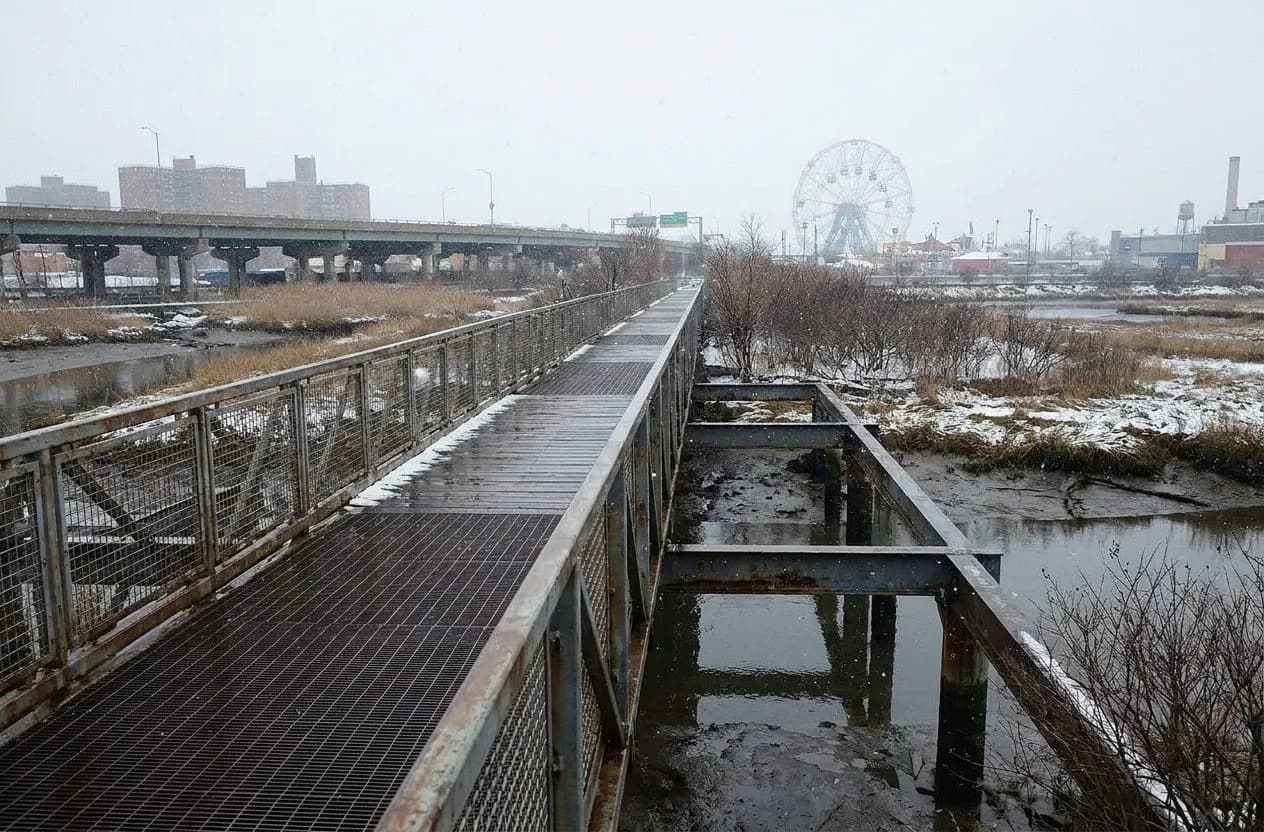
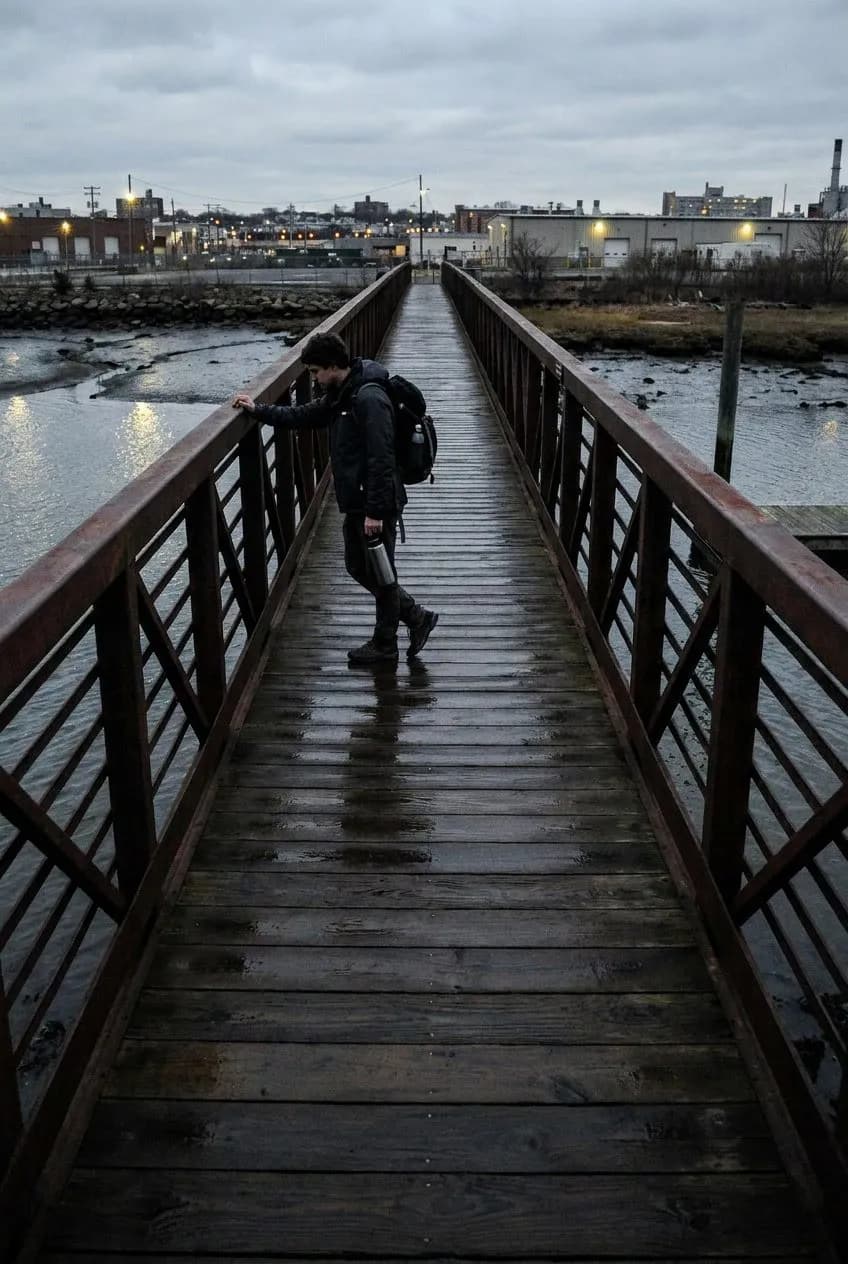
The footbridge over Kaiser Park channel opens daily (verify posted hours), a detail that matters if you're chasing the best light or the best solitude. Locals call it 'the heron crossing' for the birds that fish the pilings at dawn, long-legged and patient in a way that feels like a rebuke to the rest of the borough. The steel span is narrow, utilitarian, painted a shade of green that wants to blend into the marsh grass below. In late 2026, the paint is weathered enough to feel honest. The bridge's metal grating rings hollow underfoot, a rhythmic percussion that announces your passage to any wildlife within earshot.
Cross early and you'll have the bridge to yourself, the creek surface glassy and dark, the parkway a distant hum rather than a roar. The herons don't startle easily here; they're used to the occasional photographer, the pre-work walker. The light comes low and gold across the water, catching the phragmites in a way that makes edge geography feel less like urban planning jargon and more like actual poetry. On clear mornings, the silhouettes of herons stand motionless against the pale sky, creating compositions that would look staged if you hadn't watched them unfold organically. The smell here is distinctly tidal—salt and mud and vegetation, a scent that marks the boundary between land and water with olfactory precision.
Tuesday mornings and the four benches
If you're timing your visit to avoid crowds—and on this loop, 'crowds' means more than three other humans—Tuesday and Thursday mornings between 7 and 9am see the fewest pedestrians. The fishing pier on the north loop is where you'll want to pause, less for the fishing (though locals do drop lines here, quiet and methodical) than for the four benches that face the creek, not the parkway. It's a small design choice that makes all the difference. Someone in the planning department understood that orientation matters, that where you face determines what you see and, by extension, what you think about.
Sit facing the water and the city recedes. The Belt Parkway traffic becomes white noise, the kind of constant hum that somehow deepens rather than disrupts the quiet. The benches themselves are weathered wood, institutional but not uncomfortable, the sort of public furniture that gets overlooked in design blogs but serves its purpose. From here the creek spreads wide and brown-green, stitched with marsh grass and punctuated by the occasional gull. The view has no grandeur and all the more pull for it. On weekday mornings, you might share the pier with one or two regulars—people who've worked this spot into their routines, who nod in silent acknowledgment of shared territory before returning their attention to the water.
The sound geography of the eastern bend
Where the boardwalk curves around the eastern edge of the creek, the acoustic landscape shifts in layers. The Belt Parkway traffic rises to its loudest here, a constant rush punctuated by the occasional truck air brake. But underneath that mechanical drone, the marsh asserts its own sonic presence: the rustle of phragmites in even slight wind, the plop of something small entering water, the sharp cry of gulls wheeling overhead. If you stop walking, stop even breathing loudly for a moment, you can hear the creak of the boardwalk pilings responding to tide and current, a slow groan that marks time in increments too patient for most urban ears.
This is where the loop's sensory experience becomes most layered, most at odds with itself. Your eyes track a heron's slow stalk through shallow water while your ears process highway velocity. The air smells of salt marsh and exhaust in equal measure. It's disorienting in the way all true edge spaces are—neither one thing nor another, refusing to resolve into simple categories. Birders favor this stretch in spring and fall migration, when warblers and sparrows use the creek corridor as a highway of their own, pausing in the scrubby vegetation between longer flights.
Boardwalk rhythm and industrial ghosts
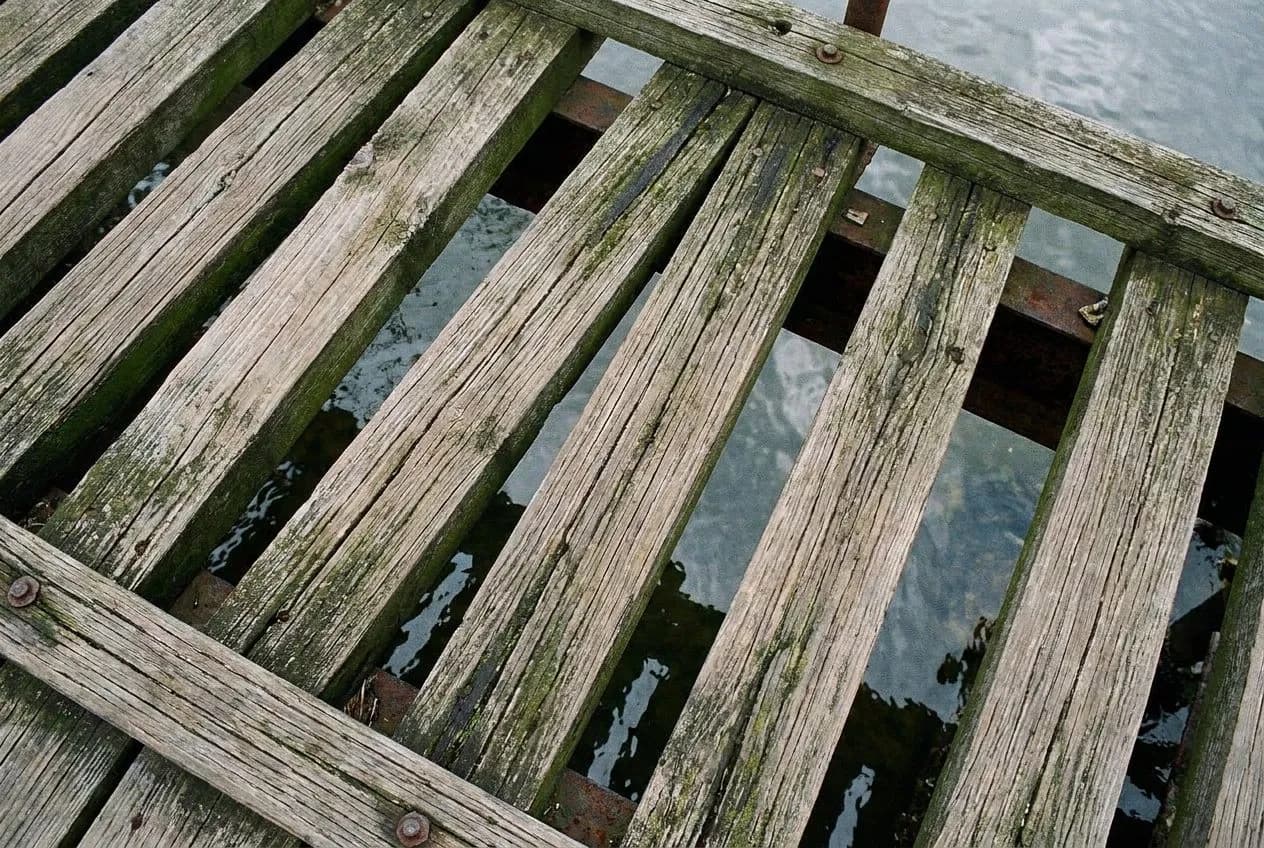
The boardwalk sections are newer than they look, rebuilt in phases over the past decade as funding trickled in. The wood is pale and springy underfoot, the railings painted white, the whole thing vaguely reminiscent of a beach town if you squint and ignore the scrapyards. Which you shouldn't. The industrial remnants—chain-link, corrugated metal, the occasional rusted barge—are half the texture here, the scaffolding that holds the marsh walks in context. These aren't picturesque ruins, nothing curated or adaptive-reused, just the honest aftermath of Brooklyn's working waterfront slowly ceding ground to other uses.
You're walking through a landscape in conversation with itself: nature reclaiming, infrastructure persisting, the city's edge blurred and unresolved. The phragmites sway in thick stands, their seed heads catching light, and every so often a gap in the vegetation opens onto water, still and reflective. The full 2.3-mile loop takes 45 minutes at a slow pace, longer if you stop to watch a heron or puzzle over the remains of a pier. There's no reason to rush. The boardwalk's rhythm becomes meditative if you let it—the slight bounce of the planks, the regular spacing of support posts, the way each section announces itself with a barely perceptible change in tone and flex.
The liminal stretch
Midway through the loop, the boardwalk curves east and the city reasserts itself in fragments: apartment towers in the distance, the occasional plane descending toward JFK, the parkway hum swelling and receding with the wind. This is the liminal stretch, the part of the walk where you're neither in wilderness nor fully in Brooklyn's grid. Joggers appear and disappear, their pace at odds with the landscape's slower pull. Some are clearly treating this as just another section of pavement to log miles on, earbuds in, eyes forward, the marsh merely backdrop to their fitness metrics.
It's here that the loop earns its reputation as a walk nobody does twice. Not because it's forgettable—the opposite—but because it resists the logic of routine. You can't optimize this circuit, can't fold it into your weekly running route or your list of scenic backdrops. It demands a different attention, the kind you can only muster occasionally, when you're willing to trade efficiency for observation.
Exit strategy and the B4
The loop deposits you back near Kaiser Park, but if you've had your fill of boardwalk and want a clean exit, break at Bayview Avenue for the B4 bus toward Bensonhurst/Sheepshead Bay. It's a practical pivot that also happens to take you through a stretch of residential Brooklyn that feels like a palate cleanser—tree-lined blocks, corner delis, the ordinary rhythms of neighborhood life. The contrast is part of the design, intentional or not.
By the time you're on the bus, the creek already feels distant, almost implausible. That's the trick of edge geography: it exists at the fringe of attention, easy to dismiss until you're standing in it. The loop doesn't demand you come back. It just sits there, waiting for the next accidental visitor, the next person willing to walk slowly enough to notice.
Practical notes
The Coney Island Creek loop begins near Kaiser Park, accessible from Bayview Avenue in Sheepshead Bay. Nearest subway: B or Q to Sheepshead Bay, then the B4 bus south. Limited street parking along Bayview Avenue. The footbridge and boardwalk are open dawn to dusk year-round; verify current conditions with NYC Parks. The loop is mostly flat and exposed—bring sun protection, water, and layered clothing for wind. The boardwalk is wheelchair accessible with some uneven transitions. Binoculars recommended for birdwatching. No bathrooms or vendors on the route; plan accordingly.
Tags: #ConeyIslandCreek #TheLongWayHome #NYC #Brooklyn #SheepsheadBay #MarshWalks #EdgeGeography #UrbanNature #BrooklynWalks #Fall2026 #HiddenNYC #HeronSightings #PedestrianBridge #TidalMarsh #CityEdge
Sources consulted: Coney Island Creek · Coney Island Creek Park · Time Out: Coney Island · NY Times: New York Region
All trademarks are the property of their respective owners.