Coney Island still runs on ritual. You start at Nathan's for the hot dogs that defined the boardwalk in 1916, you walk the Riegelmann Boardwalk with the Atlantic on one side and carnival noise on the other, you ride the Cyclone because it's been here since 1927 and it still terrifies people, and somewhere in there you claim a square of sand. Families have been doing this loop for a century. It's not subtle and it's not quiet, but it works exactly the way it's supposed to.
Karpo knows which Nathan's order to get, when the Cyclone wait is shortest, and which stretch of boardwalk to claim. It adapts to crowd size, weather, and your actual tolerance for vintage rides.

Nathan's Famous: start here, always
Nathan's Famous sits at Surf and Stillwell, the corner that anchors the entire Coney Island experience. The original location opened in 1916 and the current building keeps the same fluorescent-yellow signage and walk-up counter energy. You're here for the hot dog—natural casing, griddled until it snaps, served on a steamed bun with their specific blend of spicy brown mustard. Get it with fries; the crinkle-cut kind come out searingly hot and need a minute to cool. If you're with a group, the combo platters make sense. Go for two dogs, fries, and a drink for around twelve dollars.
The indoor seating is functional but not the point. Most people take their trays outside to the picnic tables or walk toward the boardwalk. Weekends in July and August see lines that stretch twenty deep, but they move. The staff has the rhythm down. Avoid the peak lunch window between noon and two if you can; mornings around eleven or late afternoons after four are smoother. Nathan's runs the annual Fourth of July hot dog eating contest here, and the whole corner turns into a stadium. Any other day, it's just very good fast food done the same way for more than a hundred years.
The Riegelmann Boardwalk: where everything connects
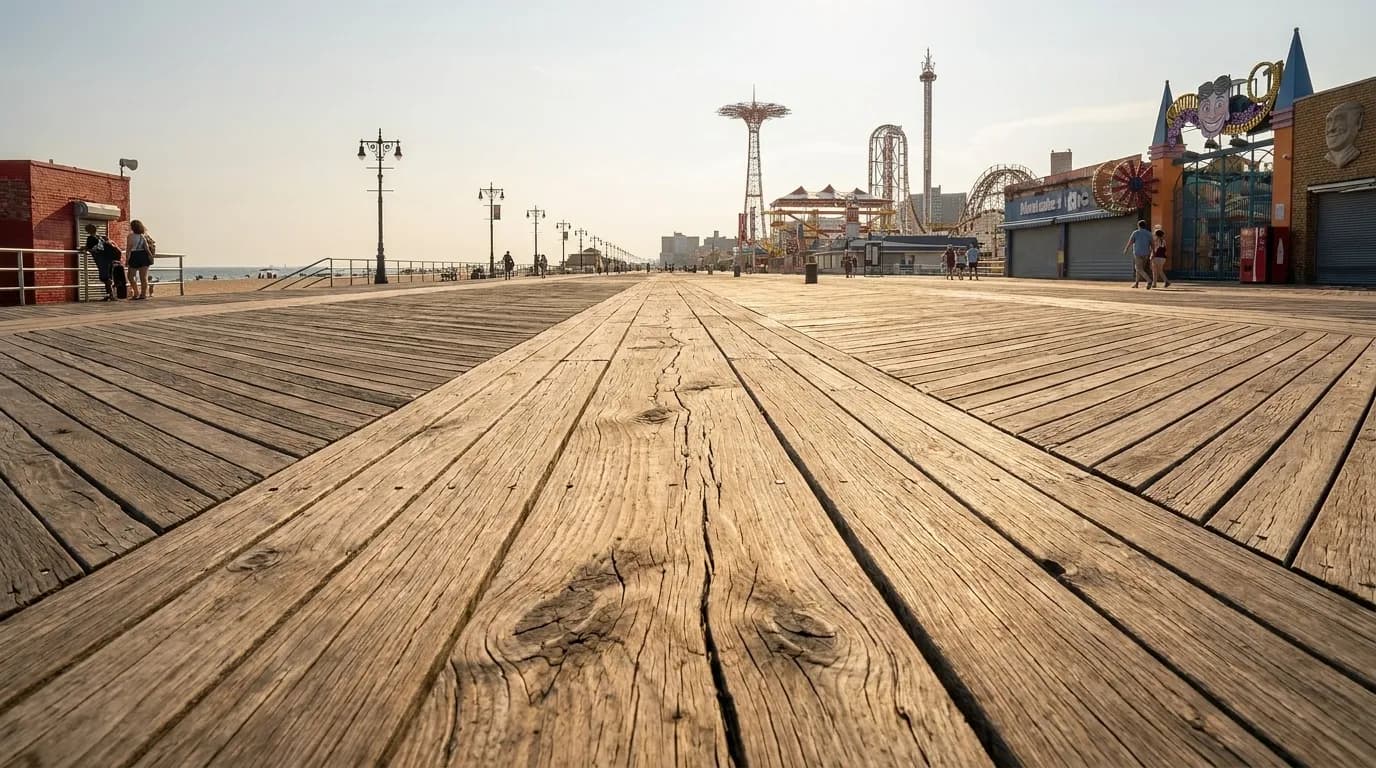
The Riegelmann Boardwalk runs 2.7 miles along the beach, from West 37th Street to Corbin Place in Brighton Beach. It's named after Edward Riegelmann, the Brooklyn borough president who pushed it through in the 1920s, and the wooden planks have been replaced and repaired constantly but the frame stays true. This is the spine of Coney Island. On one side: the beach, the ocean, lifeguard stands, volleyball nets, and people claiming territory with umbrellas and coolers. On the other: Luna Park, arcade fronts, pizza joints, souvenir stands selling airbrushed T-shirts, and the low hum of generators powering rides.
Walk west from Nathan's and you pass the main Luna Park entrance, the original Cyclone loading platform visible through the fence, then Deno's Wonder Wheel rising 150 feet up. Walk east and the boardwalk gets quieter, the density thins, and you hit the Russian-speaking stretch near Brighton Beach. The best people-watching happens between Stillwell and West 10th, where the boardwalk is widest and the mix of families, teenagers, and solo swimmers overlaps. Bring cash for the lemonade and Italian ice carts; they don't take cards. The boardwalk gets cleaned nightly, but by midday in summer the trash cans overflow and it smells like sunscreen and fried dough. That's the correct smell.
Luna Park and the Cyclone: mandatory adrenaline
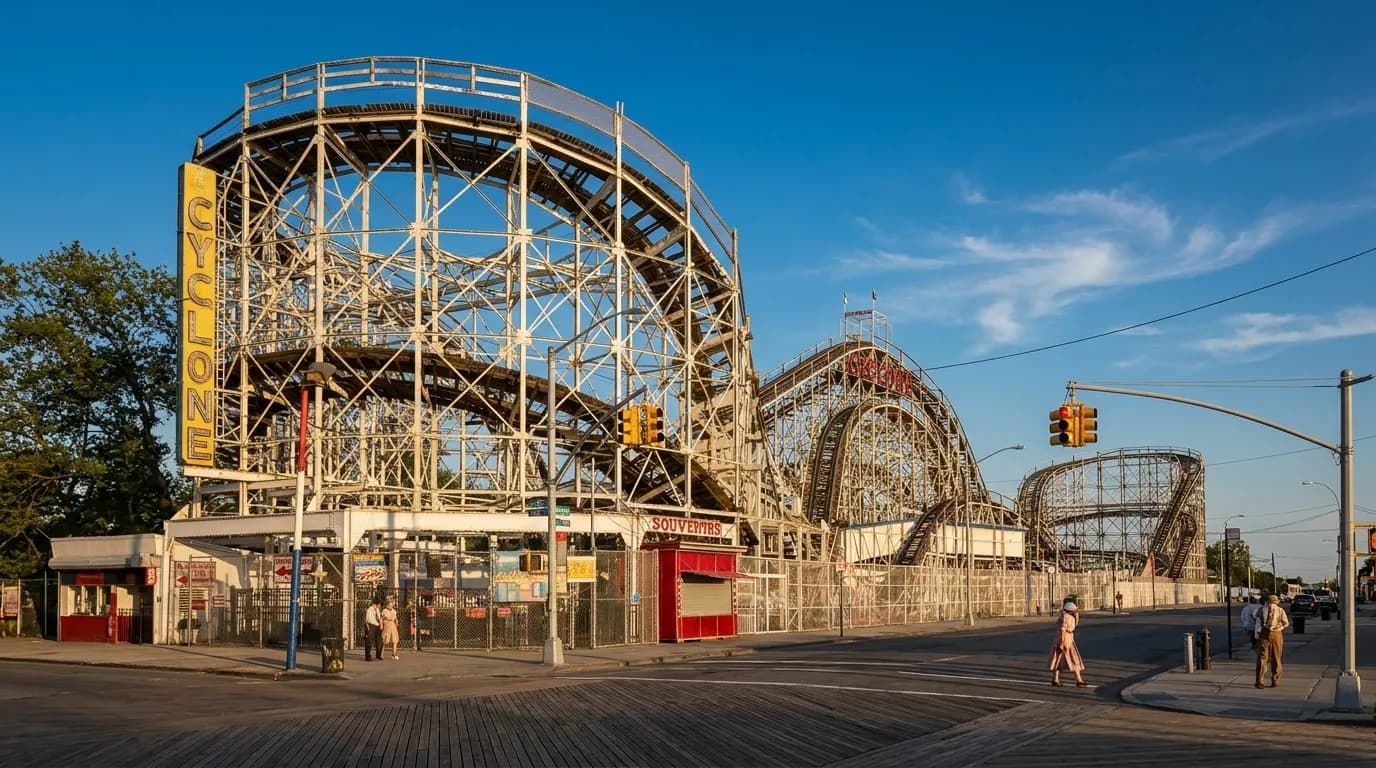
Luna Park reopened in 2010 on the old Astroland site, but the Cyclone predates everything. Built in 1927, it's a wooden roller coaster that runs 2,640 feet of track, hits twelve drops, and maxes out around sixty miles per hour. It rattles. The cars have no padding. You will feel every joint in the wood. People scream the entire ninety seconds not because it's the tallest or fastest but because it's unpredictable and loud and genuinely unnerving in the way modern coasters aren't. Ride it once to say you did it; locals ride it every summer because it's a point of pride.
The Cyclone runs its own ticketing separate from Luna Park's wristband system, around ten dollars for a single ride. Lines peak in the afternoon; try for late morning or after seven when the park starts to thin. The best seat is the front row if you want the full visual, back row if you want maximum whiplash. Luna Park itself has thirty-some rides, most geared toward kids and families—spinning teacups, a log flume, a midway with ring toss and basketball hoops. It's clean, well-run, and not trying to be anything other than a neighborhood amusement park. Wristbands run around fifty dollars for unlimited rides. If you're selective, pay per ride.
Deno's Wonder Wheel: the slow, sturdy counterpoint
Deno's Wonder Wheel opened in 1920, built by the Eccentric Ferris Wheel Company, and it's been a Coney Island landmark longer than most of the buildings around it. It's 150 feet tall, painted in bright primary colors, and offers two kinds of cars: stationary ones that stay fixed to the wheel's rim, and swinging cars that slide on interior tracks as the wheel turns. The swinging cars are the draw—they lurch and tilt as you rise, and the motion is disorienting in a way that feels genuinely vintage. The wheel takes about ten minutes to complete a full rotation, slow enough to take in the beach, the boardwalk, and the Atlantic stretching out flat and gray-blue.
Deno's runs independently from Luna Park, with its own small arcade and kiddie rides clustered at the base. A ride on the Wonder Wheel costs around ten dollars. Go at dusk if you can; the wheel is lit with thousands of LEDs and the view west toward the Parachute Jump and the Coney Island Houses catches the last light. The wheel runs year-round, weather permitting, and it's one of the few rides that feels genuinely historical rather than nostalgic. The Vourderis family has owned it since 1983 and keeps it immaculately maintained. It's designated a New York City landmark, which means it's not going anywhere.
The beach itself: claim your spot early
Coney Island Beach is a wide, flat stretch of sand that gets absolutely packed on summer weekends. Lifeguards are on duty from late May through early September, roughly ten to six, and the beach is free. Bring your own umbrella, towels, and cooler; rentals exist but they're overpriced and the quality is hit or miss. The sand closest to the boardwalk fills first, so if you want space, walk toward the water or head east past West 10th Street where the crowds thin. The ocean is cold even in July—mid-sixties on a good day—but swimmable. Waves are gentle, the slope is gradual, and it's a solid spot for kids.
Showers and changing rooms are available under the boardwalk at several access points; they're functional but not luxurious. Bathrooms are clean enough and staffed during peak season. The beach gets cleaned nightly, but by afternoon the trash situation is real. Pack out what you bring. Alcohol is not allowed on the beach, and enforcement is consistent. The vibe is multigenerational and unpretentious—Russian families with full picnic spreads, teenagers playing soccer, older men in Speedos doing laps parallel to the shore. If you want solitude, this is not your beach. If you want the full New York summer experience, this is exactly it.
Practical notes
Take the D, F, N, or Q train to Coney Island–Stillwell Avenue; the station drops you directly at Surf and Stillwell, steps from Nathan's and the boardwalk. The ride from Manhattan takes about an hour. Aim to arrive before eleven on weekends to claim beach space and beat the Nathan's lunch rush. Bring cash for boardwalk vendors and smaller food stands; many don't take cards. Sunscreen, a hat, and a refillable water bottle are non-negotiable. Luna Park hours vary by season; check their site before you go. The Cyclone and Wonder Wheel typically open by noon and run into the evening. If you're doing the full day—beach, boardwalk, rides, and food—budget four to six hours. Skip the arcade games unless you're genuinely committed to winning a stuffed animal; the odds are what you'd expect.
Tags: #coneyisland #coneyislandbeach #nathansfamous #riegelmannboardwalk #lunapark #cyclonerollercoaster #denoswonderwheel #brooklynbeach #newyorkbeach #boardwalk #summerinnyc #freetodonyc #familyday #beachday #classicnyc
All trademarks are the property of their respective owners.
Ask Karpo first
Karpo knows the Coney Island rhythm—when the Cyclone line is shortest, which Nathan's combo is the move, where to set up on the beach before it turns into a gridlock of umbrellas, and whether the Wonder Wheel swinging cars are running today. It's the local friend who's done this loop enough times to skip the mistakes and get you straight to the good parts. Next time you're planning a beach day, let Karpo build the route.