Every coffee list written about Los Angeles ranks the coffee. That is not the variable. The variable is whether you will spend eleven minutes on a one-way loop around Sunset looking for a space, arrive irritated, and drink something excellent while worrying about a street-sweeping sign you did not fully read. This is a list of good coffee sorted by the thing that actually determines whether you go: what happens to the car.
Parking rules in Los Angeles change by block, by hour and by street-sweeping day, and the sign is never the whole story. Ask Karpo what the restrictions are where you are heading, whether the lot is customer-only, and which café nearby has the easier answer.
Category one: the café that comes with a lot
The Helms district in Culver City is the cleanest example in the city. It is a collection of old bakery buildings with a shared lot, which means Bar Nine — a roaster and café that takes brewing more seriously than almost anyone in Los Angeles — is a place you can simply drive to. Cognoscenti's Culver City room, further down Washington, sits in the same low-rise, wide-street pattern where parking is a solved problem rather than a negotiation.
Jones Coffee Roasters in Pasadena is the other archetype: a working roastery on a light-industrial block south of the freeway with its own parking, where the smell of the roaster hits you before you reach the door. Industrial blocks are, consistently, the best coffee-to-parking ratio in Southern California.
Category two: the strip mall, which is not an insult here
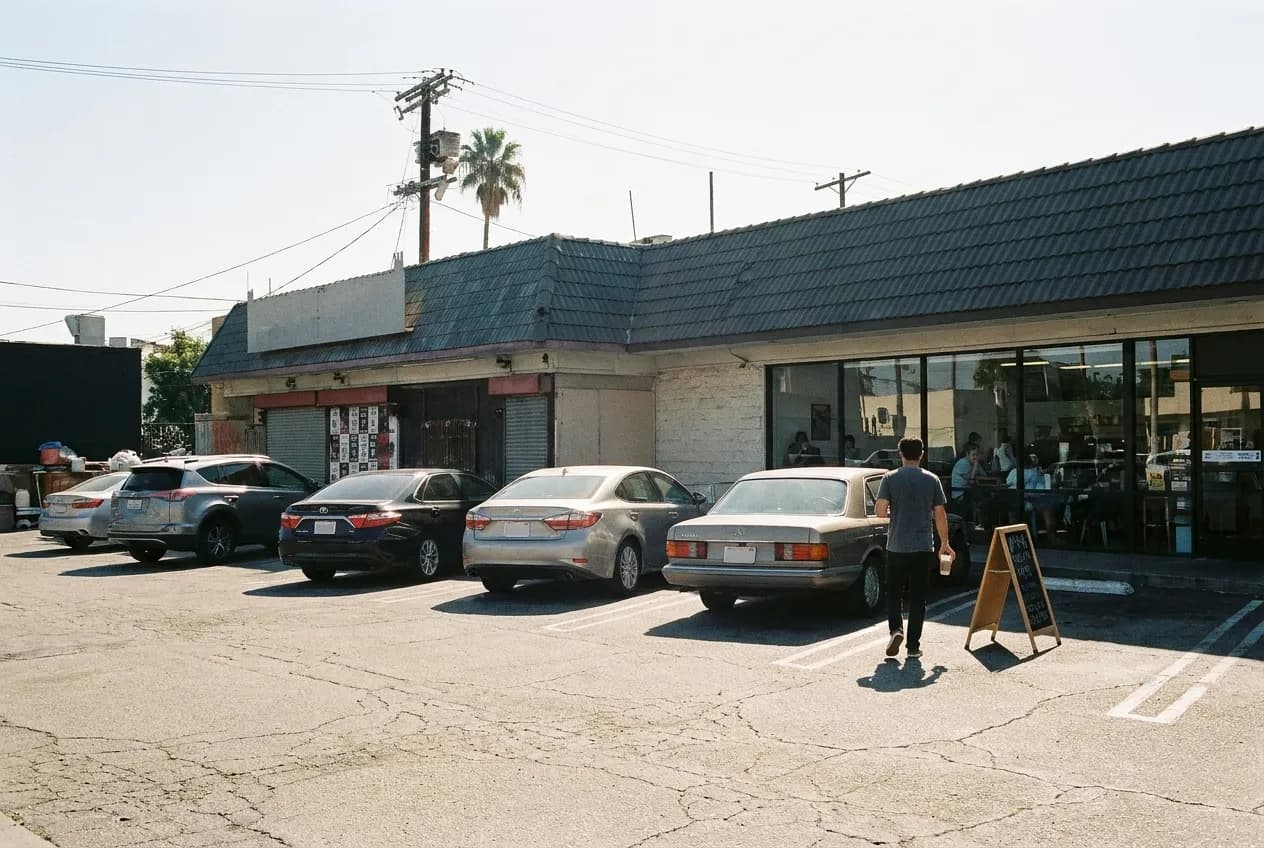
Los Angeles built tens of thousands of small commercial buildings set back from the street with a lot in front. In most cities that would be a food-quality warning. Here it is where a large share of the best independent cafés live, because the rent is lower and the owner-operator model survives. The San Gabriel Valley, the east San Fernando Valley and the stretch of South East LA served by Tierra Mia — a Latino-owned roaster chain that grew specifically by taking strip-mall corners and adding drive-thrus — all run on this pattern.
The practical rule: if the café is set back from the street with painted stalls in front, it is a fifteen-second stop. If it is flush against the sidewalk on a busy boulevard, budget ten minutes for the car.
Category three: cafés with a real lot in a walkable neighborhood
These are the unicorns. Cafe Tropical on Sunset in Silver Lake has been an anchor of that stretch since long before the neighborhood became a shorthand, and it has a lot — which in Silver Lake is close to a miracle. Kumquat's Glassell Park side of the Highland Park corridor and several of the Figueroa cafés sit on blocks with genuine off-street options behind the buildings, which is why the regulars arrive by car and the visitors circle.
Category four: the validated garage
Downtown and Century City work differently. Street parking is either metered and monitored or non-existent, and the answer is a garage with validation. Ask before you order, not after: many downtown cafés validate for an hour with a minimum purchase, and the difference between validated and not is frequently larger than the price of the coffee. The same applies to the cafés inside museum and office complexes, where an hour of garage time can cost more than lunch.
Category five: the drive-thru
There is no shame in this and Los Angeles has more of it than the coffee internet admits. Beyond the obvious chains, Tierra Mia runs proper drive-thru windows at several of its South East LA and South Bay locations, and a scattering of independent operators have taken over old fast-food buildings across the Valley and the Gateway Cities. If you have a sleeping passenger, a dog in the back or nine minutes, this category is the correct answer and the espresso is frequently better than the reputation of the format suggests.
One warning about the drive-thru tier: the queue is the parking. At the popular locations the line wraps into the lot and blocks the stalls, so the ten-minute stop becomes a twenty-minute one at exactly the hours you would want it. Mornings between 7:30am and 9am are the crunch; either side of that it is the fastest coffee in Los Angeles.
How to read a block before you commit
Four things decide whether a stop is easy. Street sweeping, which runs on posted days and is enforced aggressively across most of the city — the ticket costs more than a month of coffee. Permit districts, where the sign under the two-hour limit is the one that matters. Metered hours, which in many neighborhoods now run into the evening and on Sundays. And red curb near corners, which is enforced by camera in some parts of the city and by tow truck in others.
The habit worth building is checking the parking situation the same way you check whether a place is open. It takes a few seconds and it removes the single most common reason people abandon a plan in this city.
Practical notes
Customer-only lots are enforced by private tow companies, not the city, and they are fast; do not park at a café and walk somewhere else. Validation is almost never automatic — you have to ask at the counter. Weekend mornings between 9am and 11:30am are the worst window everywhere in the city, and cafés with lots fill first, which inverts the advantage. If you are working from a café, look for one with a lot and a back room; the ones on busy sidewalks turn tables faster because they have to. And check for laptop policies before you settle in with a monitor and a full setup — plenty of Los Angeles cafés restrict them at weekends.
Tags: #LosAngeles #CoffeeNearMe #LACoffee #CoffeeShopsLA #CulverCity #HighlandPark #Pasadena #SilverLake #SanGabrielValley #DriveThruCoffee #LAParking #ThirdWaveCoffee #CafeLife #EspressoLA #WorkFromCafe
All trademarks are the property of their respective owners.
Ask Karpo first
Want to know if the lot at the place you are heading is customer-only, what the street signs say on that block today, and which café nearby is easier at this exact hour? Ask Karpo before you leave, and again if the first lot is full.