A Walk Built Out of Layers
Lower Manhattan is the oldest neighborhood in New York City and the only one where you can see the city's layers stacked on top of each other in a single mile-and-a-half walk. This is that walk. The route starts at the steps of City Hall (1812), descends through the Financial District, cuts through Stone Street (a Dutch-era cobblestone block that has been continuously inhabited since the 1640s), passes the Fraunces Tavern (where George Washington said goodbye to his officers in 1783), and ends at the South Street Seaport (the early-1800s working waterfront that is now the city's maritime museum district).
Total distance: about 1.5 miles. Total walking time: forty minutes if you keep moving, ninety minutes if you stop at every plaque worth reading. There are a lot of plaques worth reading.
Start: City Hall
City Hall — the small marble-and-brownstone building at the foot of Park Row — has been the seat of New York City government since 1812. It is older than the Brooklyn Bridge it now sits at the foot of. The building is a working office; you can visit the rotunda on weekday tours by reservation, but the steps themselves are the photo most New Yorkers know.
The plaza around the building was redesigned in the 2010s to remove the security barricades that had been there since 9/11. The result is one of the better small public spaces in lower Manhattan. The fountain at the center has been there since 1871.
The walk south from City Hall goes through City Hall Park, which is older than the building. The park was the site of one of New York's first cattle commons in the 1600s, then a public hanging ground in the 1700s, then the eastern terminus of the colonial city.
Down Park Row
Park Row was Newspaper Row from the 1860s to the 1920s. The New York Tribune, the New York Sun, the New York Herald, and the New York World all had their headquarters on this short stretch of road. The buildings — most of them late-nineteenth-century cast-iron-and-stone office blocks — are still standing, though the newspapers are gone.
The Park Row Building at 15 Park Row was, when it opened in 1899, the tallest building in the world. It is now a residential conversion. The original limestone facade is still there.
The walk down Park Row takes you to the Brooklyn Bridge entrance, where you cut south through City Hall Park's lower edge and emerge onto Beekman Street. Two blocks south on Beekman brings you to Fulton Street.
Through the Financial District
Fulton Street is the spine of the lower Financial District — the diagonal cut that runs from the East River at South Street Seaport to the Hudson at Battery Park. Walk west on Fulton for two blocks until you hit Broadway.
Cross Broadway. You are now standing at the intersection where Lower Manhattan's medieval-style street grid begins — the streets here date to the 1620s Dutch settlement and predate the gridded city above. The streets are narrow, the buildings irregular, and the route from here to the waterfront is one of the few places in Manhattan where the city's pre-grid pattern survives.
Continue south on Broadway one block. Turn left onto Wall Street.
Wall Street is, in this section, half tourist district and half working financial center. Federal Hall (the white-columned building at 26 Wall Street) was where George Washington was inaugurated as the first president of the United States in 1789. The current building dates to 1842. It is now a National Park Service site, free to enter, open Wednesday through Sunday.
The New York Stock Exchange is across the street. The building is closed to the public since 9/11. The facade — Beaux-Arts, 1903 — is the most photographed exterior in lower Manhattan.
Stone Street
Continue down Wall Street toward the East River. Turn south at William Street. Two blocks south is the entrance to Stone Street.
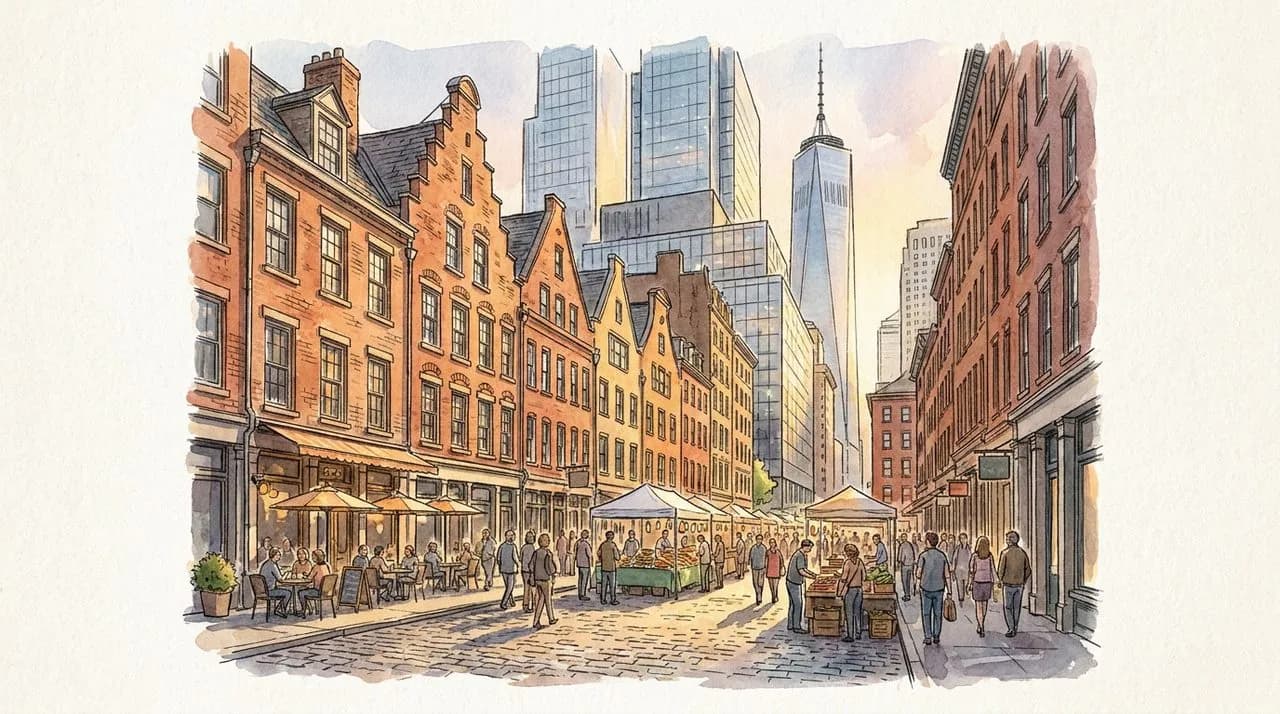
Stone Street is the city's first cobblestone street. In 1657, the residents of Brouwer Straet — Dutch for Brewers Street — petitioned the New Amsterdam city council to pave the road with cobblestones. The petition was approved. The street was paved in 1658.
The original Dutch cobblestones did not survive. They were replaced, repaved, lost, and rebuilt several times across the centuries. The current cobblestones — 23,000 Belgian blocks — were laid in 2000 as part of a comprehensive landmark restoration. The block-and-a-half between Coenties Alley and Hanover Square is fully pedestrianized.
The buildings on Stone Street are reconstructions of nineteenth-century mercantile buildings, on top of seventeenth-century property lines. The result is one of the most architecturally consistent blocks in lower Manhattan. The buildings hold a row of restaurants — Adrienne's Pizzabar, Ulysses, Mad Dog & Beans — that take over the cobblestone street with outdoor tables in summer.
The block is at its best on a weekday afternoon when the office crowd has cleared out and you can walk the cobblestones without weaving around tables. It is at its worst on a Friday evening, when the entire block is one long outdoor bar.
Fraunces Tavern
From the eastern end of Stone Street at Hanover Square, walk one block south on Pearl Street. The Fraunces Tavern is on the corner of Pearl and Broad.
The building dates to 1719, when it was built as the home of the merchant Stephan Delancey. Samuel Fraunces — a Caribbean-born tavern keeper — bought the building in 1762 and turned it into the Queen's Head Tavern, then renamed it after his own family after the Revolution. The building's most famous event was December 4, 1783, when George Washington gathered his Continental Army officers in the Long Room on the second floor to say farewell before retiring to Mount Vernon.
The current building is a 1907 restoration. The Long Room is open to the public as part of the Fraunces Tavern Museum on the second floor — $10 admission, open Tuesday through Sunday. The ground floor is still a working tavern: bar, restaurant, decent food, the New York beer list. The bar opens at 11:00 a.m. and is one of the most authentically historic places to drink in lower Manhattan.
To the Seaport
From Fraunces Tavern, walk east on Broad Street toward the river. Cross under the elevated FDR Drive at Old Slip. You are now in the original waterfront district of New York — the working port that, from the 1660s through the 1880s, made the city the largest shipping center in the Americas.
The South Street Seaport sits at the eastern end of this stretch. The historic district covers about eleven blocks around Fulton Street and South Street, with a working pier at Pier 17 (now a commercial entertainment complex), a working historic vessel fleet at Pier 16 (open to the public), and the South Street Seaport Museum on Fulton Street.
The museum is the destination. It runs out of two buildings on Fulton Street between Front and South — Schermerhorn Row, a block of 1810s counting-house buildings, and the adjacent A. A. Low Building. The collection is the maritime history of New York: nineteenth-century clipper ships, the rise and fall of the East River port, the city's relationship to the Atlantic trade. The historic-vessel fleet at Pier 16 includes the 1885 schooner Pioneer and the 1908 lightship Ambrose, both open to tour.
Admission is $18. The museum is open Wednesday through Sunday, 11:00 a.m. to 6:00 p.m.
The pier itself — Pier 17, the rebuilt entertainment complex that replaced the old Fulton Fish Market shed — is open to walk through any time. The Pier 17 rooftop is a ticketed concert venue, but the public deck at street level is free and has the best photo angle on the Brooklyn Bridge in lower Manhattan.
What to Eat Along the Way
The walk has a built-in dinner. Stone Street's restaurants are the obvious stop — a slice of pizza at Adrienne's, a beer at Ulysses, the kind of meal that fits the cobblestone setting.
Fraunces Tavern's ground-floor bar is the historical option. Steak, chowder, and a Sam Adams.
For seafood, the Seaport has Cobble & Co. (a newer raw bar) and Acqua at Pier 17 (a more polished sit-down). Both are pricier than they need to be but the views are real.
The discount move is the slice place on Front Street, two blocks west of Pier 17. A slice and a Coke for $5. Eat on the pier.
How Long to Plan For
The walk itself is forty minutes if you do not stop. The walk with stops — fifteen minutes at Federal Hall, ten minutes at Stone Street, thirty minutes at the Fraunces Tavern Museum, ninety minutes at the South Street Seaport Museum — is closer to four hours.
The compressed version (forty-five minutes walking, no museum stops, just plaques) is a good morning walk. The full version is a half-day with stops for coffee and lunch.
In either case, the route ends at Pier 17. From there the A/C train at Fulton Street is a four-minute walk west, or the 2/3 at Fulton is the same.
Why It Holds Up
Lower Manhattan is the part of the city that gets the least credit for being interesting. The financial offices, the chain stores, the over-clean Battery Park: the obvious surface of the neighborhood reads as bland. The streets underneath — the Dutch grid, the cobblestones, the 1719 tavern, the early-1800s wharf buildings — are some of the most layered urban fabric in the country.
The walk surfaces what is already there. It is free. It works in any season. It takes a single afternoon. It is one of the better self-organized New York walks for a visiting friend who has done the obvious tourist circuit.
Practical notes
- Start: City Hall steps, Park Row, New York, NY 10038.
- End: South Street Seaport Museum, 12 Fulton Street, New York, NY 10038.
- Distance: ~1.5 miles. ~40 minutes walking, half-day with stops.
- Don't miss: Stone Street's cobblestones, Federal Hall, the Long Room at Fraunces Tavern, the Pioneer at Pier 16.
- Admission: Federal Hall free, Fraunces Tavern Museum $10, South Street Seaport Museum $18.
- Pairs well with: A drink at Fraunces Tavern, dinner on Stone Street, sunset on the Brooklyn Bridge.
#southstreetseaport #stonestreet #lowermanhattan #manhattannyc #frauncestavern #longwayhome #nycwalking #nychistory #financialdistrict #karpofinds #nyclocalknowledge #hiddennyc #weekendnyc #nycparks #downtownnyc
Sources consulted: South Street Seaport Museum · National Park Service · Stone Street NYC · The New York Times · Untapped New York
All trademarks are the property of their respective owners.