A Bridge That Was Already a Miracle of Engineering When the Show First Opened
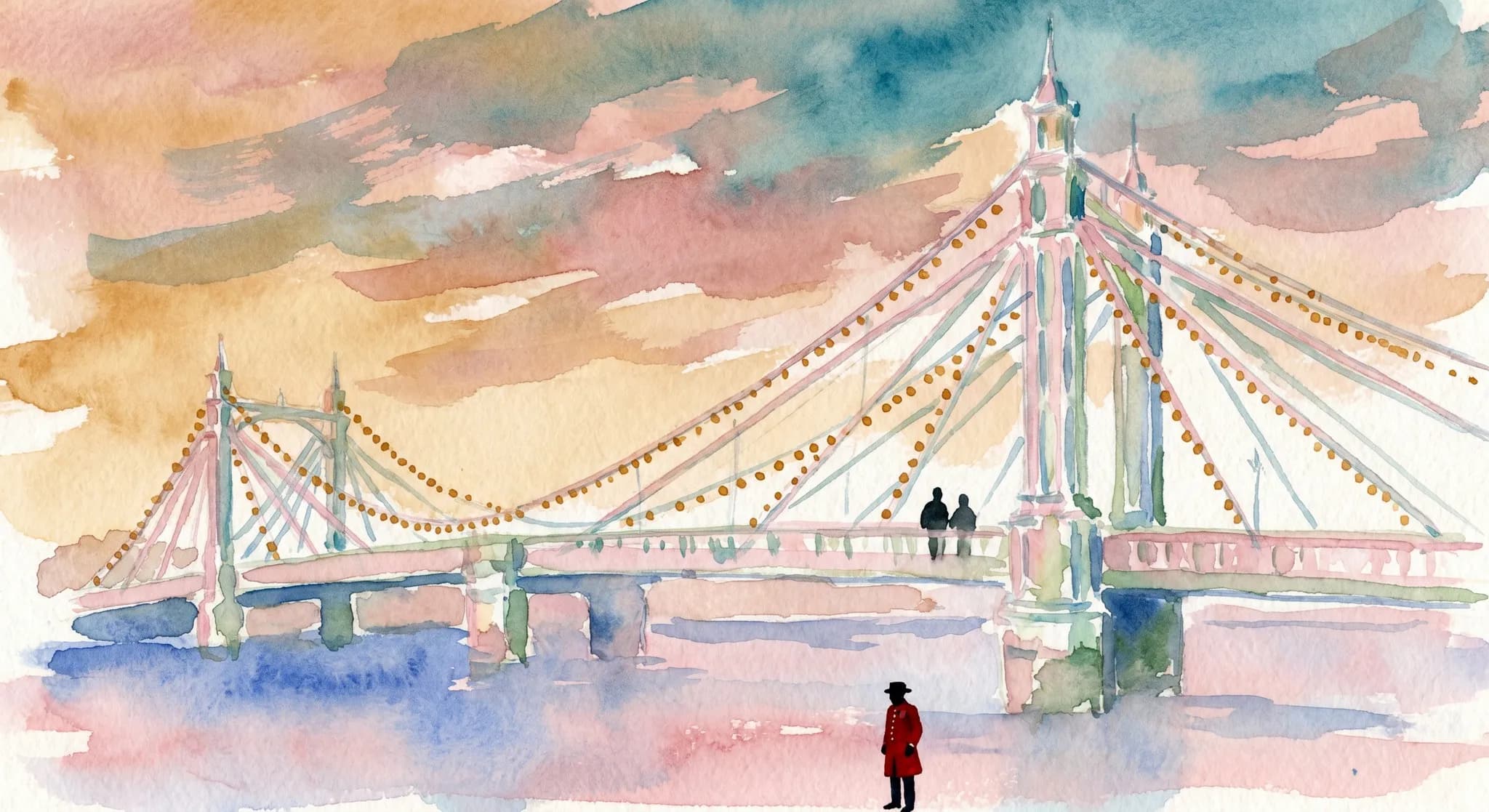
Albert Bridge opened in 1873, fourteen years before the Royal Horticultural Society held its first show on the site that would eventually host Chelsea. The bridge is a hybrid — part suspension, part cable-stayed — and has been painted in its current pink, blue and green livery since 1992 so it shows up to drivers on foggy nights. There are 4,000 light bulbs strung across the cables. It is the prettiest bridge on the Thames and one of the most structurally peculiar.
A sign at each end still reads: "ALL TROOPS MUST BREAK STEP WHEN MARCHING OVER THIS BRIDGE." It was put up because the Chelsea Pensioners — the red-coated army veterans who live at the Royal Hospital Chelsea, the actual site of the Flower Show — used to march to drill on the south bank, and their cadence was rattling the bridge. The sign is still there. The bridge has been pedestrianised on Show weekends since 2018.
When to Cross, Why It Matters
The Flower Show closes its public hours at 8pm on Wednesday through Friday and 5:30pm on Saturday. The crowd does not leave the Royal Hospital site evenly — there is a tidal wave at the official close and a quieter slow leak in the half hour after. Cross Albert Bridge between 6:50pm and 7:10pm on a Wednesday or Thursday and you are walking against the dispersing crowd, which is fine, because they all head north toward Sloane Square Tube and you are going south.
At 7pm in late May the sun is still up. The bridge is in full golden-hour light. The 4,000 bulbs come on at 7:30pm — you can be back on Chelsea Embankment by then to look at them across the river if you want, but the first pass is for the light, not the bulbs.
What Crossing Albert Bridge Costs You
Nothing. The bridge is free. The walk is free. Battersea Park is free. The Peace Pagoda is free. The combined ticket price for everything in this article is zero pounds, which is a number the Chelsea Flower Show has not produced since the year it opened.
That is the structural argument. The show is real. The plants are real. The £75 admission is real. But the actual best thing about Show week in London is the May weather and the river-evening light, and those two things are not behind a turnstile.
Battersea Park, Through the North Carriage Drive
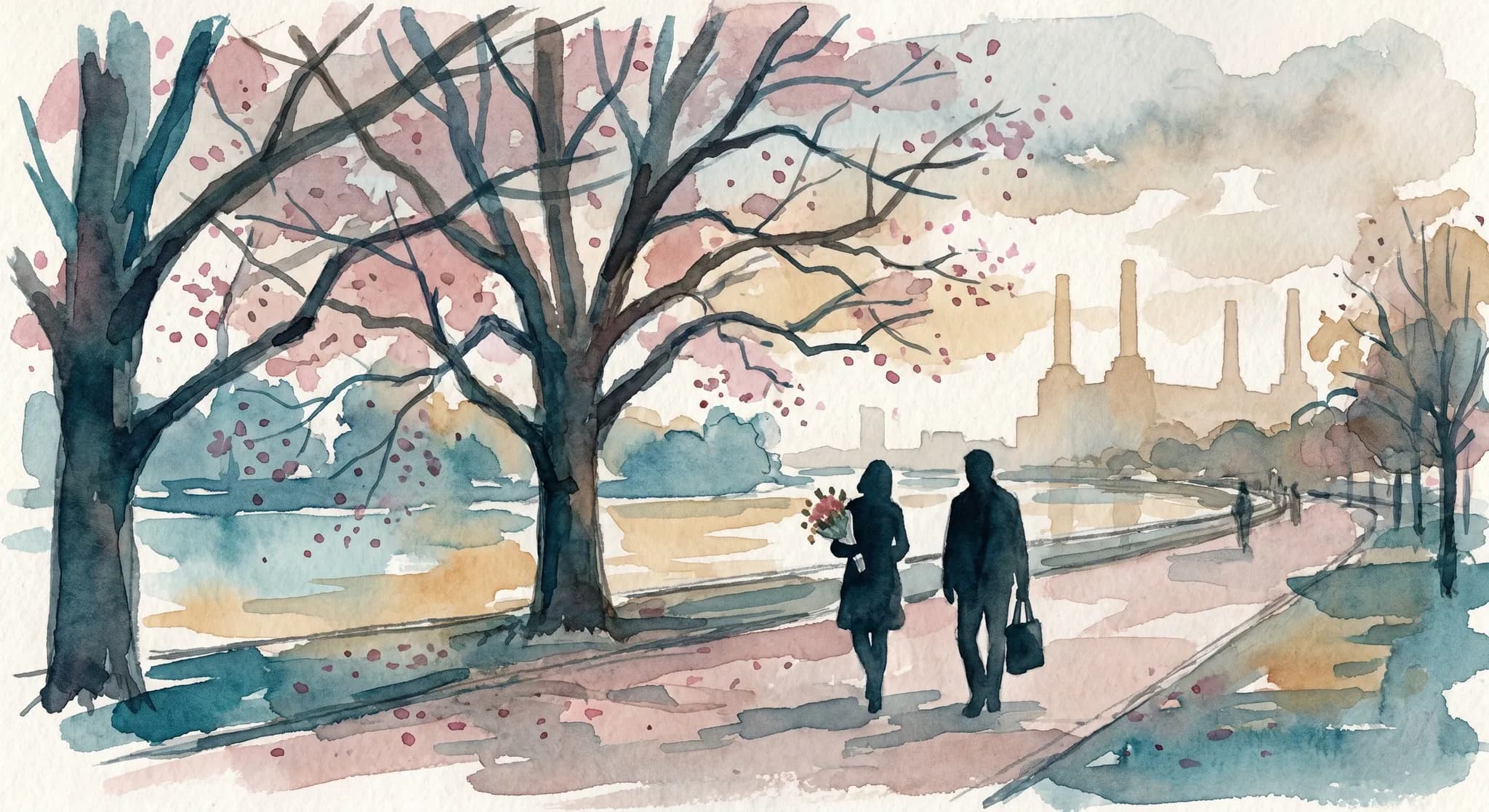
You enter Battersea Park at the Albert Gate, which is directly across the river from Albert Bridge — a 90-second crossing on foot. The 200-acre park was laid out in 1858 on land reclaimed from marshland. It has, in order of relevance to a 7pm May walk: a sub-tropical garden, a boating lake with a small island bird sanctuary, an English garden, the Children's Zoo, a war memorial, and the Peace Pagoda.
The route described here takes the North Carriage Drive — the path that runs parallel to the river along the park's northern edge — for about 800 meters, with the Thames immediately to your left through the trees and the park spreading to your right. At late May, the cherry trees are mostly past peak but a few late-blooming kanzan varieties still hold petals. The chestnut trees are in full flower. The plane trees throw long evening shadows across the path.
The Peace Pagoda and Why Almost No One Has Heard of It
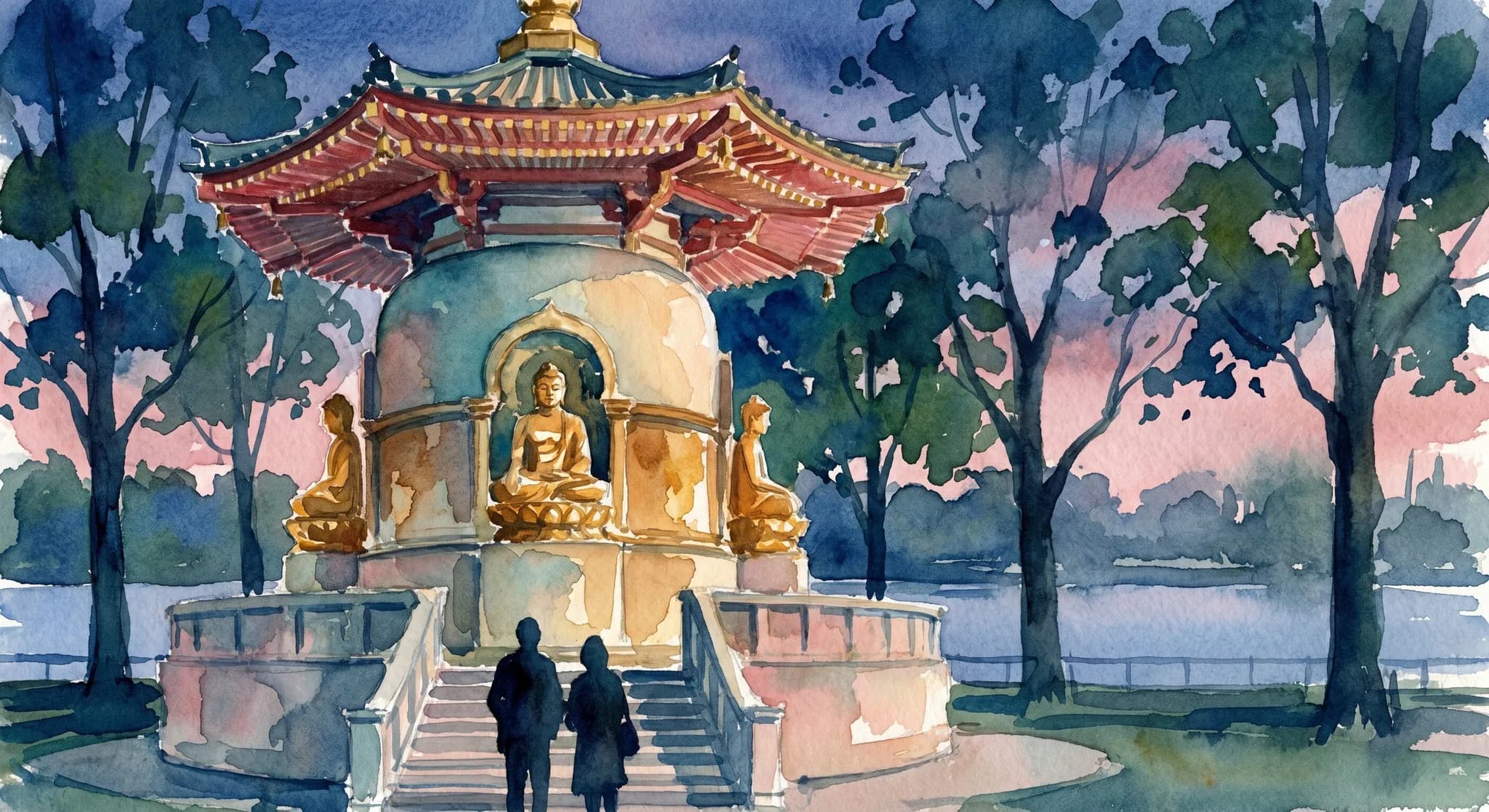
A Japanese Buddhist monk named Nichidatsu Fujii commissioned the Battersea Peace Pagoda in 1985. It was built by volunteers from the Nipponzan-Myohoji order over two years and unveiled in 1985 on the centenary of the British signing of the Geneva Conventions. It is the only Peace Pagoda in central London. There are about eighty around the world. This one sits on the river, between the boating lake and the Thames, and is tended by the resident monk Reverend Nagase, who walks the park every morning beating a hand drum.
The pagoda is a three-tiered red-and-gold structure with four large gilded statues of the Buddha around its base, each in a different traditional pose — meditation, teaching, blessing, attaining nirvana. The dome is white. The whole thing is, on a quiet May evening, completely improbable: a Buddhist religious monument in a Victorian English park, fully active as a place of practice, photographed by very few visitors per evening because almost no London guidebook puts it in the index.
The Five-Minute Sit
There is a wide stone step at the base of the Peace Pagoda. It is wide enough for ten people, but on most weekday evenings between 7:30pm and 8pm there is no one there. Sit on the step. Look at the gilded Buddha on the river-facing side. Listen to the trees.
This is the only structured five-minute decompression spot in central London that is religious, free, walkable from Sloane Square, and consistently quiet during Chelsea Flower Show week. The reason it is consistently quiet is that the Show pulls the entire west London afternoon crowd to the opposite side of the river, so the Battersea side is emptier than usual.
Then Walk East Along the River
From the Peace Pagoda you continue east along the Thames Path inside Battersea Park for another fifteen minutes. The path is paved, lit, and runs all the way to Vauxhall Bridge if you want to keep going. For this walk's purposes, stop at the Children's Zoo gate and turn around. By now it is 8:10pm. The sky is going to deep cobalt. The Albert Bridge lights are on.
Walk back to Albert Gate, cross the bridge again, and you are on Cheyne Walk on the Chelsea side at 8:35pm. The bridge from this direction at this hour, lit, against the deeper sky, with the river running below, is the picture most people take from this walk. Most of them did not stand at the Peace Pagoda first. That is the part that makes the bridge picture mean something.
The Practical Window
- Distance: 3 kilometers total — 200 meters across Albert Bridge, 1.4 km Battersea Park loop, 1.4 km return.
- Time: 55 minutes walking, 15 minutes sitting at the pagoda = 70 minutes total.
- Best start: 6:50pm Wednesday or Thursday during Chelsea Flower Show week. Same crowd dispersion logic any week of late May, just less context.
- Backup start: any weekday between 7pm and sunset April through September.
- Tickets: zero. The Royal Hospital Chelsea grounds are ticketed during Show week but the bridge, park, and pagoda are all free always.
- Getting there: District or Circle line to Sloane Square, walk south on Lower Sloane Street to Chelsea Embankment (12 minutes); or Bus 137 / 360 to Chelsea Embankment.
- Getting back: District or Northern line from Battersea Power Station Underground (opened 2021) is the easier exit if you keep walking east. Or walk back to Sloane Square the way you came.
- Note: Albert Bridge has a strict 2-tonne weight limit and a 'no troops marching in step' notice. Walking is fine.
Why This Walk This Week
Chelsea Flower Show is in the U.K. search top ten right now. The ticket is sold out. The Tube to Sloane Square at 8pm on the 22nd is going to be wall-to-wall floral hats. None of that is bad. The Show is a national institution.
But every May, while the Show is full and the press releases land, there is a parallel free version of the same thing one bridge to the south — Albert Bridge in golden-hour light, a 200-acre Victorian park with the same evening on it, a Buddhist pagoda almost no one knows is there, and a stone step you can sit on for five minutes. The Show is what made this walk worth writing about this week. The walk is what makes the Show survivable for the rest of London.
Right on time, exactly the length of Show week.
Tags: #chelseaflowershow #chelseaflowershow2026 #albertbridge #batterseapark #peacepagoda #thelongwayhome #karpofinds #londonwalks #thamespath #bluehour #londonparks #freelondon #mayinlondon #rhs #londonbridges
Sources consulted: RHS Chelsea Flower Show · Wandsworth Council — Battersea Park · London Peace Pagoda · Albert Bridge — RBKC
All trademarks are the property of their respective owners.