What it is and how it got here
Fact-checked update
Fact-checked update (August 10, 2026): this article was rechecked against centralparknyc.org, en.wikipedia.org, nycgovparks.org, timeout.com. The refresh keeps the body grounded in official venue, agency, transit, or city sources and flags time-sensitive planning details that readers should confirm before leaving.
Direct answer: Use this Central Park Reservoir Perimeter Dawn Walk Jackie guide to plan timing, transit, costs, crowd tradeoffs, and nearby stops before you go.
The reservoir was built between 1858 and 1862 as the central Manhattan terminus of the Croton Aqueduct system. For 130 years it was the city's primary drinking water reserve. By 1993 it was decommissioned as a drinking-water source (the city now drinks from upstate via the larger Catskill and Delaware systems), and in 1994 it was renamed for Jacqueline Kennedy Onassis, who lived in a Fifth Avenue apartment overlooking it and ran the loop almost daily for two decades.
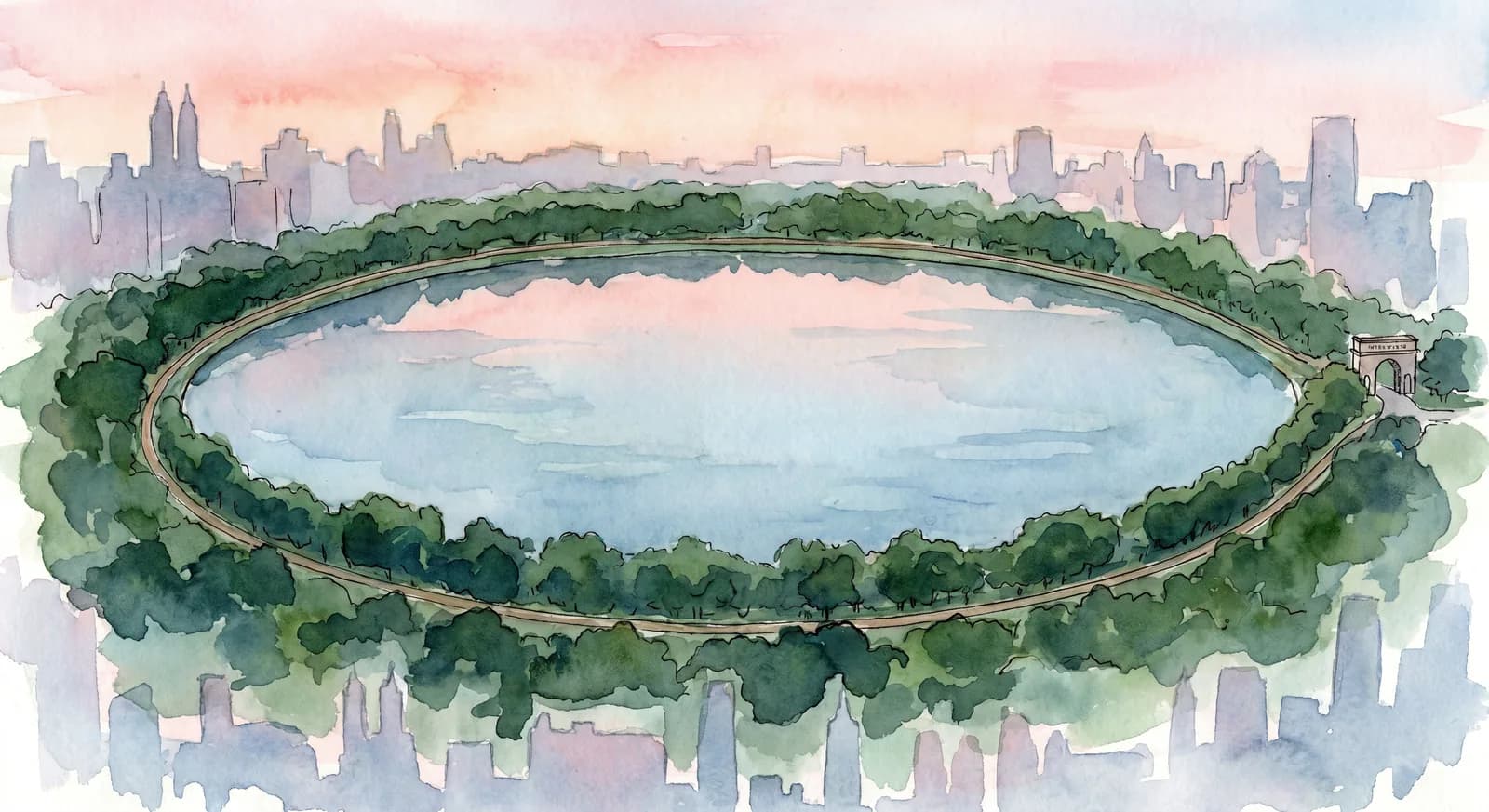
It is 106 acres of water — a pond the size of Tompkins Square Park times eleven — held in the middle of a park that itself sits in the middle of a city. The water is still there. It is not connected to anything you drink. The Department of Environmental Protection maintains it as a 'standby reserve.' From the path, what you see is roughly a billion gallons of held-still water that nobody is using, ringed by a tall chain-link fence that nobody is climbing.
Where to start, which way to go, and how long the loop takes
There are eight gates onto the reservoir path. The two that work best for a first-time visit: Engineers' Gate at East 90th Street and Fifth Avenue (the most-used entrance, with a small drinking fountain and the official mile marker), or the West 86th Street entrance (quieter, leads directly down to the southwest stretch of the path with the best skyline view).
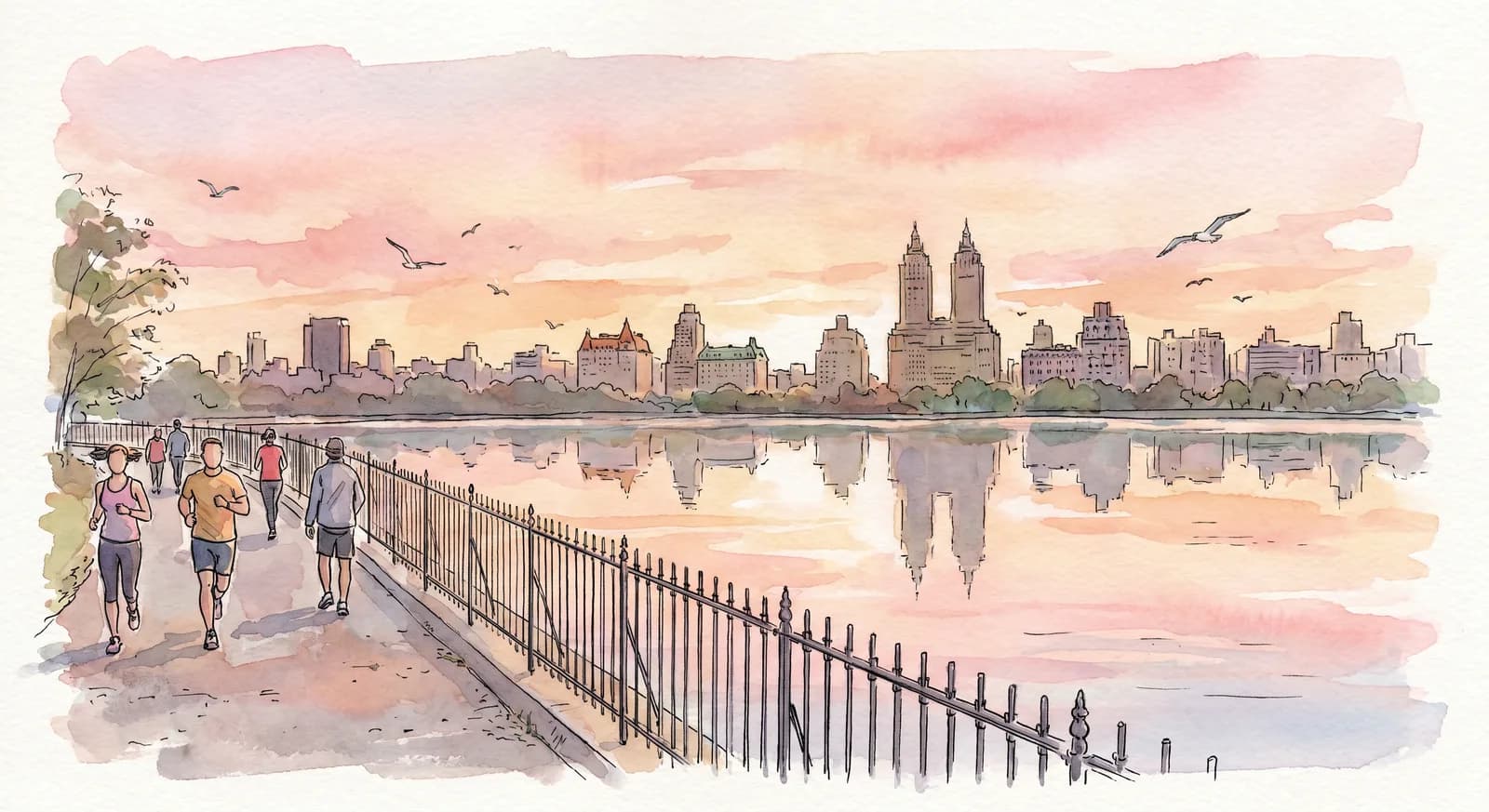
The path is one-way: counterclockwise only, marked by signs. Joggers run with the reservoir on their right shoulder. The full loop is 1.58 miles. At a normal walking pace, that is roughly thirty-five minutes; at a brisk pace, twenty-five; at a jog, sixteen. The path is cinder — soft underfoot, slightly springier than asphalt — and is closed to bicycles.
Why dawn
The reservoir path is busy from 6:30 a.m. on, and packed from 7:30 to 9:30 on weekday mornings. Before 6:00 a.m. — sunrise plus or minus fifteen minutes, depending on the season — the path is almost empty. Three things happen at that hour that do not happen at any other:
First, the water is glass. There is no breeze, no swimming geese (they wake an hour later), no flock of joggers stirring the air. The entire San Remo on the West Side, the Beresford to its north, and the limestone Fifth Avenue towers to the east all appear as a second, inverted skyline on the water's surface. The view from the southwest corner of the path, looking northeast, is the photograph; the view from the northeast corner, looking southwest, is the better photograph.
Second, the sound drops out. New York is loud at street level even at five in the morning. At reservoir level, sixty feet above the avenues and ringed by trees, the only sounds are the bird traffic in the trees and your own feet on cinder. The first siren of the day, when it cuts through, is usually a fire truck on Fifth — distant and not for you.
Third, the light. The reservoir's long axis runs roughly north-northeast to south-southwest, which means at June dawn the sun rises directly over the far end of the water from the West 86th entrance. For about eight minutes, the sun is on the water and the water is on the buildings. After that the light flattens. You have eight minutes. Use the southwest corner.
What to do with the rest of the loop
Take it slowly. The path is one of the few places in Central Park where you cannot deviate — the loop is a single line — and where the discipline is to just walk. Do not stop to take pictures every twenty meters; pick three points (south gatehouse, north gatehouse, the southwest curve looking up the long axis) and stop only at those. Carry one bottle of water; the only working fountain is at Engineers' Gate.
On the eastern stretch, between East 86th and East 96th, you walk alongside the back fence of the Guggenheim, Cooper Hewitt, and the Jewish Museum — the museums of the Museum Mile, all still locked and dark from this angle. The cherry trees on the south and west sides bloom from late April into mid-May; the dogwoods come later. In October the path is mostly red and gold and stays that way until the first frost.
Where to go for breakfast after
Exit at West 86th and walk three blocks west on 86th to Amsterdam Avenue for Barney Greengrass at 541 Amsterdam (open at 8:30 a.m., the scrambled eggs with Nova and onions are the order). Or exit at East 90th (Engineers' Gate), walk three blocks east to Madison, and have coffee and a croissant at Bluestone Lane at 1085 Madison or Maman at 1064 Madison.
If you want to extend the walk, the Bridle Path runs around the outside of the reservoir at the next-lower elevation — slightly longer, slightly softer underfoot, and open to horses, dogs, and bicycles (which are banned on the inner path). The Bridle Path adds about ten minutes to the loop and gives you a different angle on the same water.
Practical notes
- Location: Jacqueline Kennedy Onassis Reservoir, Central Park, between East 85th and West 96th Streets.
- Path length: 1.58 miles, cinder surface, one-way counterclockwise only.
- Best window: sunrise to sunrise + 40 minutes. Check NYC sunrise time for the day (roughly 5:25 a.m. in late June, 7:10 a.m. in early November).
- Best entrances: Engineers' Gate (E 90th + Fifth Avenue) for facilities, West 86th for the skyline angle.
- Closed to: bicycles, scooters, and dogs (Bridle Path below is dog-friendly).
- Pair with: breakfast at Barney Greengrass (W 86th), Bluestone Lane or Maman (Madison Avenue), or Lexington Candy Shop (E 83rd).
- Closest trains: 6 to 86th Street (East), 1/B/C to 86th Street (West).
The long way home from the Upper East Side ought to take you past one billion gallons of held-still water, around a soft cinder loop nobody is using, and back out the way you came. Pick a clear morning, set the alarm for one hour before sunrise, and walk. The skyline reflects on the surface for eight minutes a day. Be there for those eight minutes.
Sources consulted: centralparknyc.org · en.wikipedia.org · nycgovparks.org · timeout.com · nytimes.com
All trademarks are the property of their respective owners.