El Pueblo de Los Angeles runs its Mexican Independence celebrations on September 15 and 16 from ten in the morning until eight at night, with El Grito at Grand Park in front of City Hall on the fifteenth. Both of those are afternoon and evening events. Which leaves the morning - and the morning is when downtown does its best and least-photographed eating.
A festival day has a rhythm, and the eating rhythm runs about two hours ahead of the programme. Tell Karpo what time you are heading to El Pueblo and where you are coming in from, and it will find you a counter that is already busy with people who are not tourists.
Why breakfast is the right meal on a festival day
Everything about a street celebration works against a good lunch. The lines are longest between noon and three, the seating is nonexistent, and the food available on-site is festival food - which is a category with its own pleasures and is not the same thing as a meal.
Breakfast solves all three problems at once. You eat sitting down, you eat at a counter that is running at normal speed, and you arrive at the plaza already fed, which changes your relationship to a four-hour event more than any other single decision. The people who look happiest at three in the afternoon are the ones who ate at nine.
The downtown breakfast taco is its own thing
A breakfast taco in Los Angeles is not the Texan version and it is not trying to be. The dominant local form is a tortilla - usually corn, sometimes handmade that morning - built around egg with one anchor: chorizo, papas, nopales, machaca, sometimes nothing more than beans and a good salsa.
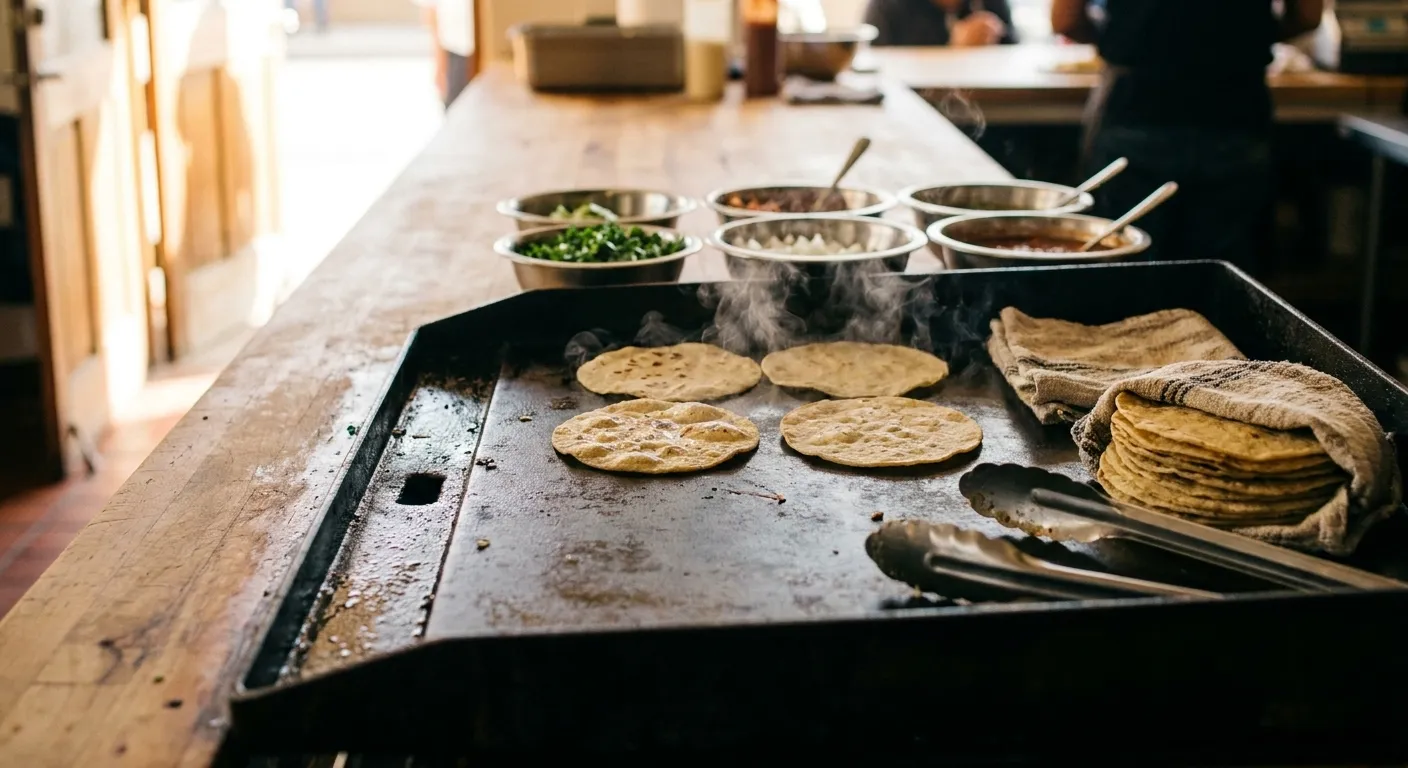
The quality signal is almost entirely the tortilla and the griddle. If the tortillas are being pressed and cooked in front of you, the rest will follow. If they are coming out of a bag and being warmed, the fillings have to work much harder and they usually cannot.
The second signal is the salsa arrangement. A counter that puts out three or four salsas in real containers, refilled through the morning, is a counter that expects regulars. One squeeze bottle of something red is a counter that expects strangers.
Where the morning food actually is
The geography around El Pueblo is specific. The plaza itself and the Olvera Street corridor are set up for visitors, and they are lovely, but they open on a visitor schedule. The eating that starts at six or seven in the morning is in the blocks around it - toward Chinatown to the north, along the edges of the Fashion District further south, and in the market halls that have fed downtown workers for a century.
Market stalls are the reliable move on a festival morning. They open early because they serve people going to work, they are used to volume, and they are indoors, which matters when the temperature is already climbing at nine in the middle of September.
The other reliable pattern is the truck that parks in the same place every weekday morning and is gone by eleven. These are not hard to find - they have a queue of people in work clothes - but they are hard to find later, which is precisely the point.
The salsa question, and how to ask it
The one thing worth doing at a counter you have not been to before is asking which salsa goes with what you ordered. It is not a difficult question and it is not a tourist question - it is the question a regular asks, and the answer tells you a great deal about the place.
A counter that has thought about it will tell you the green one with the papas and the darker one with the chorizo, or hand you a small cup of something that is not on the table. A counter that has not will point at everything. Neither answer is a verdict on the food, but the first one usually means someone in the kitchen is paying attention.
If you do not speak Spanish, pointing and raising an eyebrow does the job. Nobody at a morning taco counter has ever been offended by curiosity about salsa.
Timing the day around the ten o'clock start
El Pueblo's programme starts at ten. That means the crowd starts arriving around nine-thirty and the parking within reasonable walking distance is gone by ten-fifteen. Eating at eight and walking over at nine-thirty is a completely different day from arriving at eleven.
If you are coming for El Grito at Grand Park on the fifteenth, the same logic applies with a later clock. Evening programme, so eat properly in the late afternoon rather than trying to graze through it, and remember that Grand Park sits above the Civic Center where almost nothing is open in the evening. Eat before you climb the hill.
Both sites are close enough to each other to do in one day, which a lot of people do not realise. El Pueblo to Grand Park is a walk, not a drive.
After the sixteenth
The celebration is two days; the neighborhood is permanent. Almost every counter that is worth queueing for on the fifteenth is worth queueing for on an ordinary Tuesday, with no crowd and no programme, and that is genuinely the better version of the experience if you care mainly about the food.
Use the festival as the reason to learn where things are. Then come back on a weekday morning when the tortillas are being pressed for twelve people instead of two hundred.
Tags: breakfast tacos, El Pueblo, Olvera Street, Grand Park, Fiestas Patrias, Downtown LA, Los Angeles
All trademarks are the property of their respective owners.
Ask Karpo first
Festival days reward people who know the schedule of the neighborhood rather than the schedule of the event. Karpo knows what opens at six, what closes at eleven, and where the queue is people in work boots rather than people with cameras. Ask the night before.