 Haaland Has Seven Goals and Norway Runs Entirely Through Him
⚽️2026 FIFA WORLD CUP

Boston's Italy Football to Brazil World Cup Squad Walk: North End to Allston
A 2026 FIFA World Cup pilgrimage from Italian espresso to Brazilian churrasco, traversing Boston's diaspora neighborhoods on foot.
The Route Boston Didn't Ask For But Deserves
Boston won't host a single 2026 FIFA World Cup match. The nearest stadiums sit in New York and Philadelphia, and Gillette Stadium in Foxborough was passed over despite New England's fervent soccer following. But when Italy football takes center stage or the Brazil World Cup squad steps onto the pitch between June 11 and July 19, 2026, two of Boston's most vibrant neighborhoods will erupt in ways no official host city can replicate.
The North End's Italian cafes and social clubs have celebrated Azzurri victories since long before the 1934 and 1938 World Cup triumphs. Allston and Brighton's Brazilian bakeries, churrascarias, and corner markets have turned every Seleção match into a street festival since the 1990s wave of immigration. This walk stitches those two worlds together: a 4.7-mile pilgrimage from espresso and cannoli to pão de queijo and caipirinhas, timed to the final whistle of a group-stage thriller.
North End: Where Italy Football Never Left
Start at Hanover Street, the North End's spine, where the scent of fresh focaccia mingles with diesel exhaust and the ghosts of mid-century longshoremen. Caffè Vittoria has poured espresso since 1929, and its walls are papered with vintage Azzurri scarves, faded photographs of Roberto Baggio, and hand-painted murals of the Colosseum. On match days, the front windows fill with blue jerseys; strangers debate Gianluigi Buffon's legacy and whether the current squad can recapture 2006 glory.
Walk north toward the Paul Revere House, then loop back down Salem Street. The social clubs—Italo-American, Fisherman's Club, Madonna della Cava—are closed to outsiders most days, but their facades tell the story. Blue, white, and green bunting appears every four years like clockwork. In 2026, expect watch parties to spill onto the sidewalks, folding chairs and coolers colonizing the narrow brick streets as if Ronaldinho himself were about to dribble past the Old North Church.
Through the Seam: Back Bay and the Esplanade
Leave the North End via the Rose Kennedy Greenway, the linear park that replaced the elevated Central Artery. The walk softens here: fewer tourists, more joggers and dog-walkers. Cross into Beacon Hill, then cut through the Public Garden where swan boats drift under the footbridge. Commonwealth Avenue's tree-lined mall carries you west through Back Bay, past brownstones that house consulates and private clubs indifferent to the World Cup's existence.
At Massachusetts Avenue, veer north toward the Charles River Esplanade. The path along the water is Boston's democratic living room, crowded on warm May evenings with cyclists, rollerbladers, and runners. The skyline glitters across the basin. Sailboats tack near the Harvard Bridge. You're halfway between worlds now, the Italian espresso buzz fading, the Brazilian energy still a mile west. This is the palate cleanser, the neutral zone before the second act.
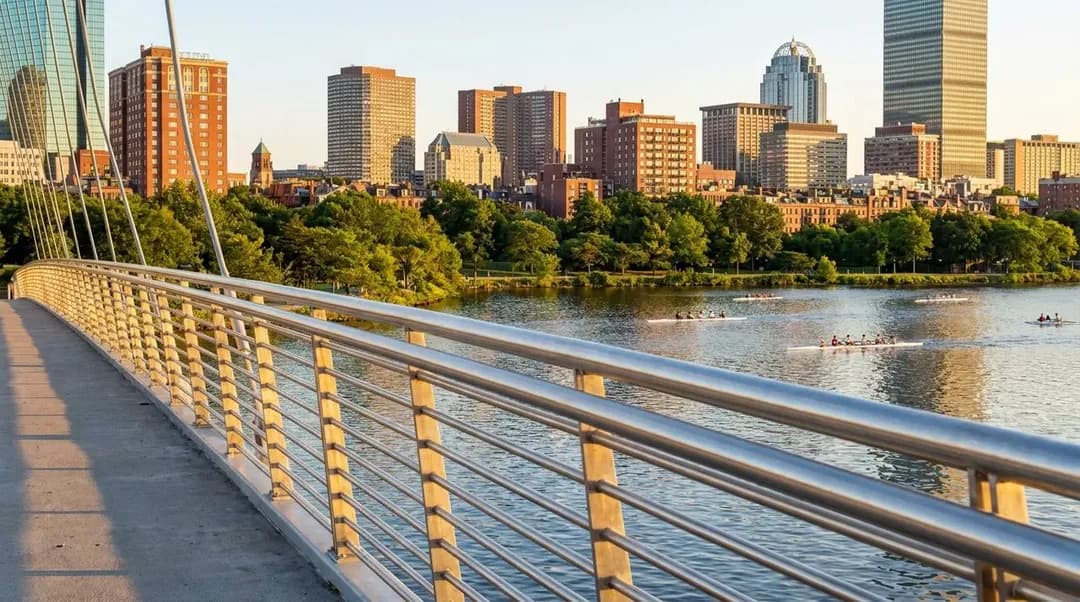
Crossing the Charles: From Beacon to Brighton
Take the Boston University Bridge across the Charles. The water below is slate-gray or sun-dappled depending on the hour. On the Cambridge side, the BU campus sprawls in red brick and glass, students oblivious to your pilgrimage. Commonwealth Avenue continues west, wider now, lined with student apartments and dive bars that will pack with World Cup crowds regardless of which teams are playing.
At Packard's Corner, the avenue bends southwest and the neighborhood shifts. Korean barbecue joints and Vietnamese pho counters signal Allston's arrival. The rents are cheaper here, the buildings shorter, the sidewalks cracked and lively. By the time you reach Harvard Avenue, you're in the heart of Boston's Brazilian corridor, where the green and gold of the Seleção replaces the Azzurri's blue.
Allston's Brazilian Heartbeat
Allston and Brighton absorbed waves of Brazilian immigrants in the 1980s and 1990s, drawn by construction jobs and tight-knit community networks. Today, the Brazil World Cup squad commands loyalty here as fierce as anything in São Paulo or Rio. Restaurante Cesaria on Cambridge Street serves moqueca and feijoada to homesick families and curious undergrads alike. The market shelves stock guaraná Antarctica, tapioca flour, and imported Havaianas.
On match days, the Brazilian Women's Group community center on Everett Street becomes an unofficial fan zone. Flags drape from fire escapes. Car horns blare in rhythmic bursts. Even those too young to remember Ronaldinho's prime wear his number 10 jersey like a talisman, a bridge to a homeland some have never seen. The 2026 World Cup will be the first held in the Americas since Brazil's devastating 2014 semifinal loss; the stakes, and the emotions, will run high.

Practical Notes for the Walk
The 4.7-mile route takes roughly ninety minutes at a steady pace, longer if you stop for espresso, pastéis, or a caipirinha. Wear comfortable shoes; Boston's brick sidewalks and cobblestones are unforgiving. The walk is best timed to finish in Allston thirty to sixty minutes after an Italy or Brazil group-stage match ends, when the streets are loudest and the collective mood—celebratory or mournful—is most palpable.
- Start: Hanover Street, North End (near Caffè Vittoria)
- Midpoint: Boston University Bridge, Charles River crossing
- End: Cambridge Street and Harvard Avenue, Allston
- Timing: 90–120 minutes walking, plus stops
- Best days: June 12–28, 2026 (group-stage window)
- Bring: water, phone charger, cash for cafes and markets
Right On Time: May 2026
It's May 19, 2026, three weeks before the World Cup's opening match in Mexico City. The North End's cafes are already stocking Italian flags and blue scarves. Allston's markets are ordering extra cases of guaraná and planning watch-party menus. Boston may not have a stadium, but it has something rarer: two distinct, passionate diaspora communities separated by a single afternoon's walk.
This route isn't about efficiency or Instagram backdrops. It's about tracing the invisible lines that connect a Neapolitan grandmother's espresso ritual to a Mineiro teenager's Neymar poster, mediated by the Charles River and the shared language of football. When the final whistle blows in a stadium hundreds of miles away, you'll be exactly where the story continues: on the sidewalks of Allston, surrounded by strangers who feel like neighbors, united by ninety minutes and a ball.
All trademarks are the property of their respective owners.
Ask Karpo for more information.
Keep reading
- Haaland Has Seven Goals and Norway Runs Entirely Through Him
 World Cup Trophy Ceremony Timing Medals and Postmatch Celebrations
 Olise and France's Attack: The Semifinal Tactical Question