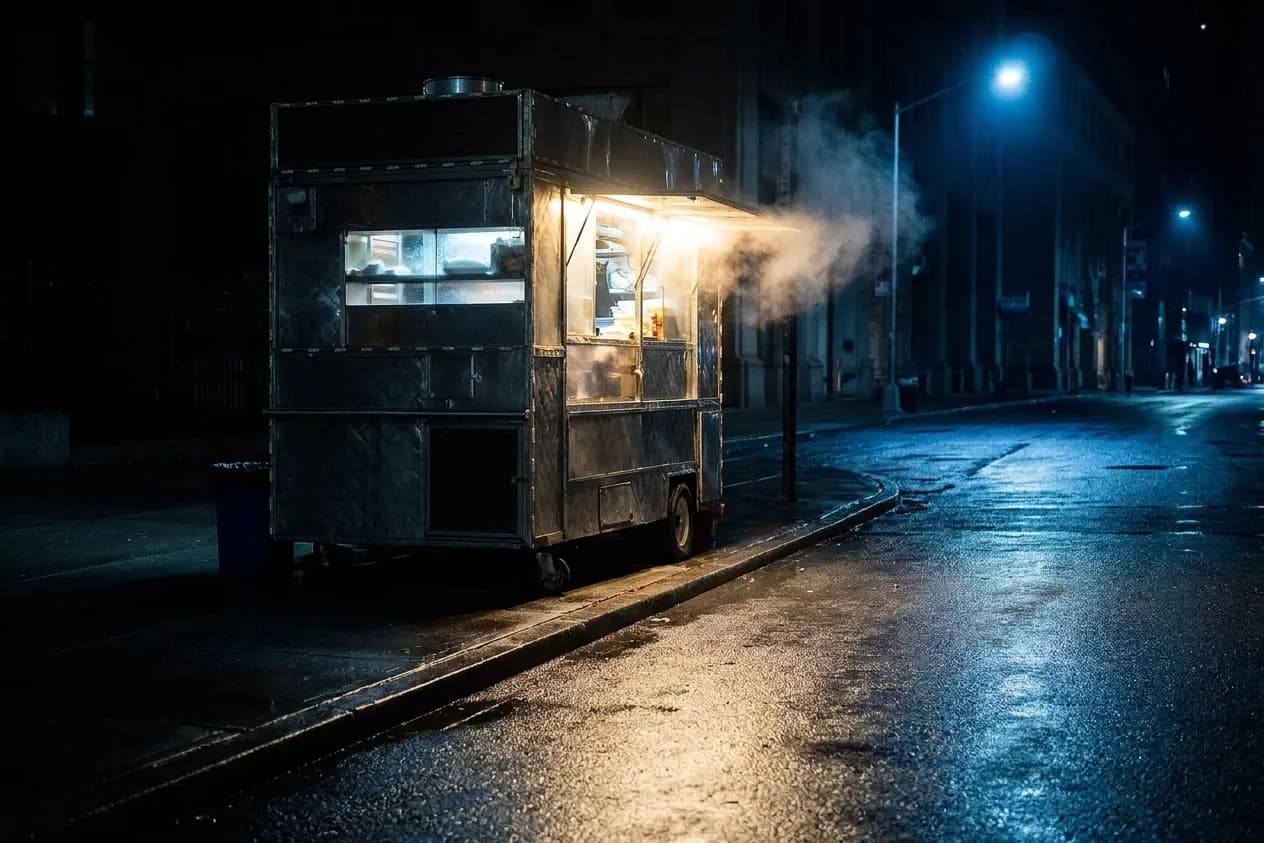
There is a shift change in New York's food supply that happens somewhere between eleven and midnight, and it is more complete than most people realise. The sit-down restaurants close. The kitchens that were serving at ten are cleaning down. And then a second network - carts, trucks, a handful of counters that only make economic sense after dark - comes on shift and runs until three, four, sometimes six in the morning. That network is disproportionately Mexican, disproportionately mobile, and it produces some of the best tacos in the city precisely because of when it operates.
Late-night food is the hardest thing in this city to find from a listing, because the things that are open are exactly the things least likely to have accurate hours online. Tell Karpo what time it actually is and where you are, and skip the twenty-minute walk to a shutter that came down at eleven.
Why the late shift is better, not worse
The instinct is to treat late-night food as a compromise - whatever is left. In the case of tacos in New York the opposite is closer to true, for a straightforward operational reason. A cart or truck working the small hours is cooking to order for a queue that arrives in bursts. Nothing sits. There is no case, no lamp, no holding. Everything on the griddle is going into someone's hand within about ninety seconds of being cooked.
The second reason is the customer. The late crowd is not tourists. It is hospitality workers coming off shift, drivers, night staff from hospitals and warehouses, and people leaving bars - a demanding, repeat clientele who eat at the same three carts every week and will simply stop coming if the quality slips. That is a much harsher quality control mechanism than a review site.
Where the network actually is
The densest late-night taco corridor in the city runs along Roosevelt Avenue in Queens, roughly from Jackson Heights out through Corona, under the elevated tracks. The elevated line is the reason - it creates a covered, well-lit strip of pavement that carts can work in almost any weather, and the surrounding neighbourhoods have a large working population on night schedules. On a Friday or Saturday it runs deep into the early morning.
In Brooklyn, the equivalent strips are around Sunset Park's Fifth Avenue, and in Bushwick along the stretches near the Myrtle and Jefferson stops, where the bar density guarantees late demand. In Manhattan the late trade is thinner and more scattered, concentrated in East Harlem and in a handful of carts that set up near club and bar clusters and move on when those close.
The pattern is consistent everywhere: late-night carts follow either night-shift workers or drinkers, and the ones following workers are usually the better food.
How to approach a cart you have never used
Look at the queue first and specifically at who is in it. A queue of people in kitchen clogs and work clothes at one in the morning is the strongest possible endorsement. A queue entirely composed of people who have clearly just left a bar tells you the cart is convenient rather than good, which is fine but is different information.
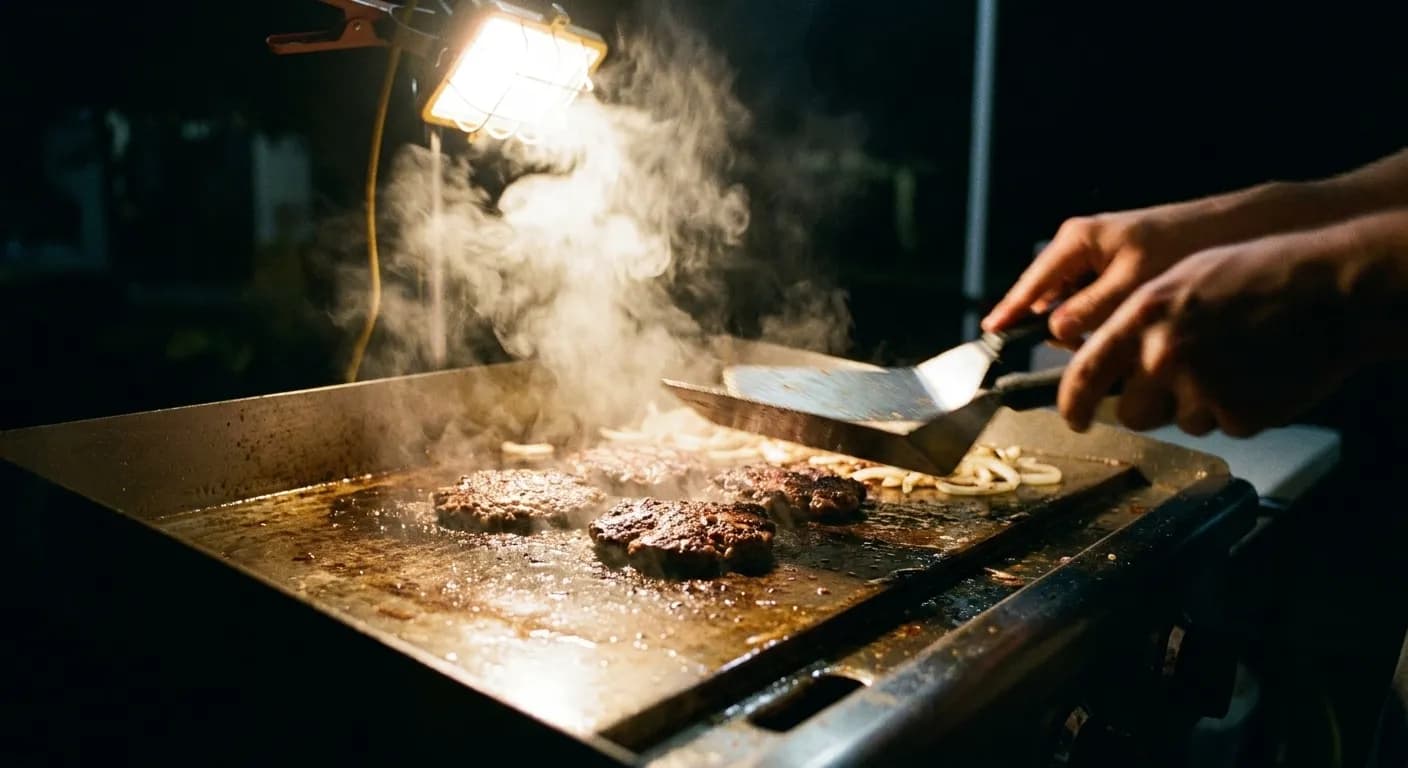
Then look at the griddle. You want to see meat actually cooking rather than a full tray of something already cooked sitting to one side. On al pastor, you want a vertical spit with a visible crust on it that is being shaved to order. And you want to see the tortillas going onto the heat rather than coming out of a bag straight onto the plate - a two-second pass on the comal makes an enormous difference and the good carts always do it.
Cash is worth carrying. A meaningful share of the late-night network is cash-preferred, and a few are cash-only, particularly the smaller carts.
The hours are real but they are not published
This is the practical problem with the whole category. Carts and trucks do not have consistent listed hours, and where hours exist they are frequently the hours of a daytime storefront the cart is loosely associated with. A truck that is reliably on a corner at two on a Saturday may not be there at all on a Tuesday, and no listing will tell you that.
The rules of thumb that hold: weekend nights are far more reliable than weeknights, the window from about midnight to three is the safest bet, and heavy rain thins the network dramatically because a cart cannot trade in it. If you are making a specific journey for a specific cart, it is worth having a second option within a few blocks, which on Roosevelt Avenue is trivial and in Manhattan is not.
Ordering well at one in the morning
Order two things, eat them, then decide. Late-night queues move fast and the temptation is to order six at once to avoid queueing twice; the better move is to order small, find out what this particular cart does well, and rejoin. Nobody minds and the second round will be better.
Ask for the salsa on the side the first time. Late-night salsas are frequently much hotter than their daytime equivalents, partly because the crowd wants them that way, and it is easier to add than to recover. And if there is consomme or a broth involved, take it - the carts that bother with it are the ones running a proper braise rather than a reheat.
Practical notes
The main late corridors are Roosevelt Avenue under the elevated tracks from Jackson Heights through Corona, Fifth Avenue in Sunset Park, and the bar-adjacent stretches of Bushwick. The reliable window is roughly midnight to three, considerably deeper on Friday and Saturday. Rain thins the cart network sharply. Cash is worth carrying.
Signals of a good cart: meat cooking rather than held, a shaved-to-order spit, tortillas passed over the heat before serving, and a queue containing people in work clothes rather than only people leaving bars.
Tags: #BestTacosInNewYorkCity #LateNightNYC #NYCTacos #TacoTruck #RooseveltAvenue #JacksonHeights #SunsetPark #Bushwick #NewYorkCity #AfterMidnight #StreetFood
All trademarks are the property of their respective owners.
Ask Karpo first
The late-night taco network is the least documented and most rewarding part of eating in this city. Ask Karpo what is genuinely trading near you right now, which corridors are still busy at the hour you are asking, and where the second option is if the first has already packed up.