Miami has more good tacos than its reputation suggests and they are distributed in a way that defeats ranked lists. They are in Allapattah, Hialeah, the industrial edge of Wynwood, along the arterials in the west of the county, and in a handful of places that look like nothing from the road. Rather than another numbered ten, here is the thing that actually generalises: two production decisions, both visible before you order, that separate a taqueria doing the work from one assembling components. Learn to read those and you can walk into an unknown place anywhere in Miami-Dade and know within ten seconds.
The best taquerias in this city keep the least convenient hours - several are strongest after ten at night and a few only fire the spit at weekends. Tell Karpo the hour and the part of town, and get the ones that are genuinely on right now.
Signal one: is there a trompo, and is it turning
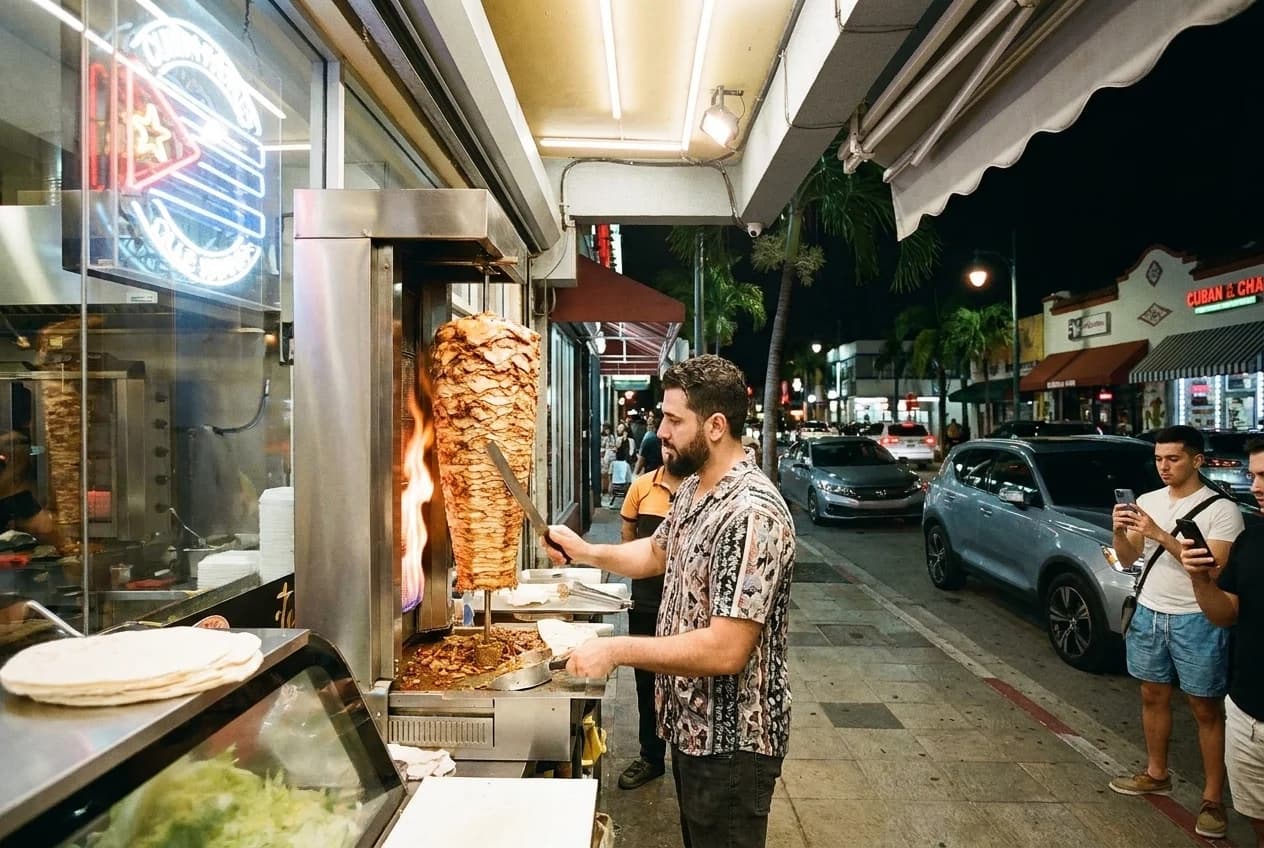
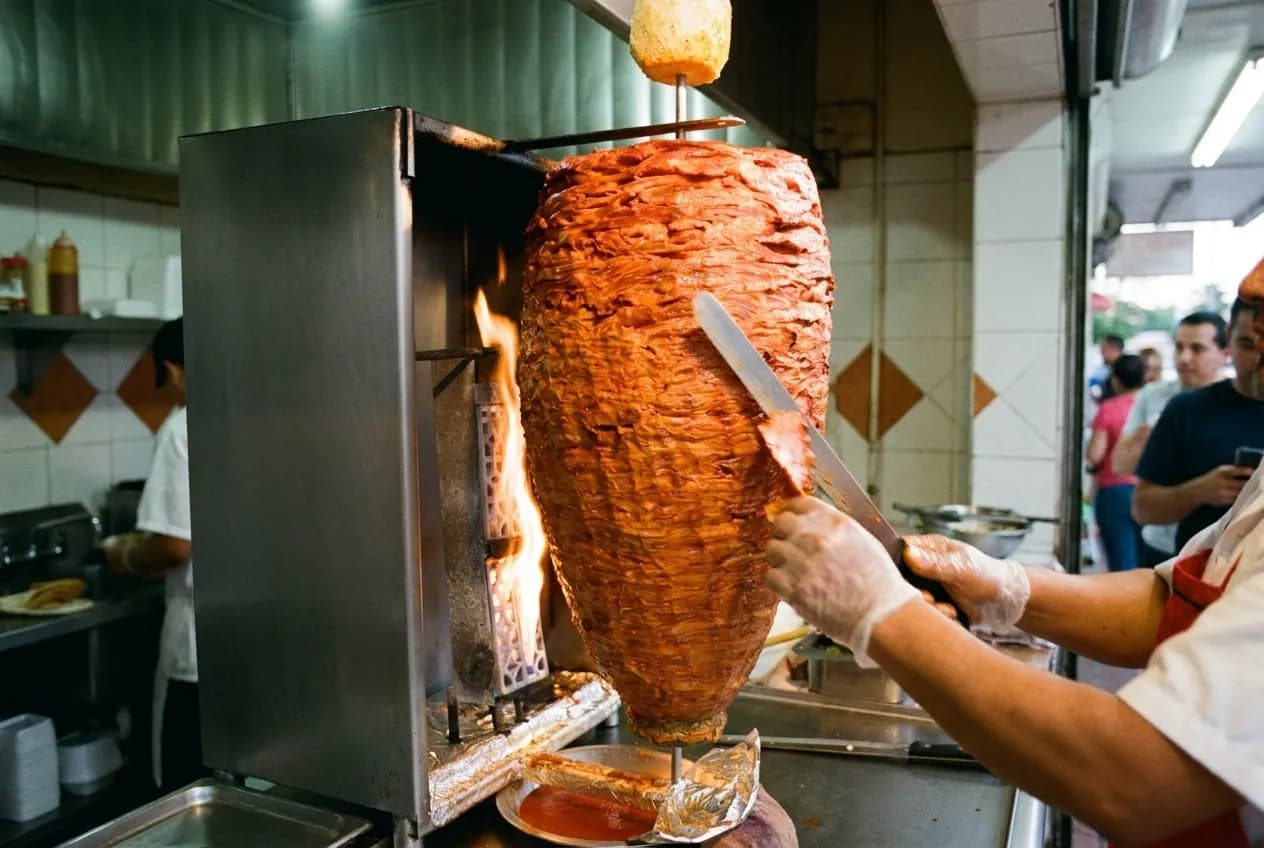
Al pastor is the taco most often faked and the easiest to check. The real method is a trompo - a vertical spit, stacked with pork that has been marinated in dried chillies and achiote, cooked by a flame on one side, with a pineapple on top. The cook shaves the outer layer off as it caramelises, so every serving comes off a surface that has been rendering for hours. The pineapple is not garnish; it drips down the cone as it cooks and the enzyme in it works on the meat.
The counterfeit is pork that has been marinated in a similar paste and then cooked on a flat griddle in a pan, which produces meat that is soft, wet and evenly coloured rather than crisp at the edges. It is fine. It is not al pastor. If you can see a spit and it is turning with a visibly darkened outer layer, the kitchen is committed. If the spit is there but cold at nine in the evening, they loaded it for lunch and you should order something else - and this is common enough to be worth checking rather than assuming.
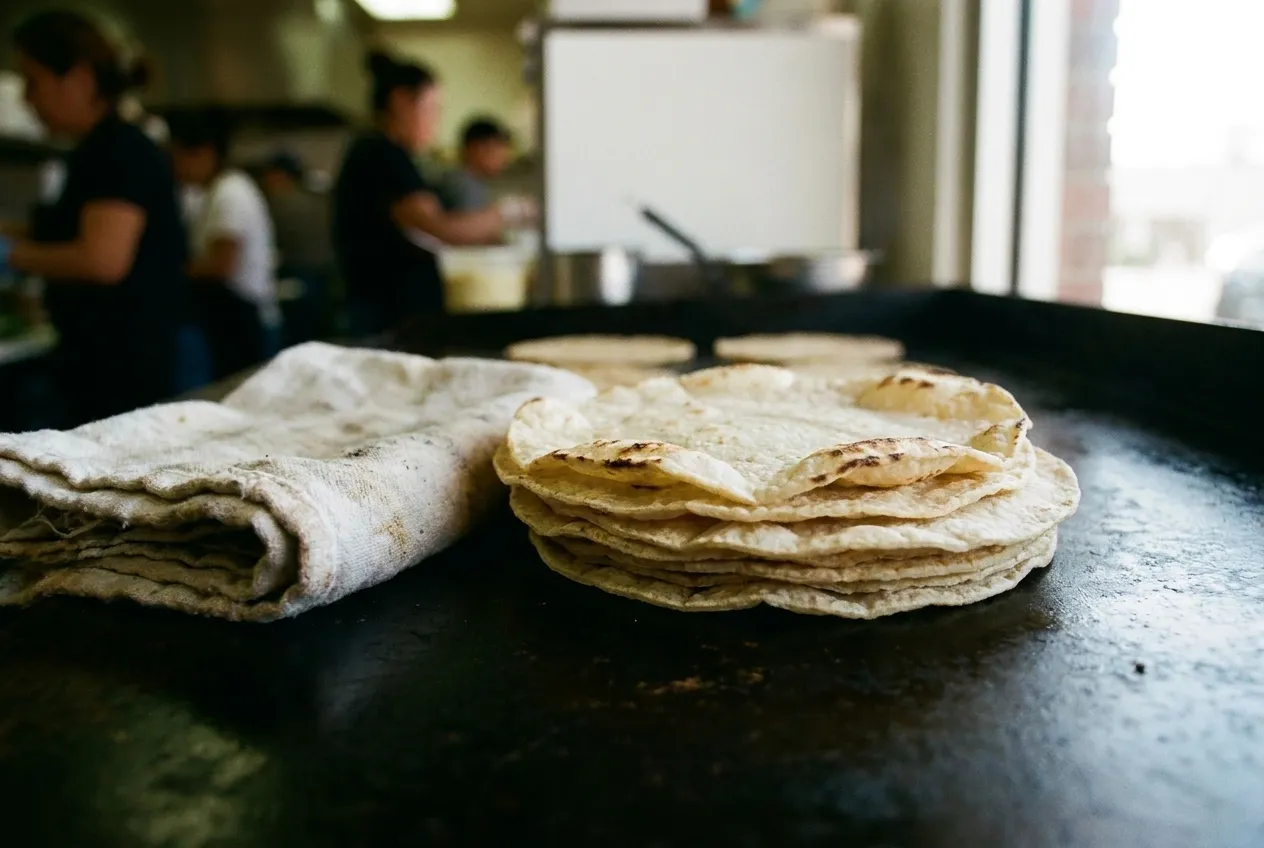
Signal two: where the tortilla came from
The second decision is the tortilla, and it matters more than the filling. Industrial corn tortillas are made from dehydrated corn flour, arrive in plastic bags, and are functionally bread. Nixtamal tortillas start from whole dried corn cooked with slaked lime, rested, drained and ground into masa - a process that changes the flavour completely and gives the tortilla the smell that people describe as toasted corn and cannot get from a bag. A taqueria that makes its own masa, or buys fresh masa daily, is telling you what it thinks matters.
You can identify it without asking. Fresh masa tortillas are slightly irregular in shape, thicker, softer, and they puff in the middle when they hit the griddle. They smell distinctly of corn. Bagged tortillas are perfectly round, uniform, and are usually doubled up because one on its own tears. Doubling is not itself a bad sign - plenty of great places double - but a single tortilla that holds a wet filling without disintegrating is almost always a fresh one.
The salsa lineup tells you the rest
After the trompo and the tortilla, look at what is on the counter. A serious taqueria puts out at least two salsas that are genuinely different from one another - typically a red one built on dried chillies, toasted and rehydrated, and a green one built on tomatillo and fresh chilli - plus pickled onion or jalapeño, lime wedges, chopped white onion and coriander. Four or five containers means someone is prepping in the morning.
One squeeze bottle of generic hot sauce means nobody is. The other tell is consistency: a red salsa with visible sediment and a slightly grainy texture was made from whole chillies; a smooth, uniformly glossy one usually was not. None of this means the food will be bad - it means you now know what kind of operation you are in and can order accordingly.
Where Miami keeps them
The concentrations are in the working parts of the county rather than the visitor ones. Allapattah, between Little Havana and the Design District, is dense with Mexican and Central American counters and is the single best neighbourhood in the inner city for this. Hialeah and the western arterials hold a very large number of small operations, mostly serving the people who live there rather than anyone driving in. The industrial fringe of Wynwood picks up late, feeding people coming out of the bars, and that is where the trompos run latest.
Two things follow. First, drive rather than walk - these are strip-mall and warehouse-adjacent addresses and the good ones are not clustered. Second, the best time is not lunch. A trompo loaded at eleven in the morning is at its best from mid-afternoon onward, and the taqueria that is unremarkable at one o'clock can be excellent at eleven at night. This is the food category where Miami's late-night supply is strongest and most reliable.
How to order once you are in
Order fewer tacos than you plan to eat, taste them, then order again. Tacos are made to order and take three minutes; there is no advantage to committing to six of one thing before you know whether the kitchen is better at pork or at beef. Start with one al pastor and one of whatever the handwritten sign is pushing, because the handwritten sign is where the kitchen puts what it is proud of that week.
Beyond pastor, the categories worth knowing are suadero, a cut from between the belly and the leg cooked slowly in fat until it shreds; lengua, beef tongue, which is the most consistently excellent taco in most taquerias and the one people avoid for no good reason; carnitas, pork confited in its own fat; and chorizo, which is a good test of whether the kitchen makes anything itself. Ask for the pastor con piña if the pineapple is not automatic - it should be.
Practical notes
Prices sit around three to five dollars a taco at the counters and higher in the sit-down rooms in Wynwood and the Design District. Cash still moves faster at the smallest places. Best hours: mid-afternoon onwards for al pastor, and after ten for the late strip. Weekends bring out barbacoa and birria at a lot of counters as a Saturday and Sunday special - those are frequently the best things on offer and they sell out by early afternoon. Parking is nearly always a car park rather than a street. And if a place has a spit, fresh masa and four salsas, do not read another review - just order.
Tags: #BestTacosInMiami #TacosNearMe #Miami #AlPastor #Trompo #Nixtamal #Allapattah #Hialeah #Wynwood #Suadero #Lengua #Barbacoa #MiamiEats #Taqueria
All trademarks are the property of their respective owners.
Ask Karpo first
Reading a taqueria from the doorway only helps once you are standing in front of one worth reading. Ask Karpo which taquerias near you have the spit going at the hour you are asking, which ones do weekend barbacoa before it sells out, and which of them is still serving when the rest of the neighbourhood has shut.