Los Angeles has more taco stands than traffic lights, and most of them look identical from across the street. The difference between a stand you will think about for weeks and one you will forget before you finish eating shows up in three places: whether the trompo is spinning, whether the tortillas come out of a bag or off a griddle, and how many salsas are set out and whether anyone is tending them. You can read all of it in the time it takes to walk from your car to the order window.
Karpo knows which taco stands in your neighborhood have fresh salsas out right now and which trucks are parked within walking distance. Ask before you leave.
The Trompo Myth: It Does Not Have to Be Turning
The belief is that a spinning trompo means the meat is good and a stationary one means the stand is lazy or slow. What is actually true is that a trompo only spins when it is being shaved. A busy stand stops and starts the motor a dozen times an hour. A slow stand leaves it running to look active.
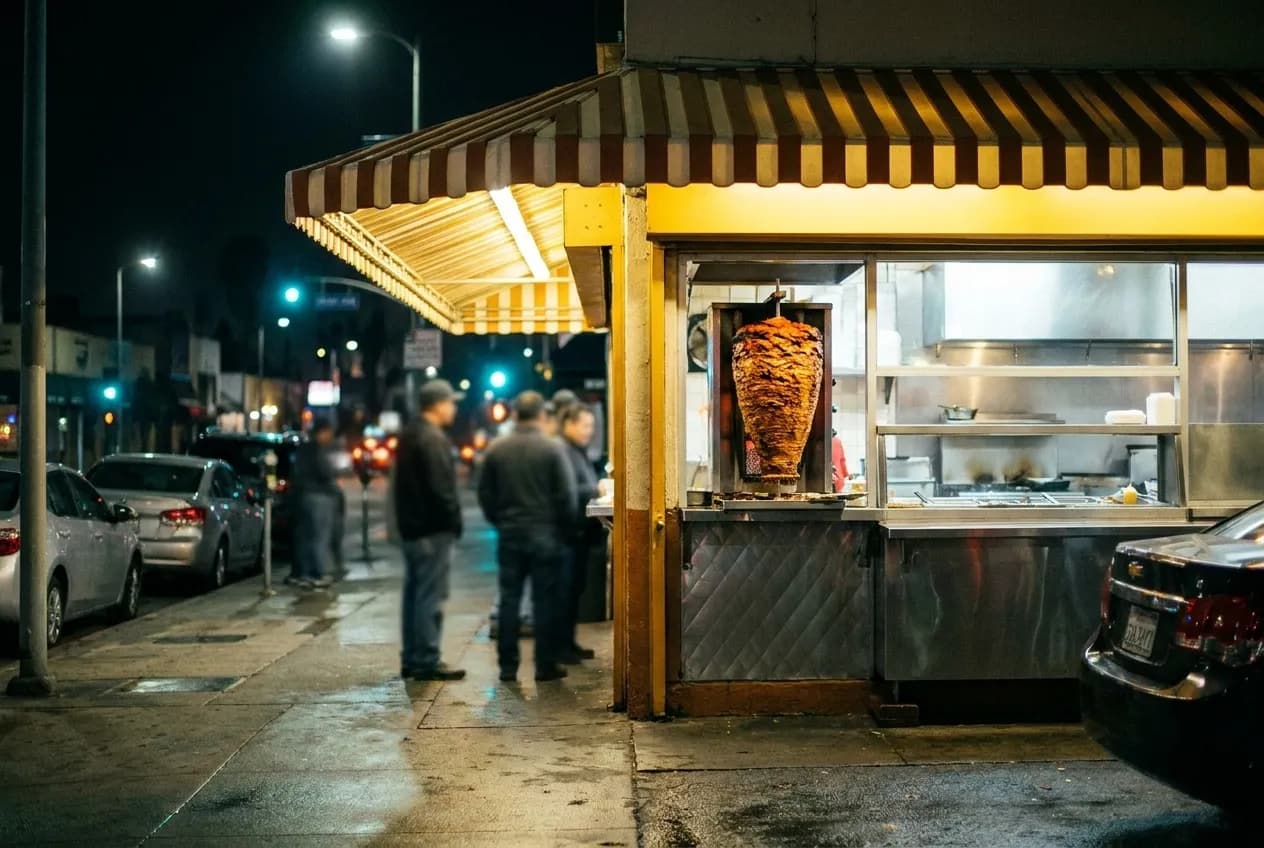
What you want to see is char. The outer layer of a properly managed trompo has dark, crisped edges where the fat has caramelized under the vertical burner. If the surface looks pale and wet, the heat is too low or the spit was dressed too recently to have developed any texture. If it looks black and dried out, it has been sitting all day.
The trompo also tells you how the stand sequences its work. A good al pastor or adobada setup has a stainless catch tray directly under the spit, and you will see the cook shave onto a cutting board in small batches rather than filling the tray and working from it. Meat that goes straight from the spit to the cutting board to the tortilla is hotter and has more texture. Meat that sits in the tray turns soft.
In Boyle Heights, East Los Angeles, Huntington Park and South Gate, you will see this sequence in operation at stands that have been on the same corner for fifteen or twenty years. The cook shaves a portion, dresses three or four tacos, shaves again. In Koreatown and Mid-Wilshire, where trucks park in the late evening, the rhythm is faster but the principle is the same. The tray stays nearly empty.
The Comal Truth: Bag Tortillas Are Not a Dealbreaker
The second belief is that fresh tortillas off a comal are mandatory and anything from a bag is a compromise. What is actually true is that a comal setup requires either a dedicated tortilla cook or a cook fast enough to work the grill and the comal simultaneously, and most neighborhood stands cannot support that labor cost on a Tuesday at nine thirty.
A stand that heats bag tortillas properly — two at a time on a clean, evenly heated plancha, flipped once, pulled while they still have steam — will serve a better taco than a stand with a comal operator who lets them sit too long or stacks them in a warmer. The tortilla should be hot enough that you have to shift it between your fingers. It should be pliable, not crisp, and it should not taste like the plancha.
What the comal does tell you is whether the stand is trying to compete on a different level. A comal setup in Pacoima, Canoga Park or Van Nuys is often attached to a stand that makes its own chorizo, its own adobo, and its own crema. The comal is not the thing itself. It is a signal that the operation has the time and the margin to make other things from scratch.
In the San Fernando Valley and in El Monte, you will find stands that press tortillas to order and cook them on a wide, flat comal set up next to the main griddle. Those stands tend to open later in the evening and close earlier, often by eleven, because the labor model does not work for a long shift. If you are passing one of those stands and it is open, stop.
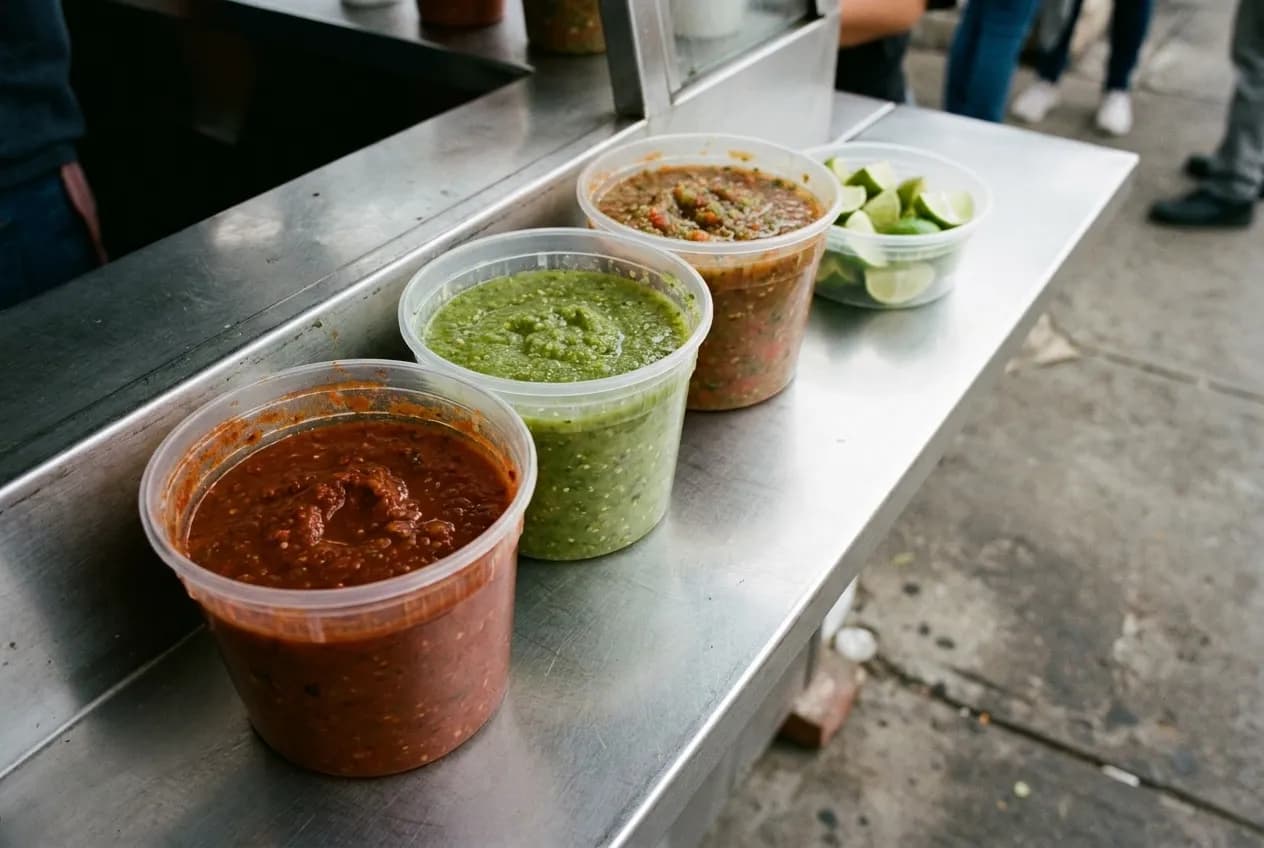
The Salsa Bar Reality: Count the Containers and Watch the Refills
The third belief is that more salsas mean better salsas. What is actually true is that a stand with six or seven salsa containers is usually working from a commissary recipe and restocking from large batches made earlier in the day. A stand with three salsas is more likely to be making them on site in small amounts.
The tell is whether you see anyone refilling the containers or wiping down the salsa bar during the time you are standing there. A salsa bar that is tended — lids replaced, spills wiped, containers swapped out when they are two-thirds empty — is a salsa bar that someone is managing as part of the product. A salsa bar that sits untouched for twenty minutes is a salsa bar that was set up at the start of the shift and will stay that way until close.
The second thing to watch is whether the salsas have separation. A red salsa with a layer of oil on top or a green salsa with visible liquid at the bottom was made hours ago and has been sitting. A salsa that looks emulsified and uniform was either made recently or was blended with enough stabilizer to hold together, which is not necessarily worse but tells you that it came from a commissary.
The ratio you want is one salsa per protein. A stand that serves asada, al pastor, and carnitas and has three salsas is matching the salsa program to the menu. A stand that serves the same three proteins and has seven salsas is padding the bar to look abundant. In Inglewood, Hawthorne, and Lynwood, the strongest stands have two or three salsas and a separate container of pickled vegetables or curtido. In Highland Park and Glassell Park, you will see stands with four salsas and a lime caddy, which is the same principle.
Reading the Line: Who Is Waiting and How They Are Waiting
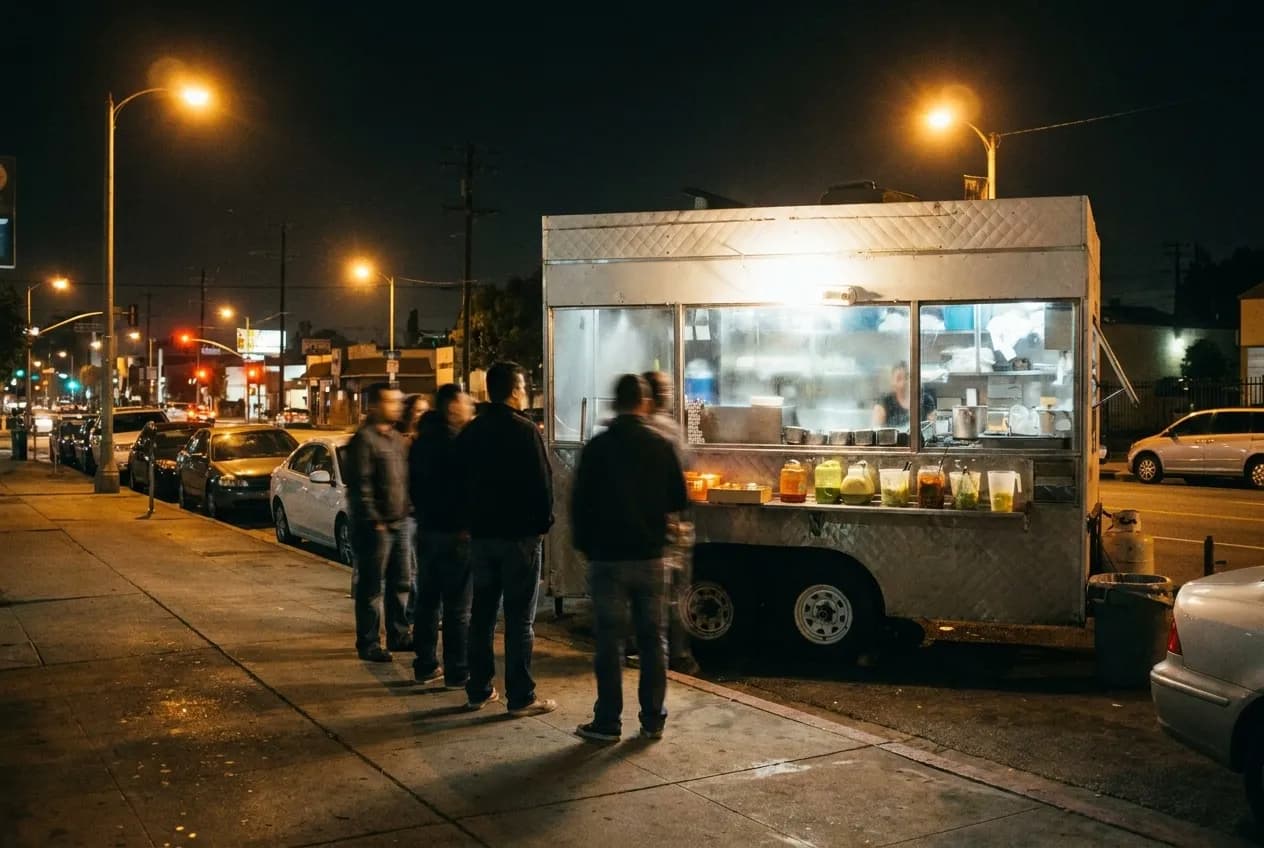
The line tells you whether the stand is serving the neighborhood or serving the internet. A line of people in work clothes or street clothes, standing in loose formation and talking to each other, is a neighborhood line. A line of people looking at their phones, standing in single file, not talking, is a destination line. Both can be good, but they are good in different ways.
A neighborhood line means the stand has been in operation long enough to build trust with the people who live or work within a few blocks. It means the stand is open on a predictable schedule and the quality is consistent enough that people return. It does not mean the tacos are exceptional. It means they are reliable, which in a city with this many options is its own achievement.
A destination line means someone posted about the stand or it appeared on a list. Destination lines are longer and slower because the customers do not know what they want and have not developed the shorthand that regular customers use. The tacos may be outstanding, but you will wait longer, and the stand may not survive the attention. Destination traffic is volatile.
The hybrid line — half neighborhood, half destination — is the line you want. It means the stand is good enough to attract outside attention but grounded enough that it still serves the people who live nearby. You will see this in El Sereno, in Eagle Rock, in Westlake, and along the eastern edge of Koreatown, where the density is high enough to support regular traffic and the rents are low enough that a stand can stay in one place for years.
When you pull up to a stand you have never tried, look at the trompo for char, watch whether the tortillas are being handled individually, count the salsa containers and see if anyone touches them while you wait, and look at the line to see who is in it. All of that happens in the time it takes to park and walk to the window. If two of the four signals are strong, order. If three are strong, order twice as much as you planned. If all four are strong, go back the next night and see if it holds.
Tags: #BestTacosInLosAngeles #LosAngelesTacos #TacoStandsLA #AlPastorLA #StreetTacosLA #LAFoodScene #HiddenGemsLA #TacoTuesdayLA #AuthenticTacosLA #EastLATacos #KoreatownEats #SanFernandoValleyFood #LAStreetFood #TacoLife #LosAngelesEats
Please drink responsibly. Must be of legal drinking age.
All trademarks are the property of their respective owners.
Ask Karpo first
Karpo tracks which taco stands in your neighborhood are open right now, whether they are slammed or quiet, and how to route from wherever you are. Ask before you decide, and you will know whether the stand you are thinking about has a line or whether the truck three blocks over is already set up.