There is a structural problem with any ranking of the best restaurants in San Francisco, which is that difficulty of booking has become a proxy for quality and the two have come apart. A restaurant that releases thirty seats a night at 9am exactly one month ahead will look impossible to get into regardless of what the food is like, and a restaurant doing genuinely excellent work with eighty covers and a walk-in bar will look unremarkable by the same measure. Reading the lists without adjusting for this produces a badly distorted picture of the city.
Availability changes hour to hour and most cancellations never hit the lists. Ask Karpo what is actually bookable near you tonight.
The tasting-menu tier is smaller than it was
San Francisco's high end contracted meaningfully over the last few years and has not rebuilt to its previous size. What survived tends to be either genuinely singular or attached to a hotel that can absorb a bad quarter. The practical consequence for a diner is that the remaining tasting menus are harder to book than the quality gap justifies — you are competing for a smaller number of seats, not chasing a higher standard than existed before.
If you want that experience, the underrated move is a weekday early seating. Restaurants at this level release their least desirable slots first and those slots are identical in kitchen output to the eight o'clock Saturday table that people fight over. You are paying the same money for the same food in a quieter room.
Where the actual quality density is
The strongest cluster in the city right now is the mid-priced neighbourhood restaurant — sixty to ninety dollars a head, a printed menu that changes weekly, a wine list with opinions and no tasting menu. The Mission, the Outer Richmond and the stretch of Divisadero through NoPa are the densest areas for this, and it is where San Francisco is genuinely distinctive rather than merely expensive.
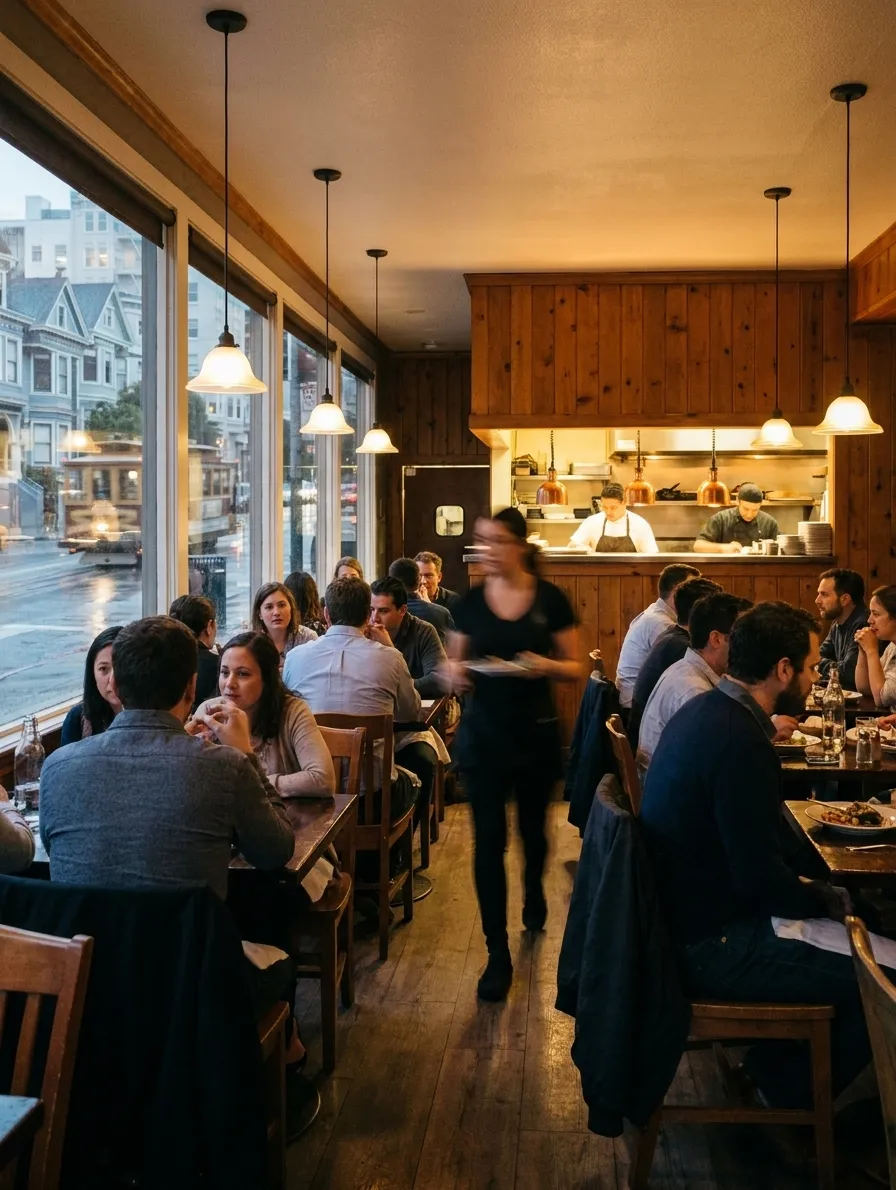
The Richmond in particular has become the interesting district. Rents are lower, the customer base is local and repeat, and the Chinese, Vietnamese, Burmese and Russian restaurants along Clement and Geary are operating at a level that would command far more attention in a smaller city. A meal there costs half what the same quality does downtown and requires no reservation strategy at all.
The reputations that no longer hold
A handful of restaurants in this city have been coasting on reviews written before 2019, and the honest advice is to check a recent source rather than a canonical one. Kitchens turn over, chefs leave, and the gap between a restaurant's reputation and its current output can run for years before the lists catch up. If a place has been on every best-of roundup for a decade without any change in how it is described, that is a signal to look for something written in the last twelve months.
The reverse is also true and more useful. Restaurants that opened in the last two years are systematically underrated by aggregate ratings simply because they have fewer reviews, and a new restaurant with a small number of very good reviews is usually a better bet than an old one with thousands of mediocre ones.
What to do about the reservation platforms
Most desirable tables in San Francisco are released at a fixed time on a fixed schedule, and most restaurants publish that schedule somewhere. Knowing it converts an impossible booking into a mildly inconvenient one. The second thing worth knowing is that cancellation traffic peaks in the late afternoon on the day itself, when people finally admit they are not going to make it across town.
Bar seating is the other lever, and it is underused. Many of the hardest restaurants in the city hold their counter for walk-ins, serve the full menu there, and fill it with people who turned up at half past five. If you are eating alone or as a pair, this is close to a cheat code.
Pricing, tipping and what the bill will actually be
San Francisco restaurants add surcharges that most visitors do not expect. A line item for employee health coverage is common and legally permitted, typically running a few per cent, and some restaurants have moved to a service-included model where the menu prices are higher and no tip is expected. Both are defensible. Both make the number at the bottom of the bill diverge from the number you estimated from the menu, sometimes by twenty per cent or more.
The practical response is to read the small print at the bottom of the menu before ordering rather than after. Restaurants are required to disclose these charges and almost all of them do, in six-point type in the corner. Knowing whether you are at a service-included place changes what a fair total looks like and prevents the accidental double-tip that a lot of out-of-town diners leave behind.
The one honest summary
The best restaurants in San Francisco right now are mostly not the ones being written about. They are mid-sized, neighbourhood-anchored, priced for people who will return, and located west of Van Ness or south of Cesar Chavez. The city's reputation was built on the high end and its current strength is in the middle. Pointing a visitor at the middle produces a better week of eating than pointing them at the top.
Tags: #SanFrancisco #SFRestaurants #BestRestaurantsSF #SFDining #MissionDistrict #InnerRichmond #ClementStreet #Divisadero #SFEats #BayAreaFood #Reservations #NeighbourhoodDining #FoodGuide
All trademarks are the property of their respective owners.
Ask Karpo first
Ask Karpo which well-reviewed restaurants near you in San Francisco have a table tonight, what the walk-in policy is at the bar, and what a full meal there tends to cost.